
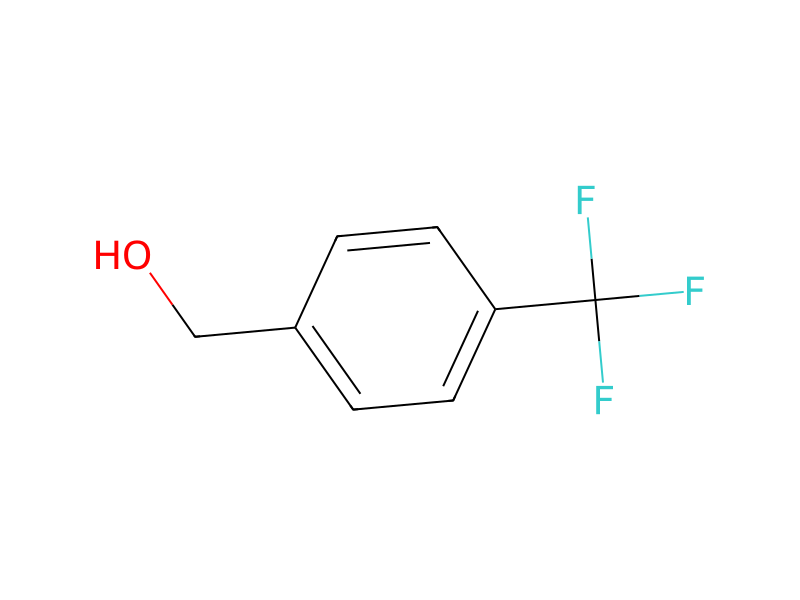
Grundinformationen
- Standard-SMILES
OCc1ccc(C(F)(F)F)cc1- InChIKey
MOOUWXDQAUXZRG-UHFFFAOYSA-N- Summenformel
- C8H7F3O
- Durchschnittliche Molmasse
- 176,14 g/mol
- Monoisotopische Masse
- 176,04489933
Namen und Bezeichner
- Bevorzugter Name
- 4-(Trifluoromethyl)benzenemethanol
- IUPAC
- [4-(trifluoromethyl)phenyl]methanol
- Lokaler Name
- 4-(Trifluormethyl)benzylalkohol
- Englischer Name
- 4-(Trifluoromethyl)benzyl alcohol
- Summenformel
- C8H7F3O
- Molmasse
- 176.14
Namen und Synonyme
4-(Trifluoromethyl)benzyl alcohol349-95-14-(trifluoromethyl)benzenemethanolDTXSID40188457Para-(trifluoromethyl)benzyl alcoholRefChem:517138DTXCID70110948206-494-6[4-(Trifluoromethyl)phenyl]methanol(4-(trifluoromethyl)phenyl)methanolp-Trifluoromethylbenzyl alcoholMFCD00004661
Weitere Namen anzeigen
TFMP2OPTF-BYLRARECHEM AL BD 01114-(Trifluoromethyl)Benzylp-Trifluoromethylbenzyl alchol4-(Trifluoromethyl) benzylalcholP-(TRIFLUOROMETHYL)BENZYL ALCOHOL
4-(Trifluoromethyl)benzylic alcoholBenzenemethanol, 4-(trifluoromethyl)-4-hydroxymethylbenzotrifluoride(4-Trifluoromethyl-phenyl)-methanol4-trifluoromethylbenzyl alcohol4-trifluoromethyl benzene methanol[4-(trifluoromethyl)phenyl]methan-1-olCCRIS 5117
Datenbank-Bezeichner
- CAS
349-95-1- PubChem CID
- 67684
- DTXSID
DTXSID40188457- ChEBI
CHEBI:156310- EC Number
- 206-494-6
- Nikkaji
- J150.012K
Eigenschaften
Berechnete Struktureigenschaften
- XLogP
- 2,1
- Polarare Oberfläche (TPSA)
- 20,2 Ų
- H-Brücken-Donoren
- 1
- H-Brücken-Akzeptoren
- 4
- Frei drehbare Bindungen
- 1
- Schwere Atome
- 12
- Formalladung
- 0
- Komplexität
- 136
Physikochemische Eigenschaften
- Schmelzpunkt
- 22 · 22-25 °C
- Siedepunkt
- 78 · 78-80 °C/4 mmHg (lit.)
- Dichte
- 1.286 g/mL · 1.286 g/mL at 25 °C (lit.)
- Brechungsindex
- 20 · n20/D 1.459(lit.)
- Flammpunkt
- 213 °F · 213 °F
- storage temp.
- Keep in dark place,Sealed in dry,Room Temperature
- Aggregatzustand
- Liquid After Melting
- pka
- 13.91 · 13.91±0.10(Predicted)
- Wichte
- 1.286 · 1.286
- Farbe
- Clear colorless to light brown
- Wasserlöslichkeit
- Soluble in water.
- BRN
- 1450174 · 1450174
- InChI
- InChI=1S/C8H7F3O/c9-8(10,11)7-3-1-6(5-12)2-4-7/h1-4,12H,5H2
- InChIKey
- MOOUWXDQAUXZRG-UHFFFAOYSA-N
- SMILES
- C1(CO)=CC=C(C(F)(F)F)C=C1
- CAS Datenbank
- 349 · 349-95-1(CAS DataBase Reference)
- NIST chemische Informationen
- 4 · 4-(Trifluoromethyl)benzyl alcohol(349-95-1)
Sicherheit und Regulatorisches
GHS-Klassifizierung
GHS Classification
Warning
H315 (100%): Causes skin irritation [Warning Skin corrosion/irritation];H319 (100%): Causes serious eye irritation [Warning Serious eye damage/eye irritation];H335 (95.8%): May cause respiratory irritation [Warning Specific target organ toxicity, single exposure; Respiratory tract irritation]
P261, P264, P264+P265, P271, P280, P302+P352, P304+P340, P305+P351+P338, P319, P321, P332+P317, P337+P317, P362+P364, P403+P233, P405, and P501 (click each P-code to see the statement)
Aggregated GHS information provided per 48 reports by companies from 7 notifications to the ECHA C&L Inventory. Each notification may be associated with multiple companies.;Information may vary between notifications depending on impurities, additives, and other factors. The percentage value in parenthesis indicates the notified classification ratio from companies that provide hazard codes. Only hazard codes with percentage values above 10% are shown. For more detailed information, please visit ECHA C&L website.
Gefahrenhinweise
Hazard Classes and CategoriesSkin Irrit. 2 (100%);Eye Irrit. 2 (100%);STOT SE 3 (95.8%)
Sicherheitsdaten
- F
- 10-23
- wgk
- 3
- hs_code
- 29062900
- risk_code
- 36/37/38
- hazard_code
- Xi
- hazard_note
- Irritant
- safety_code
- 26-36-37/39
- hazard_class
- CORROSIVE
- Speicherklasse
- 10 - Combustible liquids
- Hazard Classifications
- Eye Irrit. 2Skin Irrit. 2STOT SE 3
Chemie und Industrie
Anwendungen
Verwenden4-(Trifluoromethyl)benzyl alcohol, is used as a pharmaceutical intermediate, it is also used to predict the NMR spectrum. 4-(Trifluoromethyl)benzyl alcohol is employed as a reagent in, for example, kinetic studies of phosphonoformate prodrugs and aquachromium(IV).
Vor- und nachgelagerte Produkte
Nachgelagerte Produkte
Anbieter50 Anbieter
国药集团化学试剂有限公司86-21-63210123 · [email protected]
北京华美互利生物化工010-56205725 · [email protected]
梯希爱(上海)化成工业发展有限公司021-67121386 · [email protected]
衢州润东化工有限公司0570-8789886 18892685668 · [email protected]
上海阿拉丁生化科技股份有限公司400-6206333 13167063860 · [email protected]
上海策嵘生物科技有限公司[email protected]
温州共赢化学有限公司+86-0086-577-64498589 +86-15355981851 · [email protected]
爱斯特(成都)生物制药股份有限公司+86-28-85122536 85324413 · [email protected]
上海赫文斯化工有限公司15721252604 17321035817 · [email protected]
Dayang Chem (Hangzhou) Co.,Ltd.+86-0571-88938639 17705817739 · [email protected]
韶远科技(上海)有限公司021-50795510 4000665055 · [email protected]
科瑞迪化学400-821-5857 021-64326257 · [email protected]
Syntechem Co.,Ltd[email protected]
上海迈瑞尔生化科技有限公司4006356688 18621169109 · [email protected]
上海辅欣医药科技有限公司+86-021-021-50872116 · [email protected]
阿法埃莎(中国)化学有限公司400-6106006 · [email protected]
安耐吉化学&3A(安徽泽升科技股份有限公司)400-0056266 · [email protected]
武汉凯威斯科技有限公司86-027-67849912 · [email protected]
Allfluoro Pharmaceutical Company Limited+86-400-0216110 +86-15958047586 · [email protected]
上海瀚鸿科技股份有限公司021-54306202 13764082696 · [email protected]
上海相辉医药科技有限公司13761987713 · [email protected]
上海景颜化工科技有限公司13817811078 · [email protected]
嘉兴市艾森化工有限公司0573-85285100 18627885956 · [email protected]
上海隆盛化工有限公司58099637 13585536065 · [email protected]
山东西亚化学有限公司13355009207 13355009207 · [email protected]
四川库利南科技有限公司400-1166-196 18981987031 · [email protected]
天津希恩思生化科技有限公司400 638 7771 · [email protected]
百盛HK进出口有限公司+86-18068513926
艾科试剂4008-755-333 18080918076 · [email protected]
上海思域化工科技有限公司86-21-34053660 · [email protected]
赛默飞世尔科技(中国)有限公司800-810-5118 · [email protected]
上海特伯化学科技有限公司+86-21-60341587 · [email protected]
深圳市倍素特科技有限公司[email protected] · [email protected]
TOKYO CHEMICAL INDUSTRY CO., LTD.03-36680489 · [email protected]
卡迪亚医药科技有限公司0371-86615086 18203638366 0371-86159066 13526786601
越林试剂021-62960152 · [email protected]
上海睿升化工科技有限公司+86-021-50935922
Clearsynth Labs Limited+91-22-26355700 · [email protected]
上海将来实业股份有限公司400-0066400 13621662912 · [email protected]
安徽科迪达化工有限公司0554-2106669 · [email protected]
HBCChem, Inc.+1-510-219-6317 · [email protected]
上海卓因生物科技有限公司021-61317773 · [email protected]
天津安浩生物科技有限公司[email protected]
上海嵩爰化工科技有限公司010-1234567 18521000990 · [email protected]
江苏艾康生物医药研发有限公司025-66028182 17714375163 · [email protected]
上海孚一生物科技有限公司+86 (21) 61124340
Sigma-Aldrich西格玛奥德里奇(上海)贸易有限公司021-61415566 800-8193336 · [email protected]
AN PharmaTech Co Ltd86(21)68097365 · [email protected]
九鼎化学(上海)科技有限公司4009209199 · [email protected]
北京禾兴源科技有限公司18511709189 · [email protected]
Zugehörige Reaktionen
83


Verknüpfte Notizen
Wird geladen…