
Trifluormethansulfonsaeureanhydrid
Trifluoromethanesulfonic anhydride

Grundinformationen
- CAS
358-23-6- Standard-SMILES
O=S(=O)(OS(=O)(=O)C(F)(F)F)C(F)(F)F- InChIKey
WJKHJLXJJJATHN-UHFFFAOYSA-N- Summenformel
- C2F6O5S2
- Durchschnittliche Molmasse
- 282,14 g/mol
- Monoisotopische Masse
- 281,90913442
Überblick
Triflic anhydride is an organosulfonic anhydride. It is functionally related to a triflic acid.
Namen und Bezeichner
- Bevorzugter Name
- Trifluoromethanesulfonic anhydride
- IUPAC
- trifluoromethylsulfonyl trifluoromethanesulfonate
- Lokaler Name
- Trifluormethansulfonsaeureanhydrid
- Englischer Name
- Trifluoromethanesulfonic anhydride
- Summenformel
- C2F6O5S2
- Molmasse
- 282.14
Namen und Synonyme
Trifluoromethanesulfonic anhydride358-23-6Triflic anhydrideTrifluoromethanesulphonic anhydride8W034LHG1UTRIFLATE ANHYDRIDEMethanesulfonic acid, 1,1,1-trifluoro-, 1,1'-anhydrideCHEBI:48509DTXSID501014629RefChem:191596DTXCID101437174206-616-8
Weitere Namen anzeigen
Trifluoromethylsulfonic anhydrideTFO2(trifluoroMethane)sulfonyl trifluoroMethanesulfonateTRIFLUOROMETHANESULFONYL ANHYDRIDE
trifluoromethanesulfonic acid anhydridetrifluoromethylsulfonyl trifluoromethanesulfonateMethanesulfonic acid, trifluoro-, anhydridetrifluoromethanesulphonic acid anhydrideTF2Otrifluoromethanesulfonyl trifluoromethanesulfonateC2F6O5S2triflic acid anhydride
Datenbank-Bezeichner
- CAS
358-23-6- PubChem CID
- 67749
Eigenschaften
Berechnete Struktureigenschaften
- XLogP
- 1,6
- Polarare Oberfläche (TPSA)
- 94,3 Ų
- H-Brücken-Donoren
- 0
- H-Brücken-Akzeptoren
- 11
- Frei drehbare Bindungen
- 2
- Schwere Atome
- 15
- Formalladung
- 0
- Komplexität
- 370
Experimentelle und physikochemische Eigenschaften
Chemical ClassesOther Classes -> Acid Anhydrides, Other
PFAS
PFAS -> Suspected persistent, mobile, toxic (PMT) PFAS or PFAS-like compounds
PFAS -> PFAS identified in REACH Regulation EC No. 1272/2008
SpringerMaterials PropertiesSchoenflies notation
Density1.677 @25 °C
Vapor Pressure
8.0 [mmHg]
8 [mm Hg] @20 °C
Physical DescriptionColorless hygroscopic liquid; [Merck Index] Clear colorless liquid; [Sigma-Aldrich MSDS]
Physikochemische Eigenschaften
- Schmelzpunkt
- -80 °C · -80°C
- Siedepunkt
- 81 · 81-83 °C (lit.)
- Dichte
- 1.677 g/mL · 1.677 g/mL at 25 °C (lit.)
- Dampfdichte
- 5.2 · 5.2 (vs air)
Sicherheit und Regulatorisches
Sicherheitsangaben dienen nur zur Orientierung und ersetzen weder das Sicherheitsdatenblatt (SDB) des Lieferanten noch geltende Vorschriften oder eine fachliche Bewertung.
GHS-Klassifizierung
GHS Classification
Danger
H272 (51.1%): May intensify fire; oxidizer [Danger Oxidizing liquids; Oxidizing solids]
P210, P220, P260, P261, P264, P264+P265, P270, P271, P280, P301+P317, P301+P330+P331, P302+P361+P354, P304+P340, P305+P354+P338, P316, P317, P319, P321, P330, P363, P370+P378, P403+P233, P405, and P501 (click each P-code to see the statement)
Aggregated GHS information provided per 227 reports by companies from 22 notifications to the ECHA C&L Inventory. Each notification may be associated with multiple companies.
Gefahrenhinweise
Regulatory Information
Chemical: Methanesulfonic acid, trifluoro-, anhydride
Status: Active Update: 03-04-2020 https://echa.europa.eu/registration-dossier/-/registered-dossier/22478
Trifluoromethanesulphonic anhydride: HSNO Approval: HSR004747 Approved with controls
Hazards Summary
Reacts violently with water; Corrosive; [Merck Index] Reacts violently with water; Causes burns; Inhalation may cause corrosive injuries to upper respiratory tract and lungs; Harmful by ingestion; [Sigma-Aldrich MSDS] See Trifluoromethanesulfonic acid.
Hazard Classes and CategoriesOx. Liq. 2 (51.1%)
CSL Reaction Information
CSL00005
TETRAHYDROFURAN + Triflic anhydride
Can polymerize, large exotherm. Avoid combination on larger scale.
User-Reported
6/29/18
10/2/17
Sicherheit und Schutzausrüstung
Chemie und Industrie
Verwendung und Herstellung
UsesUsed as a reagent in synthetic organic chemistry; [Merck Index]
General Manufacturing InformationMethanesulfonic acid, 1,1,1-trifluoro-, 1,1'-anhydride: ACTIVE
Anwendungen
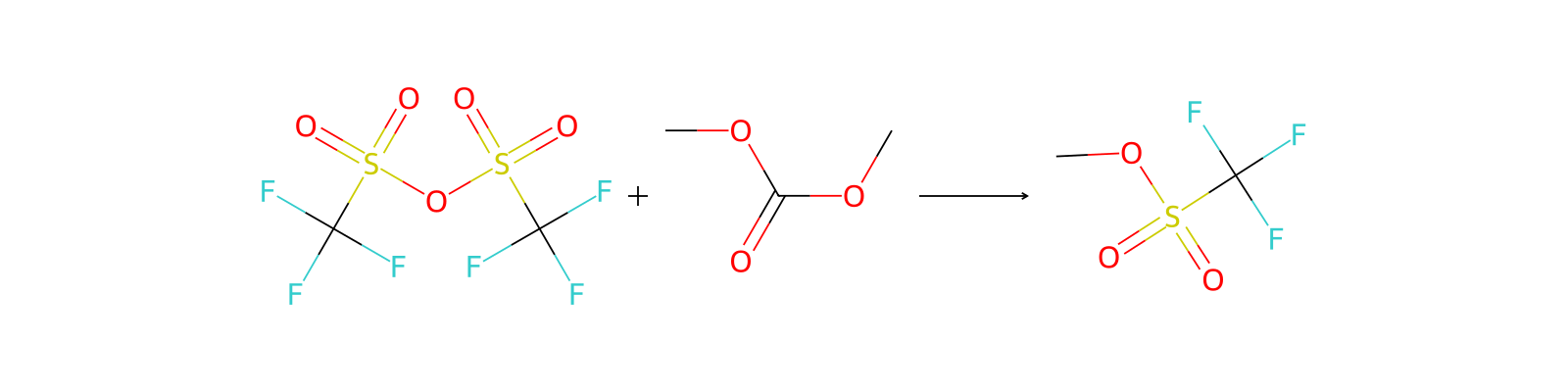
BeschreibungTrifluoromethanesulfonic anhydride, also known as triflic anhydride, has proven to be an extraordinary reagent for a broad range of transformations. As a commercially and readily available reagent, It has been widely used in synthetic chemistry due to its high electrophilicity. Given its high affinity towards O-nucleophiles, reaction with alcohols, carbonyls, sulfur phosphorus- and iodine oxides towards the formation of the corresponding triflates is strongly favored. As one of the premier leaving groups in organic chemistry, the generated triflates then open the door to various downstream transformations, including (but not limited to) substitution reactions, cross-coupling processes, redox reactions, and rearrangements[1-2].
VerwendenTrifluoromethanesulfonic Anhydride is a strong electrophile used in chemical synthesis for introducing the triflyl group.
Vor- und nachgelagerte Produkte
Vorgelagerte Rohstoffe
Zugehörige Reaktionen
2.071



Notizen zur Verbindung
Wird geladen…