StartseiteMCPWorkbenchSkills
StartseiteWorkbenchBenachrichtigungenMein Bereich
llms.txt · MCP-AnleitungDatenschutz · Nutzungsbedingungen · Supportv1.8.0
  1. Startseite
  2. /Verbindung

Dinonylphthalat

Dinonyl phthalate

HCID 6787
Neue NotizNeue ReaktionAnfrage stellen
Druckvorschau
GrundinformationenÜberblickNamen und BezeichnerEigenschaftenSicherheit und RegulatorischesChemie und IndustrieZugehörige ReaktionenNotizen zur Verbindung
TeilstruktursucheÄhnliche Strukturen suchen

Grundinformationen

CAS
84-76-4
Standard-SMILES
CCCCCCCCCOC(=O)c1ccccc1C(=O)OCCCCCCCCC
InChIKey
DROMNWUQASBTFM-UHFFFAOYSA-N
Summenformel
C26H42O4
Durchschnittliche Molmasse
418,6 g/mol
Monoisotopische Masse
418,30830982

Überblick

Dinonyl phthalate is an odorless colorless liquid. (USCG, 1999)

Namen und Bezeichner

Bevorzugter Name
Dinonyl phthalate
IUPAC
dinonyl benzene-1,2-dicarboxylate
Lokaler Name
Dinonylphthalat
Englischer Name
Dinonyl phthalate
Summenformel
C26H42O4
Molmasse
418.61

Namen und Synonyme

DINONYL PHTHALATE84-76-4Unimoll DNDinonylphthalateBisoflex 91Nonyl phthalateBisoflex DNP1,2-Benzenedicarboxylic acid, dinonyl esterDi-n-nonyl phthalatePhthalic acid, dinonyl esterBisolflex 91Ditrimethylhexyl phthalate
Weitere Namen anzeigen
Cenegunimolldnbisoflex91bisolflex91bisoflexdnpnonylphthalate
DTXSID9047966Dinonyl 1,2-benzenedicarboxylateDi-n-nonylphthalate (DnNP)90UCU78V8RDTXCID0086631,2-Benzenedicarboxylic acid, 1,2-dinonyl ester1,2-benzenedicarboxylic acid dinonyl esterRefChem:134466

Datenbank-Bezeichner

CAS
84-76-4
PubChem CID
6787
DTXSID
DTXSID9047966
ChEMBL
CHEMBL3186308
UNII
90UCU78V8R
EC Number
201-560-0
Nikkaji
J11.661K

Eigenschaften

Berechnete Struktureigenschaften

XLogP
10,1
Polarare Oberfläche (TPSA)
52,6 Ų
H-Brücken-Donoren
0
H-Brücken-Akzeptoren
4
Frei drehbare Bindungen
20
Schwere Atome
30
Formalladung
0
Komplexität
395

Experimentelle und physikochemische Eigenschaften

Chemical ClassesPhthalate
PolymersPlastics & Rubber -> Phthalate Esters
Density · 2 Einträge

0.97 (USCG, 1999) - Less dense than water; will float

0.972 at 20 °C

Viscosity112 cP at 20 °C
Color/FormColorless liquid
Solubility · 2 Einträge

Phthalate esters are soluble to various extents in many common organic solvents and oils, but have a relatively low solubility in water. /Phthalate esters/

Insoluble in water

Flash Point · 2 Einträge

420 °F (USCG, 1999)

420 °F; 215 °C /(method not specified)/

Endocrine DisruptorsPotential endocrine disrupting compound
Boiling Point · 2 Einträge

775 °F at 760 mmHg (USCG, 1999)

413 °C

Sicherheit und Regulatorisches

Sicherheitsangaben dienen nur zur Orientierung und ersetzen weder das Sicherheitsdatenblatt (SDB) des Lieferanten noch geltende Vorschriften oder eine fachliche Bewertung.

GHS-Klassifizierung

GHS Classification · 5 Einträge

This chemical does not meet GHS hazard criteria for 21.7% (5 of 23) of reports.

Warning

H302 (69.6%): Harmful if swallowed [Warning Acute toxicity, oral]

P264, P270, P301+P317, P330, and P501 (click each P-code to see the statement)

Aggregated GHS information provided per 23 reports by companies from 4 notifications to the ECHA C&L Inventory.

Gefahrenhinweise

Regulatory Information · 3 Einträge

Chemical: 1,2-Benzenedicarboxylic acid, dinonyl ester

Regulation (EC) No 178/2002 (amended)

Dinonyl phthalate: Does not have an individual approval but may be used under an appropriate group standard

Fire PotentialCombustible
Health HazardsModerately toxic by ingestion. (USCG, 1999)
Hazards Summary · 1 Eintrag

Rats exposed to saturated vapors (28 deg C) 6 hr/day for 12 days show no adverse effects. Rats exposed to 5 mL/kg/day for 7 days have CNS depression. Oral LD50 (rat) = 26 g/kg; Like dioctyl phthalate, it may cause CNS depression and mild liver toxicity after ingestion of large amounts; [HSDB] May cause irritation; [MSDSonline] See PHTHALATE ESTERS.

Reactive GroupEsters, Sulfate Esters, Phosphate Esters, Thiophosphate Esters, and Borate Esters
Special Reports · 5 Einträge

Nat'l Research Council Canada; Phthalate Esters in the Aquatic Environment (1980) NRCC No. 17583

USEPA; Ambient Water Quality Criteria Doc: Phthalate Esters (1980) EPA 440/5-80-067

Woodward KN (ed); Phthalate Esters: Toxicity and Metabolism (1988)

Chemie und Industrie

Verwendung und Herstellung

Uses · 4 Einträge

Used in plastisols and coating pastes, as a low-volatility plasticizer for vinyl resins, as a stationary liquid phase in chromatography, and to make vinyl mixes resistant to heat and detergents; [HSDB]

Plastic Composites Manufacturing [Category: Industry]

It is used for making vinyl mixes which have to withstand heat and resist migration and extraction by detergents; also useful in the technology of plastisols and coating pastes

General-purpose, low-volatility plasticizer for vinyl resins; pure grade as stationary liquid phase in chromatography.

U.S. Production · 3 Einträge

(1972) PROBABLY GREATER THAN 4.54X10+5 G

(1975) PROBABLY GREATER THAN 4.54X10+5 G

Production volumes for non-confidential chemicals reported under the Inventory Update Rule. [Table#1118]

Methods of Manufacturing · 1 Eintrag

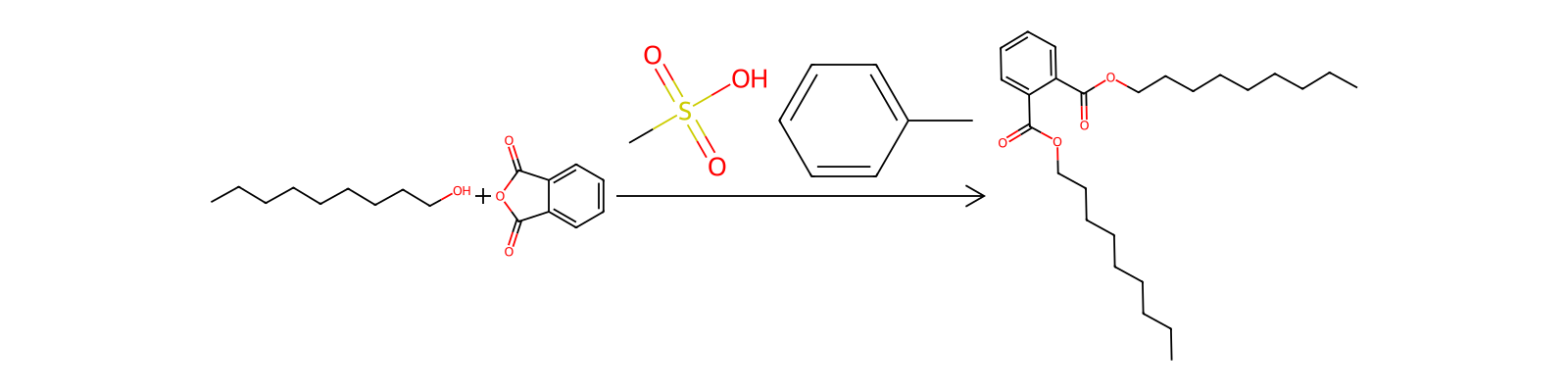
The first step, alcoholysis of phthalic anhydride (PA) to give the monoester, is rapid and goes to completion. The reaction generally starts at elevated temperatures and proceeds exothermically. The second step is the conversion of the monoester to a diester with the formation of water. This is a reversible reaction and proceeds more slowly than the first, thus determining the overall rate of reaction. To shift the equilibrium towards the diester, the water of reaction is removed by distillation. The rate of reaction can be influenced by the choice of catalyst and the reaction temperature. For fast conversion rates, high reaction temperatures are generally used. However, these are influenced by the boiling point of the alcohol and/or the type of catalyst. ... Currently, nearly all major phthalate producers use amphoteric catalysts for the esterification of high boiling alcohols. ... The reaction temperatures for the amphoteric catalysts are about 200 °C. At this temperature side reactions are minimized, and the alcohol can be recycled without purification. By using this type of catalyst, over 99.5 % conversion to diester can be achieved. /Phthalates/

General Manufacturing Information1,2-Benzenedicarboxylic acid, 1,2-dinonyl ester: ACTIVE

Anwendungen

Zugehörige Reaktionen

2
Reaktionsaufzeichnung erstellen
Reaktionsgleichung von HRID 628745
HRID 628745als Produktuspto-grants-2016_04
Reaktionsgleichung von HRID 1746336
HRID 1746336als Produktuspto-grants-2015_10

Notizen zur Verbindung

Wird geladen…

Auf dieser SeiteGrundinformationenÜberblickNamen und BezeichnerEigenschaftenSicherheit und RegulatorischesChemie und IndustrieZugehörige ReaktionenNotizen zur Verbindung
Weitere Aktionen
Neue NotizNeue ReaktionAnfrage stellen
DecompositionWhen heated to decomp it emits acrid smoke and irritating fumes.
Vapor Pressure · 2 Einträge

0.00000051 [mmHg]

VP: 1 mm Hg at 205 °C

Refractive IndexIndex of refraction: 1.4871 at 20 °C/D

Physikochemische Eigenschaften

Schmelzpunkt
-33.15 °C · -33.15°C
Siedepunkt
279 · 279-287 °C(lit.)
Dichte
0.98 g/mL · 0.98 g/mL at 20 °C(lit.)
Brechungsindex
20 · n20/D 1.486
Flammpunkt
216 °C · 216°C
Aggregatzustand
Oily Liquid
Farbe
Clear yellow-brown
Wasserlöslichkeit
1 g/L · <1 g/L (20 ºC)
BRN
1916263 · 1916263
Henry's Law Constant
1.1 · 1.1×10-1 mol/(m3Pa) at 25℃, Cousins and Mackay (2000)
Dielectric constant
4.5 · 4.5(45℃)
InChIKey
DROMNWUQASBTFM-UHFFFAOYSA-N
CAS Datenbank
84 · 84-76-4(CAS DataBase Reference)
NIST chemische Informationen
1 · 1,2-Benzenedicarboxylic acid, dinonyl ester(84-76-4)
EPA chemische Informationen
Dinonyl phthalate (84-76-4)

Phthalate Esters; Environ Health Perspect 45: 1-210 (1982)

For more Special Reports (Complete) data for DINONYL PHTHALATE (6 total), please visit the HSDB record page.

TSCA Requirements · 1 Eintrag

Pursuant to section 8(d) of TSCA, EPA promulgated a model Health and Safety Data Reporting Rule. The section 8(d) model rule requires manufacturers, importers, and processors of listed chemical substances and mixtures to submit to EPA copies and lists of unpublished health and safety studies. 1,2-Benzenedicarboxylic acid, dinonyl ester is included on this list. Effective date 10/04/82; Sunset date 10/04/92.

Reactivity Profile · 1 Eintrag

DINONYL PHTHALATE is an ester. Esters react with acids to liberate heat along with alcohols and acids. Strong oxidizing acids may cause a vigorous reaction that is sufficiently exothermic to ignite the reaction products. Heat is also generated by the interaction of esters with caustic solutions. Flammable hydrogen is generated by mixing esters with alkali metals and hydrides. Can generate electrostatic charges [Handling Chemicals Safely, 1980. p. 250].

Air and Water ReactionsFlammable. Hydrolyzed by strong mineral acids and strong alkalis.
Hazard Classes and CategoriesAcute Tox. 4 (69.6%)

Sicherheit und Schutzausrüstung

Fire FightingFire Extinguishing Agents Not to Be Used: Water may be ineffective.
First AidINHALATION: Move to fresh air.
Disposal Methods · 1 Eintrag

SRP: The most favorable course of action is to use an alternative chemical product with less inherent propensity for occupational exposure or environmental contamination. Recycle any unused portion of the material for its approved use or return it to the manufacturer or supplier. Ultimate disposal of the chemical must consider: the material's impact on air quality; potential migration in soil or water; effects on animal, aquatic, and plant life; and conformance with environmental and public health regulations.

Preventive Measures · 1 Eintrag

SRP: Contaminated protective clothing should be segregated in such a manner so that there is no direct personal contact by personnel who handle, dispose, or clean the clothing. Quality assurance to ascertain the completeness of the cleaning procedures should be implemented before the decontaminated protective clothing is returned for reuse by the workers. Contaminated clothing should not be taken home at end of shift, but should remain at employee's place of work for cleaning.

Personal Protective Equipment (PPE)Goggles or face shield; rubber gloves. (USCG, 1999)

Toxikologische Informationen

Ecotoxicity ValuesLC50; Species: Nitocra spinipes (Harpacticoid copepod, adult, length 0.6-0.8mm); Conditions: saltwater, static, 10 °C, pH 7.8, salinity: 7 ppt, alkalinity 75 mg/L CaCO3, dissolved oxygen >5 mg/L; Concentration: 300000 ug/L for 96 hr
Environmental Fate · 3 Einträge

TERRESTRIAL FATE: Based on a classification scheme(1), an estimated Koc value of 6.6X10+5(SRC), determined from a structure estimation method(2), indicates that dinonyl phthalate is expected to be immobile in soil(SRC). In sterile microcosms containing lake water and sediment, approximately 80% of di(heptyl,nonyl,undecyl) phthalate partitioned to sediment(3). Volatilization of dinonyl phthalate from moist soil surfaces is expected to be an important fate process(SRC) given an estimated Henry's Law constant of 1.4X10⁻⁵ atm-cu m/mole(SRC), using a fragment constant estimation method(4). However, adsorption to soil is expected to attenuate volatilization(SRC). Dinonyl phthalate is not expected to volatilize from dry soil surfaces(SRC) based upon an estimated vapor pressure of 5.1X10⁻⁷ mm Hg(SRC), determined from a fragment constant method(5). A half-life of 6 to 8 days in river die-away tests(3) suggests that biodegradation may be an important environmental fate process in soil(SRC).

AQUATIC FATE: Based on a classification scheme(1), an estimated Koc value of 6.6X10+5(SRC), determined from a structure estimation method(2), indicates that dinonyl phthalate is expected to adsorb to suspended solids and sediment(SRC). In sterile microcosms containing lake water and sediment, approximately 80% of di(heptyl,nonyl,undecyl) phthalate partitioned to sediment(3). Volatilization from water surfaces is expected(4) based upon an estimated Henry's Law constant of 1.4X10⁻⁵ atm-cu m/mole(SRC), developed using a fragment constant estimation method(5). Using this Henry's Law constant and an estimation method(4), volatilization half-lives for a model river and model lake are 5.6 and 47 days, respectively(SRC). However, volatilization from water surfaces is expected to be attenuated by adsorption to suspended solids and sediment in the water column. The volatilization half-life from a model pond is about 190 years when adsorption is considered(6). According to a classification scheme(7), an estimated BCF of 3(SRC), from an estimated log Kow of 9.52(8) and a regression-derived equation(9), suggests the potential for bioconcentration in aquatic organisms is low(SRC). Hydrolysis is not expected to be an important process(SRC) based on estimated hydrolysis half-lives of 7.7 years and 280 days at pHs 7 and 8, respectively(10). A half-life of 6 to 8 days in river die-away tests(3) suggests that biodegradation may be an important environmental fate process in water(SRC).

ATMOSPHERIC FATE: According to a model of gas/particle partitioning of semivolatile organic compounds in the atmosphere(1), dinonyl phthalate, which has an estimated vapor pressure of 5.1X10⁻⁷ mm Hg at 25 °C(SRC), determined from a fragment constant method(2), will exist in both the vapor and particulate phases in the ambient atmosphere. Vapor-phase dinonyl phthalate is degraded in the atmosphere by reaction with photochemically-produced hydroxyl radicals(SRC); the half-life for this reaction in air is estimated to be 16 hours(SRC), calculated from its rate constant of 2.3X10⁻¹¹ cu cm/molecule-sec at 25 °C(SRC) that was derived using a structure estimation method(3). Particulate-phase dinonyl phthalate may be removed from the air by wet or dry deposition(SRC). Dinonyl phthalate does contain chromophores that absorb at wavelengths >290 nm(4) and therefore may be susceptible to direct photolysis by sunlight(SRC).

Adverse EffectsOccupational hepatotoxin - Secondary hepatotoxins: the potential for toxic effect in the occupational setting is based on cases of poisoning by human ingestion or animal experimentation.
Plant Concentrations · 1 Eintrag

Dinonyl phthalate was found in aquatic organisms June to Sept 1999 from False Harbor, Vancouver, British Columbia; green algae (Enteromorpha intestinalis) 2.96 ng/g lipid and brown algae (Nereocysitis luetkeana, Fucus gardneri) 2.12 ng/g lipid(1).

Effluent Concentrations · 1 Eintrag

Dinonyl phthalate was found in 1 domestic sewages at 332 ug/kg and not detected in another 3 domestic sewages; 1 domestic sewage with storm runoff and small industrial effluent was undetected for dinonyl phthalate and 5 domestic sewages with storm runoff and small industrial effluent had 1583, 656, 562, 299, and 287 ug/kg of dinonyl phthalate; 2 domestic sewages with storm runoff and large industrial effluent had 464 and 661 ug/kg of dinonyl phthalate(1).

Soil Adsorption/Mobility · 1 Eintrag

Using a structure estimation method based on molecular connectivity indices(1), the Koc of dinonyl phthalate can be estimated to be 6.6X10+5(SRC). According to a classification scheme(2), this estimated Koc value suggests that dinonyl phthalate is expected to be immobile in soil. In sterile microcosms containing lake water and sediment, approximately 80% of di(heptyl,nonyl,undecyl) phthalate partitioned to sediment(3).

Atmospheric ConcentrationsINDOOR AIR: Dinonyl phthalate associated with small particulates was detected inside telephone office buildings in Wichita, KS and Lubbock, TX at a concentration of 15 ng/cu m(1).
Fish/Seafood Concentrations · 1 Eintrag

Dinonyl phthalate was analyzed for in aquatic organisms June to Sept 1999 from False Harbor, Vancouver, British Columbia (species, concn in ng/g lipid): blue mussels (Mytilus edulis) 2.25, Pacific oysters (Crassostrea gigas) 1.71, geoduck clams (Panope abrupta) 3.19, manila clams (Tapes philippinarum) 1.89, dungeness crabs (Cancer magister) 1.58, purple seastar (Pisaster ochraccus) not detected, juvenile shiner perch (Cyrnatogaster aggragata) 1.08, Pacific herring (Clupea harengus pallasi) 0.54, pile perch (Rhacochilus vacca) 1.87, striped seaperch (Embiotoca lateralis) 1.95, Pacific staghorn sculpin (Leptocottus armatus) 2.39, English sole (Pleuronectes ventulus) not detected, white-spotted greenling (Hexogrammos stelleri) 1.54, spiny dogfish (Squalus acanthias) muscle 0.34, liver 0.51, embryo not detected, surf scoters (Melanitta perspicillata) not detected, and plankton (composite of phytoplankton, zooplankton and other pelagic invertebrates) 3.33(1).

Artificial Pollution Sources · 1 Eintrag

Dinonyl phthalate's production and use as a general purpose, low volatility plasticizer for vinyl resins and use as a stationary liquid phase in chromatography(1) may result in its release to the environment through various waste streams(SRC).

Environmental Biodegradation · 2 Einträge

AEROBIC: Dinonyl phthalate, added to a semi-continuous activated sludge apparatus at 5, 10, and 20 mg added per 24 hr, underwent 52%, 48%, and 54% degradation, respectively, under aerobic conditions(1,2). When dinonyl phthalate was incubated with pure cultures of Pseudomonas acidovorans under aerobic conditions, the initial degradation products were phthalic acid and nonyl alcohol(3). Di(heptyl,nonyl,undecyl) phthalate had a half-life of 6 to 8 days in river die-away tests(4). In active microcosms containing lake water and sediment, 40 to 48% of (14)C-di(heptyl,nonyl,undecyl)phthalate radioactivity was evolved as carbon dioxide over a 41 day period; after six weeks no residual (14)C-di(heptyl,nonyl,undecyl) phthalate was found in the water column and only 2 to 6% was associated with sediments(4). In semi-continuous activated sludge tests, a primary degradation half-life of <1 day at an addition rate of 5 to 200 mg/L per 24-hour cycle was observed for di(heptyl,nonyl,undecyl) phthalate(4). In shake flask studies using an acclimated bacterial inoculum, an ultimate biodegradation half-life of 5 days was observed for di(heptyl,nonyl,undecyl) phthalate at an initial concentration of 20 mg/L(4). 98% Biodegradation of di(heptyl,nonyl,undecyl) phthalate was observed over a period of 28 days in shake flask tests using an acclimated inoculum consisting of soil and sewage microorganisms(5).

ANAEROBIC: Dinonyl phthalate was microbially transformed by activated sludge under anaerobic conditions(1).

Environmental Bioconcentration · 1 Eintrag

An estimated BCF of 3 was calculated in fish for dinonyl phthalate(SRC), using an estimated log Kow of 9.52(1) and a regression-derived equation(2). According to a classification scheme(3), this BCF suggests the potential for bioconcentration in aquatic organisms is low(SRC).

Volatilization from Water/Soil · 1 Eintrag

The Henry's Law constant for dinonyl phthalate is estimated as 1.4X10⁻⁵ atm-cu m/mole(SRC) using a fragment constant estimation method(1). This Henry's Law constant indicates that dinonyl phthalate is expected to volatilize from water surfaces(2). Based on this Henry's Law constant, the volatilization half-life from a model river (1 m deep, flowing 1 m/sec, wind velocity of 3 m/sec)(2) is estimated as 5.6 days(SRC). The volatilization half-life from a model lake (1 m deep, flowing 0.05 m/sec, wind velocity of 0.5 m/sec)(2) is estimated as 47 days(SRC). However, volatilization from water surfaces is expected to be attenuated by adsorption to suspended solids and sediment in the water column. The volatilization half-life from a model pond is about 190 years when adsorption is considered(3). Dinonyl phthalate's Henry's Law constant indicates that volatilization from moist soil surfaces may occur(SRC). Dinonyl phthalate is not expected to volatilize from dry soil surfaces(SRC) based upon an estimated vapor pressure of 5.1X10⁻⁷ mm Hg(SRC), determined from a fragment constant method(4).

Regulatorische Informationen

TSCA Requirements · 1 Eintrag

Pursuant to section 8(d) of TSCA, EPA promulgated a model Health and Safety Data Reporting Rule. The section 8(d) model rule requires manufacturers, importers, and processors of listed chemical substances and mixtures to submit to EPA copies and lists of unpublished health and safety studies. 1,2-Benzenedicarboxylic acid, dinonyl ester is included on this list. Effective date 10/04/82; Sunset date 10/04/92.

Sicherheitsdaten

wgk
1
tsca
TSCA listed
hs_code
29173300
RTECS-Nr.
TI1800000
safety_code
24/25
Giftige Stoffe Daten
84-76-4(Hazardous Substances Data)

VerwendenDinonyl Phthalate is a Phthalate derivative and an organic extract contaminant found in drinking water, which was shown to activate Nrf-2-Mediated Antioxidant response in human cell line.

Vor- und nachgelagerte Produkte

Vorgelagerte Rohstoffe

Phthalsureanhydrid