1,3-Diethyldiphenylharnstoff
Centralite
HCID 6828
Daten werden ergänzt – lade die Seite später neu, um den aktuellen Stand zu sehen
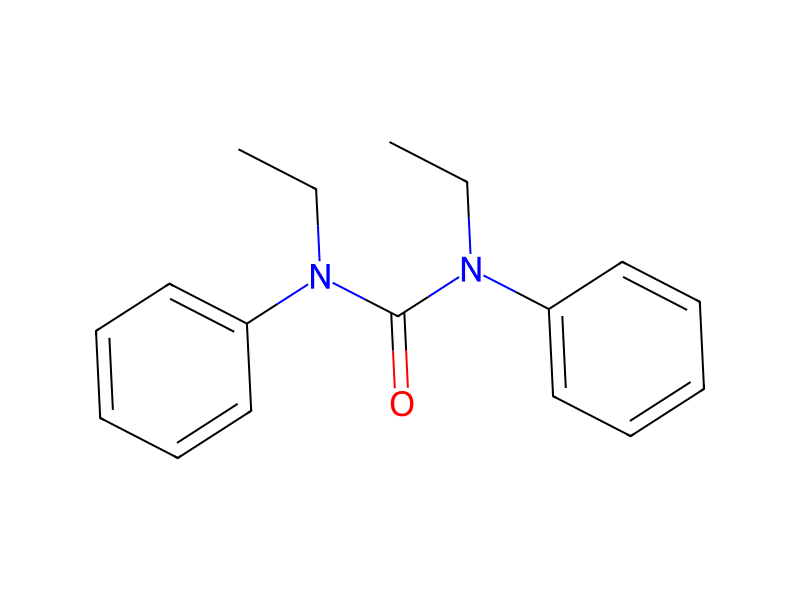
Grundinformationen
- CAS
85-98-3- Standard-SMILES
CCN(C(=O)N(CC)c1ccccc1)c1ccccc1- InChIKey
PZIMIYVOZBTARW-UHFFFAOYSA-N- Summenformel
- C17H20N2O
- Durchschnittliche Molmasse
- 268,35 g/mol
- Monoisotopische Masse
- 268,15756327
Überblick
N,n'-diethylcarbanilide appears as white flakes or white crystalline solid. Peppery odor. (NTP, 1992)
Namen und Bezeichner
- Bevorzugter Name
- Centralite
- IUPAC
- 1,3-diethyl-1,3-diphenylurea
- Lokaler Name
- 1,3-Diethyldiphenylharnstoff
- Englischer Name
- 1,3-Diethyl-1,3-diphenylurea
- Summenformel
- C17H20N2O
- Molmasse
- 268.35
Namen und Synonyme
1,3-Diethyl-1,3-diphenylurea85-98-3N,N'-DiethylcarbanilideCentraliteEthyl centraliteCentralite ICarbamiteN,N'-Diethyl-N,N'-diphenylureasym-DiethyldiphenylureaCentralite-1Bis(N-ethyl-N-phenyl)ureaUrea, N,N'-diethyl-N,N'-diphenyl-
Weitere Namen anzeigen
CENTRALITusafek-1047CENTRALIT 1DIETHYLDIPHENYLUREA
Centralite 1USAF EK-1047Carbanilide, N,N'-diethyl-DTXSID80250404169Z9SDJGNSC-28779NSC-44038DTXCID705040
Datenbank-Bezeichner
- CAS
85-98-3- PubChem CID
- 6828
- DTXSID
DTXSID8025040- ChEMBL
CHEMBL1566472- UNII
- 4169Z9SDJG
- EC Number
- 201-645-2
- Nikkaji
- J4.931J
Eigenschaften
Berechnete StruktureigenschaftenWird ergänzt
- XLogP
- 3,6
- Polarare Oberfläche (TPSA)
- 23,6 Ų
- H-Brücken-Donoren
- 0
- H-Brücken-Akzeptoren
- 1
- Frei drehbare Bindungen
- 4
- Schwere Atome
- 20
- Formalladung
- 0
- Komplexität
- 265
Experimentelle und physikochemische Eigenschaften
SpringerMaterials PropertiesCrystal structure
Density1.12 at 68 °F (NTP, 1992) - Denser than water; will sink
Solubilityless than 1 mg/mL at 70.7 °F (NTP, 1992)
Flash Point302 °F (NTP, 1992)
Boiling Point617 to 626 °F at 760 mmHg (NTP, 1992)
Melting Point174 °F (NTP, 1992)
Vapor Density9.3 (NTP, 1992) - Heavier than air; will sink (Relative to Air)
Physical Description
N,n'-diethylcarbanilide appears as white flakes or white crystalline solid. Peppery odor. (NTP, 1992)
CBI
Physikochemische Eigenschaften
Sicherheit und Regulatorisches
Sicherheitsangaben dienen nur zur Orientierung und ersetzen weder das Sicherheitsdatenblatt (SDB) des Lieferanten noch geltende Vorschriften oder eine fachliche Bewertung.
GHS-Klassifizierung
GHS Classification
Warning
H302 (100%): Harmful if swallowed [Warning Acute toxicity, oral]
P264, P270, P273, P301+P317, P330, and P501 (click each P-code to see the statement)
Aggregated GHS information provided per 85 reports by companies from 3 notifications to the ECHA C&L Inventory. Each notification may be associated with multiple companies.
Gefahrenhinweise
Regulatory Information
Chemical: Urea, N,N'-diethyl-N,N'-diphenyl-
Urea, N,N'-diethyl-N,N'-diphenyl- is listed on the EPA's Chemical Data Reporting (CDR) system. Manufacturers and importers of Urea, N,N'-diethyl-N,N'-diphenyl- are required to report information about their production and use of this chemical to the EPA under the Toxic Substances Control Act (TSCA). (40 eCFR Part 711)
REACH registered substance: 1,3-diethyldiphenylurea (EC: 201-645-2)
Urea, N,N'-diethyl-N,N'-diphenyl-: Does not have an individual approval but may be used as a component in a product covered by a group standard. It is not approved for use as a chemical in its own right.
Fire HazardsThis chemical is combustible. (NTP, 1992)
Health HazardsACUTE/CHRONIC HAZARDS: This compound may react violently when severely shocked or heated to extreme temperatures. (NTP, 1992)
Reactive GroupAmides and Imides
Reactivity AlertsExplosive
Reactivity Profile
N,N'-DIETHYLCARBANILIDE is an amide. Amides/imides react with azo and diazo compounds to generate toxic gases. Flammable gases are formed by the reaction of organic amides/imides with strong reducing agents. Amides are very weak bases (weaker than water). Imides are less basic yet and in fact react with strong bases to form salts. That is, they can react as acids. Mixing amides with dehydrating agents such as P2O5 or SOCl2 generates the corresponding nitrile. The combustion of these compounds generates mixed oxides of nitrogen (NOx). This compound is incompatible with acids and oxidizing agents. This chemical reacts violently when severely shocked or exposed to extreme temperatures. (NTP, 1992)
Chemie und Industrie
Verwendung und Herstellung
U.S. Production2023: 250,000 - <550,000 lb
Industry UsesOxidizing agent
General Manufacturing Information
All Other Chemical Product and Preparation Manufacturing
Urea, N,N'-diethyl-N,N'-diphenyl-: ACTIVE
Anwendungen
Verwenden1,3-Diethyl-1,3-diphenylurea is a gunshot residue and a stabilizer for smokeless powder.
Zugehörige Reaktionen
0
Noch keine zugehörigen Reaktionen