
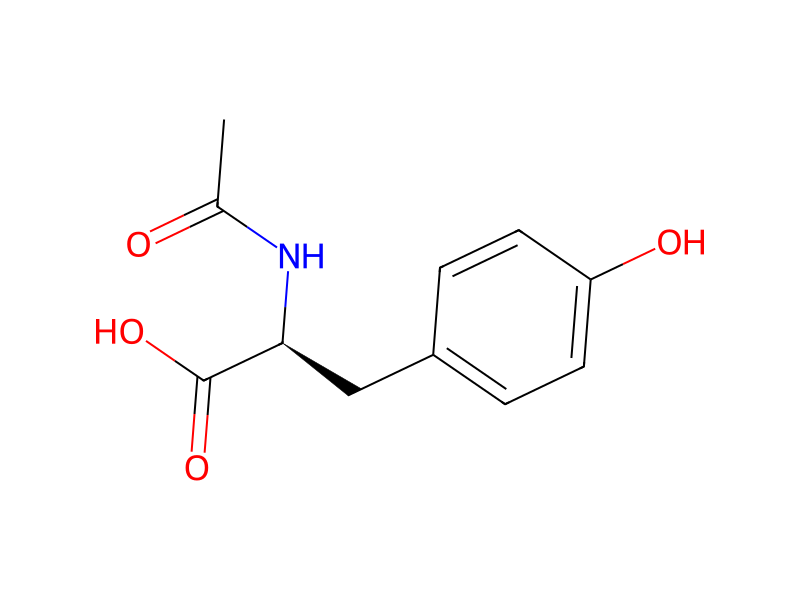
Grundinformationen
- Standard-SMILES
CC(=O)N[C@@H](Cc1ccc(O)cc1)C(=O)O- InChIKey
CAHKINHBCWCHCF-JTQLQIEISA-N- Summenformel
- C11H13NO4
- Durchschnittliche Molmasse
- 223,22 g/mol
- Monoisotopische Masse
- 223,0844579
Überblick
N-acetyl-L-tyrosine is an N-acetyltyrosine in which the chiral centre has L configuration. It has a role as a biomarker, an EC 2.1.1.4 (acetylserotonin O-methyltransferase) inhibitor and a human urinary metabolite. It is a N-acetyltyrosine and a N-acyl-L-tyrosine. It is a conjugate acid of a N-acetyl-L-tyrosinate.
Namen und Bezeichner
- Bevorzugter Name
- N-Acetyl-L-tyrosine
- IUPAC
- (2S)-2-acetamido-3-(4-hydroxyphenyl)propanoic acid
- Lokaler Name
- N-Acetyl-L-tyrosin
- Englischer Name
- N-Acetyl-L-tyrosine
- Summenformel
- C11H13NO4
- Molmasse
- 223.23
Namen und Synonyme
N-Acetyl-L-tyrosineN-AcetyltyrosineAcetyl tyrosineL-Tyrosine, N-acetyl-L-Tyrosine, acetyl-DTXSID7046045N-Acetyltyrosine (VAN)UNII-DA8G610ZO5L-N-acetyl-TyrosineTANOGEN HBTYR-EXCELACETYL L-TYROSINE
Weitere Namen anzeigen
AC-TYR-OHACETYL-L-TYROSINEACETYLTYROSINEN-ACEYL-L-TYROSINEn-acetyl-l-tyrosin-tyrosineN-Acetyl-Thiazolidine-4-carboxylic acid amino acidN-Ac-TyrN-AC-L-TYR
EINECS 208-671-3NSC 10853Tyrosine, N-acetyl-, L-L-TYROSINE, N-ACETYLDTXCID5026045N-ACETYL-L-TYROSINE [USP-RS]N-ACETYLTYROSINE [EP MONOGRAPH](2S)-2-(acetylamino)-3-(4-hydroxyphenyl)propanoic acid
Datenbank-Bezeichner
- CAS
537-55-3- PubChem CID
- 68310
- DTXSID
DTXSID7046045- ChEMBL
CHEMBL65543- ChEBI
CHEBI:21563- UNII
- DA8G610ZO5
- EC Number
- 208-671-3
- Nikkaji
- J62.819K
Eigenschaften
Berechnete Struktureigenschaften
- XLogP
- -0,2
- Polarare Oberfläche (TPSA)
- 86,6 Ų
- H-Brücken-Donoren
- 3
- H-Brücken-Akzeptoren
- 4
- Frei drehbare Bindungen
- 4
- Schwere Atome
- 16
- Formalladung
- 0
- Komplexität
- 259
Experimentelle und physikochemische Eigenschaften
DrugsPharmaceuticals -> Listed in ZINC15
Cosmetics
Cosmetic ingredients (Acetyl Tyrosine) -> CIR (Cosmetic Ingredient Review)
Tanning
LogP1.320
Solubility297 mg/mL
Boiling Point530.00 to 533.00 °C. @ 760.00 mm Hg
Melting Point
149-152
149 - 152 °C
Physical DescriptionSolid
Collision Cross Section154.5 Ų [M+Na]+ [CCS Type: DT; Method: single field calibrated with Agilent tune mix (Agilent)]
Physikochemische Eigenschaften
- Schmelzpunkt
- 149 · 149-152 °C(lit.)
- Siedepunkt
- 364.51 °C · 364.51°C (rough estimate)
- Dichte
- 1.2446 · 1.2446 (rough estimate)
- Brechungsindex
- 1.496 · 1.4960 (estimate)
- storage temp.
- Sealed in dry,Room Temperature
- Löslichkeit
- 2 O: · H2O: soluble25mg/mL
- Aggregatzustand
- Crystalline
- pka
- 3.15 · 3.15±0.10(Predicted)
- Farbe
- White to Off-White
- Wasserlöslichkeit
- Soluble in water (25 mg/ml), and ethanol.
- BRN
- 2697172 · 2697172
- Stabilität
- Stable. Incompatible with strong oxidizing agents.
- Major Application
- pharmaceutical (small molecule)
- Kosmetik-Inhaltsstoffe Funktionen
- SKIN CONDITIONINGTANNING
- InChI
- 1S/C11H13NO4/c1-7(13)12-10(11(15)16)6-8-2-4-9(14)5-3-8/h2-5,10,14H,6H2,1H3,(H,12,13)(H,15,16)/t10-/m0/s1
- InChIKey
- CAHKINHBCWCHCF-JTQLQIEISA-N
- SMILES
- CC(=O)N[C@@H](Cc1ccc(O)cc1)C(O)=O
- LogP
- 1.32 · 1.320
- CAS Datenbank
- 537 · 537-55-3(CAS DataBase Reference)
- NIST chemische Informationen
- N-acetyl-Tyr(537-55-3)
- EPA chemische Informationen
- N-Acetyl-L-tyrosine (537-55-3)
Sicherheit und Regulatorisches
GHS-Klassifizierung
GHS Classification
This chemical does not meet GHS hazard criteria for 15.5% (61 of 394) of reports.
Danger
H318 (84.3%): Causes serious eye damage [Danger Serious eye damage/eye irritation]
P264+P265, P280, P305+P354+P338, and P317 (click each P-code to see the statement)
Aggregated GHS information provided per 394 reports by companies from 4 notifications to the ECHA C&L Inventory.
Gefahrenhinweise
Regulatory Information
Chemical: L-Tyrosine, N-acetyl-
L-Tyrosine, N-acetyl-: Does not have an individual approval but may be used under an appropriate group standard
Other Safety InformationEvaluation - Chemicals that are unlikely to require further regulation to manage risks to environment
Hazard Classes and CategoriesEye Dam. 1 (84.3%)
Toxikologische Informationen
Toxicity Summary
The panel concluded that the 115 amino acid alkyl amides listed below are safe in the present practices of use and concentration in cosmetics, when formulated to be non-irritating...Acetyl Tyrosine
Safe for use in cosmetics, with qualifications
Sicherheitsdaten
- F
- 10
- wgk
- 3
- tsca
- TSCA listed
- hs_code
- 29242995
- risk_code
- 41-36/37/38
- hazard_code
- Xi
- safety_code
- 26-39-36
- Speicherklasse
- 11 - Combustible Solids
Chemie und Industrie
Pharmakologische Informationen
PharmacodynamicsN-acetyltyrosine is used as a high solubility precursor to [DB00135] used due to [DB00135]'s poor solubility. It is deacetylated to form [DB00135].
Mechanism of ActionUsed as a source of [DB00135]. See [DB00135] for more information on its role and pharmacology.
Absorption, Distribution and Excretion
N-acetyltyrosine is eliminated in the urine. The extent of urinary elimination versus utilization in the tissues appears to be related to the rapidity of infusion. When infused slowly in standard doses as in the clinical setting, about 35% is excreted unchanged in the urine. When larger doses are infused rapidly, much higher amounts are excreted reaching values up to 56%. In rat studies it was found that of the drug eliminated in the urine about 74% is present as unchanged N-acetyltyrosine and 23% is present as tyrosine.
Cellular LocationsCytoplasm
Verwendung und Herstellung
UsesCIR ingredient: Acetyl Tyrosine
Use ClassificationCosmetics -> Tanning
General Manufacturing InformationL-Tyrosine, N-acetyl-: ACTIVE
Anwendungen
VerwendenN-Acetyl-L-tyrosine is involved in catecholamine production. It can be used as a cell culture media component in the commercial biomanufacture of therapeutic recombinant proteins and monoclonal antibodies.
Vor- und nachgelagerte Produkte
Vorgelagerte Rohstoffe
Anbieter50 Anbieter
国药集团化学试剂有限公司86-21-63210123 · [email protected]
北京华美互利生物化工010-56205725 · [email protected]
梯希爱(上海)化成工业发展有限公司021-67121386 · [email protected]
上海阿拉丁生化科技股份有限公司400-6206333 13167063860 · [email protected]
INTATRADE GmbH+49 3493/605464 · [email protected]
爱斯特(成都)生物制药股份有限公司+86-28-85122536 85324413 · [email protected]
北京安司莫森技术有限公司010-82954736 13391601435 · [email protected]
科瑞迪化学400-821-5857 021-64326257 · [email protected]
上海迈瑞尔生化科技有限公司4006356688 18621169109 · [email protected]
北京华威锐科化工有限公司0757-86329057 18934348241 · [email protected]
宁波亿诺化学品有限公司86-574-27787657 · [email protected]
阿法埃莎(中国)化学有限公司400-6106006 · [email protected]
太原市瑞和丰科贸有限公司+86 351 7031519 · [email protected]
安耐吉化学&3A(安徽泽升科技股份有限公司)400-0056266 · [email protected]
上海瀚鸿科技股份有限公司021-54306202 13764082696 · [email protected]
上海景颜化工科技有限公司13817811078 · [email protected]
Pure Chemistry Scientific Inc.001-857-928-2050 or 1-888-588-9418 · [email protected]
上海泰坦科技股份有限公司400-6009262 15618770481 · [email protected]
上海隆盛化工有限公司58099637 13585536065 · [email protected]
凯试(上海)科技有限公司021-50135380 · [email protected]
张家港市思普生化有限公司512-0512-58992291,58992287 18606280718 · [email protected]
武汉丰泰威远科技有限公司027-87465837 19945049750 · [email protected]
云南西力生物技术股份有限公司0871-65217109 · [email protected]
山东西亚化学有限公司13355009207 13355009207 · [email protected]
天津希恩思生化科技有限公司400 638 7771 · [email protected]
湖南汇百侍生物科技有限公司0731-85526065 13308475853 · [email protected]
斯百全化学(上海)有限公司021-021-021-67601398-809-809-809 15221380277 · [email protected]
上海源叶生物科技有限公司13636370518 · [email protected]
艾科试剂4008-755-333 18080918076 · [email protected]
上海思域化工科技有限公司86-21-34053660 · [email protected]
赛默飞世尔科技(中国)有限公司800-810-5118 · [email protected]
TCI AMERICA800-4238616 · [email protected]
TOKYO CHEMICAL INDUSTRY CO., LTD.03-36680489 · [email protected]
TCI Europe320-37350700 · [email protected]
深圳振强药物研发有限公司0755-66853366 13670046396 · [email protected]
深圳康特腾科技有限公司86-0755-86635001 · [email protected]
越林试剂021-62960152 · [email protected]
南京杜莱生物技术有限公司025-84699383-8003;025-846993838003-8003 18013301590 · [email protected]
广州爱纯医药科技有限公司020-39119399 18927568969 · [email protected]
上海陶素生化科技有限公司021-33632979 · [email protected]
上海倍卓生物科技有限公司021-61119791,13386096464 · [email protected]
北京环宇世纪化学科技有限公司hysj_bj.com
湖北鑫源顺医药化工有限公司13971561712, 13995564702, 027-50664929 · [email protected]
上海将来实业股份有限公司021-61552785 · [email protected]
HBCChem, Inc.+1-510-219-6317 · [email protected]
上海笛柏生物科技有限公司400-008-9730,021-54359730 400-008-9730 · [email protected]
上海石洋化工有限公司021-56795766 · [email protected]
成都零六生物科技有限公司400-1166-196 13458535857 · [email protected]
四川安派博生物科技有限公司028-65294243 18682730901 · [email protected]
杭州杰恒化工有限公司0571-87396432 · [email protected]
Ergänzende Hinweise
DefinitionChEBI: N-acetyl-L-tyrosine is an N-acetyltyrosine in which the chiral centre has L configuration. It has a role as an EC 2.1.1.4 (acetylserotonin O-methyltransferase) inhibitor, a biomarker and a human urinary metabolite. It is a N-acyl-L-tyrosine and a N-acetyltyrosine. It is a conjugate acid of a N-acetyl-L-tyrosinate.
Zugehörige Reaktionen
6


Verknüpfte Notizen
Wird geladen…