
Grundinformationen
- Standard-SMILES
CCOC=C(C(=O)OCC)C(=O)OCC- InChIKey
LTMHNWPUDSTBKD-UHFFFAOYSA-N- Summenformel
- C10H16O5
- Durchschnittliche Molmasse
- 216,23 g/mol
- Monoisotopische Masse
- 216,09977361
Namen und Bezeichner
- Bevorzugter Name
- Diethyl (ethoxymethylene)malonate
- IUPAC
- diethyl 2-(ethoxymethylidene)propanedioate
- Lokaler Name
- Diethylethoxymethylenmalonat
- Englischer Name
- Diethyl ethoxymethylenemalonate
- Summenformel
- C10H16O5
- Molmasse
- 216.23
Namen und Synonyme
Diethyl ethoxymethylenemalonate87-13-8Diethyl (ethoxymethylene)malonateEthoxymethylenemalonic acid diethyl esterDiethyl EMMEPropanedioic acid, (ethoxymethylene)-, diethyl esterDTXSID5052591NSC-9068MALONIC ACID, (ETHOXYMETHYLENE)-, DIETHYL ESTER6KF8220SZ8NSC-62117DTXCID2031164
Weitere Namen anzeigen
EMMEDEEMMDiethyl 2-(ethoxymethylene)propanedioatediethyl (ethoxymethylidene)propanedioate2-Ethoxymethylene-malonic acid diethyl esteronatetl1483enemaL
Propanedioic acid, 2-(ethoxymethylene)-, 1,3-diethyl esterRefChem:133377Propanedioic acid, 2-(ethoxymethylene)-, diethyl ester201-725-7Diethyl 2-(ethoxymethylene)malonateDiethyl Ethoxymethylidenemalonate1,3-diethyl 2-(ethoxymethylidene)propanedioateMFCD00009148
Datenbank-Bezeichner
- CAS
87-13-8- PubChem CID
- 6871
- DTXSID
DTXSID5052591- UNII
- 6KF8220SZ8
- EC Number
- 201-725-7
- Nikkaji
- J61.661C
Eigenschaften
Berechnete Struktureigenschaften
- XLogP
- 1,5
- Polarare Oberfläche (TPSA)
- 61,8 Ų
- H-Brücken-Donoren
- 0
- H-Brücken-Akzeptoren
- 5
- Frei drehbare Bindungen
- 8
- Schwere Atome
- 15
- Formalladung
- 0
- Komplexität
- 224
Experimentelle und physikochemische Eigenschaften
Chemical Classes
Other Classes -> Esters, Other
Industrial compound
Physical DescriptionColorless liquid; [Alfa Aesar MSDS]
Ionization Efficiency
Positive
2.1
2.7
Agilent XCT
Electrospray ionization
formic acid (5.3nM)
Collision Cross Section146.8 Ų [M+Na]+ [CCS Type: DT; Buffer gas: N2; Ionization: ESI+; Dataset: TOXCAST; Source Identifier: DTXSID5052591]
Physikochemische Eigenschaften
- Schmelzpunkt
- -33 °C · -33°C
- Siedepunkt
- 279 · 279-283 °C(lit.)
- Dichte
- 1.08 g/mL · 1.080 g/mL at 20 °C(lit.)
- Dampfdruck
- 0.1 hPa · <0.1 hPa
- Brechungsindex
- 20 · n20/D 1.463
- Flammpunkt
- 311 °F · 311 °F
- storage temp.
- 30 °C · Store below +30°C.
- Löslichkeit
- Chloroform (Slightly), Ethyl Acetate (Slightly)
- Aggregatzustand
- Liquid
- Farbe
- Clear colorless to light yellow
- Wasserlöslichkeit
- insoluble
- BRN
- 880058 · 880058
- InChI
- 1S/C10H16O5/c1-4-13-7-8(9(11)14-5-2)10(12)15-6-3/h7H,4-6H2,1-3H3
- InChIKey
- LTMHNWPUDSTBKD-UHFFFAOYSA-N
- SMILES
- CCO\C=C(\C(=O)OCC)C(=O)OCC
- LogP
- 1.5 · 1.5-2.1 at pH7
- CAS Datenbank
- 87 · 87-13-8(CAS DataBase Reference)
- NIST chemische Informationen
- Propanedioic acid, (ethoxymethylene)-, diethyl ester(87-13-8)
- EPA chemische Informationen
- Propanedioic acid, (ethoxymethylene)-, diethyl ester (87-13-8)
Sicherheit und Regulatorisches
GHS-Klassifizierung
GHS Classification
Danger
H302 (99.1%): Harmful if swallowed [Warning Acute toxicity, oral]
P260, P261, P264, P264+P265, P270, P271, P272, P280, P301+P317, P301+P330+P331, P302+P352, P302+P361+P354, P304+P340, P305+P351+P338, P305+P354+P338, P316, P317, P319, P321, P330, P332+P317, P333+P317, P337+P317, P362+P364, P363, P403+P233, P405, and P501 (click each P-code to see the statement)
Aggregated GHS information provided per 111 reports by companies from 14 notifications to the ECHA C&L Inventory. Each notification may be associated with multiple companies.
Gefahrenhinweise
Regulatory Information
Status: Active Update: 29-03-2018 https://echa.europa.eu/registration-dossier/-/registered-dossier/12518
Diethyl ethoxymethylenemalonate: Does not have an individual approval but may be used under an appropriate group standard
Hazards Summary
A moderate skin irritant; Causes somnolence and gastrointestinal changes in oral lethal-dose studies of rats; [RTECS] An irritant; May cause skin and respiratory sensitization; Harmful by ingestion; [Alfa Aesar MSDS] Search for (87-13-8[EC/RN Number]) AND (allergic OR dermatitis OR asthma OR sensitizer OR sensitization): no results; [PubMed]
Peroxide Forming Chemical
Diethyl ethoxymethylenemalonate
D: Other compounds that may form peroxides
Kelly
Hazard Classes and CategoriesAcute Tox. 4 (99.1%)
Toxikologische Informationen
Toxicity DataLCLo (mouse) = 44 mg/m3
Sicherheitsdaten
- wgk
- 1
- tsca
- TSCA listed
- hs_code
- 29189090
- RTECS-Nr.
- OO1100000
- risk_code
- 22-36/37/38-42/43
- Toxizität
- LD50 orally in Rabbit: 925 mg/kg LD50 dermal Rat > 2000 mg/kg
- hazard_code
- Xn
- safety_code
- 26-36/37/39-27-24/25
- Speicherklasse
- 10 - Combustible liquids
- Hazard Classifications
- Acute Tox. 4 OralAquatic Acute 1Aquatic Chronic 2Eye Irrit. 2Skin Irrit. 2Skin Sens. 1A
- Selbstentzündungstemperatur
- 215 °C
Chemie und Industrie
Verwendung und Herstellung
UsesUsed to make fine chemicals; [ExPub: ECHA REACH Registrations]
General Manufacturing InformationPropanedioic acid, 2-(ethoxymethylene)-, 1,3-diethyl ester: ACTIVE
Anwendungen
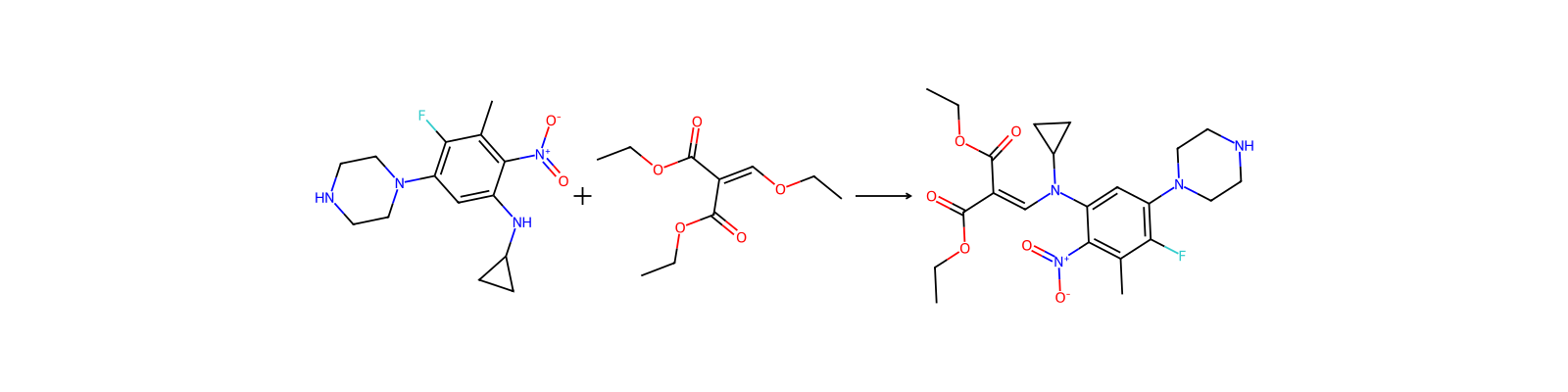
VerwendenDiethyl ethoxymethylenemalonate is used for synthesis of pyrido[3,2-e]pyrimido[1,2-c]pyrimidines. Initially, it was used to monitor lysine decarboxylase activity. It is useful in the determination of amino acids by precolumn derivatization by using reversed-phase high-performance liquid chromatography (HPLC). It plays an important role in the Gould-Jacobs reaction to prepare quinolines. For example, anile reacts with this reagent to give 4-hydroxyquinoline. It acts as an intermediate in the production of flumequine, which is a fluoroquinolone antibiotic.
Vor- und nachgelagerte Produkte
Vorgelagerte Rohstoffe
Nachgelagerte Produkte
Anbieter50 Anbieter
国药集团化学试剂有限公司86-21-63210123 · [email protected]
梯希爱(上海)化成工业发展有限公司021-67121386 · [email protected]
衢州润东化工有限公司0570-8789886 18892685668 · [email protected]
上海阿拉丁生化科技股份有限公司400-6206333 13167063860 · [email protected]
南京一化生物科技有限公司13429882898; 13429882898
爱斯特(成都)生物制药股份有限公司+86-28-85122536 85324413 · [email protected]
南通如通化工有限公司18962933129 18962933129 · [email protected]
北京安司莫森技术有限公司010-82954736 13391601435 · [email protected]
韶远科技(上海)有限公司021-50795510 4000665055 · [email protected]
科瑞迪化学400-821-5857 021-64326257 · [email protected]
Syntechem Co.,Ltd[email protected]
上海迈瑞尔生化科技有限公司4006356688 18621169109 · [email protected]
阿法埃莎(中国)化学有限公司400-6106006 · [email protected]
太原市瑞和丰科贸有限公司+86 351 7031519 · [email protected]
上海德默医药科技有限公司400-021-7337 2355568890 · [email protected]
安耐吉化学&3A(安徽泽升科技股份有限公司)400-0056266 · [email protected]
上海瀚鸿科技股份有限公司021-54306202 13764082696 · [email protected]
上海景颜化工科技有限公司13817811078 · [email protected]
嘉兴市艾森化工有限公司0573-85285100 18627885956 · [email protected]
Pure Chemistry Scientific Inc.001-857-928-2050 or 1-888-588-9418 · [email protected]
孝感深远化工有限公司15527621225; 15527621225 · [email protected]
苏州施亚生物科技有限公司86(512)5235 8471 17715136450 · [email protected]
山东西亚化学有限公司13355009207 13355009207 · [email protected]
玛雅试剂+86 (573) 82222445 (0)18006601000 452520369 · [email protected]
四川库利南科技有限公司400-1166-196 18981987031 · [email protected]
上海耐士化工科技有限公司400-188-0725 +86 21 34310725 13611771617
天津希恩思生化科技有限公司400 638 7771 · [email protected]
济南邦德化工技术有限公司86-531-88280989 · [email protected]
上海思域化工科技有限公司86-21-34053660 · [email protected]
赛默飞世尔科技(中国)有限公司800-810-5118 · [email protected]
北京伊诺凯科技有限公司400-810-7969 010-59572699 · [email protected]
江苏艾康生物医药研发有限公司025-66113011 13913916777 · [email protected]
TCI AMERICA800-4238616 · [email protected]
TOKYO CHEMICAL INDUSTRY CO., LTD.03-36680489 · [email protected]
TCI Europe320-37350700 · [email protected]
上海贤鼎生物科技有限公司4009209199 · [email protected]
越林试剂021-62960152 · [email protected]
无锡中坤生化科技有限公司+86 0510-85629785
上海汇凯化学科技有限公司021-61995394 18916691159 · [email protected]
上海洪创医药科技有限公司18151128828 · [email protected]
湖北鑫源顺医药化工有限公司13971561712, 13995564702, 027-50664929 · [email protected]
上海将来实业股份有限公司021-61552785 · [email protected]
日照力德士化工有限公司010-51268198 · [email protected]
美岚实业(上海)有限公司021-58958189 · [email protected]
上海爱蝶实业有限公司021-58957966 18930537195 · [email protected]
广拓化学(上海)有限公司021-60899189-8001 18918189673 · [email protected]
雷丁试剂0510-85629785 18013409632 · [email protected]
湖南华腾制药有限公司400-8592883 · [email protected]
上海创赛科技有限公司400-6087598 15021221957 · [email protected]
上海御略医药科技有限公司021-60345187 13671753212 · [email protected]
Zugehörige Reaktionen
918




Verknüpfte Notizen
Wird geladen…