
Isobutyrophenon
Isobutyrophenone
Daten werden ergänzt – lade die Seite später neu, um den aktuellen Stand zu sehen
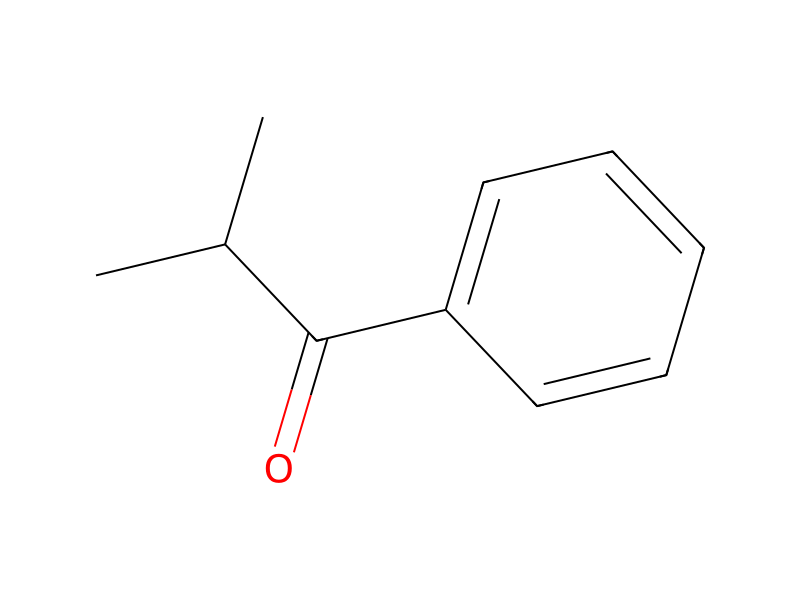
Grundinformationen
- CAS
611-70-1- Standard-SMILES
CC(C)C(=O)c1ccccc1- InChIKey
BSMGLVDZZMBWQB-UHFFFAOYSA-N- Summenformel
- C10H12O
- Durchschnittliche Molmasse
- 148,2 g/mol
- Monoisotopische Masse
- 148,088815
Namen und Bezeichner
- Bevorzugter Name
- Isobutyrophenone
- IUPAC
- 2-methyl-1-phenylpropan-1-one
- Lokaler Name
- Isobutyrophenon
- Englischer Name
- Isobutyrophenone
- Summenformel
- C10H12O
- Molmasse
- 148.2
Namen und Synonyme
Isobutyrophenone611-70-12-methyl-1-phenylpropan-1-oneIsopropyl phenyl ketone1-Propanone, 2-methyl-1-phenyl-Isopropyl phenyl ketonUNII-8L53972NTZDTXSID6048202iso-ButyrophenoneEINECS 210-275-01-PHENYL-2-METHYL-1-PROPANONEAI3-11204
Weitere Namen anzeigen
2-MethylpropiophenoneisobutyrophenonPHENYL ISOPROPYL KETONEISOBUTROPHENONEsobutyrophenonelsobutyrophenoneISOBUTYRYLBENZENE
8L53972NTZNSC 6552NSC-6552DTXCID4028177EC 210-275-02-METHYL-1-PHENYLPROPANONERefChem:1491242040-14-4
Datenbank-Bezeichner
- CAS
611-70-1- PubChem CID
- 69144
- DTXSID
DTXSID6048202- ChEMBL
CHEMBL3187314- UNII
- 8L53972NTZ
- EC Number
- 210-275-0
- Nikkaji
- J47.812A
Eigenschaften
Berechnete StruktureigenschaftenWird ergänzt
- XLogP
- 2,7
- Polarare Oberfläche (TPSA)
- 17,1 Ų
- H-Brücken-Donoren
- 0
- H-Brücken-Akzeptoren
- 1
- Frei drehbare Bindungen
- 2
- Schwere Atome
- 11
- Formalladung
- 0
- Komplexität
- 132
Experimentelle und physikochemische Eigenschaften
SpringerMaterials Properties13C nuclear magnetic resonance spectrum
LogP2.59
Physikochemische Eigenschaften
- Schmelzpunkt
- 1 °C · 1 °C
- Siedepunkt
- 215 °C · 215 °C
- Dichte
- 0.98 · 0.98
- Dampfdruck
- 1 mm · 1 mm Hg ( 50 °C)
- Brechungsindex
- 1.52 · 1.52
- Flammpunkt
- 84 °C · 84 °C
- storage temp.
- Sealed in dry,Room Temperature
- Löslichkeit
- Chloroform (Sparingly), Methanol (Slightly)
- Aggregatzustand
- clear liquid
- Farbe
- Colorless to Light yellow
- Wasserlöslichkeit
- immiscible
Sicherheit und Regulatorisches
Sicherheitsangaben dienen nur zur Orientierung und ersetzen weder das Sicherheitsdatenblatt (SDB) des Lieferanten noch geltende Vorschriften oder eine fachliche Bewertung.
GHS-Klassifizierung
GHS Classification
This chemical does not meet GHS hazard criteria for 70.4% (107 of 152) of all reports.
Warning
H315 (28.9%): Causes skin irritation [Warning Skin corrosion/irritation]
P261, P264, P264+P265, P271, P280, P302+P352, P304+P340, P305+P351+P338, P319, P321, P332+P317, P337+P317, P362+P364, P403+P233, P405, and P501 (click each P-code to see the statement)
Aggregated GHS information provided per 152 reports by companies from 6 notifications to the ECHA C&L Inventory. Each notification may be associated with multiple companies.
Gefahrenhinweise
Regulatory Information
Status: Active Update: 18-11-2019 https://echa.europa.eu/registration-dossier/-/registered-dossier/1890
1-Propanone, 2-methyl-1-phenyl-: Does not have an individual approval but may be used under an appropriate group standard
Hazard Classes and CategoriesSkin Irrit. 2 (28.9%)
Sicherheitsdaten
- wgk
- 3
- tsca
- TSCA listed
- hs_code
- 2914399090
- risk_code
- 36/37/38
- hazard_code
- Xi
- safety_code
- 26-36
- Speicherklasse
- 10 - Combustible liquids
- Hazard Classifications
- Acute Tox. 4 Oral
Chemie und Industrie
Verwendung und Herstellung
General Manufacturing Information1-Propanone, 2-methyl-1-phenyl-: ACTIVE
Anwendungen
VerwendenIsobutyrophenone is used as an internal standard in the determination of hydroxyzine hydrochloride and benzyl alcohol in injection solutions. It is also used in the preparation of alpha-hydroxyisobutyrophenone. Isobutyrophenone is employed as photosensitizer intermediate. It can react with bromoacetic acid ethyl ester to get 3-hydroxy-4-methyl-3-phenyl-valeric acid ethyl ester.
Darstellung
synthetischeIsobutyrophenone synthesis: Benzene underwent a Friedel–Crafts acylation with isobutyryl chloride to synthesize isobutyrophenone. The reaction was performed using excess benzene as a replacement for a typical solvent and heat to reflux (88 °C) for a period of 3 hours. Any unreacted benzene was recovered after the reaction during the distillation process. A 66 % yield of isobutyrophenone was obtained from the solar synthesis, compared to a 44 % yield from an in-lab, electrical heating analysis.
Vor- und nachgelagerte Produkte
Vorgelagerte Rohstoffe
Nachgelagerte Produkte
Zugehörige Reaktionen
41



Notizen zur Verbindung
Wird geladen…