StartseiteMCPWorkbenchSkills
StartseiteWorkbenchBenachrichtigungenMein Bereich
llms.txt · MCP-AnleitungDatenschutz · Nutzungsbedingungen · Supportv1.8.3
  1. Startseite
  2. /Verbindung

Di-p-tolylamin

Benzenamine, 4-methyl-N-(4-methylphenyl)-
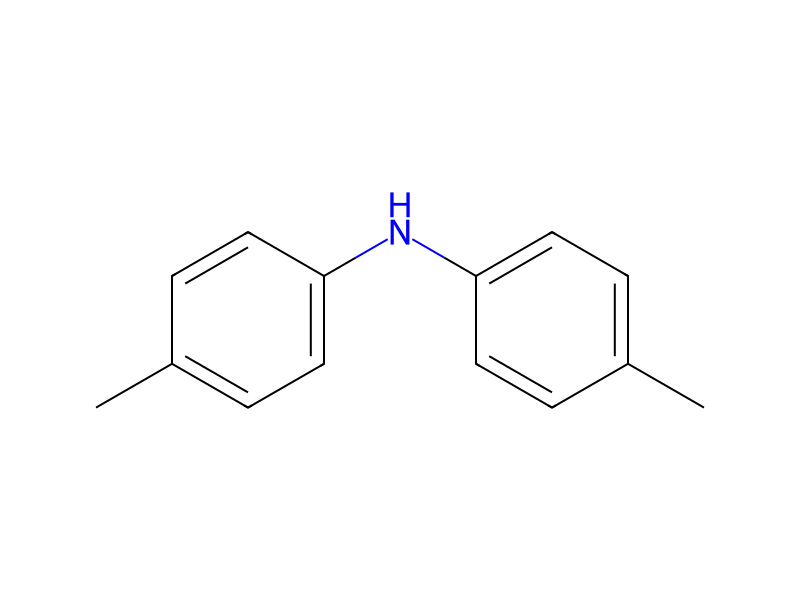
HCID 69293
Neue Reaktion
Drucken
GrundinformationenNamen und BezeichnerEigenschaftenSicherheit und RegulatorischesChemie und IndustrieZugehörige ReaktionenNotizen zur Verbindung
TeilstruktursucheÄhnliche Strukturen suchen

Grundinformationen

CAS
620-93-9
Standard-SMILES
Cc1ccc(Nc2ccc(C)cc2)cc1
InChIKey
RHPVVNRNAHRJOQ-UHFFFAOYSA-N
Summenformel
C14H15N
Durchschnittliche Molmasse
197,27 g/mol
Monoisotopische Masse
197,12044948

Namen und Bezeichner

Bevorzugter Name
Benzenamine, 4-methyl-N-(4-methylphenyl)-
IUPAC
4-methyl-N-(4-methylphenyl)aniline
Lokaler Name
Di-p-tolylamin
Englischer Name
Di-p-tolylamine
Summenformel
C14H15N
Molmasse
197.28

Namen und Synonyme

Di-p-tolylaminebis(4-methylphenyl)amineBenzenamine, 4-methyl-N-(4-methylphenyl)-EINECS 210-659-84-Methyl-N-(4-methylphenyl)benzenamineRefChem:561900210-659-84,4'-Dimethyldiphenylamine620-93-94-Methyl-N-(4-methylphenyl)anilinep,p'-Ditolylamine4,4-Dimethyldiphenylamine
Weitere Namen anzeigen
DMDPADI-P-TolyamineDi-p-toLDitlylaminep,p'-DitolyamineP,P'-DITLYLAMINE4,4'-DitolylamineBis(p-tolyl)amine
MFCD00059317di-p-tolylaminbis(4-tolyl) amineN,N-di(p-toluyl)amineDi-p-tolylamine, 97%4,4`-DimethyldiphenylamineIFLab1_001787HMS1417B05

Datenbank-Bezeichner

CAS
620-93-9
PubChem CID
69293
DTXSID
DTXSID5060726
EC Number
210-659-8
Nikkaji
J29.936G

Eigenschaften

Berechnete Struktureigenschaften

XLogP
4,2
Polarare Oberfläche (TPSA)
12 Ų
H-Brücken-Donoren
1
H-Brücken-Akzeptoren
1
Frei drehbare Bindungen
2
Schwere Atome
15
Formalladung
0
Komplexität
154

Experimentelle und physikochemische Eigenschaften

SpringerMaterials PropertiesDensity

Physikochemische Eigenschaften

Schmelzpunkt
78 · 78-82°C
Siedepunkt
330 °C · 330 °C
Dichte
1.0514 · 1.0514 (rough estimate)
Brechungsindex
1.6095 · 1.6095 (estimate)
storage temp.
Keep in dark place,Inert atmosphere,Room temperature
Löslichkeit
Chlorofrm (Slightly), Methanol (Slightly)
Aggregatzustand
Solid
pka
1.68 · 1.68±0.40(Predicted)
Farbe
Off-White
InChI
InChI=1S/C14H15N/c1-11-3-7-13(8-4-11)15-14-9-5-12(2)6-10-14/h3-10,15H,1-2H3
InChIKey
RHPVVNRNAHRJOQ-UHFFFAOYSA-N
SMILES
C1(NC2=CC=C(C)C=C2)=CC=C(C)C=C1

Sicherheit und Regulatorisches

Sicherheitsangaben dienen nur zur Orientierung und ersetzen weder das Sicherheitsdatenblatt (SDB) des Lieferanten noch geltende Vorschriften oder eine fachliche Bewertung.

GHS-Klassifizierung

GHS Classification · 4 Einträge

Warning

H302 (33.3%): Harmful if swallowed [Warning Acute toxicity, oral]

P261, P264, P264+P265, P270, P271, P280, P301+P317, P302+P352, P304+P340, P305+P351+P338, P317, P319, P321, P330, P332+P317, P337+P317, P362+P364, P403+P233, P405, and P501 (click each P-code to see the statement)

Aggregated GHS information provided per 3 reports by companies from 2 notifications to the ECHA C&L Inventory. Each notification may be associated with multiple companies.

Gefahrenhinweise

Hazard Classes and CategoriesAcute Tox. 4 (33.3%)

Sicherheitsdaten

wgk
3
tsca
TSCA listed
hs_code
2921499090
Speicherklasse
11 - Combustible Solids

Chemie und Industrie

Verwendung und Herstellung

General Manufacturing InformationBenzenamine, 4-methyl-N-(4-methylphenyl)-: ACTIVE
Anwendungen · 2 Einträge

BeschreibungDi-p-tolylamine (also known as 4,4′-dimethyldiphenylamine) is an intermediate for OLED materials. Acting as a strong electron-donating unit, Di-p-tolylamine is chemically incorporated into the molecular framework of the host material POPCPA, and is used to fabricate highly efficient blue phosphorescent OLED devices with low driving voltages (maximum power efficiency of 45.3 lm/W; driving voltage of 2.6 V at 1 cd/m2). This compound shares a similar diphenylamine structure to that found in commonly used hole-transporting materials (such as TAPC); the methyl-substituted diphenylamine unit possesses good electron-donating ability and steric hindrance, which helps to increase the material's glass transition temperature (90°C) and thermal decomposition temperature (406°C), thereby enhancing the thermal stability of the device[1].

Verwenden4,4''-Dimethyldiphenylamine is a reagent used in the comparative studies of the analgesic and anti-inflammatory properties of N-phenylanthranilic acids and mefenamic acid, and the anti parasitic activities of some substituted diphenylamines.

Vor- und nachgelagerte Produkte

Vorgelagerte Rohstoffe

Acetamide, N,N-bis(4-methylphenyl)-Bis(4-tolyl)boronic acidSodium tetra(p-tolyl)borate4-Bromtoluol4-Iodtoluol4-Tolylboronic acid

Zugehörige Reaktionen

26
Reaktionsaufzeichnung erstellen
Reaktionsgleichung von HRID 64536
HRID 64536als Edukt
Reaktionsgleichung von HRID 159878
HRID 159878als Edukt
Reaktionsgleichung von HRID 324714
HRID 324714als Produkt
Reaktionsgleichung von HRID 353412
HRID 353412als Edukt
Reaktionsgleichung von HRID 353413
HRID 353413als Edukt
Reaktionsgleichung von HRID 489871
HRID 489871als Edukt
Reaktionsgleichung von HRID 871820
HRID 871820als Edukt
Reaktionsgleichung von HRID 1190241
HRID 1190241als Edukt
ZurückSeite 1 von 4

Notizen zur Verbindung

Auf dieser SeiteGrundinformationenNamen und BezeichnerEigenschaftenSicherheit und RegulatorischesChemie und IndustrieZugehörige ReaktionenNotizen zur Verbindung
CAS Datenbank
620 · 620-93-9(CAS DataBase Reference)
EPA chemische Informationen
4 · 4,4'-Dimethyldiphenylamine (620-93-9)
Chlortoluol (p)
p-Toluidin