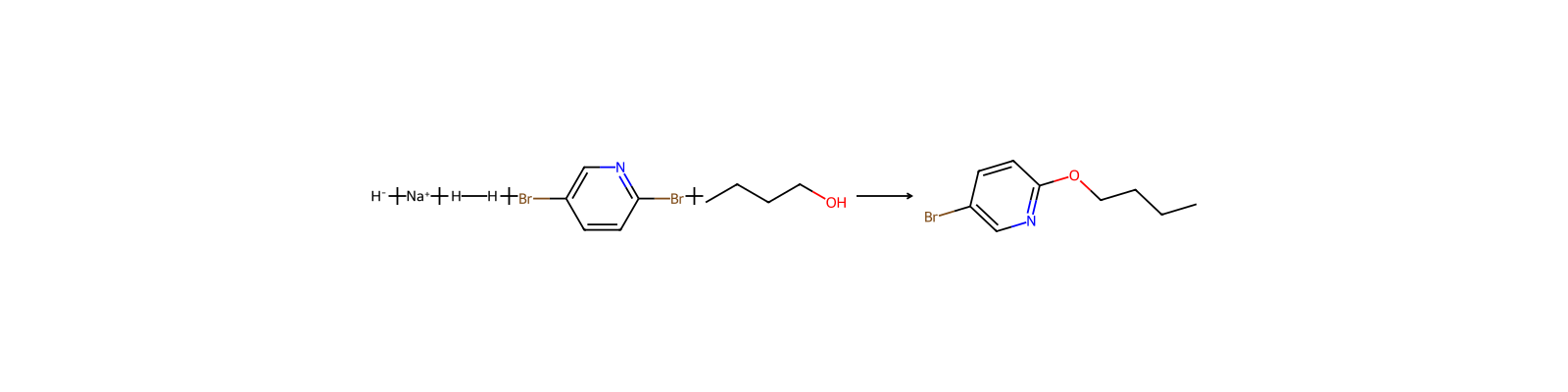
2,5-Dibrompyridin
2,5-Dibromopyridine
Daten werden ergänzt – lade die Seite später neu, um den aktuellen Stand zu sehen

Grundinformationen
- CAS
624-28-2- Standard-SMILES
Brc1ccc(Br)nc1- InChIKey
ZHXUWDPHUQHFOV-UHFFFAOYSA-N- Summenformel
- C5H3Br2N
- Durchschnittliche Molmasse
- 236,89 g/mol
- Monoisotopische Masse
- 234,8632233
Namen und Bezeichner
- Bevorzugter Name
- 2,5-Dibromopyridine
- IUPAC
- 2,5-dibromopyridine
- Lokaler Name
- 2,5-Dibrompyridin
- Englischer Name
- 2,5-Dibromopyridine
- Summenformel
- C5H3Br2N
- Molmasse
- 236.89
Namen und Synonyme
2,5-Dibromopyridine624-28-2Pyridine, 2,5-dibromo-EINECS 210-839-6(2,5-DBrPyr)DTXSID00211452NSC 76597RefChem:82777DTXCID00133943210-839-6ZHXUWDPHUQHFOV-UHFFFAOYSA-N2,5-dibromo-pyridine
Weitere Namen anzeigen
Dibromopyridine5-DibroMop2,5-DBr-Py5-DibroMopyridine2,5-Dibrompyridin2,5 dibromopyrdine
2,5-DIBROMOPYRIDINMFCD00006221NSC-765972,5-Dibromo Pyridine67987-57-93,6-DIBROMOPYRIDINENSC765972,5-dibrompyridine
Datenbank-Bezeichner
- CAS
624-28-2- PubChem CID
- 69353
- DTXSID
DTXSID00211452- UNII
- V4W4Z4K29X
- EC Number
- 210-839-6
- Nikkaji
- J79.763D
Eigenschaften
Berechnete StruktureigenschaftenWird ergänzt
- XLogP
- 2,6
- Polarare Oberfläche (TPSA)
- 12,9 Ų
- H-Brücken-Donoren
- 0
- H-Brücken-Akzeptoren
- 1
- Frei drehbare Bindungen
- 0
- Schwere Atome
- 8
- Formalladung
- 0
- Komplexität
- 76,8
Experimentelle und physikochemische Eigenschaften
Chemical ClassesNitrogen Compounds -> Pyridines
Physical DescriptionDark brown powder; [Sigma-Aldrich MSDS]
Physikochemische Eigenschaften
- Schmelzpunkt
- 92 · 92-95 °C (lit.)
- Siedepunkt
- 235 °C · 235 °C / 772mmHg
- Dichte
- 2.0383 · 2.0383 (rough estimate)
- Brechungsindex
- 1.58 · 1.5800 (estimate)
- Flammpunkt
- 62 ℃ · 62℃
- storage temp.
- Inert atmosphere,Room Temperature
- Löslichkeit
- Chloroform (Slightly), Methanol (Slightly)
- pka
- -1.57 · -1.57±0.10(Predicted)
- Aggregatzustand
- Crystalline Powder
- Farbe
- Almost white or light beige to brown
Sicherheit und Regulatorisches
Sicherheitsangaben dienen nur zur Orientierung und ersetzen weder das Sicherheitsdatenblatt (SDB) des Lieferanten noch geltende Vorschriften oder eine fachliche Bewertung.
GHS-Klassifizierung
GHS Classification
Warning
H315 (100%): Causes skin irritation [Warning Skin corrosion/irritation]
P261, P264, P264+P265, P271, P280, P302+P352, P304+P340, P305+P351+P338, P319, P321, P332+P317, P337+P317, P362+P364, P403+P233, P405, and P501 (click each P-code to see the statement)
Aggregated GHS information provided per 48 reports by companies from 7 notifications to the ECHA C&L Inventory. Each notification may be associated with multiple companies.
Gefahrenhinweise
Regulatory Information
Status: No longer Valid Update: 17-10-2019 https://echa.europa.eu/registration-dossier/-/registered-dossier/30054
2,5-Dibromopyridine: Does not have an individual approval but may be used under an appropriate group standard
Hazards SummaryA skin and strong eye irritant; [Sigma-Aldrich MSDS]
Hazard Classes and CategoriesSkin Irrit. 2 (100%)
Sicherheitsdaten
- wgk
- 3
- ridadr
- UN2811
- hs_code
- 29333999
- risk_code
- 36/37/38-20/21/22
- hazard_code
- Xi,Xn
- safety_code
- 26-37/39-36/37/39-36
- hazard_class
- IRRITANT
- Speicherklasse
- 11 - Combustible Solids
Chemie und Industrie
Anwendungen
BeschreibungPyridine and its derivatives are distributed widely by nature. Many plant constituents are as contain pyridine ring compounds in the structure of alkaloids, etc.; they are the bases producing many vital compounds and are indispensable raw materials during medicine, agricultural chemicals, dyestuff, tension-active agents, rubber ingredients, fodder additives, foodstuff additives, tackiness agents, etc. are produced.2,5-dibromo pyridine is an important intermediate of organic synthesis and is mainly used in medicine intermediate, organic synthesis, and organic solvent, can also be applicable to aspects such as DYE PRODUCTION, pesticide production and spices. Selective monolithiation of 2,5-dibromopyridine at either the 2-position or the 5-position is reported. Solvent and concentration strongly influence the selectivity. Coordinating solvents and higher concentration favour the 5-position, while non-coordinating solvents and lower concentration favour the 2-position[1].
Verwenden2,5-Dibromopyridine (cas# 624-28-2) is a compound useful in organic synthesis.
Darstellung
synthetischeTo synthesize 2,5-dibromopyridine, follow these steps:Add 2-amino-5-bromopyridine (13.0 kg) into a water-cooled solution at 10 °C.Slowly add 47% aqueous hydrogen bromide (37 L) to the mixture.Introduce liquid bromine (11 L) into the mixture.Maintain the reaction temperature below 10 °C.Prepare a solution of NaNO2 (16.1 kg) and H2O (19 L) and add it dropwise to the mixture while keeping the temperature between 0-5 °C.Stir the reaction mixture for 30 minutes.Treat the mixture with a solution of NaOH (28.0 kg) in water (30 L) at a controlled rate below 20-25 °C.Extract the reaction mixture with diethyl ether (3 × 40 L).Dry the organic layer with anhydrous Na2SO4.Remove the desiccant by filtration.Evaporate the resulting filtrate under reduced pressure to dryness.Suspend the residue in heptane (10 L).Collect the target product molecule, 2,5-dibromopyridine, by filtration.Synthesis method of 2,5-dibromopyridine
Vor- und nachgelagerte Produkte
Vorgelagerte Rohstoffe
Zugehörige Reaktionen
771



Notizen zur Verbindung
Wird geladen…