StartseiteMCPWorkbenchSkills
StartseiteWorkbenchBenachrichtigungenMein Bereich
llms.txt · MCP-AnleitungDatenschutz · Nutzungsbedingungen · Supportv1.8.3
  1. Startseite
  2. /Verbindung

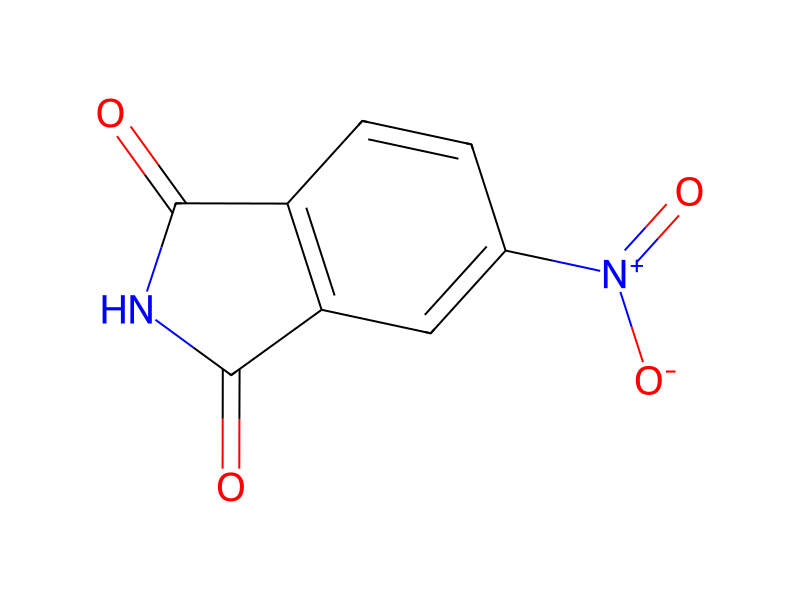
4-Nitrophthalimid

4-Nitrophthalimide

HCID 6969
Neue Reaktion
Drucken

Daten werden ergänzt – lade die Seite später neu, um den aktuellen Stand zu sehen
GrundinformationenÜberblickNamen und BezeichnerEigenschaftenSicherheit und RegulatorischesChemie und IndustrieZugehörige ReaktionenNotizen zur Verbindung
TeilstruktursucheÄhnliche Strukturen suchen

Grundinformationen

CAS
89-40-7
Standard-SMILES
O=C1NC(=O)c2cc([N+](=O)[O-])ccc21
InChIKey
ANYWGXDASKQYAD-UHFFFAOYSA-N
Summenformel
C8H4N2O4
Durchschnittliche Molmasse
192,13 g/mol
Monoisotopische Masse
192,01710661

Überblick

4-nitrophthalimide is a yellow powder. (NTP, 1992)

Namen und Bezeichner

Bevorzugter Name
4-Nitrophthalimide
IUPAC
5-nitroisoindole-1,3-dione
Lokaler Name
4-Nitrophthalimid
Englischer Name
4-Nitrophthalimide
Summenformel
C8H4N2O4
Molmasse
192.13

Namen und Synonyme

4-NITROPHTHALIMIDE89-40-75-NitrophthalimidePhthalimide, 4-nitro-DTXSID102577626NA19UI3UNSC-5394DTXCID405776RefChem:100145201-905-55-nitroisoindoline-1,3-dione5-Nitro-1H-isoindole-1,3(2H)-dione
Weitere Namen anzeigen
AKOS B0287334-Nitrophtalimide4-nitro-phthalimid4-NirtophthalimideP-NITRO-PHTHALIMIDE4-Nitrophthalimide>
1H-Isoindole-1,3(2H)-dione, 5-nitro-5-nitroisoindole-1,3-dione5-nitro-2,3-dihydro-1H-isoindole-1,3-dioneNSC 5394MFCD000058844-nitro-phthalimide5-nitro-phthalimide4-Nitrophthalimide, 98%

Datenbank-Bezeichner

CAS
89-40-7
PubChem CID
6969
DTXSID
DTXSID1025776
ChEMBL
CHEMBL1607202
UNII
26NA19UI3U
EC Number
201-905-5
Nikkaji
J68.901G、J886.781J

Eigenschaften

Berechnete StruktureigenschaftenWird ergänzt

XLogP
1
Polarare Oberfläche (TPSA)
92 Ų
H-Brücken-Donoren
1
H-Brücken-Akzeptoren
4
Frei drehbare Bindungen
0
Schwere Atome
14
Formalladung
0
Komplexität
309

Experimentelle und physikochemische Eigenschaften

Solubilityless than 0.1 mg/mL at 64 °F (NTP, 1992)
Melting Point356 to 360 °F (NTP, 1992)
Physical Description4-nitrophthalimide is a yellow powder. (NTP, 1992)

Physikochemische Eigenschaften

Schmelzpunkt
206 °C · 206 °C
Siedepunkt
328.09 °C · 328.09°C (rough estimate)
Dichte
1.5513 · 1.5513 (rough estimate)
Brechungsindex
1.49 · 1.4900 (estimate)
storage temp.
Sealed in dry,Room Temperature
Aggregatzustand
powder to crystal
pka
7.79 · 7.79±0.20(Predicted)
Farbe
Yellow powder
Wasserlöslichkeit
0.01 g/100 · <0.01 g/100 mL at 18 ºC
BRN
180224 · 180224
Stabilität
Stable. Combustible. Incompatible with moisture, water, strong oxidising agents, strong bases.
Major Application
diagnostic assay manufacturinghematologyhistology
InChI
1S/C8H4N2O4/c11-7-5-2-1-4(10(13)14)3-6(5)8(12)9-7/h1-3H,(H,9,11,12)
InChIKey
ANYWGXDASKQYAD-UHFFFAOYSA-N
SMILES
[O-][N+](=O)c1ccc2C(=O)NC(=O)c2c1
CAS Datenbank
89 · 89-40-7(CAS DataBase Reference)
NIST chemische Informationen
4 · 4-Nitro-phthalimide(89-40-7)
EPA chemische Informationen
4 · 4-Nitrophthalimide (89-40-7)

Sicherheit und Regulatorisches

Sicherheitsangaben dienen nur zur Orientierung und ersetzen weder das Sicherheitsdatenblatt (SDB) des Lieferanten noch geltende Vorschriften oder eine fachliche Bewertung.

GHS-Klassifizierung

GHS Classification · 4 Einträge

Warning

H315 (100%): Causes skin irritation [Warning Skin corrosion/irritation]

P261, P264, P264+P265, P271, P280, P302+P352, P304+P340, P305+P351+P338, P319, P321, P332+P317, P337+P317, P362+P364, P403+P233, P405, and P501 (click each P-code to see the statement)

Aggregated GHS information provided per 46 reports by companies from 6 notifications to the ECHA C&L Inventory. Each notification may be associated with multiple companies.

Gefahrenhinweise

Fire HazardsFlash point data for this chemical are not available, however it is probably combustible. (NTP, 1992)
Reactive GroupAmines, Phosphines, and Pyridines
Reactivity Profile · 1 Eintrag

A nitrated amine. Amines are combustible. The combustion of amines yields noxious NOx. REACTIVITY - Amines are chemical bases. They neutralize acids to form salts plus water. These acid-base reactions are exothermic. The amount of heat that is evolved per mole of amine in a neutralization is largely independent of the strength of the amine as a base. Amines may be incompatible with isocyanates, halogenated organics, peroxides, phenols (acidic), epoxides, anhydrides, and acid halides. Flammable gaseous hydrogen is generated by amines in combination with strong reducing agents, such as hydrides. Aromatic nitro compounds range from slight to strong oxidizing agents. If mixed with reducing agents, including hydrides, sulfides and nitrides, they may begin a vigorous reaction that culminates in a detonation. The aromatic nitro compounds may explode in the presence of a base such as sodium hydroxide or potassium hydroxide even in the presence of water or organic solvents. The explosive tendencies of aromatic nitro compounds are increased by the presence of multiple nitro groups.

Air and Water ReactionsThis compound can be hydrolyzed. (NTP, 1992). Insoluble in water.
Hazard Classes and CategoriesSkin Irrit. 2 (100%)

Sicherheit und Schutzausrüstung

Fire FightingFires involving this compound can be controlled using a dry chemical, carbon dioxide or Halon extinguisher. (NTP, 1992)
First Aid · 1 Eintrag

EYES: First check the victim for contact lenses and remove if present. Flush victim's eyes with water or normal saline solution for 20 to 30 minutes while simultaneously calling a hospital or poison control center. Do not put any ointments, oils, or medication in the victim's eyes without specific instructions from a physician. IMMEDIATELY transport the victim after flushing eyes to a hospital even if no symptoms (such as redness or irritation) develop.

Nonfire Spill Response · 1 Eintrag

SMALL SPILLS AND LEAKAGE: Should a spill occur while you are handling this chemical, FIRST REMOVE ALL SOURCES OF IGNITION, then you should dampen the solid spill material with 60-70% ethanol and transfer the dampened material to a suitable container. Use absorbent paper dampened with 60-70% ethanol to pick up any remaining material. Seal the absorbent paper, and any of your clothes, which may be contaminated, in a vapor-tight plastic bag for eventual disposal. Solvent wash all contaminated surfaces with 60-70% ethanol followed by washing with a soap and water solution. Do not reenter the contaminated area until the Safety Officer (or other responsible person) has verified that the area has been properly cleaned.

Personal Protective Equipment (PPE) · 1 Eintrag

RECOMMENDED RESPIRATOR: Where the neat test chemical is weighed and diluted, wear a NIOSH-approved half face respirator equipped with an organic vapor/acid gas cartridge (specific for organic vapors, HCl, acid gas and SO2) with a dust/mist filter. (NTP, 1992)

Sicherheitsdaten

wgk
3
tsca
TSCA listed
hs_code
29251900
RTECS-Nr.
TI5625000
risk_code
36/37/38
Toxizität
mmo-sat 333 mg/plate EMMUEG 11(Suppl 12),1,88
hazard_code
Xi
hazard_note
Irritant
safety_code
37/39-26-36-24/25
Speicherklasse
11 - Combustible Solids
Hazard Classifications
Eye Irrit. 2Skin Irrit. 2STOT SE 3

Chemie und Industrie

Verwendung und Herstellung

General Manufacturing Information1H-Isoindole-1,3(2H)-dione, 5-nitro-: ACTIVE

Anwendungen

Verwenden4-Nitrophthalimide is used as intermediate of organic synthesis and fluorescent dyes, it can be used to produce azo dyes, luminol, etc. It can also be used to prepare 4-nitrophthalonitrile, 5-cyanophthalide and other drug intermediates.

Darstellung · 1 Eintrag

synthetische4-Nitrophthalimide is synthesized from phthalimide by nitration. Cool the fuming nitric acid to below 5°C, slowly add concentrated sulfuric acid dropwise, and control the temperature to 10-13°C. Plus phthalimide. Leave at room temperature overnight. Then, it was poured into ice water with stirring, and the precipitate was precipitated below 20°C. Filter, wash with water, dry, and then recrystallize from ethanol to obtain 4-nitrophthalimide with a yield of 60%.

Vor- und nachgelagerte Produkte

Vorgelagerte Rohstoffe

PhthalimidSalpetersure4-Nitrophthalsureanhydrid1H-Isoindol-1-one, 3-hydroxy-5-nitro-2,3-dihydro-1H-inden-1-oneSchwefelsure

Nachgelagerte Produkte

4-Nitrophthalsure4-Nitrophthalsureanhydrid2-Amino-4-nitrobenzoesäureN-Methyl-4-nitrophthalimid4-Nitrophthaloxime4-Nitrophthalhydrazide1(3H)-Isobenzofuranone, 5-fluoro-4-Aminophthalhydrazide4-Amino-N-methylphthalimide2-(6-Bromohexyl)-5-nitroisoindoline-1,3-dione1H-Isoindole-1,3(2H)-dione, 2-chloro-5-nitro-

Zugehörige Reaktionen

56
Reaktionsaufzeichnung erstellen
Reaktionsgleichung von HRID 165632
HRID 165632als Edukt
Reaktionsgleichung von HRID 206657
HRID 206657als Edukt
Reaktionsgleichung von HRID 250352
HRID 250352als Edukt
Reaktionsgleichung von HRID 250464
HRID 250464als Edukt
Reaktionsgleichung von HRID 250490
HRID 250490als Edukt
Reaktionsgleichung von HRID 409292
HRID 409292als Edukt
Reaktionsgleichung von HRID 523697
HRID 523697als Edukt
Reaktionsgleichung von HRID 523811
HRID 523811als Edukt
ZurückSeite 1 von 7

Notizen zur Verbindung

Auf dieser SeiteGrundinformationenÜberblickNamen und BezeichnerEigenschaftenSicherheit und RegulatorischesChemie und IndustrieZugehörige ReaktionenNotizen zur Verbindung