
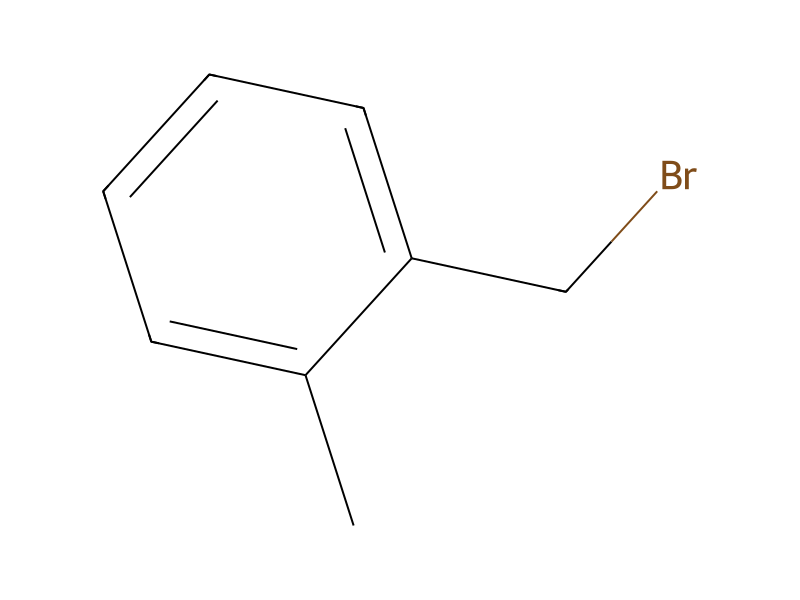
Grundinformationen
- Standard-SMILES
Cc1ccccc1CBr- InChIKey
WGVYCXYGPNNUQA-UHFFFAOYSA-N- Summenformel
- C8H9Br
- Durchschnittliche Molmasse
- 185,06 g/mol
- Monoisotopische Masse
- 183,98876239
Überblick
o-Xylyl bromide, also known as methylbenzyl bromide or T-stoff, is a poisonous organic chemical compound, formerly used as a tear gas. Physically it is a colourless liquid (melting point 21 °C) with a pleasant aromatic odour. o-Xylyl bromide is highly toxic, irritant and lachrymatory, and has been incorporated in chemical weapons since the early months of World War I. The first extensive use of xylyl bromide was the firing by German forces of 18,000 "T-shells" at Russian positions in the Battle of Bolimów in January 1915. In the absence of clarification, the name "xylyl bromide" may refer to any one of 3 xylyl isomers (o-Xylyl, p-Xylyl, m-Xylyl) or a mixture of all three.
Namen und Bezeichner
- Bevorzugter Name
- o-Xylyl bromide
- IUPAC
- 1-(bromomethyl)-2-methylbenzene
- Lokaler Name
- α-Brom-o-xylol
- Englischer Name
- 2-Methylbenzyl bromide
- Summenformel
- C8H9Br
- Molmasse
- 185.06
Namen und Synonyme
2-Methylbenzyl bromide89-92-91-(Bromomethyl)-2-methylbenzenealpha-Bromo-o-xyleneO-XYLYL BROMIDEo-Methylbenzyl bromide2-Xylyl bromide2-(Bromomethyl)tolueneBenzene, 1-(bromomethyl)-2-methyl-A-BROMO-O-XYLENEo-(Bromomethyl)toluene.alpha.-Bromo-o-xylene
Weitere Namen anzeigen
1-(bromomethyl)-2-methyl-benzenuorobenzyL2-xylylbromideà-bromo-o-xylene2-BROMO-O-XYLENEα-Bromo-o-xylene
o-Xylene, alpha-bromo-alpha-Bromo-ortho-xyleneNSC 60145HSDB 2192.alpha.-Bromo-ortho-xyleneEINECS 201-951-63NDQ4L309UNSC-60145
Datenbank-Bezeichner
- CAS
28777-60-8、89-92-9- PubChem CID
- 6992
- DTXSID
DTXSID00870422- UNII
- 3NDQ4L309U
- EC Number
- 201-951-6
- Nikkaji
- J4.311G
Eigenschaften
Berechnete Struktureigenschaften
- XLogP
- 3
- Polarare Oberfläche (TPSA)
- 0 Ų
- H-Brücken-Donoren
- 0
- H-Brücken-Akzeptoren
- 0
- Frei drehbare Bindungen
- 1
- Schwere Atome
- 9
- Formalladung
- 0
- Komplexität
- 80,6
Experimentelle und physikochemische Eigenschaften
Chemical ClassesOther Classes -> Halogenated Monoaromatics
SpringerMaterials PropertiesNuclear quadrupole resonance spectroscopy
Density1.381 g/cu cm at 23 °C
Color/FormPrisms
Solubility
Insoluble in water
Practically insol in water; sol in alcohol, ether
Soluble in acetone, benzene, organic solvents
Flash Point82 °C (180 °F) - closed cup
Boiling Point
217 °C
BP: 223-234 °C; 216-217 °C at 742 mm Hg; 102 °C at 15 mm Hg
DecompositionHazardous decomposition products formed under fire conditions. - Carbon oxides, Hydrogen bromide gas
Melting Point21 °C
Vapor Pressure0.15 [mmHg]
Refractive IndexIndex of refraction: 1.5730 at 27 °C/D
Physical DescriptionPrisms; [Merck Index] Colorless liquid with melting point of 18-20 deg C; [MSDSonline]
Physikochemische Eigenschaften
- Schmelzpunkt
- 16 · 16-20 °C(lit.)
- Siedepunkt
- 216 · 216-217 °C742 mm Hg(lit.)
- Dichte
- 1.381 g/mL · 1.381 g/mL at 25 °C(lit.)
- Brechungsindex
- 20 · n20/D 1.575(lit.)
- Flammpunkt
- 180 °F · 180 °F
- storage temp.
- 2 · 2-8°C
- Aggregatzustand
- clear liquid
- Farbe
- Colorless to Light yellow
- Wasserlöslichkeit
- practically insoluble
- Merck
- 14 · 14,10090
- BRN
- 636333 · 636333
- Henry's Law Constant
- 1.3 · 1.3×10-2 mol/(m3Pa) at 25℃, HSDB (2015)
- InChI
- 1S/C8H9Br/c1-7-4-2-3-5-8(7)6-9/h2-5H,6H2,1H3
- InChIKey
- WGVYCXYGPNNUQA-UHFFFAOYSA-N
- SMILES
- Cc1ccccc1CBr
- CAS Datenbank
- 89 · 89-92-9(CAS DataBase Reference)
- NIST chemische Informationen
- 1 · Benzene, 1-(bromomethyl)-2-methyl-(89-92-9)
Sicherheit und Regulatorisches
GHS-Klassifizierung
GHS Classification
Danger
H314 (100%): Causes severe skin burns and eye damage [Danger Skin corrosion/irritation]
P260, P264, P271, P280, P284, P301+P330+P331, P302+P361+P354, P304+P340, P305+P354+P338, P316, P320, P321, P363, P403+P233, P405, and P501 (click each P-code to see the statement)
Aggregated GHS information provided per 46 reports by companies from 5 notifications to the ECHA C&L Inventory. Each notification may be associated with multiple companies.
Gefahrenhinweise
Regulatory InformationBenzene, 1-(bromomethyl)-2-methyl-: Does not have an individual approval but may be used under an appropriate group standard
Fire PotentialSlight, when exposed to heat or flame.
Hazards SummaryPowerful lachrymator; [Merck Index] Toxic by inhalation and ingestion; A strong irritant; [Hawley] Toxic by inhalation; Causes burns; May cause pneumonitis and pulmonary edema after inhalation of high concentrations; [MSDSonline]
Hazard Classes and CategoriesSkin Corr. 1B (100%)
Shipment Methods and Regulations
No person may /transport,/ offer or accept a hazardous material for transportation in commerce unless that person is registered in conformance ... and the hazardous material is properly classed, described, packaged, marked, labeled, and in condition for shipment as required or authorized by ... /the hazardous materials regulations (49 CFR 171-177)./
The International Air Transport Association (IATA) Dangerous Goods Regulations are published by the IATA Dangerous Goods Board pursuant to IATA Resolutions 618 and 619 and constitute a manual of industry carrier regulations to be followed by all IATA Member airlines when transporting hazardous materials.
The International Maritime Dangerous Goods Code lays down basic principles for transporting hazardous chemicals. Detailed recommendations for individual substances and a number of recommendations for good practice are included in the classes dealing with such substances. A general index of technical names has also been compiled. This index should always be consulted when attempting to locate the appropriate procedures to be used when shipping any substance or article.
Shipping Name/ Number DOT/UN/NA/IMO
UN 1701; Xylyl bromide, liquid
UN 3417; Xylyl bromide, solid
IMO 6.1; Xylyl bromide, liquid; Xylyl bromide, solid
Hazardous Reactivities and IncompatibilitiesAlcohols, Bases, Amines, Oxidizing agents
Sicherheit und Schutzausrüstung
Fire Fighting Procedures
For small (incipient) fires, use media such as "alcohol" foam, dry chemical, or carbon dioxide. For large fires, apply water from as far as possible. Use very large quantities (flooding) of water applied as a mist or spray; solid streams of water may be ineffective. Cool all affected containers with flooding quantities of water.
Use water spray to cool unopened containers.
Wear self contained breathing apparatus for fire fighting if necessary.
If material on fire or involved in fire: Use water in flooding quantities as fog. Use "alcohol" foam, dry chemical or carbon dioxide. Cool all affected containers with flooding quantities of water. Use water spray to knock-down vapors. /Xylyl bromide, liquid; Xylyl bromide, solid/
Personnel protection: ... Wear positive pressure self-contained breathing apparatus when fighting fires involving this material. /Xylyl bromide, liquid; Xylyl bromide, solid/
Storage ConditionsKeep container tightly closed in a dry and well-ventilated place. Containers which are opened must be carefully resealed and kept upright to prevent leakage.
Cleanup Methods
Use personal protective equipment. Avoid breathing vapors, mist or gas. Ensure adequate ventilation. Remove all sources of ignition. Evacuate personnel to safe areas. Beware of vapors accumulating to form explosive concentrations. Vapors can accumulate in low areas.
Contain spillage, and then collect with an electrically protected vacuum cleaner or by wet-brushing and place in container for disposal according to local regulations. Keep in suitable, closed containers for disposal.
Prevent further leakage or spillage if safe to do so. Do not let product enter drains.
Disposal Methods
SRP: The most favorable course of action is to use an alternative chemical product with less inherent propensity for occupational harm/injury/toxicity or environmental contamination. Recycle any unused portion of the material for its approved use or return it to the manufacturer or supplier. Ultimate disposal of the chemical must consider: the material's impact on air quality; potential migration in soil or water; effects on animal and plant life; and conformance with environmental and public health regulations.
Contaminated packaging: Dispose of as unused product.
This combustible material may be burned in a chemical incinerator equipped with an afterburner and scrubber. Offer surplus and non-recyclable solutions to a licensed disposal company.
Preventive Measures
Handle in accordance with good industrial hygiene and safety practice. Wash hands before breaks and at the end of workday.
Avoid inhalation of vapor or mist. Keep away from sources of ignition - No smoking. Take measures to prevent the buildup of electrostatic charge.
In case of skin contact: Take off contaminated clothing and shoes immediately. Wash off with soap and plenty of water.
If material not on fire and not involved in fire: Keep sparks, flames, and other sources of ignition away. Keep material out of water sources and sewers. Use water spray to knock-down vapors. /Xylyl bromide, liquid; Xylyl bromide, solid/
Personnel protection: Avoid breathing vapors. Keep upwind. ... Avoid bodily contact with the material. ... Do not handle broken packages unless wearing appropriate personal protective equipment. Wash away any material which may have contacted the body with copious amounts of water or soap and water. ... If contact with the material anticipated, wear appropriate chemical protective clothing. /Xylyl bromide, liquid; Xylyl bromide, solid/
Personal Protective Equipment (PPE)
Wear protective gloves/ protective clothing/ eye protection/ face protection.
Complete suit protecting against chemicals.
Tightly fitting safety goggles. Faceshield (8-inch minimum). Use equipment for eye protection tested and approved under appropriate government standards such as NIOSH (US) or EN 166(EU).
Handle with gloves. Gloves must be inspected prior to use. Use proper glove removal technique (without touching glove's outer surface) to avoid skin contact with this product. Dispose of contaminated gloves after use in accordance with applicable laws and good laboratory practices. Wash and dry hands.
For more Personal Protective Equipment (PPE) (Complete) data for O-XYLYL BROMIDE (6 total), please visit the HSDB record page.
Toxikologische Informationen
Treatment
EYES: irrigate opened eyes for several minutes under running water. INGESTION: do not induce vomiting. Rinse mouth with water (never give anything by mouth to an unconscious person). Seek immediate medical advice. SKIN: should be treated immediately by rinsing the affected parts in cold running water for at least 15 minutes, followed by thorough washing with soap and water. If necessary, the person should shower and change contaminated clothing and shoes, and then must seek medical attention. INHALATION: supply fresh air. If required provide artificial respiration.
Health EffectsStrong lachrymator. Strong irritant to eyes, skin and soft tissues. Highly toxic if inhaled, swallowed or absorbed through skin
Environmental Fate
TERRESTRIAL FATE: Based on a classification scheme(1), an estimated Koc value of 730(SRC), determined from a structure estimation method(2), indicates that o-xylyl bromide is expected to have low mobility in soil(SRC). Volatilization of o-xylyl bromide from moist soil surfaces is expected to be an important fate process(SRC) given an estimated Henry's Law constant of 7.6X10⁻⁵ atm-cu m/mole(SRC), using a fragment constant estimation method(3). o-Xylyl bromide is expected to volatilize from dry soil surfaces(SRC) based upon an estimated vapor pressure of 0.15 mm Hg at 25 °C(SRC), determined from a fragment constant method(2). However, due to a reported hydrolysis half-life of 3.4 hours at 20 °C for o-xylyl bromide(4) adsorption, volatilization, and biodegradation are not expected to be important environmental fate processes in moist soil(SRC).
AQUATIC FATE: Based on a classification scheme(1), an estimated Koc value of 730(SRC), determined from a structure estimation method(2), indicates that o-xylyl bromide is expected to adsorb to suspended solids and sediment(SRC). Volatilization from water surfaces is expected(3) based upon an estimated Henry's Law constant of 7.6X10⁻⁴ atm-cu m/mole(SRC), developed using a fragment constant estimation method(4). Using this Henry's Law constant and an estimation method(3), volatilization half-lives for a model river and model lake are 6 hrs and 6 days, respectively(SRC). According to a classification scheme(5), an estimated BCF of 85(SRC), from an estimated log Kow of 3.43(2) and a regression-derived equation(2), suggests the potential for bioconcentration in aquatic organisms is moderate(SRC). However, due to a reported hydrolysis half-life of 3.4 hours at 20 °C for o-xylyl bromide(6) adsorption, volatilization, bioconcentration, and biodegradation are not expected to be important environmental fate processes in water(SRC).
ATMOSPHERIC FATE: According to a model of gas/particle partitioning of semivolatile organic compounds in the atmosphere(1), o-xylyl bromide, which has an estimated vapor pressure of 0.15 mm Hg at 25 °C(SRC), determined from a fragment constant method(2), is expected to exist solely as a vapor in the ambient atmosphere. Vapor-phase o-xylyl bromide is degraded in the atmosphere by reaction with photochemically-produced hydroxyl radicals(SRC); the half-life for this reaction in air is estimated to be 4.3 days(SRC), calculated from its rate constant of 3.7X10⁻¹² cu cm/molecule-sec at 25 °C(SRC) that was derived using a structure estimation method(2). o-Xylyl bromide does not contain chromophores that absorb at wavelengths >290 nm(4) and, therefore, is not expected to be susceptible to direct photolysis by sunlight(SRC).
Adverse EffectsDermatotoxin - Skin burns.
Exposure RoutesOral (L626) ; inhalation (L626) ; dermal (L626)
Toxicity Summary
Organobromide compounds such as o-Xylyl bromide are strong alkylating agents. Consequently they can readily modify free thiols (cysteines) and methionine residues of the surfaces of proteins leading to the disruption of enzyme, transporter or membrane functions. One of the most probable protein targets is the TRPA1 ion channel that is expressed in sensory nerves (trigeminal nerve) of the eyes, nose, mouth and lungs.
Signs and SymptomsCauses severe eye and skin burns. Irritating to eyes, skin, and respiratory system. Acute exposure (ingestion or inhalation) can lead to coma, nausea, vomiting, and metabolic acidosis may occur.
Soil Adsorption/Mobility
Using a structure estimation method based on molecular connectivity indices(1), the Koc of o-xylyl bromide can be estimated to be 730(SRC). According to a classification scheme(2), this estimated Koc value suggests that o-xylyl bromide is expected to have moderate mobility in soil. However, due to a reported hydrolysis half-life of 3.4 hours at 20 °C for o-xylyl bromide(3) adsorption is not expected to be important environmental fate processes in moist soil(SRC).
Human Toxicity Excerpts
/OTHER TOXICITY INFORMATION/ Powerful lacrimator.
/OTHER TOXICITY INFORMATION/ ... Strongly lacrimatory. /Xylyl bromides/
Artificial Pollution Sources
o-Xylyl bromide's production and presense in a mixture with the p- and m-isomers in organic synthesis(1) may result in its release to the environment through various waste streams. Its use in mixture with p- and m-isomers as a tear gas will result in its direct release to the environment(SRC).
Carcinogen ClassificationNo indication of carcinogenicity (not listed by IARC). (L135)
Environmental Bioconcentration
An estimated BCF of 85 was calculated in fish for o-xylyl bromide(SRC), using an estimated log Kow of 3.43(1) and a regression-derived equation(1). According to a classification scheme(2), this BCF suggests the potential for bioconcentration in aquatic organisms is moderate(SRC). However, due to a reported hydrolysis half-life of 3.4 hours at 20 °C for o-xylyl bromide(3) bioconcentration is not expected to be important environmental fate processes in water(SRC).
Sicherheitsdaten
- F
- 19
- wgk
- 3
- ridadr
- UN 1701 6.1/PG 2
- hs_code
- 29036990
- RTECS-Nr.
- CY9039100
- risk_code
- 36/37/38-34-20/21/22
- hazard_code
- C
- safety_code
- 26-36/37/39-45
- hazard_class
- 6.1
- packing_group
- II
- Speicherklasse
- 6.1A - Combustible acute toxic Cat. 1 and 2very toxic hazardous materials
- Giftige Stoffe Daten
- 89-92-9(Hazardous Substances Data)
- Hazard Classifications
- Skin Corr. 1B
Chemie und Industrie
Pharmakologische Informationen
Metabolism/Metabolites
Bromine is mainly absorbed via inhalation, but may also enter the body through dermal contact. Bromine salts can be ingested. Due to its reactivity, bromine quickly forms bromide and may be deposited in the tissues, displacing other halogens. (L626)
Verwendung und Herstellung
Uses
Used in organic synthesis and as a military tear gas; [Merck Index]
In war-gas formulations
Organic synthesis, tear gas. /Mixture of ortho-, meta-, and para-isomers/
A poison. /Xylyl Bromide/
Occupational exposure to xylyl bromide may occur through inhalation and dermal contact with this compound at workplaces where xylyl bromide is produced or used.
Methods of ManufacturingBromination of xylene. /Mixture of ortho-, meta-, and para-isomers/
Formulations/PreparationsGrade: technical. /Mixture of ortho-, meta-, and para-isomers/
Vor- und nachgelagerte Produkte
Nachgelagerte Produkte
Anbieter50 Anbieter
国药集团化学试剂有限公司86-21-63210123 · [email protected]
梯希爱(上海)化成工业发展有限公司021-67121386 · [email protected]
Hebei Chuanghai Biotechnology Co., Ltd+86-17732866630 · [email protected]
杭州品高化工有限公司0571-87658025 · [email protected]
爱斯特(成都)生物制药股份有限公司+86-28-85122536 85324413 · [email protected]
Dayang Chem (Hangzhou) Co.,Ltd.+86-0571-88938639 17705817739 · [email protected]
Syntechem Co.,Ltd[email protected]
上海迈瑞尔生化科技有限公司4006356688 18621169109 · [email protected]
阿法埃莎(中国)化学有限公司400-6106006 · [email protected]
上海瀚鸿科技股份有限公司021-54306202 13764082696 · [email protected]
Protheragen-ING+86-15618352007 · [email protected]
嘉兴市艾森化工有限公司0573-85285100 18627885956 · [email protected]
上海泰坦科技股份有限公司400-6009262 15618770481 · [email protected]
石家庄欧特佳化工有限公司0311-87795622 · [email protected]
上海隆盛化工有限公司58099637 13585536065 · [email protected]
武汉市皇臻生物化工有限公司13795480948 · [email protected]
山东西亚化学有限公司13355009207 13355009207 · [email protected]
玛雅试剂+86 (573) 82222445 (0)18006601000 452520369 · [email protected]
天津希恩思生化科技有限公司400 638 7771 · [email protected]
苏州思变化学技术有限公司0512-65617459 18915409046 · [email protected]
赛默飞世尔科技(中国)有限公司800-810-5118 · [email protected]
北京伊诺凯科技有限公司400-810-7969 010-59572699 · [email protected]
TCI AMERICA800-4238616 · [email protected]
TOKYO CHEMICAL INDUSTRY CO., LTD.03-36680489 · [email protected]
TCI Europe320-37350700 · [email protected]
卡迪亚医药科技有限公司0371-86615086 18203638366 0371-86159066 13526786601
上海贤鼎生物科技有限公司4009209199 · [email protected]
上海睿升化工科技有限公司+86-021-50935922
北京京土恒盛化工科技有限公司00-13911456598 13911456598 · [email protected]
PT CHEM GROUP LIMITED+86-85511178; +86-85511178 · [email protected]
上海鑫圭生物科技有限公司15121041756 · [email protected]
上海麦克林生化科技股份有限公司15221275939 15221275939 · [email protected]
上海嵩爰化工科技有限公司010-1234567 18521000990 · [email protected]
Changzhou Fullone Chemical Co., Ltd.+86-13328197671 +86-13861172460 · [email protected]
Sigma-Aldrich西格玛奥德里奇(上海)贸易有限公司021-61415566 800-8193336 · [email protected]
AN PharmaTech Co Ltd86(21)68097365 · [email protected]
厦门志信化学有限公司+86-5922680277 +86-13806087780 · [email protected]
广东翁江化学试剂有限公司0751-2886766 13927870850 · [email protected]
嘉兴市德亿化工有限公司0573-85866609 13325730825 · [email protected]
上海玻尔化学试剂有限公司19102157732 · [email protected]
R&D Scientific Inc.+1-2266000236 · [email protected]
上海阿拉丁生化科技股份有限公司6206333 13167063860 · [email protected]
陕西缔都医药化工有限公司+86-29-81139210 +86-17392587031 · [email protected]
上海源叶生物科技有限公司13636370518 · [email protected]
山东西亚化学有限公司4009903999 13395398332 · [email protected]
上海煜柯化学品有限公司13391486464 · [email protected]
杭州摩库生物医药科技有限公司400-711-5280 86-571-81025280 · [email protected]
陕西缔都医药化工有限公司029-81154043 17391733319 · [email protected]
Shanghai Acmec Biochemical Technology Co., Ltd.+86-18621343501 · [email protected]
江苏艾康生物医药研发有限公司025-58859352 19370895928 · [email protected]
Zugehörige Reaktionen
145



Verknüpfte Notizen
Wird geladen…