
1,2-Benzoldicarbonitril
Phthalonitrile
Daten werden ergänzt – lade die Seite später neu, um den aktuellen Stand zu sehen
Grundinformationen
- CAS
91-15-6- Standard-SMILES
N#Cc1ccccc1C#N- InChIKey
XQZYPMVTSDWCCE-UHFFFAOYSA-N- Summenformel
- C8H4N2
- Durchschnittliche Molmasse
- 128,13 g/mol
- Monoisotopische Masse
- 128,03744813
Überblick
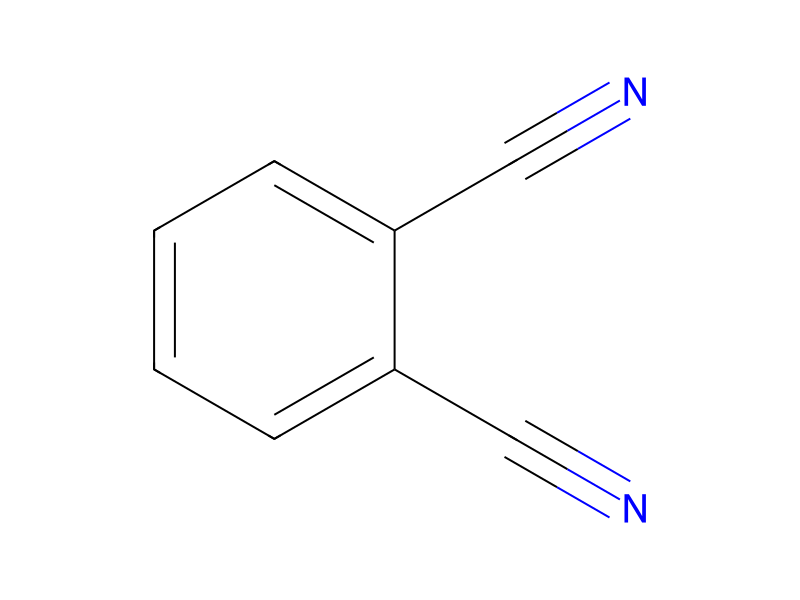
Phthalonitrile is a dinitrile that is benzene which is substituted by cyano groups at positions 1 and 2. It is a member of benzenes and a dinitrile.
Namen und Bezeichner
- Bevorzugter Name
- Phthalonitrile
- IUPAC
- benzene-1,2-dicarbonitrile
- Lokaler Name
- 1,2-Benzoldicarbonitril
- Englischer Name
- Phthalonitrile
- Summenformel
- C8H4N2
- Molmasse
- 128.13
Namen und Synonyme
Phthalonitrile1,2-Dicyanobenzene91-15-61,2-BENZENEDICARBONITRILEo-Phthalodinitrilebenzene-1,2-dicarbonitrileo-Dicyanobenzeneo-Cyanobenzonitrileo-Benzenedinitrileo-Pdno-BenzenedicarbonitrilePhthalic acid dinitrile
Weitere Namen anzeigen
PhthalodinitrilPHTHALODINITRILEO-PHTHALONITRILEC8H4N2o-pdn[qr]usafnd-09
USAF ND-09FtalodinitrilFtalonitril1,2-Benzendikarbonitrilortho-DicyanobenzeneDTXSID8029604978627YAJUNSC-17562
Datenbank-Bezeichner
- CAS
91-15-6- PubChem CID
- 7042
- DTXSID
DTXSID8029604- ChEMBL
CHEMBL3185350- ChEBI
CHEBI:232056- UNII
- 978627YAJU
- EC Number
- 202-044-8
- Nikkaji
- J3.921G
Eigenschaften
Berechnete StruktureigenschaftenWird ergänzt
- XLogP
- 1
- Polarare Oberfläche (TPSA)
- 47,6 Ų
- H-Brücken-Donoren
- 0
- H-Brücken-Akzeptoren
- 2
- Frei drehbare Bindungen
- 0
- Schwere Atome
- 10
- Formalladung
- 0
- Komplexität
- 178
Experimentelle und physikochemische Eigenschaften
Chemical ClassesNitrogen Compounds -> Nitriles
SpringerMaterials PropertiesSchoenflies notation
LogP
log Kow = 0.99
0.58
0.99
OdorSlightly aromatic
Density
1.238 g/cu cm
1.24 g/cm³
Color/Form
NEEDLES FROM WATER OR PETROLEUM ETHER
Buff-colored crystals
Faint grayish yellow
Solubility
Soluble in alcohol and ether
Soluble in acetone and benzene.
In water, 395 mg/l @ 25 °C.
Solubility in water, g/100ml at 25 °C: 0.06
Flash Point
162 °C
162 °C
Boiling Point
Sicherheit und Regulatorisches
Sicherheitsangaben dienen nur zur Orientierung und ersetzen weder das Sicherheitsdatenblatt (SDB) des Lieferanten noch geltende Vorschriften oder eine fachliche Bewertung.
GHS-Klassifizierung
GHS Classification
Danger
H300 (28.4%): Fatal if swallowed [Danger Acute toxicity, oral]
P261, P262, P264, P270, P271, P273, P280, P301+P316, P302+P352, P304+P340, P316, P321, P330, P361+P364, P403+P233, P405, and P501 (click each P-code to see the statement)
Aggregated GHS information provided per 162 reports by companies from 11 notifications to the ECHA C&L Inventory. Each notification may be associated with multiple companies.
Danger
H301: Toxic if swallowed [Danger Acute toxicity, oral]
Gefahrenhinweise
Regulatory Information
Status: Active Update: 31-01-2022 https://echa.europa.eu/registration-dossier/-/registered-dossier/1983
Phthalonitrile: Does not have an individual approval but may be used under an appropriate group standard
Fire HazardsCombustible. Gives off irritating or toxic fumes (or gases) in a fire. Finely dispersed particles form explosive mixtures in air.
Hazards Summary
Inhalation of high concentrations may cause CNS effects; [ICSC] Emergency treatment: Benzyl cyanide; [HSDB] Lethal doses cause tremor and convulsions in rats; [RTECS] TLV Basis = convulsions and decreased body weight; Unlike the aliphatic nitriles, aromatic nitriles such as m-phthalodinitrile do not liberate cyanide in the body. [ACGIH] An acute neurotoxin; Not irritating to skin or eyes; [Reference #1] See m-Phthalodinitrile. See NITRILES.
UN ClassificationUN Hazard Class: 6.1; UN Pack Group: III
Chemical DangersDecomposes on heating. This produces toxic fumes including cyanide. On combustion, forms nitrogen oxides. Reacts with strong oxidants.
Chemie und Industrie
Pharmakologische Informationen
Mechanism of Action... systemic cyanide poisoning is suspected.
Metabolism/Metabolites
Organic nitriles are converted into cyanide ions through the action of cytochrome P450 enzymes in the liver. Cyanide is rapidly absorbed and distributed throughout the body. Cyanide is mainly metabolized into thiocyanate by either rhodanese or 3-mercaptopyruvate sulfur transferase. Cyanide metabolites are excreted in the urine. (L96)
Verwendung und Herstellung
Uses
Used as an intermediate mainly for the production of phthalocyanine dyes; Also used in sintering metals; [ACGIH]
Metal Extraction and Refining [Category: Industry]
Intermediate in organic synthesis, (esp pigments and dyes), base material for high temp lubricants and coatings
Insecticide, synergist /Former/
Used as a starting material for producing phthalocyanine pigments, fluorescent brighteners and photographic sensitizers.
Phthalonitrile is used as a precursor to phthalocyanine pigments (which are precursors to the blue dye in jeans), fluorescent brighteners, and photographic sensitizers. (L611)
Methods of Manufacturing
Vapor phase reaction of ammonia and phthalic anhydride over alumina catalyst @ high temp.
Produced commercially from o-xylene by ammoxidation; produced commercially from phthalic acid, phthalic anhydride, phthalamide or phthalimide by reaction with ammonia and elimination of water @ 300-500 °C in gas-phase with catalyst.
General Manufacturing Information
1,2-Benzenedicarbonitrile: ACTIVE
HIGHLY TOXIC STOMACH POISON FOR CATERPILLARS & DIPTEROUS LARVAE.
Anwendungen
Zugehörige Reaktionen
108


Notizen zur Verbindung
Wird geladen…