
Butyl-4,4-bis(tert-butyldioxy)valerat
Pentanoic acid, 4,4-bis((1,1-dimethylethyl)dioxy)-, butyl ester
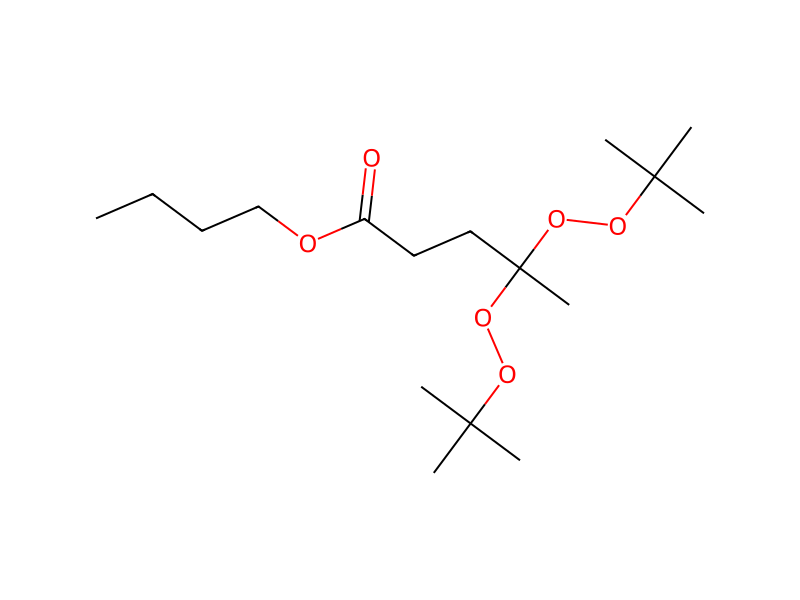
Grundinformationen
- CAS
995-33-5- Standard-SMILES
CCCCOC(=O)CCC(C)(OOC(C)(C)C)OOC(C)(C)C- InChIKey
BXIQXYOPGBXIEM-UHFFFAOYSA-N- Summenformel
- C17H34O6
- Durchschnittliche Molmasse
- 334,4 g/mol
- Monoisotopische Masse
- 334,2355388
Überblick
This solid peroxide is sensitive to heat. Storage of this material must be done so with stringent temperature control measures. Its explosion hazard is also mitigated by mixing the peroxide with an inert solid.
Namen und Bezeichner
- Bevorzugter Name
- Pentanoic acid, 4,4-bis((1,1-dimethylethyl)dioxy)-, butyl ester
- IUPAC
- butyl 4,4-bis(tert-butylperoxy)pentanoate
- Lokaler Name
- Butyl-4,4-bis(tert-butyldioxy)valerat
- Englischer Name
- Butyl 4,4-bis(tert-butyldioxy)valerate
- Summenformel
- C17H34O6
- Molmasse
- 334.45
Namen und Synonyme
Butyl 4,4-bis(tert-butyldioxy)valerate995-33-5EINECS 213-626-6Pentanoic acid, 4,4-bis((1,1-dimethylethyl)dioxy)-, butyl esterPentanoic acid, 4,4-bis[(1,1-dimethylethyl)dioxy]-, butyl esterRefChem:859977213-626-6butyl 4,4-bis(tert-butylperoxy)pentanoateButyl 4,4-di(tert-butylperoxy)valerateButyl 4,4'-bis(tert-butylperoxy)valerate (Technical Grade)varox dcp-40kevarox dcp-40c
Weitere Namen anzeigen
rigonox 17Trigonox 17Perhexa V 40Luperox 230XLTrigonox 17/40butyl 4,4-di(butylperoxy)valerate
varox 230-xlvarox 118Butyl 4,4-bis(tert-butylperoxy)pentanoate; Butyl 4,4-bis(tert-butylperoxy)valerate;Butyl 4,4-di-tert-butylperoxyvalerate; Butyl 4,4'-bis(tert-butylperoxy)valerate;n-butyl 4,4-bis(t-butylperoxy) valerateSCHEMBL44038DTXSID10613664,4-bis[(1,1-dimethylethyl)dioxy]-pentanoicacibutylesterbutyl-4,4-bis(tert.-butyl peroxy)valerate
Eigenschaften
Berechnete Struktureigenschaften
- XLogP
- 3,8
- Polarare Oberfläche (TPSA)
- 63,2 Ų
- H-Brücken-Donoren
- 0
- H-Brücken-Akzeptoren
- 6
- Frei drehbare Bindungen
- 13
- Schwere Atome
- 23
- Formalladung
- 0
- Komplexität
- 322
Experimentelle und physikochemische Eigenschaften
Physical Description
This solid peroxide is sensitive to heat. Storage of this material must be done so with stringent temperature control measures. Its explosion hazard is also mitigated by mixing the peroxide with an inert solid.
This solid peroxide is sensitive to heat. Storage of this material must be done so with stringent temperature control measures. Its explosion hazard is also mitigated by mixing the peroxide with an inert solid.
Dry Powder; CBI
Physikochemische Eigenschaften
- Siedepunkt
- 363.9 · 363.9±37.0 °C(Predicted)
- Dichte
- 0.9669 g/cm3 · 0.9669 g/cm3
- Dampfdruck
- 0.053 Pa · 0.053Pa at 25℃
- Löslichkeit
- Chloroform (Slightly), DMSO (Slightly), Ethyl Acetate (Slightly)
- Aggregatzustand
- Oil
- Farbe
- Colourless
- Wasserlöslichkeit
- 2.16 mg/L · 2.16mg/L at 20.2℃
- Stabilität
- Possibly Shock Sensitive
Sicherheit und Regulatorisches
Sicherheitsangaben dienen nur zur Orientierung und ersetzen weder das Sicherheitsdatenblatt (SDB) des Lieferanten noch geltende Vorschriften oder eine fachliche Bewertung.
GHS-Klassifizierung
GHS Classification
Danger
H242 (100%): Heating may cause a fire [Danger Self-reactive substances and mixtures; Organic peroxides]
P210, P234, P235, P240, P273, P280, P370+P378, P391, P403, P410, P411, P420, and P501 (click each P-code to see the statement)
Aggregated GHS information provided per 22 reports by companies from 4 notifications to the ECHA C&L Inventory. Each notification may be associated with multiple companies.
Gefahrenhinweise
Regulatory Information
Chemical: Pentanoic acid, 4,4-bis[(1,1-dimethylethyl)dioxy]-, butyl ester
Pentanoic acid, 4,4-bis[(1,1-dimethylethyl)dioxy]-, butyl ester is listed on the EPA's Chemical Data Reporting (CDR) system. Manufacturers and importers of Pentanoic acid, 4,4-bis[(1,1-dimethylethyl)dioxy]-, butyl ester are required to report information about their production and use of this chemical to the EPA under the Toxic Substances Control Act (TSCA). (40 eCFR Part 711)
REACH registered substance: Butyl 4,4-bis(tert-butyldioxy)valerate (EC: 213-626-6)
Butyl 4,4-bis(tert-butyldioxy)valerate: Does not have an individual approval but may be used as a component in a product covered by a group standard. It is not approved for use as a chemical in its own right.
DOT LabelOrganic Peroxide
Fire HazardsExcerpt from ERG Guide 146 [Organic Peroxides (Heat, Contamination and Friction Sensitive)]:
Health HazardsExcerpt from ERG Guide 146 [Organic Peroxides (Heat, Contamination and Friction Sensitive)]:
Reactive Group
Peroxides, Organic
Peroxides, Organic
Chemie und Industrie
Verwendung und Herstellung
U.S. Production2023: <75,000 lb
Consumer UsesNot Known or Reasonably Ascertainable
Industry UsesCBI
General Manufacturing Information
Rubber Product Manufacturing
Pentanoic acid, 4,4-bis[(1,1-dimethylethyl)dioxy]-, butyl ester: ACTIVE
Zugehörige Reaktionen
1
Notizen zur Verbindung
Wird geladen…