
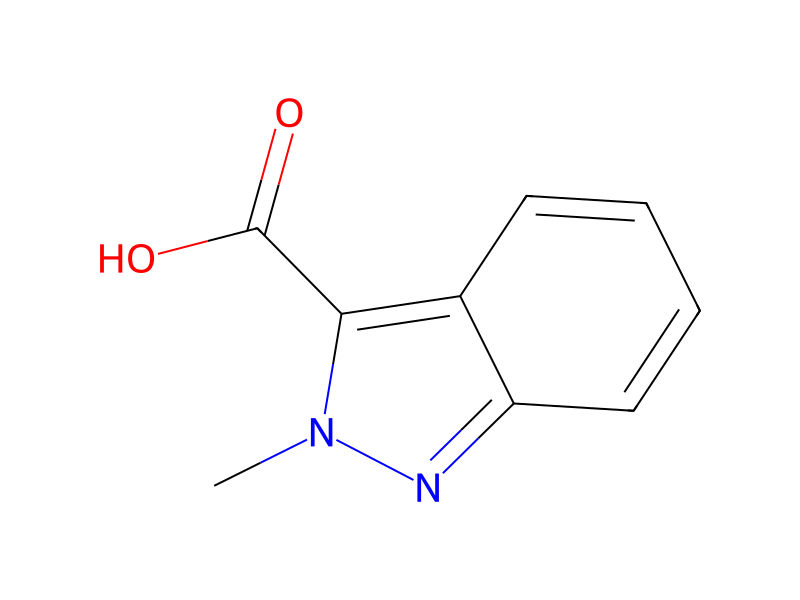
Grundinformationen
- Standard-SMILES
Cn1nc2ccccc2c1C(=O)O- InChIKey
ABRISPFTOZIXMP-UHFFFAOYSA-N- Summenformel
- C9H8N2O2
- Durchschnittliche Molmasse
- 176,17 g/mol
- Monoisotopische Masse
- 176,0585775
Namen und Bezeichner
- Bevorzugter Name
- 2-Methyl-2H-indazole-3-carboxylic acid
- IUPAC
- 2-methylindazole-3-carboxylic acid
- Englischer Name
- GRANISETRON-D3
- Summenformel
- C9H8N2O2
- Molmasse
- 176.17
Namen und Synonyme
2-Methyl-2H-indazole-3-carboxylic acid34252-44-3DTXSID30427620RefChem:263185DTXCID60378454691-338-32-methylindazole-3-carboxylic AcidGranisetron EP Impurity GMFCD073685562H-Indazole-3-carboxylic acid, 2-methyl-Granisetron Hydrochloride Imp. G (EP); Granisetron Imp. G (EP); 2-Methyl-2H-indazole-3-carboxylic Acid; Granisetron Hydrochloride Impurity G; Granisetron Impurity G2-METHYL-2H-INDAZOLE-3-CARBOXYLICACID
Weitere Namen anzeigen
Granisetron ImpurityCl3-Carboxy-2-methyl-2H-indazole2-Methylindazole-3-carboxylicAci2-Methyl-2H-indazole-3-carboxylic AGranisetron Hydrochloride Impurity G2H-Indazole-3-carboxylic acid,2-methyl-Granisetron Hydrochloride EP Impurity G
Granisetron Imp. G (EP)7F74Q4NXW7orb2695754SCHEMBL1563562ABRISPFTOZIXMP-UHFFFAOYSA-NFr21265SBB089157AKOS006346248
Datenbank-Bezeichner
- CAS
34252-44-3- PubChem CID
- 7060537
- DTXSID
DTXSID30427620- UNII
- 7F74Q4NXW7
- EC Number
- 691-338-3
Eigenschaften
Berechnete Struktureigenschaften
- XLogP
- 1,4
- Polarare Oberfläche (TPSA)
- 55,1 Ų
- H-Brücken-Donoren
- 1
- H-Brücken-Akzeptoren
- 3
- Frei drehbare Bindungen
- 1
- Schwere Atome
- 13
- Formalladung
- 0
- Komplexität
- 220
Physikochemische Eigenschaften
- Schmelzpunkt
- 217 · 217-219
- Siedepunkt
- 417.4 · 417.4±18.0 °C(Predicted)
- Dichte
- 1.35 · 1.35
- storage temp.
- Sealed in dry,Room Temperature
- Löslichkeit
- DMSO (Slightly), Methanol (Slightly)
- Aggregatzustand
- Solid
- pka
- 3.02 · 3.02±0.10(Predicted)
- Farbe
- White to Off-White
Sicherheit und Regulatorisches
GHS-Klassifizierung
GHS Classification
Danger
H301+H311+H331 (33.3%): Toxic if swallowed, in contact with skin or if inhaled [Danger Acute toxicity, oral; acute toxicity, dermal; acute toxicity, inhalation]
P261, P262, P264, P264+P265, P270, P271, P280, P301+P316, P301+P317, P302+P352, P304+P340, P305+P351+P338, P316, P319, P321, P330, P332+P317, P337+P317, P361+P364, P362+P364, P403+P233, P405, and P501 (click each P-code to see the statement)
Aggregated GHS information provided per 3 reports by companies from 3 notifications to the ECHA C&L Inventory. Each notification may be associated with multiple companies.
Gefahrenhinweise
Hazard Classes and CategoriesAcute Tox. 3 (33.3%)
Sicherheitsdaten
- ridadr
- 2811
- hs_code
- 29339900
- risk_code
- 22-36-36/37/38-20/21/22
- hazard_code
- Xn
- hazard_note
- Harmful
- safety_code
- 26-36/37/39-22
Chemie und Industrie
Anwendungen
Verwenden2-Methyl-2H-indazole-3-carboxylic acid can be used as a reagent used to synthesize 5-HT2A and 5-HT3 receptor ligands for use in treating CNS-related disorders.
Vor- und nachgelagerte Produkte
Vorgelagerte Rohstoffe
Anbieter50 Anbieter
上海凌富药物研究有限公司+86(21)5895 0110 19945755304 · [email protected]
上海策嵘生物科技有限公司[email protected]
济南百隆化学有限公司[email protected] · [email protected]
艾吉析科技(上海)有限公司17717235263 · [email protected]
广州隽沐生物科技股份有限公司020-36607679; 13502246435 · [email protected]
广州佳途科技股份有限公司81960175 18933936954 · [email protected]
杭州品高化工有限公司0571-87658025 · [email protected]
南京望知星医药科技有限公司18569809817 · [email protected]
Dayang Chem (Hangzhou) Co.,Ltd.+86-0571-88938639 17705817739 · [email protected]
广州隽唐科技有限公司020-36607679 13502246435 · [email protected]
上海海皋科技有限公司021-57646680 18306277365 · [email protected]
Aladdin Scientific[email protected]
Sinco Pharmachem (ShenZhen) R&D Co., Ltd.+86-18603013401 · [email protected]
毕佳索(上海毕得医药科技股份有限公司)400-6005915 · [email protected]
北京索莱宝科技有限公司010-50973130 17801761073 · [email protected]
安耐吉化学&3A(安徽泽升科技有限公司)021-58432009 400-005-6266 · [email protected]
孟成科技(上海)有限公司400-820-6829 · [email protected]
常州科化生物科技有限公司0519-68985668 13685222090 · [email protected]
上海瀚鸿科技股份有限公司021-54306202 13764082696 · [email protected]
上海泰坦科技股份有限公司400-6009262 15618770481 · [email protected]
北京零式京安科技有限责任公司10-61256048 13810278579 · [email protected]
湖北广奥生物科技有限公司027-02702759223056 18162699093 · [email protected]
杭州东帆化学有限公司86-0571-85151182
Moxin Chemicals+86-17320513646 +86-17320513646 · [email protected]
苏州启航生物科技有限公司18151111370
杭州云易国科生物科技有限公司18457506494 · [email protected]
武汉泰凯塞科技有限公司027-86697669 13986148687 · [email protected]
赛默飞世尔科技(中国)有限公司800-810-5118 · [email protected]
上海遐瑞医药科技有限公司+86 21 61551611
深圳振强药物研发有限公司0755-66853366 13670046396 · [email protected]
河南赢创生物科技有限公司15672878902 · [email protected]
KARMEL TECHNOLOGY (HK) CO.,LIMITED+8618795957998 · [email protected]
PT CHEM GROUP LIMITED+86-85511178; +86-85511178 · [email protected]
上海毕得医药科技股份有限公司400-164-7117 18317119277 · [email protected]
杭州杰恒化工有限公司0571-87396432 · [email protected]
上海寰川实业有限公司021-61478794 · [email protected]
常州翔龙医药科技有限公司18915873328 18915873328 · [email protected]
深圳摩科生化科技有限公司18627923403 · [email protected]
凯试(上海)科技有限公司021-50135380 · [email protected]
南京熙泽医药科技有限公司025-66023220 15250997978 · [email protected]
珠海安哲生物科技有限公司13169972583 · [email protected]
九鼎化学(上海)科技有限公司4009209199 · [email protected]
Henan Alfa Chemical Co., Ltd+8618339805032 · [email protected]
北京建强伟业科技有限公司(FUSION弗珍试剂品牌)0531-88924771 15614660963 · [email protected]
深圳卓越生物医药科技有限公司0755-26050679 18318671572 · [email protected]
河南誉康卓宁进出口有限公司13393721940 · [email protected]
Standardpharm Co. Ltd.86-714-3992388 · [email protected]
艾吉析科技(上海)有限公司17721401538;17717235263 17721401538 · [email protected]
嘉兴市浙嘉生物科技有限公司0573-85609002 · [email protected]
上海源叶生物科技有限公司13636370518 · [email protected]
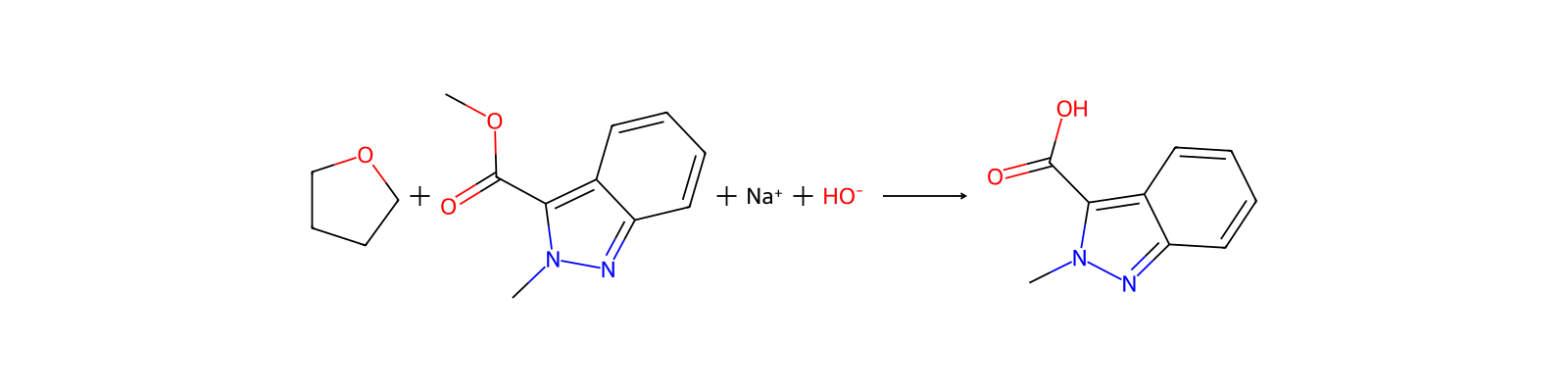
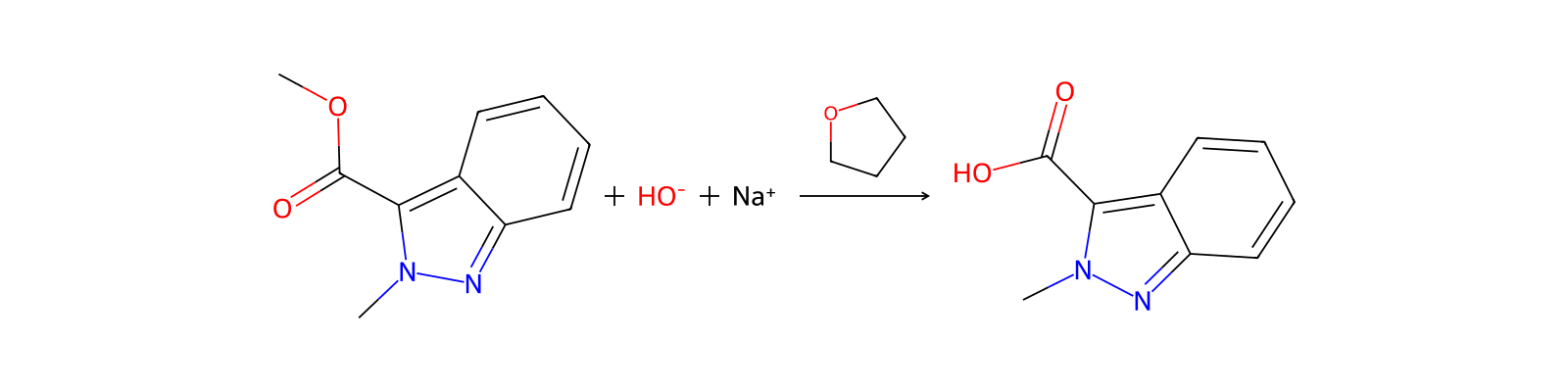
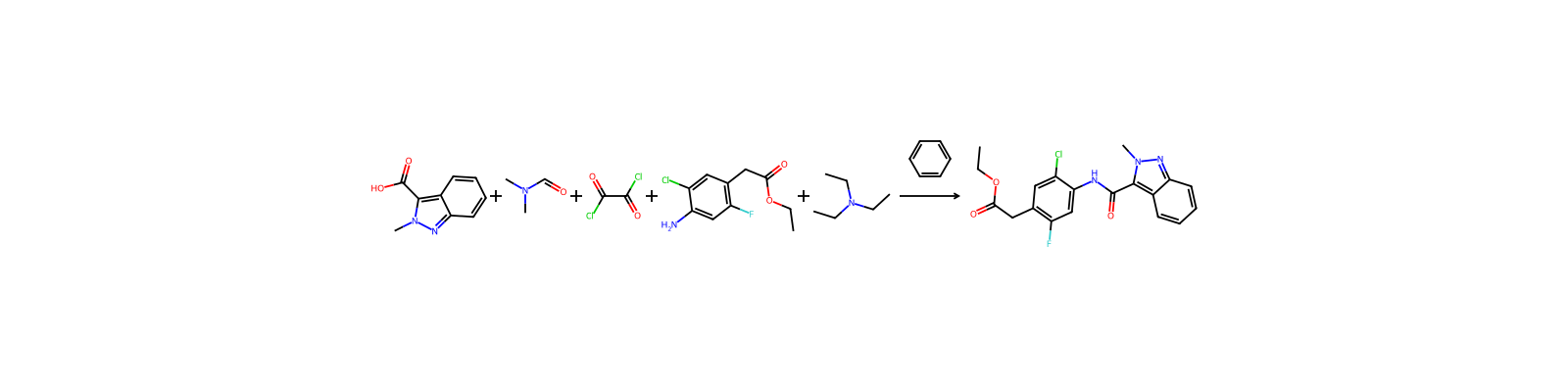
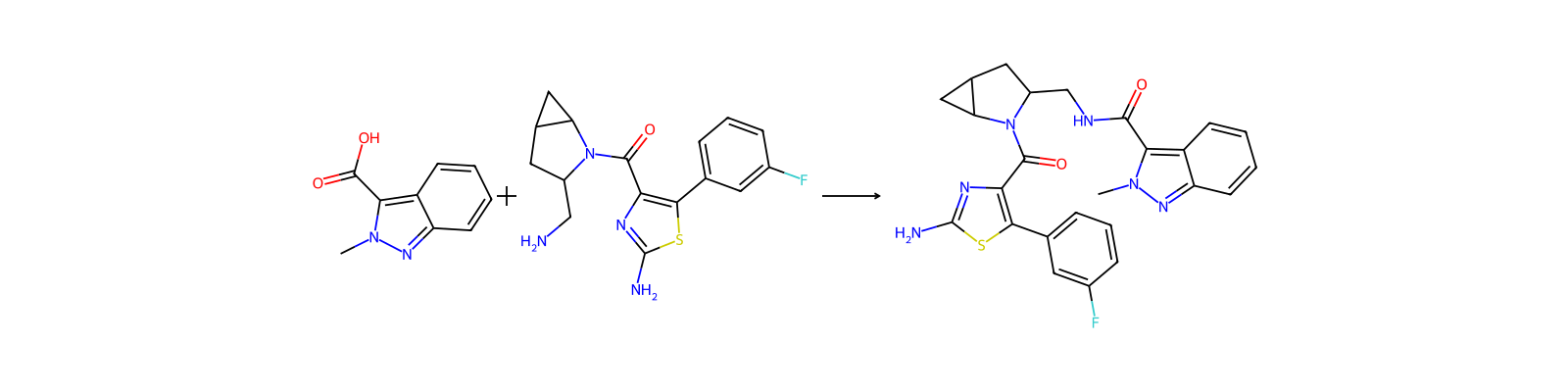
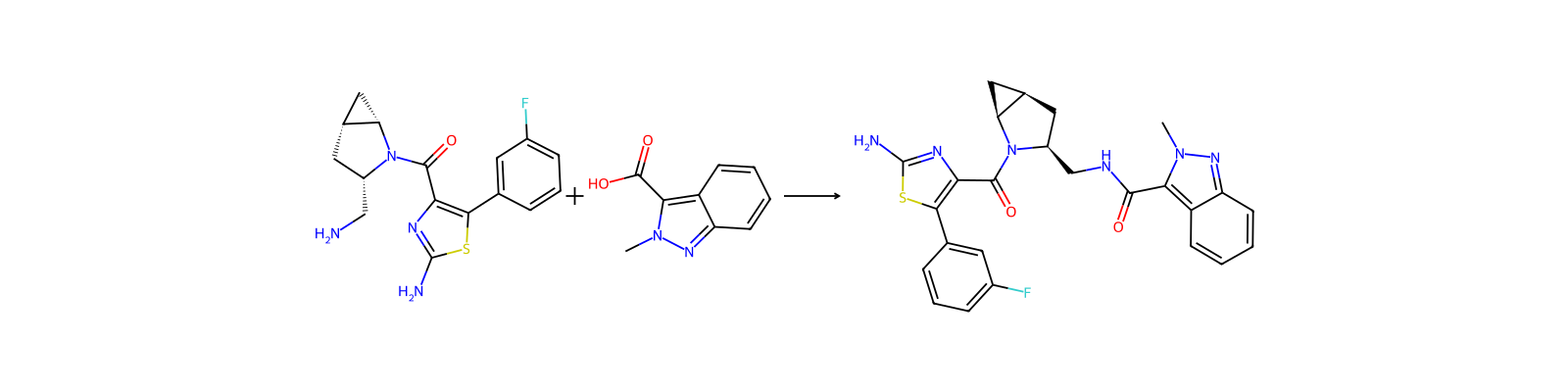
Zugehörige Reaktionen
6
Verknüpfte Notizen
Wird geladen…