
Dicyclopropylketon
Dicyclopropyl ketone

Grundinformationen
- CAS
1121-37-5- Standard-SMILES
O=C(C1CC1)C1CC1- InChIKey
BIPUHAHGLJKIPK-UHFFFAOYSA-N- Summenformel
- C7H10O
- Durchschnittliche Molmasse
- 110,15 g/mol
- Monoisotopische Masse
- 110,07316494
Namen und Bezeichner
- Bevorzugter Name
- Dicyclopropyl ketone
- IUPAC
- dicyclopropylmethanone
- Lokaler Name
- Dicyclopropylketon
- Englischer Name
- Dicyclopropyl ketone
- Summenformel
- C7H10O
- Molmasse
- 110.15
Namen und Synonyme
Dicyclopropyl ketone1121-37-5DicyclopropylketoneCyclopropyl ketoneMethanone, dicyclopropyl-FGQ92KB360NSC-49148DTXSID70149910RefChem:133260DTXCID8072401214-331-5Dicyclopropylmethanone
Weitere Namen anzeigen
DICYLOPROPYL KETONEBicyclopropylKetoneDicyclopropylKetone>DICYCLOPROPYLMETHYLOXIMEDicyclopropyl ketone,95%Methanone,dicyclopropyl-Dicyclopropyl-methanoneNSC
dicyclopropyl-methanoneMFCD00001276dicyclopropylmethyloximeEINECS 214-331-5NSC 49148AI3-37701DICYCLOPROPYL-KETONDicyclopropylketone, 90%
Datenbank-Bezeichner
- CAS
1121-37-5- PubChem CID
- 70721
- DTXSID
DTXSID70149910- UNII
- FGQ92KB360
- EC Number
- 214-331-5
- Nikkaji
- J80.161E
Eigenschaften
Berechnete Struktureigenschaften
- XLogP
- 0,9
- Polarare Oberfläche (TPSA)
- 17,1 Ų
- H-Brücken-Donoren
- 0
- H-Brücken-Akzeptoren
- 1
- Frei drehbare Bindungen
- 2
- Schwere Atome
- 8
- Formalladung
- 0
- Komplexität
- 106
Experimentelle und physikochemische Eigenschaften
SpringerMaterials PropertiesSchoenflies notation
Physikochemische Eigenschaften
- Schmelzpunkt
- 44 · 44.0-44.5 °C
- Siedepunkt
- 160 · 160-162 °C(lit.)
- Dichte
- 0.977 g/mL · 0.977 g/mL at 25 °C(lit.)
- Brechungsindex
- 20 · n20/D 1.467(lit.)
- Flammpunkt
- 103 °F · 103 °F
- storage temp.
- 30 °C · Store below +30°C.
- Aggregatzustand
- liquid
- Wichte
- 0.957 · 0.957
- Wasserlöslichkeit
- Soluble in water.
- BRN
- 774172 · 774172
- Henry's Law Constant
- 3.1 · 3.1×100 mol/(m3Pa) at 25℃, Bagno et al. (1991)
- InChI
- InChI=1S/C7H10O/c8-7(5-1-2-5)6-3-4-6/h5-6H,1-4H2
Sicherheit und Regulatorisches
Sicherheitsangaben dienen nur zur Orientierung und ersetzen weder das Sicherheitsdatenblatt (SDB) des Lieferanten noch geltende Vorschriften oder eine fachliche Bewertung.
GHS-Klassifizierung
GHS Classification
Warning
H226 (100%): Flammable liquid and vapor [Warning Flammable liquids]
P210, P233, P240, P241, P242, P243, P280, P303+P361+P353, P370+P378, P403+P235, and P501 (click each P-code to see the statement)
Aggregated GHS information provided per 103 reports by companies from 7 notifications to the ECHA C&L Inventory.
Gefahrenhinweise
Hazard Classes and CategoriesFlam. Liq. 3 (100%)
Sicherheitsdaten
- wgk
- 3
- ridadr
- UN 1224 3/PG 3
- hs_code
- 29142900
- risk_code
- 10-36/37/38-20/21/22-5
- hazard_code
- F,Xn
- hazard_note
- Harmful/Flammable
- safety_code
- 16-36-26-3
- hazard_class
- 3
- packing_group
- III
- Speicherklasse
- 3 - Flammable liquids
- Hazard Classifications
- Flam. Liq. 3
Chemie und Industrie
Anwendungen
VerwendenDicyclopropyl Ketone is used as a reagent in the synthesis of a new class of potent and selective agonists of dimeric carbamoylguanidine-type histamine H2 receptor ligands. Also used in the preparation of chemical space analogs of PNU-282,987 and SSR180711, which have nicotinic receptor activity.
Darstellung
synthetischePreparation of Dicyclopropyl ketoneReaction: To a one liter three-necked flask fitted with a reflux condenser and a metal Hershberg stirrer there was added 600 ml. of 20% sodium hydroxide and 165g . (0.9mole) of 1,7 -dichloro-4-heptanone. The mixture was refluxed for 30 minutes with vigorous stirring, then steam distilled until the characteristic odor of dicyclopropyl ketone was absent from the distillate. The distillate was then saturated with potassium carbonate, the upper layer separated and the water layer extracted once with ether. The combined organic layers were dried over potassium carbonate. after removal of the ether there was dist illed 69g. (70%) of dicyclopropyl ketone, b.p . 69° at 20 mm, nD25 1.4648-1.4654.
Vor- und nachgelagerte Produkte
Vorgelagerte Rohstoffe
Nachgelagerte Produkte
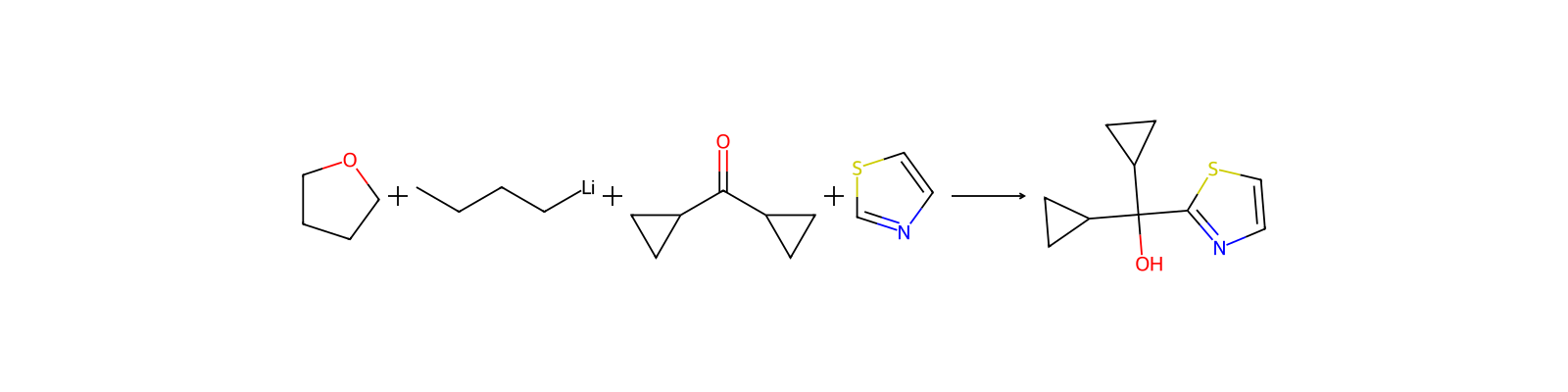
Zugehörige Reaktionen
25



Notizen zur Verbindung
Wird geladen…