
Sodium Citrate Dihydrate
Grundinformationen
- CAS
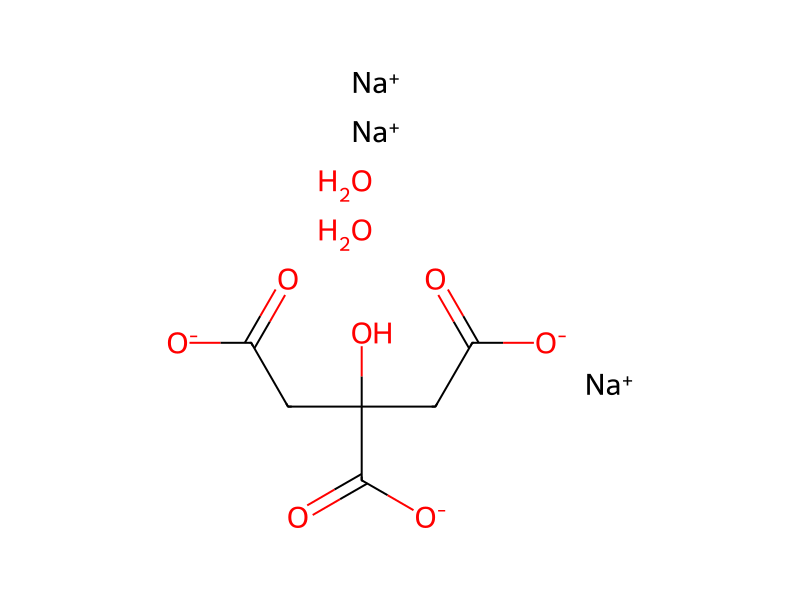
6132-04-3- Standard-SMILES
O.O.O=C([O-])CC(O)(CC(=O)[O-])C(=O)[O-].[Na+].[Na+].[Na+]- InChIKey
NLJMYIDDQXHKNR-UHFFFAOYSA-K- Summenformel
- C6H9Na3O9
- Durchschnittliche Molmasse
- 294,1 g/mol
- Monoisotopische Masse
- 293,99396471
Überblick
Sodium citrate dihydrate is the dihydrate of trisodium citrate. It has a role as an anticoagulant. It contains a sodium citrate.
Namen und Bezeichner
- Bevorzugter Name
- Sodium Citrate Dihydrate
- IUPAC
- trisodium;2-hydroxypropane-1,2,3-tricarboxylate;dihydrate
- Englischer Name
- Trisodium citrate dihydrate
- Summenformel
- C6H9Na3O9
- Molmasse
- 294.1
Namen und Synonyme
Trisodium citrate dihydrateSodium citrate dihydrate6132-04-3Sodium citrate hydrateB22547B95KCitric acid, trisodium salt, dihydrateSodium citrate hydrousEmetrol Chewables OrangeNauzeneDTXSID1049437CHEBI:32142N-1560
Weitere Namen anzeigen
CITRIC ACID MONOSODIUM CITRATE TRIBASIC DIHYDRATETRI-SODIUM CITRATE DIHYDRATESODIUM CITRATE, DIHYDRATESodiuM Citrate (AS)SODIUM CITRATE TRISODIUM SALT DIHYDRATENATRII CITRASTRI-SODIUM CITRATE 2H2OSodiumCitrateTribasicUspACIDUM CITRICUM MONOHYDRICUM
Natrii citras, dehydrateAnticoagulant Sodium CitrateTricitrasolEmetrol PowderEmetrol ChewablesNauzene ChewablesCVS HealthRefChem:6335
Datenbank-Bezeichner
Eigenschaften
Berechnete Struktureigenschaften
- Polarare Oberfläche (TPSA)
- 143 Ų
- H-Brücken-Donoren
- 3
- H-Brücken-Akzeptoren
- 9
- Frei drehbare Bindungen
- 2
- Schwere Atome
- 18
- Formalladung
- 0
- Komplexität
- 211
Experimentelle und physikochemische Eigenschaften
Chemical ClassesMetals -> Organic Acids, Metal Salts
SolubilitySolubility in water, g/100ml: 77
Animal DrugsPharmaceuticals -> UK Veterinary Medicines Directorate List
Decomposition150 °C
Physical Description
White odorless solid; [Merck Index] Colorless odorless crystalline powder; [Alfa Aesar MSDS]
WHITE SOLID IN VARIOUS FORMS.
Physikochemische Eigenschaften
- Schmelzpunkt
- 300 °C · >300 °C(lit.)
- Dichte
- 1.76 · 1.76
- FEMA
- 3026 · 3026 | SODIUM CITRATE
- Flammpunkt
- 173.9 °C · 173.9 °C
- storage temp.
- 5 °C · Store at +5°C to +30°C.
- Löslichkeit
- 2 O: · H2O: 100 mg/mL
- Aggregatzustand
- powder
Sicherheit und Regulatorisches
Sicherheitsangaben dienen nur zur Orientierung und ersetzen weder das Sicherheitsdatenblatt (SDB) des Lieferanten noch geltende Vorschriften oder eine fachliche Bewertung.
GHS-Klassifizierung
GHS Classification
This chemical does not meet GHS hazard criteria for 97% (520 of 536) of all reports.
Not Classified
Aggregated GHS information provided per 536 reports by companies from 4 notifications to the ECHA C&L Inventory.
Gefahrenhinweise
Regulatory Information
Chemical: 1,2,3-Propanetricarboxylic acid, 2-hydroxy-, trisodium salt, dihydrate
Trisodium citrate dihydrate: Does not have an individual approval but may be used under an appropriate group standard
Other Safety InformationIMAP assessments - 1,2,3-Propanetricarboxylic acid, 2-hydroxy-, trisodium salt, dihydrate: Human health tier I assessment
Fire HazardsCombustible.
Hazards SummaryAn eye and respiratory tract irritant; [ICSC] May cause irritation; [Alfa Aesar MSDS] See Sodium citrate, anhydrous.
EPA Safer ChemicalChemical: Sodium citrate, dihydrate
Chemical DangersThe solution in water is a weak base.
Hazard Classes and CategoriesNot Classified
Sicherheit und Schutzausrüstung
Fire Fighting
Chemie und Industrie
Pharmakologische Informationen
FDA Pharmacological Classification
SODIUM CITRATE DIHYDRATE
Anti-coagulant [EPC]; Acidifying Activity [MoA]; Calculi Dissolution Agent [EPC]; Decreased Coagulation Factor Activity [PE]; Calcium Chelating Activity [MoA]
TRISODIUM CITRATE DIHYDRATE
Anti-coagulant [EPC]; Acidifying Activity [MoA]; Calculi Dissolution Agent [EPC]; Calcium Chelating Activity [MoA]; Decreased Coagulation Factor Activity [PE]
MeSH Pharmacological Classification
Agents that prevent BLOOD CLOTTING.
A chemical system that functions to control the levels of specific ions in solution. When the level of hydrogen ion in solution is controlled the system is called a pH buffer.
Substances capable of inhibiting, retarding or arresting the process of fermentation, acidification or other deterioration of foods.
Verwendung und Herstellung
Uses
Used in blood collection (anticoagulant), photography, and food production (sequestering agent, emulsifier, and acidulant); [Merck Index] Permitted for use as an inert ingredient in non-food pesticide products; [EPA]
Photographic Processing [Category: Other]
Household ProductsInformation on 307 consumer products that contain Sodium citrate dihydrate in the following categories is provided:
Use Classification
EPA Safer Chemical Functional Use Classes -> Chelating Agents;Preservatives and Antioxidants;Processing Aids and Additives
Safer Chemical Classes -> Green circle - The chemical has been verified to be of low concern
Anwendungen
Trisodium citrate dihydrate, is widely applied in food, beverages and fillers as a buffering, sequestering or an emulsifying agent. It used as an anticoagulant in blood transfusions, osmotic laxative, functional fluids, solvents cleaning, furnishing care products, laundry dishwashing products and cleaning automobile radiators.
Zugehörige Reaktionen
38






Notizen zur Verbindung
Wird geladen…