
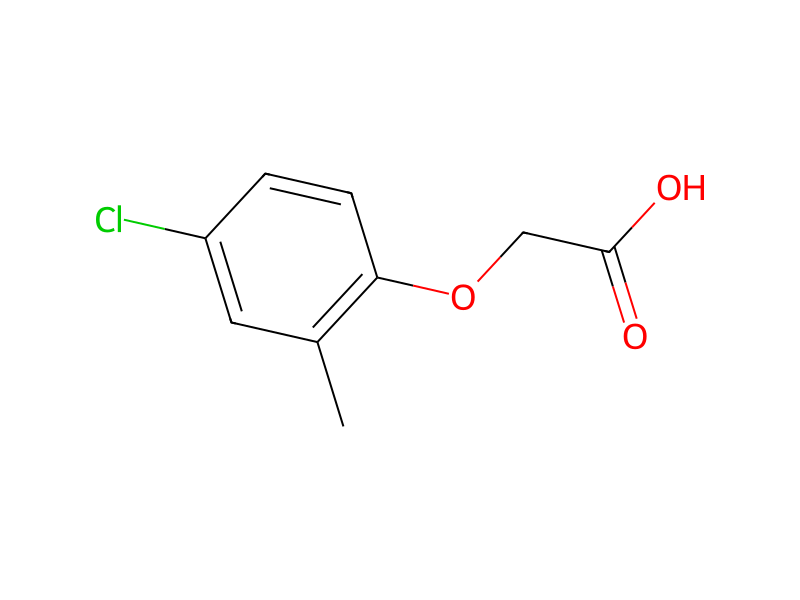
Grundinformationen
- Standard-SMILES
Cc1cc(Cl)ccc1OCC(=O)O- InChIKey
WHKUVVPPKQRRBV-UHFFFAOYSA-N- Summenformel
- C9H9ClO3
- Durchschnittliche Molmasse
- 200,62 g/mol
- Monoisotopische Masse
- 200,02402183
Überblick
(4-chloro-2-methylphenoxy)acetic acid is a chlorophenoxyacetic acid that is (4-chlorophenoxy)acetic acid substituted by a methyl group at position 2. It has a role as a synthetic auxin, a phenoxy herbicide and an environmental contaminant. It is a chlorophenoxyacetic acid and a member of monochlorobenzenes. It is a conjugate acid of a (4-chloro-2-methylphenoxy)acetate.
Namen und Bezeichner
- Bevorzugter Name
- (4-chloro-2-Methylphenoxy)acetic acid
- IUPAC
- 2-(4-chloro-2-methylphenoxy)acetic acid
- Lokaler Name
- MCPA (ISO)
- Englischer Name
- 2-Methyl-4-chlorophenoxyacetic acid
- Summenformel
- C9H9ClO3
- Molmasse
- 200.62
Namen und Synonyme
MCPA94-74-62-METHYL-4-CHLOROPHENOXYACETIC ACID(4-Chloro-2-methylphenoxy)acetic acidZelanMephanacEmcepanNetazolRhonoxHerbicide MHedarex MHedonal M
Weitere Namen anzeigen
MCPbanvelmMCPA Ester2-(4-CHLORO-2-METHYLPHENOXY)ACETIC ACID4-CHLORO-2-METHYLCHLOROPHENOXYACETICACIDBH MCPAbanleneplus2-Methyl-4-chlorophenoxyacetic
Okultin MLeuna MBordermasterHornotuhoLinormoneAgroxonChiptoxKrezone
Datenbank-Bezeichner
- CAS
94-74-6- PubChem CID
- 7204
- DTXSID
DTXSID4024195- ChEMBL
CHEMBL394657- ChEBI
CHEBI:50099- UNII
- D888C394VO
- EC Number
- 202-360-6
- Nikkaji
- J25.212C
Eigenschaften
Berechnete Struktureigenschaften
- XLogP
- 2,6
- Polarare Oberfläche (TPSA)
- 46,5 Ų
- H-Brücken-Donoren
- 1
- H-Brücken-Akzeptoren
- 3
- Frei drehbare Bindungen
- 3
- Schwere Atome
- 13
- Formalladung
- 0
- Komplexität
- 184
Experimentelle und physikochemische Eigenschaften
SpringerMaterials PropertiesFusion temperature
Pesticides
Pesticide -> EPA IRIS
Herbicides
Active substance -> EU Pesticides database: Approved
Pesticides -> Herbicides, Chlorophenoxy
Herbicides, Transformation products
Pesticide
LogP
log Kow = 3.25
2.8
2.69
Density
1.56 @ 25 °C/15.5 °C
Relative density (water = 1): 1.3
Color/Form
White to light brown solid flakes, crystal powder or liquid.
Plates from benzene or toluene
White crystalline solid (pure compd)
Colorless crystalline solid (pure)
Solubility
Solubility: in water 270 g/l, methanol 340 g/l, benzene 1 g/l /2-Methyl-4-chlorophenoxyacetic acid sodium salt/
INSOL IN CARBON DISULFIDE; SOLUBILITY (G/100 ML): ETHER 77, ETHANOL 153, N-HEPTANE 0.5, TOLUENE 6.2, XYLENE 4.9
SOL IN CARBON TETRACHLORIDE
Free acid insol in water but sodium and amine salts are soluble
Sol in benzene
For more Solubility (Complete) data for 2-METHYL-4-CHLOROPHENOXYACETIC ACID (6 total), please visit the HSDB record page.
CorrosivityNon-corrosive
Decomposition
When heated to decomposition it emits toxic fumes of /hydrogen chloride and nitrogen oxides/.
WHEN HEATED TO DECOMP, IT EMITS TOXIC FUMES OF /HYDROGEN CHLORIDE/.
Melting Point
118-119 °C
Melting point: 115-117 °C /technical grade MCPA/
113-119 °C
Vapor Pressure
0.0000059 [mmHg]
5.90X10⁻⁶ mm Hg
Vapor pressure, Pa at 20 °C: (negligible)
Henry's Law ConstantHenry's Law constant= 4.8X10⁻¹⁰ atm-cu m/mole @ 25 °C
Physical Description
White solid; [Hawley] Slightly beige solid; [MSDSonline]
WHITE CRYSTALLINE POWDER WITH CHARACTERISTIC ODOUR.
Physikochemische Eigenschaften
- Schmelzpunkt
- 114 · 114-118 °C (lit.)
- Siedepunkt
- 288.02 °C · 288.02°C (rough estimate)
- Dichte
- 1.2799 · 1.2799 (rough estimate)
- Brechungsindex
- 1.523 · 1.5230 (estimate)
- Flammpunkt
- 2 °C · 2 °C
- storage temp.
- Sealed in dry,Room Temperature
- Löslichkeit
- water: insoluble(lit.)
- Aggregatzustand
- Solid
- pka
- 3.14 · 3.14±0.10(Predicted)
- Farbe
- White to Light yellow to Light orange
- Wasserlöslichkeit
- 1.174 g/L · 1.174g/L(25 ºC)
- Merck
- 14 · 14,5764
- BRN
- 2051752 · 2051752
- Henry's Law Constant
- 9.9 · 9.9×101 mol/(m3Pa) at 25℃, Mabury and Crosby (1996)
- InChI
- 1S/C9H9ClO3/c1-6-4-7(10)2-3-8(6)13-5-9(11)12/h2-4H,5H2,1H3,(H,11,12)
- InChIKey
- WHKUVVPPKQRRBV-UHFFFAOYSA-N
- SMILES
- Cc1cc(Cl)ccc1OCC(O)=O
- CAS Datenbank
- 94 · 94-74-6(CAS DataBase Reference)
- NIST chemische Informationen
- [(4-Chloro-o-tolyl)oxy]acetic acid(94-74-6)
- EPA chemische Informationen
- MCPA (94-74-6)
Sicherheit und Regulatorisches
GHS-Klassifizierung
GHS Classification
Danger
H302: Harmful if swallowed [Warning Acute toxicity, oral]
P264, P264+P265, P270, P273, P280, P301+P317, P302+P352, P305+P354+P338, P317, P321, P330, P332+P317, P362+P364, P391, and P501 (click each P-code to see the statement)
Danger
H302 (100%): Harmful if swallowed [Warning Acute toxicity, oral]
P261, P264, P264+P265, P270, P271, P273, P280, P301+P317, P302+P352, P304+P340, P305+P354+P338, P317, P321, P330, P332+P317, P362+P364, P391, and P501 (click each P-code to see the statement)
Gefahrenhinweise
Regulatory Information
TP - indicates a substance that is the subject of a proposed TSCA section 4 test rule.
05/57/EC, Reg. (EU) 2017/1511, Reg. (EU) 2018/1262, Reg. (EU) 2019/1589, Reg. (EU) 2021/1449, Reg. (EU) 2022/1480, Reg. (EU) 2023/1757, Reg. (EU) No 540/2011, Reg. (EU) No 762/2013, Reg. (EU)2020/1511
MCPA: HSNO Approval: HSR003327 Approved with controls
The New Jersey Worker and Community Right to Know Act requires public and private employers to provide information about hazardous substances at their workplaces. (N.J.S.A. 34:5A-1 et. seq.)
Other Safety InformationIMAP assessments - Acetic acid, (4-chloro-2-methylphenoxy)-: Environment tier I assessment
Fire HazardsNot combustible. Liquid formulations containing organic solvents may be flammable. Gives off irritating or toxic fumes (or gases) in a fire. Risk of fire and explosion if formulations contain flammable/explosive solvents.
Fire PotentialNonflammable
Hazards Summary
A skin, eye, and respiratory tract irritant; May be toxic to human reproduction or development, based on animal studies; [ICSC] May cause skin, eye, nose, and throat irritation; Effects in high dose oral studies of rats include histopathological changes to liver, kidneys, and spleen; [HSDB] Based on animal studies, not likely to cause congenital defects; No human data available; [REPROTOX] Chlorophenoxy herbicides are possibly carcinogenic to humans (Group 2B), but No adequate data were available on the carcinogenicity of MCPA. [IARC] See 2,4D.
EC ClassificationSymbol: Xn, N; R: 22-38-41-50/53; S: (2)-26-37-39-60-61
UN ClassificationUN Hazard Class: 9; UN Pack Group: III
Special Reports
EXTENSIVE ACUTE & CHRONIC TOXICITY DATA FOR MCPA IN MAMMALS, BIRDS, WILDLIFE, AQUATIC ORGANISMS, AMPHIBIANS, INSECTS & NEMATODES ARE PRESENTED.[BOVEY RW; TOXICOLOGY OF PHENOXY HERBICIDES IN ANIMALS AND MAN - GENERAL CONSIDERATIONS; IN: THE SCIENCE OF 2,4,5-T AND ASSOCIATED HERBICIDES. (JOHN WILEY & SONS: NY); CHO4: 71 (1980)]
FIFRA Requirements
Tolerances are established for residues of the herbicide 2-methyl-4-chlorophenoxyacetic acid from application of the herbicide in the acid form or in the form of its sodium, ethanolamine, diethanolamine, triethanolamine, isopropanolamine, diisopropanolamine, triisopropanolamine, or dimethylamine salts or its isooctyl or butoxyethyl esters in or on raw agricultural commodities as follows: alfalfa; alfalfa, hay; barley, grain; barley, straw; clovers; clover, hay; flax, straw; flaxseed; grasses, pasture; grasses, rangeland; grass, canary, annual, seed; grass, canary, annual, straw; grass, hay; lespedeza; lespedeza, hay; oats, forage; oats, grain; oats, straw; peas; peavines; peavines, hay; rice, grain; rice, straw; rye, forage; rye, grain; rye, straw; sorghum, fodder; sorghum, forage; sorghum, grain; trefoils; trefoil, hay; vegetables, seed and pod; vetches; vetch, hay; wheat, forage; wheat, grain; wheat, straw.
Tolerances are established for combined negligible residues (N) of the herbicide 2-methyl-4-chlorophenoxyacetic acid and its metabolite 2-methyl-4-chlorophenol in or on the following raw agicultural commodities: cattle, fat; cattle, mbyp; cattle, meat; goats, fat; goats, mbyp; goats, meat; hogs, fat; hogs, mbyp; hogs, meat; horses, fat; horses, mbyp; horses, meat; milk; sheep, fat; sheep, mbyp; and sheep, meat.
As the federal pesticide law FIFRA directs, EPA is conducting a comprehensive review of older pesticides to consider their health and environmental effects and make decisions about their future use. Under this pesticide reregistration program, EPA examines health and safety data for pesticide active ingredients initially registered before November 1, 1984, and determines whether they are eligible for reregistration. In addition, all pesticides must meet the new safety standard of the Food Quality Protection Act of 1996. 2-methyl-4-chlorophenoxyacetic acid is found on List A, which contains most food use pesticides and consists of the 194 chemical cases (or 350 individual active ingredients) for which EPA issued registration standards prior to FIFRA, as amended in 1988. Case No: 0017; Pesticide type: Herbicide; Registration Standard Date: 09/12/89; Case Status: OPP is reviewing data from the pesticide's producers regarding its human health and/or environmental effects, or OPP is determining the pesticide's eligibility for reregistration and developing the Reregistration Eligibility Decision (RED) document.; Active ingredient (AI): 2-methyl-4-chlorophenoxyacetic acid; Data Call-in (DCI) Date(s): 05/12/93, 04/06/94, 03/03/95, 10/13/95; AI Status: The producers of the pesticide has made commitments to conduct the studies and pay the fees required for reregistration, and are meeting those commitments in a timely manner.
Chemical DangersDecomposes on heating. This produces toxic and corrosive fumes including hydrogen chloride and phosgene. The substance is a weak acid. Attacks many metals in the presence of water.
Packaging and LabellingDo not transport with food and feedstuffs.
Hazard Classes and Categories
Acute Tox. 4 (100%)
Acute toxicity - category 4
Acute toxicity (Oral) - Category 4
Serious eye damage/eye irritation - Category 1
Hazardous to the aquatic environment (Acute) - Category 1
Acute Tox. 4 *
Sicherheit und Schutzausrüstung
Fire FightingIn case of fire in the surroundings, use appropriate extinguishing media.
First Aid Measures
Fresh air, rest. Refer for medical attention.
Remove contaminated clothes. Rinse and then wash skin with water and soap. Refer for medical attention .
Rinse with plenty of water (remove contact lenses if easily possible). Refer immediately for medical attention.
Rinse mouth. Give one or two glasses of water to drink. Refer immediately for medical attention.
Safe StorageProvision to contain effluent from fire extinguishing. Separated from strong bases and food and feedstuffs. Store in an area without drain or sewer access. Cool.
Storage Conditions
Keep in well-ventilated area.
Do not transport or store near fertilizers, seeds, insecticides, or fungicides.
Disposal Methods
SRP: At the time of review, criteria for land treatment or burial (sanitary landfill) disposal practices are subject to significant revision. Prior to implementing land disposal of waste residue (including waste sludge), consult with environmental regulatory agencies for guidance on acceptable disposal practices.
Incineration: Liquids should be atomized into an incinerator equipped with an appropriate effluent gas cleaning device, and combustion maybe improved by mixing with a more flammable solvent (acetone or benzene). Solids should be combined with paper or other flammable material. An alternate procedure is to dissolve the solid in a flammable solvent and spray the solutions into the fire chamber.
Spillage Disposal
Personal protection: filter respirator for organic gases and particulates adapted to the airborne concentration of the substance. Do NOT let this chemical enter the environment. Sweep spilled substance into sealable containers. If appropriate, moisten first to prevent dusting. Carefully collect remainder. Then store and dispose of according to local regulations.
Preventive Measures
SRP: The scientific literature for the use of contact lenses in industry is conflicting. The benefit or detrimental effects of wearing contact lenses depend not only upon the substance, but also on factors including the form of the substance, characteristics and duration of the exposure, the uses of other eye protection equipment, and the hygiene of the lenses. However, there may be individual substances whose irritating or corrosive properties are such that the wearing of contact lenses would be harmful to the eye. In those specific cases, contact lenses should not be worn. In any event, the usual eye protection equipment should be worn even when contact lenses are in place.
Eye PreventionWear safety goggles or eye protection in combination with breathing protection if powder.
Inhalation RiskEvaporation at 20 °C is negligible; a harmful concentration of airborne particles can, however, be reached quickly on spraying or when dispersed, especially if powdered.
Skin PreventionProtective gloves. Protective clothing.
Exposure PreventionPREVENT DISPERSION OF DUST!
Allowable Tolerances
Tolerances are established for residues of the herbicide 2-methyl-4-chlorophenoxyacetic acid from application of the herbicide in the acid form or in the form of its sodium, ethanolamine, diethanolamine, triethanolamine, isopropanolamine, diisopropanolamine, triisopropanolamine, or dimethylamine salts or its isooctyl or butoxyethyl esters in or on raw agricultural commodities as follows: alfalfa, 0.1 ppm; alfalfa, hay, 0.1 ppm; barley, grain, 0.1 ppm (N); barley, straw, 2 ppm; clovers, 0.1 ppm; clover, hay, 0.1 ppm; flax, straw, 2 ppm; flaxseed, 0.1 ppm (N); grasses, pasture, 300 ppm; grasses, rangeland, 300 ppm; grass, canary, annual, seed, 0.1 ppm; grass, canary, annual, straw, 0.1 ppm; grass, hay, 20 ppm; lespedeza, 0.1 ppm; lespedeza, hay, 0.1 ppm; oats, forage, 20 ppm; oats, grain, 0.1 ppm; oats, straw, 2 ppm; peas, 0.1 ppm (N); peavines, 0.1 ppm (N); peavines, hay, 0.1 ppm (N); rice, grain, 0.1 ppm (N); rice, straw, 2 ppm; rye, forage, 20 ppm; rye, grain, 0.1 ppm (N); rye, straw, 2 ppm; sorghum, fodder, 20 ppm; sorghum, forage, 20 ppm; sorghum, grain, 0.1 ppm; trefoils, 0.1 ppm; trefoil, hay, 0.1 ppm; vegetables, seed and pod, 0.1 ppm; vetches, 0.1 ppm; vetch, hay, 0.1 ppm; wheat, forage, 20 ppm; wheat, grain, 0.1 ppm (N); wheat, straw, 2 ppm.
Tolerances are established for combined negligible residues (N) of the herbicide 2-methyl-4-chlorophenoxyacetic acid and its metabolite 2-methyl-4-chlorophenol in or on the following raw agicultural commodities: cattle, fat, 0.1 ppm (N); cattle, mbyp, 0.1 ppm (N); cattle, meat, 0.1 ppm (N); goats, fat, 0.1 ppm (N); goats, mbyp, 0.1 ppm (N); goats, meat, 0.1 ppm (N); hogs, fat, 0.1 ppm (N); hogs, mbyp, 0.1 ppm (N); hogs, meat, 0.1 ppm (N); horses, fat, 0.1 ppm (N); horses, mbyp, 0.1 ppm (N); horses, meat, 0.1 ppm (N); milk, 0.1 ppm (N); sheep, fat, 0.1 ppm (N); sheep, mbyp, 0.1 ppm (N); and sheep, meat, 0.1 ppm (N).
Toxikologische Informationen
Body Burden
2-Methyl-4-chlorophenoxyacetic acid residues were measured in 18 urine samples collected from workers who had been spray applying the herbicide less than 24 hr previous(1); concns of 10-50 ppb were found in 8 samples, concns of 50-150 ppb were found in 5 samples, and concns of 150-500 ppb were found in 5 samples(1). In another monitoring study of farmers and professional spraymen, median urine concns of 0.31-1.7 ug/ml were detected(2).
IN A SUICIDE, SPECIMENS TAKEN AT AUTOPSY CONTAINED THE FOLLOWING CONCENTRATIONS OF MCPA: BLOOD, 230 PPM; LIVER, 146 PPM; HEART, 154 PPM; & BRAIN, 32.8 PPM. IN ANOTHER CASE, THE CONCENTRATIONS IN AUTOPSY SPECIMENS OF BLOOD & URINE WERE 180 & 800 PPM, RESPECTIVELY.
TreatmentTreatment may include washing any areas of contact, GI decontamination if swallowed, administering an IV and forced alkaline diuresis. (L346)
Interactions
Probenecid increased the acute toxicity of chlorophenoxyacetic acids (2,4-D, 2,4,5-T and MCPA) in rats. Probenecid increased the brain to plasma ratios of all the three (14)C labelled chlorophenoxyacetic acids. The increase was due only partly to the displacement of chlorophenoxyacids from their binding sites in rat plasma proteins by probenecid. Probenecid did not change significantly the intracerebral distribution pattern of (14)C labelled chlorophenoxyacetic acids.
Target OrgansHepatic
Health Effects
Exposure to large amounts of CDDs causes chloracne, a severe skin disease with acne-like lesions that occur mainly on the face and upper body. CDDs may also cause liver damage and induce long-term alterations in glucose metabolism and subtle changes in hormonal levels. In addition, studies have shown that CDDs may disrupt the endocrine system and weaken the immune system, as well as cause reproductive damage and birth defects, central and peripheral nervous system pathology, thyroid disorders, endometriosis, and diabetes. 2,3,7,8-Tetrachlorodibenzo-p-dioxin is also a known human carcinogen. (L177, L178)
Ecotoxicity Values
LC50 LEPOMIS MACROCHIRUS (BLUEGILL) MORE THAN 10 MG/L/96 HR @ 24 °C, FINGERLING. STATIC BIOASSAY WITHOUT AERATION, PH 7.2-7.5, WATER HARDNESS 40-50 MG/L AS CALCIUM CARBONATE AND ALKALINITY OF 30-35 MG/L. /LIQUID CONCENTRATE 27.6%/
LC50 Salmo gairdneri (Rainbow trout) 232 mg/l/96 hr /Conditions of bioassay not specified/
TLm Crassostrea virginica (American oyster) 3.13X10+4 ppb/14 day, larvae, static lab bioassay
LC50 Lepomis macrochirus (Bluegill) 1500 ug/l/48 hr /Conditions of bioassay not specified/
Environmental Fate
TERRESTRIAL FATE: Based on a classification scheme(1), a Koc value ranging from the 50 to 62 (2), indicates that MCPA is expected to have high mobility in soil(SRC). Volatilization of MCPA from moist soil surfaces is not expected to be an important fate process(SRC) based on its Henry's Law constant of 4.80X10⁻¹⁰ atm-cu/mole(3). MCPA is not expected to volatilize from dry soil surfaces(SRC) based upon a vapor pressure of 5.90X10⁻⁶ mm Hg(4). The primary degradation process for MCPA in soil is biodegradation(5). A literature review of available laboratory persistence studies of MCPA in soil found soil half-lives ranging from <7 to 41 days with an average of about 2-3 weeks(6). MCPA is susceptible to photodegradation in sunlight(5,7); however, photodegradation at the soil surface is not considered a major degradation pathway since it is applied post-emergence to growing crops, and residues reaching the soil will be protected from sunlight by the crop canopy(5). Under field studies, the resultant average persistence of MCPA at recommended application rates is up to 1 month in moist conditions and up to 6 months under drier climates(8).
AQUATIC FATE: Based on a classification scheme(1), a Koc value ranging from 50 to 62(2), indicates that MCPA is not expected to adsorb to suspended solids and sediment(SRC). Volatilization from water surfaces is not expected(3) based upon its Henry's Law constant of 4.80X10⁻¹⁰ atm-cu m/mole(4). According to a classification scheme(5), a BCF of 1(6), suggests the potential for bioconcentration in aquatic organisms is low. Based on degradation studies, it appears that MCPA will biodegrade in water but at a slower rate than in soil. In flooded sediment, the complete degradation of MCPA took 96 wks, but only 48 wks in moist soil; the ratio of relative persistence in moist soil vs. flooded sediment was determined to be 1:2.3(7). The direct photolysis half-life of MCPA in water (at surface conditions under summer sunlight) is about 19-20 days(8).
ATMOSPHERIC FATE: According to a model of gas/particle partitioning of semivolatile organic compounds in the atmosphere(1), MCPA, which has a vapor pressure of 5.90X10⁻⁶ mm Hg at 25 °C(2), will exist in both the vapor and particulate phases in the ambient atmosphere. Vapor-phase MCPA is degraded in the atmosphere by reaction with photochemically-produced hydroxyl radicals(SRC); the half-life for this reaction in air is estimated to be 30 hours(SRC), calculated from its rate constant of 1.3X10⁻¹¹ cu cm/molecule-sec at 25 °C(SRC), determined using a structure estimation method(3). Particulate-phase MCPA may be removed from the air by wet and dry deposition(SRC). Aerial drift from herbicidal spraying operations can transport MCPA to nearby ponds and streams(4). A multi-year study of MCPA in surface water of a small prairie watershed concluded that the aqueous concns of MCPA were related to elevated precipitation and air levels rather than to runoff losses(5). MCPA may undergo direct photolysis since it is photochemically reactive in water(6). Exposure of aqueous solutions of MCPA in distilled water to Oct sunlight in Davis, CA resulted in a 14% decomposition of MCPA after 245 hr of exposure(7).
Food Survey Values
No 2-methyl-4-chlorophenoxyacetic acid (MCPA) residues were detected in any food composites collected from July 1, 1969 to June 30, 1976 as part of the FDA's (Food and Drug Administration) Total Diet Study (market basket survey of ready-to-eat US foods)(1). In earlier Total Diet Study analyses (June 1964 to Apr 1969), MCPA was detected in 11 of 1236 food composite samples at levels ranging from a trace to 0.40 ppm(2-5).
Adverse EffectsOccupational hepatotoxin - Secondary hepatotoxins: the potential for toxic effect in the occupational setting is based on cases of poisoning by human ingestion or animal experimentation.
Exposure RoutesThe substance can be absorbed into the body by inhalation of its aerosol, through the skin and by ingestion.
Milk Concentrations... 2-METHYL-4-CHLOROPHENOL WAS DETECTED IN MILK OF DAIRY COWS ... .
Toxicity Summary
CDDs cause their toxic effects by binding to the aryl hydrocarbon receptor and subsequently altering the trascription of certain genes. The affinity for the Ah receptor depends on the structure of the specific CDD. The change in gene expression may result from the direct interaction of the Ah receptor and its heterodimer-forming partner, the aryl hydrocarbon receptor nuclear translocator, with gene regulatory elements or the initiation of a phosphorylation/dephosphorylation cascade that subsequently activates other transcription factors. The affected genes include several oncogenes, growth factors, receptors, hormones, and drug-metabolizing enzymes. The change in transcription/translation of these genes is believed to be the cause of most of the toxic effects of CDDs. This includes 2,3,7,8-tetrachlorodibenzo-p-dioxin's carcinogenicity is thought to be the result of its ability to alter the capacity of both exogenous and endogenous substances to damage the DNA by inducing CYP1A1- and CYP1A2-dependent drug-metabolizing enzymes. (L177)
Regulatorische Informationen
FIFRA Requirements
Tolerances are established for residues of the herbicide 2-methyl-4-chlorophenoxyacetic acid from application of the herbicide in the acid form or in the form of its sodium, ethanolamine, diethanolamine, triethanolamine, isopropanolamine, diisopropanolamine, triisopropanolamine, or dimethylamine salts or its isooctyl or butoxyethyl esters in or on raw agricultural commodities as follows: alfalfa; alfalfa, hay; barley, grain; barley, straw; clovers; clover, hay; flax, straw; flaxseed; grasses, pasture; grasses, rangeland; grass, canary, annual, seed; grass, canary, annual, straw; grass, hay; lespedeza; lespedeza, hay; oats, forage; oats, grain; oats, straw; peas; peavines; peavines, hay; rice, grain; rice, straw; rye, forage; rye, grain; rye, straw; sorghum, fodder; sorghum, forage; sorghum, grain; trefoils; trefoil, hay; vegetables, seed and pod; vetches; vetch, hay; wheat, forage; wheat, grain; wheat, straw.
Tolerances are established for combined negligible residues (N) of the herbicide 2-methyl-4-chlorophenoxyacetic acid and its metabolite 2-methyl-4-chlorophenol in or on the following raw agicultural commodities: cattle, fat; cattle, mbyp; cattle, meat; goats, fat; goats, mbyp; goats, meat; hogs, fat; hogs, mbyp; hogs, meat; horses, fat; horses, mbyp; horses, meat; milk; sheep, fat; sheep, mbyp; and sheep, meat.
As the federal pesticide law FIFRA directs, EPA is conducting a comprehensive review of older pesticides to consider their health and environmental effects and make decisions about their future use. Under this pesticide reregistration program, EPA examines health and safety data for pesticide active ingredients initially registered before November 1, 1984, and determines whether they are eligible for reregistration. In addition, all pesticides must meet the new safety standard of the Food Quality Protection Act of 1996. 2-methyl-4-chlorophenoxyacetic acid is found on List A, which contains most food use pesticides and consists of the 194 chemical cases (or 350 individual active ingredients) for which EPA issued registration standards prior to FIFRA, as amended in 1988. Case No: 0017; Pesticide type: Herbicide; Registration Standard Date: 09/12/89; Case Status: OPP is reviewing data from the pesticide's producers regarding its human health and/or environmental effects, or OPP is determining the pesticide's eligibility for reregistration and developing the Reregistration Eligibility Decision (RED) document.; Active ingredient (AI): 2-methyl-4-chlorophenoxyacetic acid; Data Call-in (DCI) Date(s): 05/12/93, 04/06/94, 03/03/95, 10/13/95; AI Status: The producers of the pesticide has made commitments to conduct the studies and pay the fees required for reregistration, and are meeting those commitments in a timely manner.
State Drinking Water Guidelines
(FL) FLORIDA 1,000 ug/l
(ME) MAINE 4 ug/l
(MN) MINNESOTA 3 ug/l
Federal Drinking Water GuidelinesEPA 30 ug/L
Sicherheitsdaten
- wgk
- 2
- tsca
- TSCA listed
- ridadr
- UN 2765
- hs_code
- 29189900
- RTECS-Nr.
- AG1575000
- risk_code
- 22-38-41-36-20/21/22-11-50/53
- Toxizität
- LD50 orally in rats: 700 mg/kg (Rowe, Hymas)
- hazard_code
- Xn,F,N
- safety_code
- 26-37-39-36-16-61-60-36/37
- hazard_class
- 9
- packing_group
- III
- Speicherklasse
- 11 - Combustible Solids
- Giftige Stoffe Daten
- 94-74-6(Hazardous Substances Data)
- Hazard Classifications
- Acute Tox. 4 OralAquatic Acute 1Aquatic Chronic 1Eye Dam. 1Skin Irrit. 2
Chemie und Industrie
Pharmakologische Informationen
Metabolism/Metabolites
YIELDS 4-CHLORO-2-HYDROXYMETHYLPHENOXYACETIC ACID & N-(4-CHLORO-2-METHYLPHENOXYACETYL)-L-ASPARTIC ACID IN RAPE & IN CAMPION. YIELDS 4-CHLORO-2-METHYLPHENOXYACETYL-BETA-D-GLUCOSE PROBABLY IN RAPE. /FROM TABLE/
... 2-METHYL-4-CHLOROPHENOL WAS DETECTED IN MILK OF DAIRY COWS & IN KIDNEYS OF SHEEP & CATTLE.
ARTHROBACTER SP AND FLAVOBACTERIUM PEREGRINUM DEGRADED MCPA TO 4-CHLORO-2-METHYLPHENOL. FLAVOBACTERIUM FURTHER OXIDIZED PHENOL TO RELEASE ALL CHLORIDE. ASPERGILLUS NIGER VAN TIEGH ALSO METABOLIZED MCPA TO 4-CHLORO-2-METHYL-5-HYDROXYPHENOXYACETIC ACID.
... GRAM-NEGATIVE SOIL BACTERIUM METABOLIZED MCPA TO 5-CHLORO-O-CRESOL, A COMPOUND BELIEVED TO BE 6-HYDROXY-MCPA & ALPHA-METHYL-GAMMA-CARBOXYMETHYLENE-DELTA ALPHA-BUTENOLIDE.
For more Metabolism/Metabolites (Complete) data for 2-METHYL-4-CHLOROPHENOXYACETIC ACID (6 total), please visit the HSDB record page.
CDDs are absorbed through oral, inhalation, and dermal routes of exposure. CDDs are carried in the plasma by serum lipids and lipoproteins, distributing mainly to the liver and adipose tissue. CDDs are very slowly metabolized by the microsomal monooxygenase system to polar metabolites that can undergo conjugation with glucuronic acid and glutathione. They may increase the rate of their own metabolism by inducing CDDs induce both phase I and phase II enzymes. The major routes of excretion of CDDs are the bile and the feces, though smaller amounts are excreted in the urine and via lactation. (L177)
MeSH Pharmacological ClassificationPesticides used to destroy unwanted vegetation, especially various types of weeds, grasses (POACEAE), and woody plants. Some plants develop HERBICIDE RESISTANCE.
Absorption, Distribution and Excretion
... NOT ABSORBED THROUGH SKIN TO ANY APPRECIABLE EXTENT ... . /2,4-D/
(14)C MCPA ... INJECTED IV INTO PREGNANT MICE, WHICH WERE THEN STUDIED BY AUTORADIOGRAPHY AT INTERVALS OF 5 MIN TO 72 HR. DISTRIBUTION PATTERN WAS CHARACTERIZED BY HIGH CONCN IN BLOOD UP TO 4 HR & ACCUMULATION IN VISCERAL YOLK SAC EPITHELIUM UP TO 24 HR AFTER INJECTION. RADIOACTIVE SUBSTANCE PASSED THE PLACENTA, BUT FETAL TISSUES NEVER REACHED CONCN OF THE MATERNAL TISSUES. RADIOACTIVITY WAS ELIMINATED FROM FETUSES & MOTHERS BY 24 HR AFTER INJECTION.
WHEN ADMINISTERED TO RATS BY STOMACH TUBE, THE HIGHEST CONCENTRATIONS OF (14)C MCPA IN THE TISSUES WAS REACHED IN 2-8 HR & THEN DECLINED RAPIDLY. DURING THE FIRST 24 HOURS 92.3% OF THE DOSE WAS DISCOVERED IN URINE & 6.8% IN THE FECES.
ABOUT 50% OF THE TOTAL DOSE WAS DETECTED IN URINE OF 4 VOLUNTEERS WITHIN 48 HR AFTER EACH INGESTED 5 MG OF MCPA. FIVE DAYS AFTER INGESTION, THE CONCENTRATION IN THE URINE WAS BELOW THE DETECTABLE LEVEL OF 0.02 PPM.
For more Absorption, Distribution and Excretion (Complete) data for 2-METHYL-4-CHLOROPHENOXYACETIC ACID (8 total), please visit the HSDB record page.
Verwendung und Herstellung
Uses
Used as a post-emergence herbicide for control of annual and perennial broad leaved weeds in cereals, herbage seed crops, flax, rice, vines, peas, potatoes, asparagus, grassland, turf, orchards, roadsides, forestry, and aquatic areas; [HSDB]
Farming (Pesticides) [Category: Industry]
For 2-Methyl-4-chlorophenoxyacetic acid (USEPA/OPP Pesticide Code: 030501) ACTIVE products with label matches. /SRP: Registered for use in the U.S. but approved pesticide uses may change periodically and so federal, state and local authorities must be consulted for currently approved uses./
MCPA is used as a postemergence herbicide for control of broadleaf weeds in agricultural applications.
HERBICIDE FOR CONTROL OF ANNUAL & PERENNIAL WEEDS
Post-emergence control of annual and perennial broad leaved weeds (including thistles and docks) in cereals (alone or undersown), herbage seed crops, flax, rice, vines, peas, potatoes, asparagus, grassland, turf, under fruit trees, and on roadside verges and embankments. Control of broad-leaved and woody weeds in forestry. Control of aquatic broad leaved weeds.
ImpuritiesThe technical grade might contain 3-40% 6-chloro-2-methylphenoxyacetic acid. The hormone-type herbicide, commercial grade contains 4% of 4-chloro-o-cresol.
U.S. Production(1975) 1.77X10+9 GRAMS (CONSUMPTION)
Consumption Patterns
HERBICIDE, OF WHICH APPROXIMATELY 69% IS USED ON WHEAT, 18% ON OTHER GRAINS, & 13% ON RICE (1975)
(1992) Total pounds applied to: wheat and grains (3,445,394); barley (633,976); pasture (225,232); oats (207,439); rice (60,022); field and grass seed (51,260; flax (13,334); dry peas (7,103); rye (6,942); green peas (6,636).
Methods of Manufacturing
CHLORINATION OF O-CRESOL FOLLOWED BY REACTION WITH THE SODIUM SALT OF MONOCHLOROACETIC ACID
Ethylmercaptan + 2-methyl-4-chlorophenoxyacetic acid (thioesterification)
Formulations/Preparations
USEPA/OPP Pesticide Code 030501; Trade Names: Mephanac; Agroxone; Bordermaster; BH MCPA; Cekherbex; chiptox; DED-Weed; empal; Hedonal M; Hormotuho; Kilsem; M 40; Phenoxylene Plus; Rhomene; Rhonox; Shamrox; Vacate; Fluid 4; weedar; Weedone; Zelan; Dikotex; Hedonal.
TECHNICAL MCPA HAS TYPICAL COMPOSITION OF: MCPA, 94-96%; 2-METHYL-6-CHLOROPHENOXYACETIC ACID, 1.5-3.0%; MIXTURE OF 2-METHYL-4,6-DICHLOROPHENOXYACETIC ACID, 2-METHYLPHENOXYACETIC ACID, 2-CHLOROPHENOXYACETIC ACID, 4-CHLOROPHENOXYACETIC ACID, & 2,6-DIMETHYL-4-CHLOROPHENOXYACETIC 0.5-1.5%; CHLORO-O-CRESOL, 0.5% & WATER, 1.0%.
MCPA IS AVAILABLE AS AMINES, ESTERS, & SODIUM OR POTASSIUM SALTS.
BANVEL M IS MIXTURE OF MCPA & BANVEL. BROMINAL PLUS & BRONATE...ARE MIXTURE OF MCPA & BROMOXYNIL. PHENOXYLENE SUPER IS MIXTURE OF MCPA WITH DICAMBA. BANLENE PLUS, RAZOL DOCK PROPORTIONS.
For more Formulations/Preparations (Complete) data for 2-METHYL-4-CHLOROPHENOXYACETIC ACID (10 total), please visit the HSDB record page.
Use Classification
Environmental transformation -> Pesticides (parent, predecessor)
Herbicides, Transformation products
General Manufacturing Information
Acetic acid, 2-(4-chloro-2-methylphenoxy)-: ACTIVE
Avoid spray drifts onto susceptible plants such as grapes, tomatoes, & cotton.
SELECTIVE FOLIAGE BROADLEAF KILLER, SIMILAR TO 2,4-D. MORE SELECTIVE THAN 2,4-D @ EQUAL RATES ON CEREALS, LEGUMES & FLAX. APPLICATION METHODS: AERIAL & GROUND APPLICATION; LOW-VOLUME SPRAY. RATES: USED @ RATES FROM 0.12 TO 1 LB AI/ACRE. USUAL CARRIER: WATER 2 TO 30 GAL/ACRE.
... Herbicide absorbed by the leaves and roots, with translocation. Concentrates in the meristematic regions, where it inhibits growth.
/MCPA/ is a systemic hormone-type selective herbicide.
For more General Manufacturing Information (Complete) data for 2-METHYL-4-CHLOROPHENOXYACETIC ACID (6 total), please visit the HSDB record page.
Anwendungen
VerwendenLabelled MCPA (C369470). Herbicide.
Vor- und nachgelagerte Produkte
Vorgelagerte Rohstoffe
Nachgelagerte Produkte
Anbieter50 Anbieter
国药集团化学试剂有限公司86-21-63210123 · [email protected]
梯希爱(上海)化成工业发展有限公司021-67121386 · [email protected]
衢州润东化工有限公司0570-8789886 18892685668 · [email protected]
上海阿拉丁生化科技股份有限公司400-6206333 13167063860 · [email protected]
Career Henan Chemica Co+86-0371-86658258 +86-13203830695 · [email protected]
盐城通铭生物科技有限公司15195160625 · [email protected]
武汉欣扬瑞和化学科技有限公司153-07155313 15307155313 · [email protected]
Dayang Chem (Hangzhou) Co.,Ltd.+86-0571-88938639 17705817739 · [email protected]
武汉绿景丰华生物科技有限公司19972070065 · [email protected]
郑州德元凯化工有限公司17837139533 · [email protected]
上海迈瑞尔生化科技有限公司4006356688 18621169109 · [email protected]
北京华威锐科化工有限公司0757-86329057 18934348241 · [email protected]
武汉易泰科技有限公司上海分公司18930552037 · [email protected]
太原市瑞和丰科贸有限公司+86 351 7031519 · [email protected]
安耐吉化学&3A(安徽泽升科技股份有限公司)400-0056266 · [email protected]
梯希爱(上海)化工贸易有限公司021-61109150 · [email protected]
上海瀚鸿科技股份有限公司021-54306202 13764082696 · [email protected]
湖北魏氏化学试剂股份有限公司027-59102966 18717199209 · [email protected]
上海泰坦科技股份有限公司400-6009262 15618770481 · [email protected]
上海隆盛化工有限公司58099637 13585536065 · [email protected]
凯试(上海)科技有限公司021-50135380 · [email protected]
上海稳同科技有限公司02151600108 13062666369 · [email protected]
河北茹麒科技有限公司176-03256889 17603256889 · [email protected]
菏泽博纳医药科技有限公司15865805009 · [email protected]
苏州启航生物科技有限公司18662190603;18151111370 · [email protected]
玛雅试剂+86 (573) 82222445 (0)18006601000 452520369 · [email protected]
瀚商化工科技有限公司021-50521775 15800962688
斯百全化学(上海)有限公司021-021-021-67601398-809-809-809 15221380277 · [email protected]
艾科试剂4008-755-333 18080918076 · [email protected]
上海思域化工科技有限公司86-21-34053660 · [email protected]
江苏艾康生物医药研发有限公司025-66113011 13913916777 · [email protected]
TCI AMERICA800-4238616 · [email protected]
TOKYO CHEMICAL INDUSTRY CO., LTD.03-36680489 · [email protected]
TCI Europe320-37350700 · [email protected]
湖北薪和化工有限公司027-83258456 15392830626 · [email protected]
上海湄水化工科技有限公司021-60549325 18616193163
上海将来实业股份有限公司400-0066400 13621662912 · [email protected]
上海将来实业股份有限公司021-61552785 · [email protected]
HBCChem, Inc.+1-510-219-6317 · [email protected]
郑州鸿晟医药科技有限公司0371-0371-13526885213 15637198702 · [email protected]
成都零六生物科技有限公司400-1166-196 13458535857 · [email protected]
杭州杰恒化工有限公司0571-87396432 · [email protected]
Changzhou Fullone Chemical Co., Ltd.+86-13328197671 +86-13861172460 · [email protected]
湖北巨胜科技有限公司027-59599241 18871490274 · [email protected]
Sigma-Aldrich西格玛奥德里奇(上海)贸易有限公司021-61415566 800-8193336 · [email protected]
深圳振强药物研发有限公司+86-0755-66853366 +86-13670046396 · [email protected]
天津阿尔塔科技有限公司022-6537-8550 15522853686 · [email protected]
TargetMol中国(陶术生物)021-021-33632979 15002134094 · [email protected]
上海陶术生物科技股份有限公司+1-781-999-5354; +1-00000000000 · [email protected]
九鼎化学(上海)科技有限公司4009209199 · [email protected]
Ergänzende Hinweise
DefinitionChEBI: A chlorophenoxyacetic acid that is (4-chlorophenoxy)acetic acid substituted by a methyl group at position 2.
Zugehörige Reaktionen
17


Verknüpfte Notizen
Wird geladen…