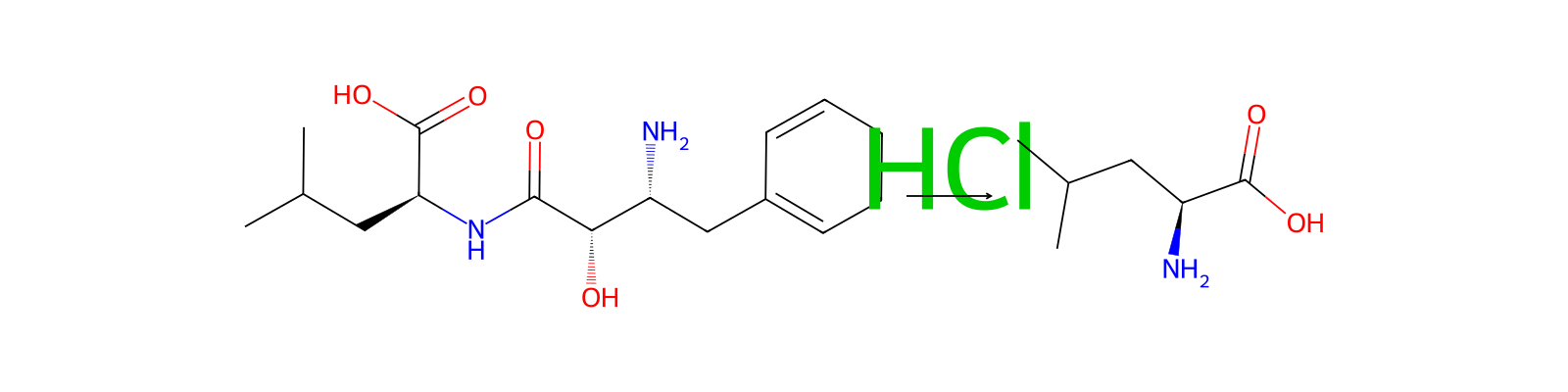
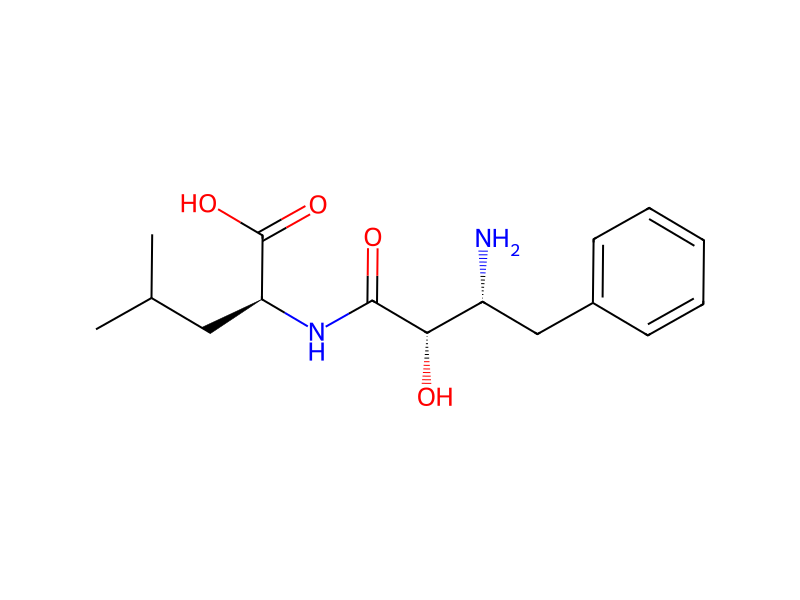
Grundinformationen
- Standard-SMILES
CC(C)C[C@H](NC(=O)[C@@H](O)[C@H](N)Cc1ccccc1)C(=O)O- InChIKey
VGGGPCQERPFHOB-RDBSUJKOSA-N- Summenformel
- C16H24N2O4
- Durchschnittliche Molmasse
- 308,37 g/mol
- Monoisotopische Masse
- 308,17360725
Namen und Bezeichner
- Bevorzugter Name
- Ubenimex
- IUPAC
- (2S)-2-[[(2S,3R)-3-amino-2-hydroxy-4-phenylbutanoyl]amino]-4-methylpentanoic acid
- Englischer Name
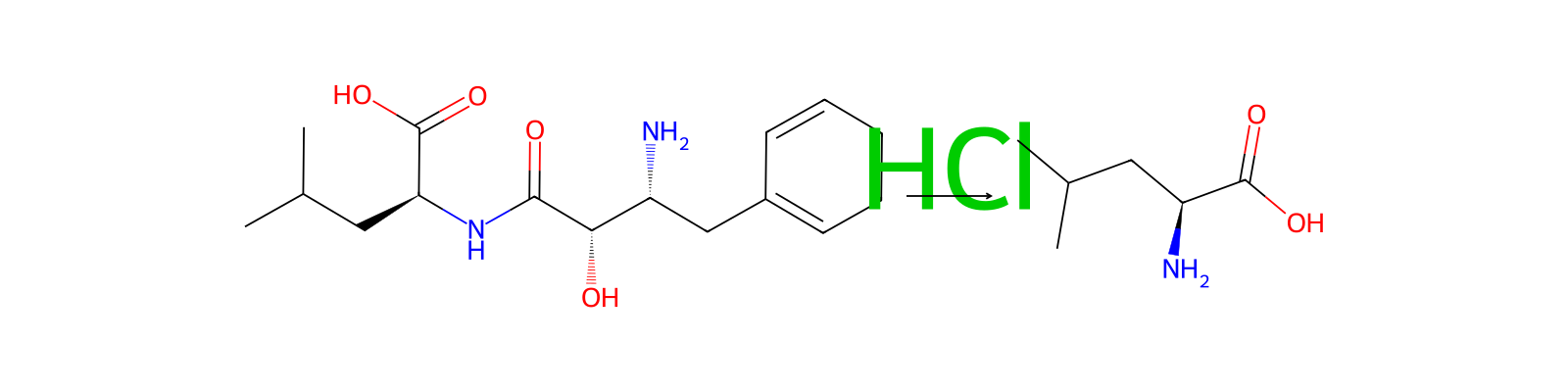
- Bestatin hydrochloride
- Summenformel
- C16H25ClN2O4
- Molmasse
- 344.83
Namen und Synonyme
BestatinUbenimex58970-76-6NK-421UbenimexumNK 421I0J33N5627NSC-265489((2S,3R)-3-amino-2-hydroxy-4-phenylbutanoyl)-L-leucine(3-Amino-2-hydroxy-4-phenylbutanoyl)-L-leucine(S-(R*,S*))-N-(3-Amino-2-hydroxy-4-phenylbutyroyl)-L-leucineL-Leucine, N-(3-amino-2-hydroxy-1-oxo-4-phenylbutyl)-, (S-(R*,S*))-
Weitere Namen anzeigen
Bestatin.HCIBESTATIN HCLUbenimex HClUbenimex-d7 HClUbenimex hydrochlorideHYDROCHLORIDE,UbenimexBestatin HCl - Bio-X ?Wufenmei HydrochlorideBestatin hydrochlorideBestatin research grade
(2S)-2-[[(2S,3R)-3-amino-2-hydroxy-4-phenylbutanoyl]amino]-4-methylpentanoic acidNSC265489DTXSID4048430(2S)-2-(((2S,3R)-3-amino-2-hydroxy-4-phenylbutanoyl)amino)-4-methylpentanoic acidRefChem:9009613-amino-2-hydroxy-4-phenylbutyryl-L-leucine2-((3-amino-2-hydroxy-4-phenylbutanoyl)amino)-4-methylpentanoic acidDTXCID0028404
Datenbank-Bezeichner
- CAS
58970-76-6、65391-42-6- PubChem CID
- 72172
- DTXSID
DTXSID301369975- ChEMBL
CHEMBL29292- UNII
- I0J33N5627
- EC Number
- 261-529-2
- Nikkaji
- J12.831G
Eigenschaften
Berechnete Struktureigenschaften
- XLogP
- -1
- Polarare Oberfläche (TPSA)
- 113 Ų
- H-Brücken-Donoren
- 4
- H-Brücken-Akzeptoren
- 5
- Frei drehbare Bindungen
- 8
- Schwere Atome
- 22
- Formalladung
- 0
- Komplexität
- 367
Physikochemische Eigenschaften
- Schmelzpunkt
- 216 · 216-218 °C
- storage temp.
- 2 · 2-8°C
- Löslichkeit
- 2 O: · H2O: 25 mg/mL, clear, colorless
- Aggregatzustand
- White to off-white powder.
- Farbe
- White
- Biologische Quelle
- synthetic (organic)
- Wasserlöslichkeit
- Soluble in water (4 mg/ml, warm), DMSO (>25 mg/ml), methanol, acetic acid, dimethyl formamide, and 100% ethanol.
- BRN
- 4628066 · 4628066
- Stabilität
- 2 years · Stable for 2 years from date of purchase as supplied. Solutions in DMSO, distilled water, or ethanol may be stored at -20° for up to 1 month.
- InChI
- 1S/C16H24N2O4.ClH/c1-10(2)8-13(16(21)22)18-15(20)14(19)12(17)9-11-6-4-3-5-7-11;/h3-7,10,12-14,19H,8-9,17H2,1-2H3,(H,18,20)(H,21,22);1H/t12-,13+,14+;/m1./s1
- InChIKey
- XGDFITZJGKUSDK-UDYGKFQRSA-N
- SMILES
- O=C(N[C@@H](CC(C)C)C(O)=O)[C@@H](O)[C@H](N)CC1=CC=CC=C1.Cl[H]
- CAS Datenbank
- 65391 · 65391-42-6(CAS DataBase Reference)
Sicherheit und Regulatorisches
GHS-Klassifizierung
GHS Classification
Warning
H315 (100%): Causes skin irritation [Warning Skin corrosion/irritation];H319 (100%): Causes serious eye irritation [Warning Serious eye damage/eye irritation];H335 (100%): May cause respiratory irritation [Warning Specific target organ toxicity, single exposure; Respiratory tract irritation]
P261, P264, P264+P265, P271, P280, P302+P352, P304+P340, P305+P351+P338, P319, P321, P332+P317, P337+P317, P362+P364, P403+P233, P405, and P501 (click each P-code to see the statement)
Aggregated GHS information provided per 2 reports by companies from 2 notifications to the ECHA C&L Inventory. Each notification may be associated with multiple companies.;Information may vary between notifications depending on impurities, additives, and other factors. The percentage value in parenthesis indicates the notified classification ratio from companies that provide hazard codes. Only hazard codes with percentage values above 10% are shown. For more detailed information, please visit ECHA C&L website.
Gefahrenhinweise
Hazard Classes and CategoriesSkin Irrit. 2 (100%);Eye Irrit. 2 (100%);STOT SE 3 (100%)
Sicherheitsdaten
- F
- 3-10
- wgk
- 3
- hs_code
- 29242995
- risk_code
- 20/21/22-36/37/38
- hazard_code
- Xn
- safety_code
- 22-24/25-36-26
- Speicherklasse
- 11 - Combustible Solids
Chemie und Industrie
Pharmakologische Informationen
MeSH Pharmacological Classification
Substances that augment, stimulate, activate, potentiate, or modulate the immune response at either the cellular or humoral level. The classical agents (Freund's adjuvant, BCG, Corynebacterium parvum, et al.) contain bacterial antigens. Some are endogenous (e.g., histamine, interferon, transfer factor, tuftsin, interleukin-1). Their mode of action is either non-specific, resulting in increased immune responsiveness to a wide variety of antigens, or antigen-specific, i.e., affecting a restricted type of immune response to a narrow group of antigens. The therapeutic efficacy of many biological response modifiers is related to their antigen-specific immunoadjuvanticity.
Chemical substances, produced by microorganisms, inhibiting or preventing the proliferation of neoplasms.
Biologically active substances whose activities affect or play a role in the functioning of the immune system.
Compounds which inhibit or antagonize biosynthesis or actions of proteases (ENDOPEPTIDASES).
Agents used to treat AIDS and/or stop the spread of the HIV infection. These do not include drugs used to treat symptoms or opportunistic infections associated with AIDS.
Substances that inhibit the growth or reproduction of BACTERIA.
Anwendungen
Verwendencompetitive aminopeptidase B inhibitor
Anbieter50 Anbieter
梯希爱(上海)化成工业发展有限公司021-67121386 · [email protected]
上海阿拉丁生化科技股份有限公司400-6206333 13167063860 · [email protected]
Shandong chuangyingchemical Co., Ltd.18853181302 · [email protected]
湖南韵邦生物科技股份有限公司85561037 15386497078 · [email protected]
陕西缔都新材料有限公司81124267 17392282731 · [email protected]
上海麦克林生化科技股份有限公司021-50706066 15221275939 · [email protected]
上海毕得医药科技股份有限公司400-1647117 13681763483 · [email protected]
Henan Rane Chemical Co., Ltd.+86-18738066252 · [email protected]
湖北海克斯生化有限公司17362916295; 17362916295 · [email protected]
陕西晨明生物科技有限公司15529026321
湖北研科时代科技有限公司15780669880 · [email protected]
爱斯特(成都)生物制药股份有限公司+86-28-85122536 85324413 · [email protected]
LGM Pharma1-(800)-881-8210 · [email protected]
Syntechem Co.,Ltd[email protected]
湖北威德利化学试剂有限公司17771473825 13385289472 · [email protected]
广东元丰化学试剂有限公司0751-2829979 13318593351 · [email protected]
成都傲飞生物化学品有限责任公司+86-028-60911900 13540204019 · [email protected]
河北鸿韬生物工程有限公司15512737321
United Life Science020-82099279 18988941402 · [email protected]
InvivoChem中国13549236410 · [email protected]
MedBio脉铂医药021-69568360 18916172912 · [email protected]
銳迪國際科技有限公司18024082417 · [email protected]
MedChemexpress LLC021-58955995 · [email protected]
上海稳同科技有限公司02151600108 13062666369 · [email protected]
Creative Peptides[email protected]
ChemeGen 中国18818260767 · [email protected]
TCI AMERICA800-4238616 · [email protected]
TOKYO CHEMICAL INDUSTRY CO., LTD.03-36680489 · [email protected]
TCI Europe320-37350700 · [email protected]
广州爱纯医药科技有限公司020-39119399 18927568969 · [email protected]
山东思扬生物科技有限公司15666921172
上海陶素生化科技有限公司021-33632979 · [email protected]
上海喀露蓝科技有限公司18149758185 18149758185 · [email protected]
北京奥秘佳得医药科技有限公司+86-13522808617 · [email protected]
成都零六生物科技有限公司400-1166-196 13458535857 · [email protected]
湖南华腾制药有限公司400-8592883 · [email protected]
天津普西唐生物医药科技有限公司010-60605840 · [email protected]
杭州杰恒化工有限公司0571-87396432 · [email protected]
梯尔希(南京)药物研发有限公司18012923235 · [email protected]
池州凯隆进出口贸易有限公司[email protected]
Sigma-Aldrich西格玛奥德里奇(上海)贸易有限公司021-61415566 800-8193336 · [email protected]
上海一研生物科技有限公司021-69985186 13611928337 · [email protected]
上海陶术生物科技股份有限公司+1-781-999-5354; +1-00000000000 · [email protected]
四川精萃天成药物科技有限公司028-87865381 18108190480 · [email protected]
九鼎化学(上海)科技有限公司4009209199 · [email protected]
BOC Sciences16314854226; +8616314854226 · [email protected]
湖北魏氏化学试剂股份有限公司13125137732 18686406941
湖北辰心化工有限公司17362916295
山东萍聚生物科技有限公司18613662662; 18613662662
风咏生物(AbMole)021-10000000 13000000000 · [email protected]
Zugehörige Reaktionen
3

Verknüpfte Notizen
Wird geladen…