Benzothiazole
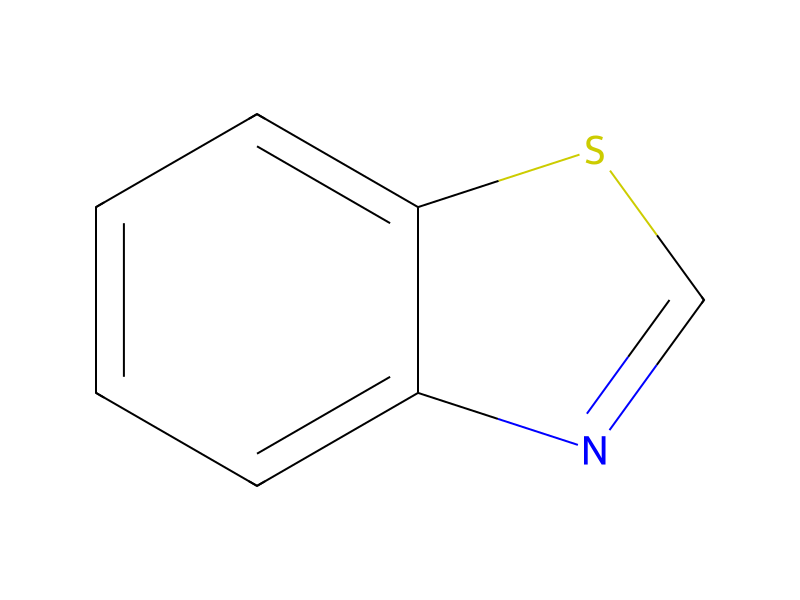
95-16-9c1ccc2scnc2c1IOJUPLGTWVMSFF-UHFFFAOYSA-NBenzothiazole is an organic heterobicyclic compound that is a fusion product between benzene and thiazole. The parent of the class of benzothiazoles. It has a role as a xenobiotic, a plant metabolite and an environmental contaminant.
95-16-9DTXSID7024586CHEMBL510309CHEBI:459932.01
2.03
ODOR SIMILAR TO THAT OF QUINOLINE
Unpleasant odor
1.246 AT 20 °C/4 °C
1.236-1.240
1.238 @25 °C
Sicherheitsangaben dienen nur zur Orientierung und ersetzen weder das Sicherheitsdatenblatt (SDB) des Lieferanten noch geltende Vorschriften oder eine fachliche Bewertung.
Danger
H301+H311 (10.2%): Toxic if swallowed or in contact with skin [Danger Acute toxicity, oral; acute toxicity, dermal]
P261, P262, P264, P264+P265, P270, P271, P280, P301+P316, P301+P317, P302+P352, P304+P340, P305+P351+P338, P316, P317, P321, P330, P337+P317, P361+P364, P405, and P501 (click each P-code to see the statement)
Aggregated GHS information provided per 1775 reports by companies from 12 notifications to the ECHA C&L Inventory. Each notification may be associated with multiple companies.
H402: Harmful to aquatic life [Hazardous to the aquatic environment, acute hazard]
P273, and P501 (click each P-code to see the statement)
Chemical: Benzothiazole
Regulation (EC) No 1831/2003 (amended)
Benzothiazole is listed on the EPA's Chemical Data Reporting (CDR) system. Manufacturers and importers of Benzothiazole are required to report information about their production and use of this chemical to the EPA under the Toxic Substances Control Act (TSCA). (40 eCFR Part 711)
REACH registered substance: Benzothiazole (EC: 202-396-2)
Benzothiazole: Does not have an individual approval but may be used under an appropriate group standard
Not irritating to skin, but irritating to eyes of rabbits; Lethal-dose gavage study of cats produced mild methemoglobinemia and Heinz bodies in up to 100% of erythrocytes; [IUCLID] Safe when used as a flavoring agent in food; [JECFA] A mild skin and eye irritant; Causes pulmonary emboli and other changes to liver in dermal lethal-dose study of rabbits and oral lethal-dose study of rats; [RTECS] A mild skin and strong eye irritant; [Alfa Aesar MSDS]
Used as a flavor, antimicrobial agent, and component of cyanine dyes; Derivatives used as rubber accelerators; [HSDB] Used in organic synthesis; [Merck Index]
FLAVORING SUBSTANCE OR ADJUVANT
RUBBER ACCELERATOR /THIAZOLES/
ANTIMICROBIAL AGENT
Component of cyanine dyes
2023: 250,000 - <550,000 lb
(1986) No Data
PREPD FROM N,N-DIMETHYLANILINE & SULFUR: KNOWLES, WATT, J ORG CHEM 7, 56 (1942).
BY REFLUXING MIXT OF ZINC O-AMINOPHENYLSULFIDE & FORMIC ACID, FOLLOWED BY STEAM DISTILLATION OF ALKALIZED REACTION MIXT...BY HEATING FORMANILID OR DIMETHYLANILINE WITH SULFUR...BY OXIDATION OF 2-MERCAPTOBENZOTHIAZOLE OR OF CORRESPONDING DISULFIDE...
Fragrance Ingredients
Flavouring Agent -> FLAVOURING_AGENT -> JECFA Functional Classes
Flavoring Agents -> JECFA Flavorings Index
Rubber Product Manufacturing
Wird geladen…
SLIGHTLY SOL IN WATER; SOL IN ALC, CARBON DISULFIDE
Very soluble in ether, soluble in acetone, slightly soluble in water.
4.3 mg/mL at 25 °C
Very slightly soluble in water; Soluble in acetone, carbon disulfide
Miscible at room temperature (in ethanol)
227-228 °C AT 765 MM HG
231.00 to 233.00 °C. @ 760.00 mm Hg
231 °C
231 °C @760 [mm Hg]
Drzyga O et al; Appl Environ Microbiol 62 (5): 1710-16 (1996). Cometabolic transformation and cleavage of nitrodiphenylamines by three newly isolated sulfate reducing bacterial strains.
Paxeus N; Water Res 30 (5): 1115-22 (1996). Organic pollutants in the effluents of large wastewater treatment plants in Sweden.
Puig A et al; J Chromatog 733 (1-2): 511-22 (1996). Wastewater from the manufacture of rubber vulcanization accelerators: Characterization, downstream monitoring and chemical treatment.
Scott BF et al; Water Qual Res J Canada 31 (2): 341-60 (1996). Determination of benzothiazole and alkylphosphates in water samples from the Great Lakes drainage basin.
For more Special Reports (Complete) data for BENZOTHIAZOLE (10 total), please visit the HSDB record page.
Acute Tox. 3 (88.2%)
Acute toxicity (Oral) - Category 4
Hazardous to the aquatic environment (Acute) - Category 3
REACT WITH WATER, STEAM OR ACIDS TO PRODUCE TOXIC & FLAMMABLE VAPORS OF HYDROGEN SULFIDE. /SULFIDES/
ON CONTACT WITH ACID, ACID FUMES, WATER OR STEAM, THEY WILL PRODUCE TOXIC & FLAMMABLE VAPORS. /CYANIDES/
SRP: At the time of review, criteria for land treatment or burial (sanitary landfill) disposal practices are subject to significant revision. Prior to implementing land disposal of waste residue (including waste sludge), consult with environmental regulatory agencies for guidance on acceptable disposal practices.
1.1 [mg/m3]
13 [mg/m3]
75 [mg/m3]
TERRESTRIAL FATE: Based on a recommended classification scheme(1), an estimated Koc value of 295(SRC), determined from an experimental log Kow(2,SRC) and a recommended regression-derived equation(3), indicates that benzothiazole will have moderate mobility in soil(SRC). Volatilization of benzothiazole will not be important from moist soil surfaces(SRC) given an estimated Henry's Law constant of 3.7X10⁻⁷ atm-cu m/mole(SRC), using a fragment constant estimation method(4). Biodegradation of benzothiazole occurs rapidly under aerobic conditions. Employing a standard BOD dilution technique and an activated sludge inoculum, a theoretical BOD of 100% was observed for a 0.0125 mM sample of benzothiazole over an unspecified time period(5). Unspecified concentrations of benzothiazole were degraded by both mixed cultures and activated sludge mediums(6).
AQUATIC FATE: Based on a recommended classification scheme(1), an estimated Koc value of 295(SRC), determined from an experimental log Kow(2,SRC) and a recommended regression-derived equation(1), indicates that benzothiazole may adsorb to suspended solids and sediment in water(SRC). Volatilization from water surfaces should be slow based upon an estimated Henry's law constant of 3.7X10⁻⁷ atm-cu m/mol (SRC), developed using a fragment constant estimation method(3). Estimated half-lives for a model river and model lake are 114 and 832 days, respectively(1,SRC). According to a classification scheme(4), an estimated BCF value of 20(1,SRC), from an experimental log Kow(2), suggests that bioconcentration in aquatic organisms is low(SRC). The biodegradation of benzothiazole occurs rapidly under aerobic conditions. Complete biodegradation of 72X10-6 mols/l of benzothiazole incorporated into an activated sludge medium obtained from a municipal wastewater treatment facility was observed after a period of 16 days(5).
ATMOSPHERIC FATE: According to a model of gas/particle partitioning of semivolatile organic compounds in the atmosphere(1), benzothiazole, which has an estimated vapor pressure of 0.014 mm Hg at 25 °C(2,SRC), will exist solely as a vapor in the ambient atmosphere. Benzothiazole is degraded in the atmosphere by reaction with photochemically-produced hydroxyl radicals(SRC); the half-life for this reaction in air is estimated to be about 18 hours(3,SRC).
Quantities of benzothiazole were found in salt fermented anchovies and hair tail viscera shrimp at concentrations of 124 ng/g and 247 ng/g respectively(1). Unspecified amounts of benzothiazole were detected in samples of cassava roots from the Dominican Republic(2), nectarines from California(3), apples from Kogyoku, Japan(4) and volatiles of roasted filbert nuts(5).
ONE OF 2 TIRE PLANTS STUDIED FOR TRACE ORGANIC COMPDS IN WASTE WATERS RECYCLES ANTI-TACK SOLN & EMITS MOSTLY BENZOTHIAZOLE & 2-MERCAPTOBENZOTHIAZOLE.
Benzothiazole was detected in effluents of German incinerator plants at concentrations of about 3.1X10⁻⁷ g/cu m (1). Unspecified concentrations of benzothiazole were detected in pyrolytic oil waste streams in Winchester, Virginia following a fire at a tire storage facility(2). Unspecified concentrations of benzothiazole were detected in effluents from rubber vulcanization manufacturing facilities(3,4). Concentrations of 2 ppb were detected in wastewater streams in the vicinity of a specialty chemical manufacturing plant whose location was not specified(5). Benzothiazole was detected in tire manufacturing plant wastewater streams at unspecified locations at concentrations of 20-60 ppb(6).
The Koc of benzothiazole is estimated as approximately 295(SRC), using an experimental log Kow of 2.01(1,SRC) and a regression-derived equation(2,SRC). According to a recommended classification scheme(3), this estimated Koc value suggests that benzothiazole has moderate mobility in soil(SRC).
Benzothiazole's production and use as a synthetic reagent in organic chemistry(1) may result in its release to the environment through various waste streams(SRC). The degradation of fungicides containing 2-(thiocyanomethylthio)benzothiazole and the rubber vulcanization agent, 2-mercaptobenzothiazole results in the formation of benzothiazole(2).
Complete biodegradation of 72X10-6 mols/l of benzothiazole incorporated into an activated sludge medium obtained from a municipal wastewater treatment facility was observed after 16 days (1). Employing a standard BOD dilution technique and an activated sludge inoculum, a theoretical BOD of 100% was observed for a 0.0125 mM sample of benzothiazole over an unspecified time period, while a 0.125 mM sample produced a theoretical BOD of 10%(2). An activated sludge innoculum biodegraded benzothiozaole over a 6 month incubation period(3). This data would suggest that low levels of benzothiazole are totally biodegraded, while high concentrations are expected to be toxic to microbes(SRC).
An estimated BCF value of 20 was calculated for benzothiazole(SRC), using an experimental log Kow of 2.01(1) and a recommended regression-derived equation(2). According to a classification scheme(3), this BCF value suggests that bioconcentration in aquatic organisms is low(SRC).
Benzothiazole: ACTIVE
REPORTED USES: NON-ALCOHOLIC BEVERAGES, CANDY, BAKED GOODS, MEAT, MEAT SAUCES, SOUPS, MILK, DAIRY PRODUCTS ALL 0.5 PPM. /FROM TABLE/
BENZOTHIAZOLE IS USED TO PREVENT MICROBIAL GROWTH IN SHOES & ATHLETES FOOT DEVELOPMENT. POROUS INSOLES ARE IMPREGNATED WITH SOLN CONTAINING BENZOTHIAZOLE.
...IN...COCOA, SHALLOW-FRIED BEEF, SOYBEAN MILK, STORED CASEIN, HEATED MILK, STALE NON-FAT DRY MILK, & STERILIZED CONCENTRATED MILK...ONLY THIAZOLE DERIV REPORTED WAS BENZOTHIAZOLE.
...BENZOTHIAZOLE /WAS REPORTED/ TO BE PRESENT IN BEER.
BeschreibungStibinobenzol bildet ein gelbes, wasserunlösliches, an der Luft sehr oxidables Pulver. Manchmal verläuft die Oxidation so lebhaft, daß die Substanz Feuer fängt. Konzentrierte Salpetersäure bewirkt explosionsartige Zersetzung. Stibinobenzol hat keinen defi
BeschreibungBenzothiazole and its derivative are recognized as the most important heterocyclic compounds. This series of compounds is of particular interests. It has various kinds of pharmacological properties and has been included in many kinds of natural products and pharmaceutical agents. The broad spectrum of pharmacological activity in individual benzothiazole derivative enables it to serve as unique and valuable scaffolds for experimental drug design. It is already known that benzothiazole and its derivative has various biological applications including anticancer, antimicrobial, anticonvulsant, antiviral, antidiabetic, antipsychotic, antiinflammatory, analgesic, fungicidal and diuretic. Its derivatives also have many applications in polymer chemistry, dyes, drugs, and silver photography as well as rubber industry.
OccurrenceReported found in apricot, cooked asparagus, mozzarella cheese, skim milk powder, roasted beef, beer, malt whiskey, coconut meat, fresh mango, cooked broccoli and kelp.
VerwendenVarious benzothiazole-benzamides synthesized were evaluated for their analgesic and antidepressant activities.
synthetischeBy refluxing a mixture of zinc o-aminophenylsulfide and formic acid, followed by steam distillation of the alkalized reaction mixture; by heating formanilid or dimethylaniline with sulfur; by oxidation of 2-mercaptobenzothiazole or of the corresponding disulfide.
DefinitionChEBI: An organic heterobicyclic compound that is a fusion product between benzene and thiazole. The parent of the class of benzothiazoles.