
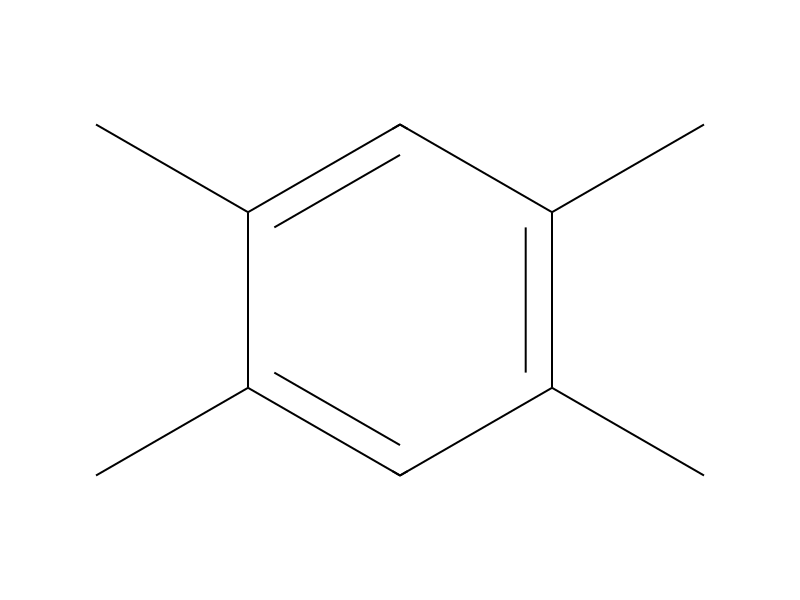
Grundinformationen
- Standard-SMILES
Cc1cc(C)c(C)cc1C- InChIKey
SQNZJJAZBFDUTD-UHFFFAOYSA-N- Summenformel
- C10H14
- Durchschnittliche Molmasse
- 134,22 g/mol
- Monoisotopische Masse
- 134,10955045
Überblick
1,2,4,5-tetramethylbenzene appears as colorless crystals with a camphor-like odor. (NTP, 1992)
Namen und Bezeichner
- Bevorzugter Name
- Durene
- IUPAC
- 1,2,4,5-tetramethylbenzene
- Lokaler Name
- 1,2,4,5-Tetramethylbenzol
- Englischer Name
- 1,2,4,5-Tetramethylbenzene
- Summenformel
- C10H14
- Molmasse
- 134.22
Namen und Synonyme
1,2,4,5-TETRAMETHYLBENZENEDurene95-93-2DurolBenzene, 1,2,4,5-tetramethyl-p-Xylene, 2,5-dimethyl-DTXSID1029124181426CFYBNSC-6770DTXCID309124CHEBI:38978RefChem:590468
Weitere Namen anzeigen
1,2,4,5-TETRAMETHYLBENZENE (DURENE)1,2,4,5-TetramethyL1,2,4,5-TERAMETHYLBENZENEbenzene,1,2,4,5-tetramethyl-Durol[R]1.2.4.5-TetraMThymol Impurity?401,2,4,5-Tetramethylb
202-465-7MFCD000085281,2,4,5-tetramethyl-benzeneCAS-95-93-2NSC 6770EINECS 202-465-7DurenUNII-181426CFYB
Datenbank-Bezeichner
- CAS
95-93-2- PubChem CID
- 7269
- DTXSID
DTXSID1029124- ChEMBL
CHEMBL1797134- ChEBI
CHEBI:38978- UNII
- 181426CFYB
- EC Number
- 202-465-7
- Nikkaji
- J4.714G
Eigenschaften
Berechnete Struktureigenschaften
- XLogP
- 4
- Polarare Oberfläche (TPSA)
- 0 Ų
- H-Brücken-Donoren
- 0
- H-Brücken-Akzeptoren
- 0
- Frei drehbare Bindungen
- 0
- Schwere Atome
- 10
- Formalladung
- 0
- Komplexität
- 80,6
Experimentelle und physikochemische Eigenschaften
Chemical ClassesOther Classes -> Aromatic Hydrocarbons
SpringerMaterials Properties13C nuclear magnetic resonance spectrum
Density
0.8875 at 68 °F (NTP, 1992) - Less dense than water; will float
0.838 @ 81°C
Flash Point
130 °F (NFPA, 2010)
74 °C
Boiling Point
386.2 °F at 760 mmHg (NTP, 1992)
196 °C @760 [mm Hg]
Melting Point174.6 °F (NTP, 1992)
Physical Description
1,2,4,5-tetramethylbenzene appears as colorless crystals with a camphor-like odor. (NTP, 1992)
Colorless solid; [CAMEO]
Physikochemische Eigenschaften
- Schmelzpunkt
- 78 °C · 78 °C
- Siedepunkt
- 196 · 196-197 °C
- Dichte
- 0.838 g/mL · 0.838 g/mL at 25 °C(lit.)
- Dampfdichte
- 4.6 · 4.6 (vs air)
- Dampfdruck
- 160 mm · 160 mm Hg ( 140 °C)
- Brechungsindex
- 1.5093 · 1.5093
- Flammpunkt
- 165 °F · 165 °F
- storage temp.
- Flammables area
- Löslichkeit
- 0.00348 g/l · 0.00348g/l
- Aggregatzustand
- crystals
- Farbe
- White to Almost white
- Wichte
- 0.838 · 0.838
- Geruch (Odor)
- rancid sweet
- Wasserlöslichkeit
- insoluble
- Spezifische Wärmekapazität
- 1.6 J/ · Cp(crystal): 1.6 J/(g·K), at 25℃
- Merck
- 14 · 14,3468
- BRN
- 1903393 · 1903393
- Henry's Law Constant
- 2.49 at · 2.49 at 25 °C (approximate - calculated from water solubility and vapor pressure)
- InChI
- 1S/C10H14/c1-7-5-9(3)10(4)6-8(7)2/h5-6H,1-4H3
- InChIKey
- SQNZJJAZBFDUTD-UHFFFAOYSA-N
- SMILES
- Cc1cc(C)c(C)cc1C
- LogP
- 4 · 4.000
- CAS Datenbank
- 95 · 95-93-2(CAS DataBase Reference)
- NIST chemische Informationen
- 1 · Benzene, 1,2,4,5-tetramethyl-(95-93-2)
- EPA chemische Informationen
- 1 · 1,2,4,5-Tetramethylbenzene (95-93-2)
Sicherheit und Regulatorisches
GHS-Klassifizierung
GHS Classification
This chemical does not meet GHS hazard criteria for 8.1% (24 of 298) of reports.
Danger
H228 (89.6%): Flammable solid [Danger Flammable solids]
P210, P240, P241, P273, P280, P370+P378, and P501 (click each P-code to see the statement)
Aggregated GHS information provided per 298 reports by companies from 7 notifications to the ECHA C&L Inventory. Each notification may be associated with multiple companies.
Gefahrenhinweise
Regulatory Information
Chemical: Benzene, 1,2,4,5-tetramethyl-
Benzene, 1,2,4,5-tetramethyl-: Does not have an individual approval but may be used under an appropriate group standard
DOT LabelFlammable Solid
Fire HazardsExcerpt from ERG Guide 133 [Flammable Solids]:
Health HazardsExcerpt from ERG Guide 133 [Flammable Solids]:
Reactive GroupHydrocarbons, Aromatic
Reactivity Profile
Vigorous reactions, sometimes amounting to explosions, can result from the contact between aromatic hydrocarbons, such as 1,2,4,5-TETRAMETHYLBENZENE, and strong oxidizing agents. They can react exothermically with bases and with diazo compounds. Substitution at the benzene nucleus occurs by halogenation (acid catalyst), nitration, sulfonation, and the Friedel-Crafts reaction.
Air and Water ReactionsInsoluble in water.
Hazard Classes and CategoriesFlam. Sol. 1 (89.6%)
Sicherheit und Schutzausrüstung
Fire FightingTo extinguish a fire involving this chemical you may use a dry chemical, carbon dioxide, foam or halon extinguisher; a water spray may also be used. (NTP, 1992)
First Aid
EYES: First check the victim for contact lenses and remove if present. Flush victim's eyes with water or normal saline solution for 20 to 30 minutes while simultaneously calling a hospital or poison control center. Do not put any ointments, oils, or medication in the victim's eyes without specific instructions from a physician. IMMEDIATELY transport the victim after flushing eyes to a hospital even if no symptoms (such as redness or irritation) develop.
Nonfire Spill Response
SMALL SPILLS AND LEAKAGE: If you spill this chemical, use absorbent paper to pick up all liquid spill material. Your contaminated clothing and absorbent paper should be sealed in a vapor-tight plastic bag for eventual disposal. Solvent wash all contaminated surfaces with alcohol followed by washing with a strong soap and water solution. Do not reenter the contaminated area until the Safety Officer (or other responsible person) has verified that the area has been properly cleaned.
Isolation and EvacuationExcerpt from ERG Guide 133 [Flammable Solids]:
Protective Action Criteria (PAC)
21 [mg/m3]
230 [mg/m3]
1400 [mg/m3]
Personal Protective Equipment (PPE)
RECOMMENDED RESPIRATOR: Where the neat test chemical is weighed and diluted, wear a NIOSH-approved half face respirator equipped with an organic vapor/acid gas cartridge (specific for organic vapors, HCl, acid gas and SO2) with a dust/mist filter.
Sicherheitsdaten
- wgk
- 1
- tsca
- TSCA listed
- ridadr
- UN 1325 4.1/PG 2
- hs_code
- 29029080
- RTECS-Nr.
- DC0500000
- risk_code
- 11-53-50
- Toxizität
- LD50 orally in Rabbit: 6700 mg/kg
- hazard_code
- F,N
- safety_code
- 16-61
- hazard_class
- 4.1
- packing_group
- III
- Speicherklasse
- 4.1B - Flammable solid hazardous materials
- Hazard Classifications
- Aquatic Acute 1Aquatic Chronic 1Flam. Sol. 1
Chemie und Industrie
Verwendung und Herstellung
UsesOccurs in coal tar; [Merck Index]
General Manufacturing InformationBenzene, 1,2,4,5-tetramethyl-: ACTIVE
Anwendungen
Verwenden1,2,4,5-Tetramethylbenzene is used in method for reducing odor in room in remodeling work by removing causative substances.
Vor- und nachgelagerte Produkte
Vorgelagerte Rohstoffe
Nachgelagerte Produkte
Anbieter50 Anbieter
国药集团化学试剂有限公司86-21-63210123 · [email protected]
梯希爱(上海)化成工业发展有限公司021-67121386 · [email protected]
阿诺西(上海)生物技术有限公司400-1107768 15058188853 · [email protected]
上海阿拉丁生化科技股份有限公司400-6206333 13167063860 · [email protected]
南通润丰石油化工有限公司66017690 19952660367 · [email protected]
湖北成丰化工有限公司13125175253 · [email protected]
湖北鑫杰成化工科技有限公司13554075426 · [email protected]
武汉欣扬瑞和化学科技有限公司153-07155313 15307155313 · [email protected]
杭州品高化工有限公司0571-87658025 · [email protected]
温州共赢化学有限公司+86-0086-577-64498589 +86-15355981851 · [email protected]
爱斯特(成都)生物制药股份有限公司+86-28-85122536 85324413 · [email protected]
山东前元高分子材料有限公司18678041314 18765609661 · [email protected]
Dayang Chem (Hangzhou) Co.,Ltd.+86-0571-88938639 17705817739 · [email protected]
衢州明锋化工有限公司0570-3062502 13819002126;13819008176 · [email protected]
Syntechem Co.,Ltd[email protected]
河北秒变生物科技有限公司17733850068
上海迈瑞尔生化科技有限公司4006356688 18621169109 · [email protected]
上海辅欣医药科技有限公司+86-021-021-50872116 · [email protected]
江苏普乐司生物科技有限公司0513-66017706 18551496367 · [email protected]
上海晶抗生物工程有限公司021-54721350 13524668266 · [email protected]
武汉市聚舜化工有限公司027-02783261126 18971318572 · [email protected]
阿法埃莎(中国)化学有限公司400-6106006 · [email protected]
安耐吉化学&3A(安徽泽升科技股份有限公司)400-0056266 · [email protected]
梯希爱(上海)化工贸易有限公司021-61109150 · [email protected]
上海瀚鸿科技股份有限公司021-54306202 13764082696 · [email protected]
山东洛克化工有限公司17653113209 13065062079 · [email protected]
上海景颜化工科技有限公司13817811078 · [email protected]
嘉兴市艾森化工有限公司0573-85285100 18627885956 · [email protected]
上海毕楷科技有限公司18516304666
四川库利南科技有限公司400-1166-196 18981987031 · [email protected]
天津希恩思生化科技有限公司400 638 7771 · [email protected]
Xiamen AmoyChem Co., Ltd+86-86-5926051114 · [email protected]
斯百全化学(上海)有限公司021-021-021-67601398-809-809-809 15221380277 · [email protected]
上海思域化工科技有限公司86-21-34053660 · [email protected]
赛默飞世尔科技(中国)有限公司800-810-5118 · [email protected]
北京伊诺凯科技有限公司400-810-7969 010-59572699 · [email protected]
TOKYO CHEMICAL INDUSTRY CO., LTD.03-36680489 · [email protected]
越林试剂021-62960152 · [email protected]
安徽科迪达化工有限公司0554-2106669 · [email protected]
日照力德士化工有限公司010-51268198 · [email protected]
郑州阿尔法化工有限公司0371-53732842 15981811963 · [email protected]
美岚实业(上海)有限公司021-58958189 · [email protected]
上海爱蝶实业有限公司021-58957966 18930537195 · [email protected]
上海麦克林生化科技股份有限公司15221275939 15221275939 · [email protected]
Sigma-Aldrich西格玛奥德里奇(上海)贸易有限公司021-61415566 800-8193336 · [email protected]
大连易得瑞化工有限公司15141125520 15141125520 · [email protected]
成都瑞欧克科技有限公司028-64353063 · [email protected]
九鼎化学(上海)科技有限公司4009209199 · [email protected]
武汉峰耀同辉化学制品有限公司027-87466205 15377579727 · [email protected]
厦门志信化学有限公司+86-5922680277 +86-13806087780 · [email protected]
Zugehörige Reaktionen
16


Verknüpfte Notizen
Wird geladen…