
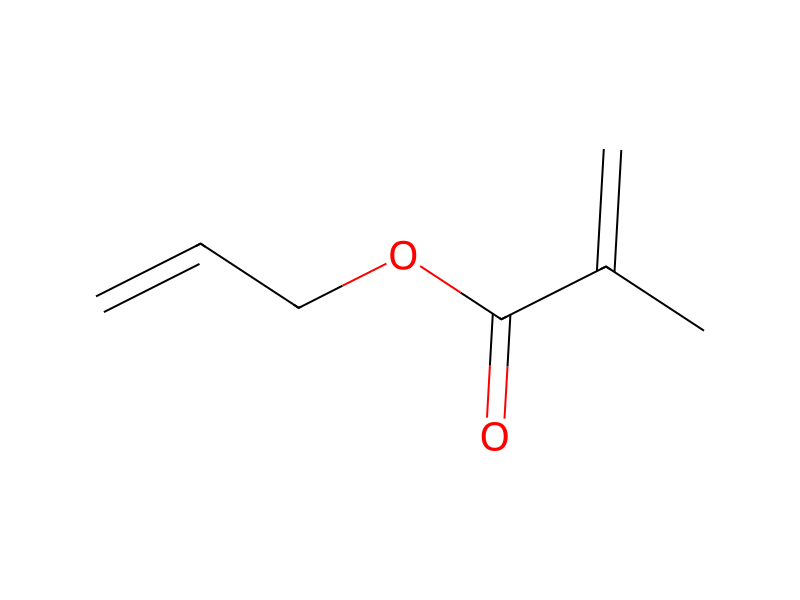
Grundinformationen
- Standard-SMILES
C=CCOC(=O)C(=C)C- InChIKey
FBCQUCJYYPMKRO-UHFFFAOYSA-N- Summenformel
- C7H10O2
- Durchschnittliche Molmasse
- 126,15 g/mol
- Monoisotopische Masse
- 126,06807956
Namen und Bezeichner
- Bevorzugter Name
- Allyl methacrylate
- IUPAC
- prop-2-enyl 2-methylprop-2-enoate
- Englischer Name
- Allyl methacrylate
- Summenformel
- C7H10O2
- Molmasse
- 126.1531
Namen und Synonyme
ALLYL METHACRYLATE96-05-9Ageflex AMAMethacrylic acid, allyl ester2-Propenoic acid, 2-methyl-, 2-propenyl esterAllylester kyseliny methakryloveDTXSID2021816G2IG50653ZNSC-185972-Propenoic acid, 2-methyl-, 2-propen-1-yl esterDTXCID401816RefChem:6794
Weitere Namen anzeigen
202-473-0Methacrylic Acid Allyl Esterprop-2-enyl 2-methylprop-2-enoateNSC 18597prop-2-en-1-yl 2-methylprop-2-enoateMFCD00008592Allyl Methacrylate (stabilized with MEHQ)allylmethacrylate
Datenbank-Bezeichner
- CAS
96-05-9- PubChem CID
- 7274
- DTXSID
DTXSID2021816- ChEMBL
CHEMBL1889548- UNII
- G2IG50653Z
- EC Number
- 202-473-0
- Nikkaji
- J38.884J
Eigenschaften
Berechnete Struktureigenschaften
- XLogP
- 1,7
- Polarare Oberfläche (TPSA)
- 26,3 Ų
- H-Brücken-Donoren
- 0
- H-Brücken-Akzeptoren
- 2
- Frei drehbare Bindungen
- 4
- Schwere Atome
- 9
- Formalladung
- 0
- Komplexität
- 136
Experimentelle und physikochemische Eigenschaften
Density
0.9335 g/cu cm at 20 °C
0.9335
Viscosity12 mPa-s at 20 °C
Color/FormColorless liquid
Flash Point33.9 °C
Boiling Point
150 °C
302 °F
DecompositionWhen heated to decomposition it emits acrid smoke and irritating fumes.
Polymerization
Methyl methacrylate, and in general the methacrylic esters, polymerize much less readily than the corresponding ordinary acrylates. None the less, they are stabilized by adding hydroquinone or pyrogallol, particularly in the presence of metallic copper. /Methacrylates/
Vapor Pressure
5.77 [mmHg]
5.77 mm Hg at 25 °C
5.77 mmHg
Refractive Index
Index of refraction: 1.4360 at 20 °C
Index of refraction: 1.4328 at 25 °C/D
Physical Description
Liquid
Clear colorless liquid with a pungent odor; [ACGIH]
Colorless liquid.
Kovats Retention Index
849
1188
Other Experimental Properties67 °C at 50 mm Hg; 55 °C at 30 mm Hg
Physikochemische Eigenschaften
- Siedepunkt
- 30 · 30-50 °C(Press: 23 Torr)
- Dichte
- 0.927 g/cm3 · 0.927 g/cm3
Sicherheit und Regulatorisches
GHS-Klassifizierung
GHS Classification
Danger
H226: Flammable liquid and vapor [Warning Flammable liquids];H302: Harmful if swallowed [Warning Acute toxicity, oral];H311: Toxic in contact with skin [Danger Acute toxicity, dermal];H330: Fatal if inhaled [Danger Acute toxicity, inhalation];H400: Very toxic to aquatic life [Warning Hazardous to the aquatic environment, acute hazard]
P210, P233, P240, P241, P242, P243, P260, P262, P264, P270, P271, P273, P280, P284, P301+P317, P302+P352, P303+P361+P353, P304+P340, P316, P320, P321, P330, P361+P364, P370+P378, P391, P403+P233, P403+P235, P405, and P501 (click each P-code to see the statement)
Danger
Gefahrenhinweise
Regulatory Information
Chemical: 2-Propenoic acid, 2-methyl-, 2-propenyl ester
2-Propenoic acid, 2-methyl-, 2-propen-1-yl ester is listed on the EPA's Chemical Data Reporting (CDR) system. Manufacturers and importers of 2-Propenoic acid, 2-methyl-, 2-propen-1-yl ester are required to report information about their production and use of this chemical to the EPA under the Toxic Substances Control Act (TSCA). (40 eCFR Part 711)
Status: Active Update: 17-11-2022 https://echa.europa.eu/registration-dossier/-/registered-dossier/14401
2-Propenoic acid, 2-methyl-, 2-propenyl ester: HSNO Approval: HSR001394 Approved with controls
Hazards Summary
TLV Basis: liver damage; Causes liver damage in rats fed 60/mg/kg/day but not at 15 mg/kg/day; Three individuals reported skin irritation after exposure to 3% allyl methacrylate in olive oil; No reports of skin sensitization in humans or after animal testing; [ACGIH] See ACRYLIC RESINS (MONOMERS).
Hazard Classes and Categories
Flam. Liq. 3 (99.7%);Acute Tox. 4 (99.7%);Acute Tox. 3 (34.5%);Acute Tox. 4 (65.5%);Acute Tox. 2 (34.5%);Acute Tox. 3 (62.5%);STOT RE 2 (34.5%);Aquatic Acute 1 (99.7%);Aquatic Chronic 3 (33.4%)
Flammable liquid - category 3;Hazardous to the aquatic environment (acute) - category 1;Acute toxicity (inhalation) - category 3;Acute toxicity (dermal) - category 4;Acute toxicity (ingestion) - category 4
Flammable liquids - Category 3;Acute toxicity (Oral) - Category 4;Acute toxicity (Dermal) - Category 3;Skin corrosion/irritation - Category 2;Hazardous to the aquatic environment (Acute) - Category 1
Flammable liquids - Category 3;Acute toxicity (Oral) - Category 4;Acute toxicity (Dermal) - Category 3;Acute toxicity (Inhalation: Vapours) - Category 2;Serious eye damage/eye irritation - Category 2B;Specific target organ toxicity - Single exposure - Category 2 (liver), Category 3 (narcotic effects, respiratory tract irritation);Specific target organ toxicity - Repeated exposure - Category 2 (liver);Hazardous to the aquatic environment (Acute) - Category 1
Flam. Liq. 3;Acute Tox. 2;Acute Tox. 3;Acute Tox. 4;Aquatic Acute 1
Skin, Eye, and Respiratory Irritations
Methacrylates ... produce slight to moderate skin and eye irritation ... depending upon volatility, these materials also may be sensory irritants. /Methacrylic acid & derivatives/
A skin and eye irritant.
Sicherheit und Schutzausrüstung
Storage Conditions
Temp during storage must be kept low to minimize formation of peroxides and other oxidation products. ... Storage temp below 30 °C are recommended for the polyfunctional methacrylates. ... The methacrylate monomers should not be stored for longer than one year. Shorter storage times are recommended for the aminomethacrylates, ie, three months, and the polyfunctional methacrylates, ie, six months. Many of these cmpd are sensitive to UV light and should, therefore, be stored in the dark. The methacryclic esters may be stored in mild steel, stainless steel, or aluminum. /Methiacrylic acid & derivatives/
Cleanup Methods
SRP: Wastewater from contaminant suppression, cleaning of protective clothing/equipment, or contaminated sites should be contained and evaluated for subject chemical or decomposition product concentrations. Concentrations shall be lower than applicable environmental discharge or disposal criteria. Alternatively, pretreatment and/or discharge to a permitted wastewater treatment facility is acceptable only after review by the governing authority and assurance that "pass through" violations will not occur. Due consideration shall be given to remediation worker exposure (inhalation, dermal and ingestion) as well as fate during treatment, transfer and disposal. If it is not practicable to manage the chemical in this fashion, it must be evaluated in accordance with EPA 40 CFR Part 261, specifically Subpart B, in order to determine the appropriate local, state and federal requirements for disposal.
Disposal Methods
SRP: The most favorable course of action is to use an alternative chemical product with less inherent propensity for occupational harm/injury/toxicity or environmental contamination. Recycle any unused portion of the material for its approved use or return it to the manufacturer or supplier. Ultimate disposal of the chemical must consider: the material's impact on air quality; potential migration in soil or water; effects on animal and plant life; and conformance with environmental and public health regulations.
SRP: Criteria for land treatment or burial (sanitary landfill) disposal practices are subject to significant revision. Prior to implementing land disposal of waste residue (including waste sludge), consult with environmental regulatory agencies for guidance on acceptable disposal practices.
Preventive Measures
SRP: The scientific literature for the use of contact lenses by industrial workers is inconsistent. The benefits or detrimental effects of wearing contact lenses depend not only upon the substance, but also on factors including the form of the substance, characteristics and duration of the exposure, the uses of other eye protection equipment, and the hygiene of the lenses. However, there may be individual substances whose irritating or corrosive properties are such that the wearing of contact lenses would be harmful to the eye. In those specific cases, contact lenses should not be worn. In any event, the usual eye protection equipment should be worn even when contact lenses are in place.
SRP: Contaminated protective clothing should be segregated in a manner that results in no direct personal contact by personnel who handle, dispose of, or clean the clothing. Quality assurance procedures to confirm the efficacy of the cleaning procedures should be implemented prior to the decontaminated protective clothing being returned for reuse by the workers. Contaminated clothing (including shoes/socks) should not be taken home at end of shift, but should remain at employee's place of work for cleaning.
... Hazard is the generation of considerable exothermic heat in some of the reactions, so that high pressures & temp may develop. This danger ... should be borne in mind when designing plant. Awareness of the dangers and of good engineering design are essential to safety. Employees should be instructed about the necessity of cleansing the skin if it is contaminated by materials which are irritants or skin-absorbed. With careful design, however, and complete enclosure of those processes where toxic chemicals or intermediates occur, dangerous exposures can be avoided. /Acrylic acid & derivatives/
Threshold Limit Values (TLV)
1.0 [ppm]
1 ppm [2017]
Personal Protective Equipment (PPE)Suitable protective clothing and self-contained respiratory protective apparatus should be available for use of those who may have to rescue persons overcome by fumes. /Acrylic acid and derivatives/
Toxikologische Informationen
Ecotoxicity Values
LC50; Species: Pimephales promelas (Fathead minnow, age 30 days, mean length 20.6 mm, mean weight 0.132 g); Conditions: flow through, 24.9 °C, pH 7.66, hardness 45.6 mg/L (CaCO3), dissolved oxygen 7.1 mg/L, alkalinity 44.4 mg/L (CaCO3); Concentration: 0.99 mg/L for 96 hr (95% confidence limit 0.90-1.1 mg/L) /98+% purity/
Environmental Fate
TERRESTRIAL FATE: Based on a classification scheme(1), an estimated Koc value of 110(SRC), determined from a structure estimation method(2), indicates that allyl methacrylate is expected to have high mobility in soil(SRC). Volatilization of allyl methacrylate from moist soil surfaces is expected to be an important fate process(SRC) given an estimated Henry's Law constant of 4.1X10⁻⁴ atm-cu m/mole(SRC), using a fragment constant estimation method(3). Allyl methacrylate is expected to volatilize from dry soil surfaces(SRC) based upon a vapor pressure of 5.77 mm Hg at 25 °C(4). A 62% of theoretical BOD using activated sludge in the Japanese MITI test(5) suggests that biodegradation is an important environmental fate process in soil(SRC).
AQUATIC FATE: Based on a classification scheme(1), an estimated Koc value of 110(SRC), determined from a structure estimation method(2), indicates that allyl methacrylate is not expected to adsorb to suspended solids and sediment(SRC). Volatilization from water surfaces is expected(3) based upon an estimated Henry's Law constant of 4.1X10⁻⁴ atm-cu m/mole(SRC), developed using a fragment constant estimation method(4). Using this Henry's Law constant and an estimation method(3), volatilization half-lives for a model river and model lake are 5.7 hours and 5.2 days, respectively(SRC). According to a classification scheme(5), an estimated BCF of 12(SRC), from an estimated log Kow of 2.12(6) and a regression-derived equation(7), suggests the potential for bioconcentration in aquatic organisms is low(SRC). A 62% of theoretical BOD using activated sludge in the Japanese MITI test(8) suggests that biodegradation is an important environmental process in water(SRC).
ATMOSPHERIC FATE: According to a model of gas/particle partitioning of semivolatile organic compounds in the atmosphere(1), allyl methacrylate, which has a vapor pressure of 5.77 mm Hg at 25 °C(2), is expected to exist solely as a vapor in the ambient atmosphere. Vapor-phase allyl methacrylate is degraded in the atmosphere by reaction with photochemically-produced hydroxyl radicals(SRC); the half-life for this reaction in air is estimated to be 8.4 hours(SRC), calculated from its rate constant of 4.6X10⁻¹¹ cu cm/molecule-sec at 25 °C(SRC) that was derived using a structure estimation method(3). Allyl methacrylate contains chromophores that absorb at wavelengths >290 nm(4) and therefore may be susceptible to direct photolysis by sunlight(SRC).
Adverse EffectsOccupational hepatotoxin - Secondary hepatotoxins: the potential for toxic effect in the occupational setting is based on cases of poisoning by human ingestion or animal experimentation.
Soil Adsorption/Mobility
Using a structure estimation method based on molecular connectivity indices(1), the Koc of allyl methacrylate can be estimated to be 110(SRC). According to a classification scheme(2), this estimated Koc value suggests that allyl methacrylate is expected to have high mobility in soil.
Human Toxicity Excerpts
/OTHER TOXICITY INFORMATION/ Biologically, methacrylates resemble acrylates, except for lower reactivity and thus decreased toxicity. This is probably due to steric hindrance by its methyl group and in turn decreased rates of membrane transport and systemic translocation. /Methacrylic esters/
Artificial Pollution SourcesAllyl methacrylate's production and use as a cross-linking agent, a monomer, and an intermediate(1,2) may result in its release to the environment through various waste streams(SRC).
Environmental BiodegradationAEROBIC: Allyl methacrylate, present at 100 mg/L, reached 62% of its theoretical BOD in 2 weeks using an activated sludge inoculum at 30 mg/L in the Japanese MITI test(1).
Environmental Bioconcentration
An estimated BCF of 12 was calculated for allyl methacrylate(SRC), using an estimated log Kow of 2.12(1) and a regression-derived equation(2). According to a classification scheme(3), this BCF suggests the potential for bioconcentration in aquatic organisms is low(SRC).
Volatilization from Water/Soil
The Henry's Law constant for allyl methacrylate is estimated as 4.1X10⁻⁴ atm-cu m/mole(SRC) using a fragment constant estimation method(1). This Henry's Law constant indicates that allyl methacrylate is expected to volatilize from water surfaces(2). Based on this Henry's Law constant, the volatilization half-life from a model river (1 m deep, flowing 1 m/sec, wind velocity of 3 m/sec)(2) is estimated as 5.7 hours(SRC). The volatilization half-life from a model lake (1 m deep, flowing 0.05 m/sec, wind velocity of 0.5 m/sec)(2) is estimated as 5.2 days(SRC). Allyl methacrylate's Henry's Law constant indicates that volatilization from moist soil surfaces may occur(SRC). Allyl methacrylate is expected to volatilize from dry soil surfaces(SRC) based upon a vapor pressure of 5.77 mm Hg(3).
Non-Human Toxicity Excerpts
/LABORATORY ANIMALS: Acute Exposure/ The skin sensitization potential of allyl methacrylate (AMA) was studied in Hartley albino guinea pigs. Two groups of guinea pigs (10 per compound) were subjected to repeated insult patch tests either with AMA or with dinitrochlorobenzene (DNCB). All guinea pigs treated with DNCB (positive control) were sensitized. None of the guinea pigs treated with AMA exhibited any evidence of sensitization and no reactions attributable to AMA were elicited as a result of exposure during the insult phase of the patch test.
/LABORATORY ANIMALS: Acute Exposure/ 21 different acrylate and methacrylate compounds, including allyl methacrylate, were scanned for their ability to induce contact sensitivity, using 5 different sensitization protocols. Contact reactions of varying intensities were produced to all the mono-, di-, and triacrylates tested. Methacrylates did not sensitize guinea pigs.
/LABORATORY ANIMALS: Subchronic or Prechronic Exposure/ A 28-day subchronic dermal toxicity of allyl methacrylate (AMA) was conducted in New Zealand white rabbits. Groups of six male and six female rabbits were treated with the test material at dose levels of 0, 25, 50, and 100 mg/kg/day for four weeks. One (recovery) group of male and female rabbits was also treated with 100 mg/kg/day of AMA. No overt signs of toxicity or abnormal behavior were seen among the rabbits during the treatment period. Two females from the 50 mg/kg/day group and two females at the highest dose level died during the course of the study. No mortalities and no significant adverse effects were observed in the low dose and control rabbits. Males treated with the highest dose level exhibited reduced weight gain and lower food consumption. The test material has no significant adverse effects on serum biochemistry, urine and hematological parameters or absolute and relative organ weights. No chemical related gross pathological alterations were observed in any of the organs or tissues examined at the time of necropsy except slight hemorrhage in the fascia of the skin of rabbits treated with 100 mg/kg/day of AMA. There were no significant chemical related microscopic changes found in any of the test rabbits. The animals of the satellite group appeared fully recovered following the 28-day dermal exposure to AMA.
/LABORATORY ANIMALS: Developmental or Reproductive Toxicity/ The developmental toxicities of 4 methacrylates /including allyl methacrylate/ were studied in Sprague-Dawley rats after inhalation exposure for 6 hr/day, during days 6 to 20 of gestation. The exposure concentrations were, ... for allyl methacrylate, 0, 12, 25, 50, or 100 ppm. No significant increases in embryo/fetal lethality or fetal malformations were observed after exposure ... . Fetal toxicity evidenced by statistically significant decreases in fetal body weights was observed at exposure levels > or = 100 ppm allyl methacrylate...
/LABORATORY ANIMALS: Neurotoxicity/ Monomeric methyl methacrylate at concentrations of approx 10 mmol decreased the amplitude of action potential of desheathed amphibian sciatic nerve and produced hyperpolarization of resting potential. The ethyl, allyl, and butyl esters were more active than methyl methacrylate. Isobutyl methacrylate was less active, and sodium methacrylate had no effect. Sodium and potassium currents across the nerve membrane at the node of Ranvier were decreased by methyl methacrylate.
Environmental Abiotic Degradation
The rate constant for the vapor-phase reaction of allyl methacrylate with photochemically-produced hydroxyl radicals has been estimated as 4.6X10⁻¹¹ cu cm/molecule-sec at 25 °C(SRC) using a structure estimation method(1). This corresponds to an atmospheric half-life of about 8.4 hours at an atmospheric concentration of 5X10+5 hydroxyl radicals per cu cm(1). The rate constant for the vapor-phase reaction of allyl methacrylate with ozone has been estimated as 2.3X10⁻¹⁷ cu cm/molecule-sec at 25 °C(SRC) that was derived using a structure estimation method(1). This corresponds to an atmospheric half-life of about 0.49 days at an atmospheric concentration of 7X10+11 ozone molecules per cu cm(2). A base-catalyzed second-order hydrolysis rate constant of 9.2X10⁻³ L/mole-sec(SRC) was estimated using a structure estimation method(3); this corresponds to half-lives of 24 and 2.4 years at pH values of 7 and 8, respectively(3). Hydrolysis products include methacrylic acid and allyl alcohol(4). Allyl methacrylate contains chromophores that absorb at wavelengths >290 nm(5) and therefore may be susceptible to direct photolysis by sunlight(SRC).
Probable Routes of Human Exposure
According to the 2006 TSCA Inventory Update Report, the number of persons reasonably likely to be exposed in the industrial manufacturing, processing, and use for allyl methacrylate is 100 to 999; the data may be greatly underestimated(1).
Occupational exposure to allyl methacrylate may occur through inhalation and dermal contact with this compound at workplaces where allyl methacrylate is produced or used. Use data indicate that the general population may be exposed to allyl methacrylate via dermal contact with this compound. (SRC)
Regulatorische Informationen
Regulatory Information
Chemical: 2-Propenoic acid, 2-methyl-, 2-propenyl ester
2-Propenoic acid, 2-methyl-, 2-propen-1-yl ester is listed on the EPA's Chemical Data Reporting (CDR) system. Manufacturers and importers of 2-Propenoic acid, 2-methyl-, 2-propen-1-yl ester are required to report information about their production and use of this chemical to the EPA under the Toxic Substances Control Act (TSCA). (40 eCFR Part 711)
Status: Active Update: 17-11-2022 https://echa.europa.eu/registration-dossier/-/registered-dossier/14401
2-Propenoic acid, 2-methyl-, 2-propenyl ester: HSNO Approval: HSR001394 Approved with controls
Chemie und Industrie
Pharmakologische Informationen
Metabolism/Metabolites
... Allyl methacrylate, was metabolized to acrolein. This metabolic pathway can explain the high potency of allyl methacrylate to deplete glutathione despite its low intrinsic chemical reactivity.
Acrylates and methacrylates are detoxified predominantly via conjugation with glutathione via the Michael addition reaction or glutathione-S-transferase. They are also likely to be hydrolyzed via carboxylesterases. The lower molecular weight esters are rapidly metabolized and eliminated, therefore, will not likely cause cumulative toxicity.
Small quantities of methacrylates may readily be metabolized by saponification into the alcohol and methacrylic acid. The latter may form an acetyl-coenzyme a derivative, which then enters the normal lipid metabolism. /Methacrylates/
Verwendung und Herstellung
Uses
Used as a monomer, intermediate, and cross-linking agent (contact lenses); Also used in acrylic coatings; [HSDB] Used mainly in closed system processing as a co-monomer (rigid plastics) and cross linker (silanes); Also used in coatings, photoresists, adhesives, dental composites, floor polishes, and vulcanized rubber; [ACGIH]
Painting (Pigments, Binders, and Biocides) [Category: Paint];Plastic Composites Manufacturing [Category: Industry]
Cross-linking agent with methacrylate esters in contact lenses and with alkyl acrylates in pressure-sensitive adhesives; in curable acrylic coatings; for preparing mucilages and thickening agents for aqueous systems
As monomer and intermediate
U.S. Production
2023: 700,000 - <850,000 lb;2022: 2,500,000 - <4,000,000 lb;2021: 1,000,000 - <2,500,000 lb;2020: 1,000,000 - <2,500,000 lb
(1984) Probably less than 2.27 X 10+6 g
(1987) 1.27X10+6 lb
(1988) 1.80X10+6 lb
2-Propenoic acid, 2-methyl-, 2-propenyl ester is listed as a High Production Volume (HPV) chemical (65FR81686). Chemicals listed as HPV were produced in or imported into the U.S. in >1 million pounds in 1990 and/or 1994. The HPV list is based on the 1990 Inventory Update Rule. (IUR) (40 CFR part 710 subpart B; 51FR21438).
For more U.S. Production (Complete) data for Allyl methacrylate (6 total), please visit the HSDB record page.
Industry UsesMonomers;Not Known or Reasonably Ascertainable;Intermediate
Methods of Manufacturing
Alcoholysis of methyl methacrylate by allyl alcohol in the presence of sodium methylate and hydroquinone, a polymerization inhibitor; also can be made by esterification of the acid by allyl alcohol. Hydroquinone can be removed by distillation or washing with 5% sodium hydroxide.
The methacrylates can be synthesized by catalytic oxidation of isobutylene and subsequent esterification with the appropriate alcohol, or by reacting acetone with hydrocyanic acid and subsequent esterification in sulfuric acid with the appropriate alcohol. /Methacrylic esters/
General Manufacturing Information
Paint and Coating Manufacturing;Plastics Material and Resin Manufacturing;Adhesive Manufacturing;All Other Basic Organic Chemical Manufacturing
2-Propenoic acid, 2-methyl-, 2-propen-1-yl ester: ACTIVE
Alkyl mercury compounds have been used as seed disinfectants and for fungicides. They have also been used in organic synthesis. /Mercury alkyl compounds/
Anbieter50 Anbieter
国药集团化学试剂有限公司86-21-63210123 · [email protected]
梯希爱(上海)化成工业发展有限公司021-67121386 · [email protected]
上海阿拉丁生化科技股份有限公司400-6206333 13167063860 · [email protected]
南通润丰石油化工有限公司66017690 19952660367 · [email protected]
合肥翰刚医药科技有限公司+8618062405514 · [email protected]
武汉欣扬瑞和化学科技有限公司153-07155313 15307155313 · [email protected]
河北创海生物科技有限公司+86-86-13131129325 · [email protected]
Dayang Chem (Hangzhou) Co.,Ltd.+86-0571-88938639 17705817739 · [email protected]
Hebei Yanxi Chemical Co., Ltd.+86-17531190177 · [email protected]
Syntechem Co.,Ltd[email protected]
上海迈瑞尔生化科技有限公司4006356688 18621169109 · [email protected]
上海晶抗生物工程有限公司021-54721350 13524668266 · [email protected]
阿法埃莎(中国)化学有限公司400-6106006 · [email protected]
安耐吉化学&3A(安徽泽升科技股份有限公司)400-0056266 · [email protected]
上海瀚鸿科技股份有限公司021-54306202 13764082696 · [email protected]
上海景颜化工科技有限公司13817811078 · [email protected]
上海康亮化工有限公司021-52139310 17701759099
合肥天健化工有限公司551-65418679 15856988503;15837135945 · [email protected]
山东西亚化学有限公司13355009207 13355009207 · [email protected]
玛雅试剂+86 (573) 82222445 (0)18006601000 452520369 · [email protected]
HONG KONG IPURE BIOLOGY CO.,LIMITED86 18062405514 18062405514 · [email protected]
四川库利南科技有限公司400-1166-196 18981987031 · [email protected]
天津希恩思生化科技有限公司400 638 7771 · [email protected]
艾科试剂4008-755-333 18080918076 · [email protected]
上海思域化工科技有限公司86-21-34053660 · [email protected]
赛默飞世尔科技(中国)有限公司800-810-5118 · [email protected]
TCI AMERICA800-4238616 · [email protected]
TOKYO CHEMICAL INDUSTRY CO., LTD.03-36680489 · [email protected]
TCI Europe320-37350700 · [email protected]
上海贤鼎生物科技有限公司4009209199 · [email protected]
山东艾特化工有限公司18615658326 18615658326 · [email protected]
日照力德士化工有限公司010-51268198 · [email protected]
美岚实业(上海)有限公司021-58958189 · [email protected]
上海石洋化工有限公司021-56795766 · [email protected]
上海爱蝶实业有限公司021-58957966 18930537195 · [email protected]
成都零六生物科技有限公司400-1166-196 13458535857 · [email protected]
广拓化学(上海)有限公司021-60899189-8001 18918189673 · [email protected]
天津普西唐生物医药科技有限公司010-60605840 · [email protected]
上海麦克林生化科技股份有限公司15221275939 15221275939 · [email protected]
青岛瑞那斯高分子材料有限公司0532-0532-86867058 18562606086 · [email protected]
上海有朋化工有限公司021-69005955 13701776567 · [email protected]
上海凯赛化工有限公司021-33516722 13701817765 · [email protected]
上海彤源化工有限公司021-021-69182866 13701855675 · [email protected]
上海孚一生物科技有限公司+86 (21) 61124340
上海兴鲁化工科技有限公司02120970332 · [email protected]
成都润泽本土化工有限公司13096311329 028-88469284 616445927 · [email protected]
上海蓝润化学有限公司021-69515658 ; 69515628 13701998368 · [email protected]
上海容立化学科技有限公司021-69992220 13701886816 · [email protected]
上海康拓化工有限公司021-69185552 13701777608 · [email protected]
池州凯隆进出口贸易有限公司[email protected]
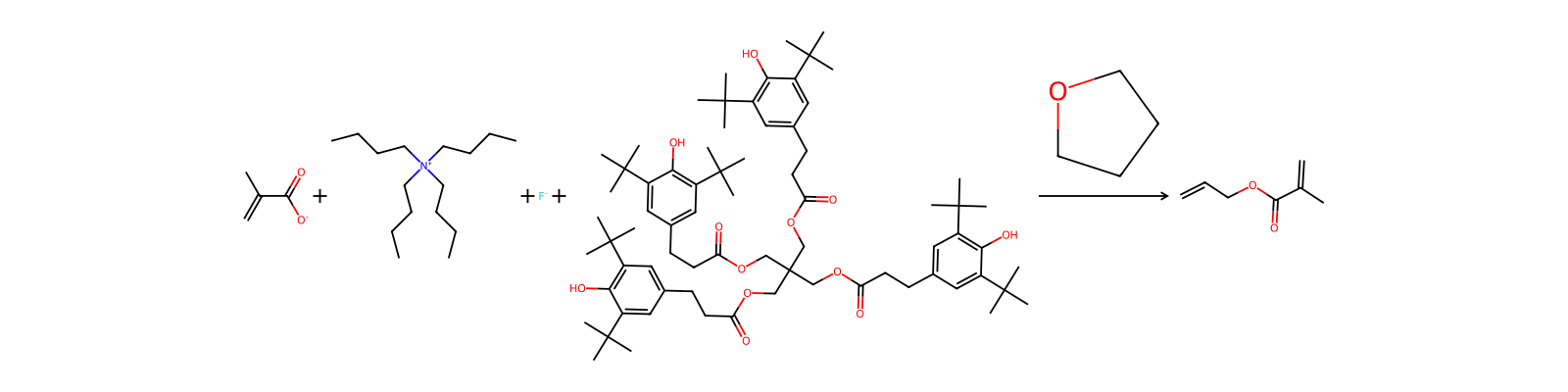
Zugehörige Reaktionen
60




Verknüpfte Notizen
Wird geladen…