StartseiteMCPWorkbenchSkills
StartseiteWorkbenchBenachrichtigungenMein Bereich
llms.txt · MCP-AnleitungDatenschutz · Nutzungsbedingungen · Supportv1.8.0
  1. Startseite
  2. /Verbindung

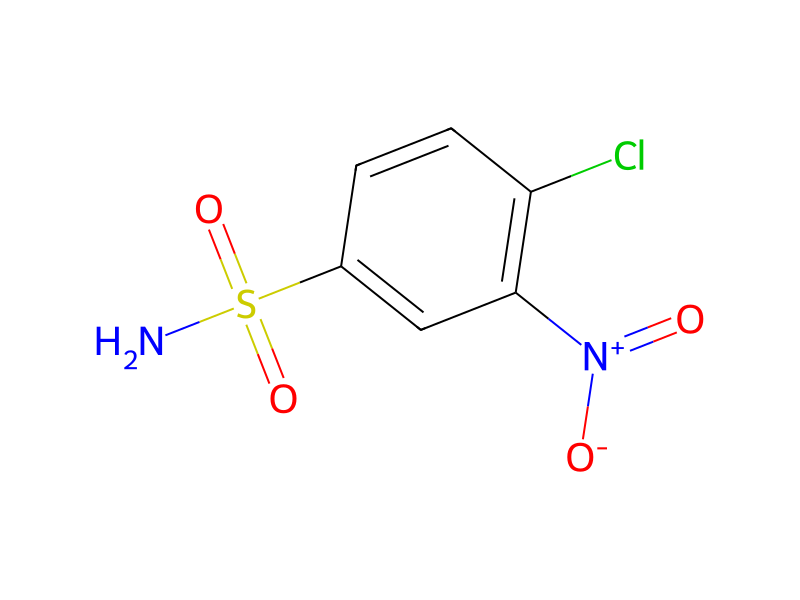
4-Chlor-3-nitrobenzolsulfonamid

4-Chloro-3-nitrobenzenesulfonamide

HCID 7324
Neue NotizNeue ReaktionAnfrage stellen
Druckvorschau

Daten werden ergänzt – lade die Seite später neu, um den aktuellen Stand zu sehen
GrundinformationenNamen und BezeichnerEigenschaftenSicherheit und RegulatorischesChemie und IndustrieZugehörige ReaktionenNotizen zur Verbindung
TeilstruktursucheÄhnliche Strukturen suchen

Grundinformationen

CAS
97-09-6
Standard-SMILES
NS(=O)(=O)c1ccc(Cl)c([N+](=O)[O-])c1
InChIKey
SPZGXONNVLTQDE-UHFFFAOYSA-N
Summenformel
C6H5ClN2O4S
Durchschnittliche Molmasse
236,63 g/mol
Monoisotopische Masse
235,96585532

Namen und Bezeichner

Bevorzugter Name
4-Chloro-3-nitrobenzenesulfonamide
IUPAC
4-chloro-3-nitrobenzenesulfonamide
Lokaler Name
4-Chlor-3-nitrobenzolsulfonamid
Englischer Name
4-Chloro-3-nitrobenzenesulfonamide
Summenformel
C6H5ClN2O4S
Molmasse
236.63

Namen und Synonyme

4-CHLORO-3-NITROBENZENESULFONAMIDEBenzenesulfonamide, 4-chloro-3-nitro-4-Chloro-3-nitrobenzenesulphonamideHSDB 2568UNII-2O1T5ZXF222O1T5ZXF22EINECS 202-559-8NSC 512314NSC-512314DTXSID80526494-CHLORO-3-NITROBENZENESULPHONAMIDE [HSDB]RefChem:98444
Weitere Namen anzeigen
YELLOW SULFONEBUTTPARK 76\07-884-Chloro-3-Nitrosulfonamide4-CHLORO-3-NITROSULFAMYLBENZENE2-NITROCHLOROBENZENE-4-SULFONAMIDEO-NITROCHLOROBENZENE-P-SULFONAMIDE4-chloro-3-nitro-benzenesulfonamid
DTXCID9031222Benzenesulfonamide, 4chloro3nitroSPZGXONNVLTQDE-UHFFFAOYSA-N97-09-63-Nitro-4-chlorobenzenesulfonamide4-chloro-3-nitrobenzene-1-sulfonamideMFCD000357834-Chloro-3-nitro-benzenesulfonamide

Datenbank-Bezeichner

CAS
97-09-6
PubChem CID
7324
DTXSID
DTXSID8052649
ChEMBL
CHEMBL51663
UNII
2O1T5ZXF22
EC Number
202-559-8
Nikkaji
J30.819F

Eigenschaften

Berechnete StruktureigenschaftenWird ergänzt

XLogP
0,8
Polarare Oberfläche (TPSA)
114 Ų
H-Brücken-Donoren
1
H-Brücken-Akzeptoren
5
Frei drehbare Bindungen
1
Schwere Atome
14
Formalladung
0
Komplexität
320

Experimentelle und physikochemische Eigenschaften

Chemical ClassesNitrogen Compounds -> Other Aromatics (Nitrogen)
LogP · 2 Einträge

log Kow = 0.66

1.91

Vapor Pressure0.0000018 [mmHg]
Physical DescriptionSolid; [MSDSonline]

Physikochemische Eigenschaften

Schmelzpunkt
25 · 25-35 °C
Siedepunkt
175 · 175-176 °C
Dichte
1.5966 · 1.5966 (rough estimate)
Brechungsindex
1.6 · 1.6000 (estimate)
storage temp.
Inert atmosphere,Room Temperature
pka
9.28 · 9.28±0.60(Predicted)
Aggregatzustand
crystalline powder
Farbe
White to off white

Sicherheit und Regulatorisches

Sicherheitsangaben dienen nur zur Orientierung und ersetzen weder das Sicherheitsdatenblatt (SDB) des Lieferanten noch geltende Vorschriften oder eine fachliche Bewertung.

GHS-Klassifizierung

GHS Classification · 4 Einträge

Warning

H315 (96.7%): Causes skin irritation [Warning Skin corrosion/irritation]

P261, P264, P264+P265, P271, P280, P302+P352, P304+P340, P305+P351+P338, P319, P321, P332+P317, P337+P317, P362+P364, P403+P233, P405, and P501 (click each P-code to see the statement)

Aggregated GHS information provided per 60 reports by companies from 7 notifications to the ECHA C&L Inventory. Each notification may be associated with multiple companies.

Gefahrenhinweise

Regulatory InformationStatus: Active Update: 22-03-2021 https://echa.europa.eu/registration-dossier/-/registered-dossier/32354
Hazards Summary · 1 Eintrag

Used therapeutically, sulfonamides can cause a range of hypersensitivity reactions including rashes and injury to the liver and kidneys; Methemoglobinemia has been reported after overdose; [HSDB] An irritant; May cause skin sensitization; [MSDSonline]

Hazard Classes and CategoriesSkin Irrit. 2 (96.7%)

Sicherheit und Schutzausrüstung

Disposal Methods · 1 Eintrag

SRP: At the time of review, criteria for land treatment or burial (sanitary landfill) disposal practices are subject to significant revision. Prior to implementing land disposal of waste residue (including waste sludge), consult with environmental regulatory agencies for guidance on acceptable disposal practices.

Toxikologische Informationen

Chemie und Industrie

Verwendung und Herstellung

Uses · 3 Einträge

Used as a chemical intermediate for azo dyes; [HSDB]

CHEMICAL INTERMEDIATE FOR AZO DYES

Dye intermediate

U.S. Production · 3 Einträge

(1972) 2.3X10+8 GRAMS

(1975) 7.90X10+7 GRAMS

(1976) 3.16X10+5 kg

Methods of ManufacturingPOSSIBLY BY REACTION OF 4-CHLORO-3-NITROBENZENESULFONYLCHLORIDE WITH AQUEOUS AMMONIA
General Manufacturing InformationBenzenesulfonamide, 4-chloro-3-nitro-: INACTIVE

Vor- und nachgelagerte Produkte

Vorgelagerte Rohstoffe

Sulfuryldichlorid4-Chlor-3-nitrobenzolsulfonylchlorid1-Chlor-2-nitrobenzolAmmoniak, wasserfrei1,4-Dioxan

Nachgelagerte Produkte

5-[[4-(Aminosulfonyl)-2-nitrophenyl]amino]-2-[[4-[[4-(aminosulfonyl)-2-nitrophenyl]amino]phenyl]amino]benzolsulfonsureSulfanilamide, N4-(p-ethoxyphenyl)-3-nitro-DISPERSE YELLOW 33

Zugehörige Reaktionen

136
Reaktionsaufzeichnung erstellen
Reaktionsgleichung von HRID 135679
HRID 135679als EduktTraining data from https://doi.org/10.1039/C8SC04228D (9/10)
Reaktionsgleichung von HRID 138122
HRID 138122als EduktTraining data from https://doi.org/10.1039/C8SC04228D (9/10)
Reaktionsgleichung von HRID 230533
HRID 230533als Eduktuspto-grants-2009_07
Reaktionsgleichung von HRID 230534
HRID 230534als Eduktuspto-grants-2009_07
Reaktionsgleichung von HRID 299035
HRID 299035als EduktTraining data from https://doi.org/10.1039/C8SC04228D (8/10)
Reaktionsgleichung von HRID 306092
HRID 306092als EduktTraining data from https://doi.org/10.1039/C8SC04228D (8/10)
Reaktionsgleichung von HRID 346161
HRID 346161als Eduktuspto-grants-1991_10
Reaktionsgleichung von HRID 346781
HRID 346781als Eduktuspto-grants-2007_02
Seite 1 von 17

Notizen zur Verbindung

Wird geladen…

Auf dieser SeiteGrundinformationenNamen und BezeichnerEigenschaftenSicherheit und RegulatorischesChemie und IndustrieZugehörige ReaktionenNotizen zur Verbindung
Weitere Aktionen
Neue NotizNeue ReaktionAnfrage stellen
Wasserlöslichkeit
224.8 mg/L · 224.8mg/L(15 ºC)
Henry's Law Constant
8.2 · 8.2×103 mol/(m3Pa) at 25℃, HSDB (2015)
InChI
InChI=1S/C6H5ClN2O4S/c7-5-2-1-4(14(8,12)13)3-6(5)9(10)11/h1-3H,(H2,8,12,13)
InChIKey
SPZGXONNVLTQDE-UHFFFAOYSA-N
SMILES
C1(S(N)(=O)=O)=CC=C(Cl)C([N+]([O-])=O)=C1
CAS Datenbank
97 · 97-09-6(CAS DataBase Reference)
EPA chemische Informationen
4 · Benzenesulfonamide, 4-chloro-3-nitro- (97-09-6)
Environmental Fate · 3 Einträge

TERRESTRIAL FATE: Based on a recommended classification scheme(1), an estimated Koc value of 54(SRC), determined from an experimental log Kow(2) and a recommended regression-derived equation(3), indicates that 4-chloro-3-nitrobenzenesulfonamide should have very high mobility in soil(SRC). Volatilization of 4-chloro-3-nitrobenzenesulfonamide should not be important from moist soil surfaces(SRC) given an estimated Henry's Law constant of 1.2X10⁻⁹ atm-cu m/mole(4,SRC), or from dry soil surfaces(SRC) based on an estimated vapor pressure of 1.8X10⁻⁶ mm Hg(5,SRC). Insufficient data are available to determine the rate or importance of biodegradation of 4-chloro-3-nitrobenzenesulfonamide in soil(SRC).

AQUATIC FATE: An estimated Koc value of 54(SRC), determined from an experimental log Kow(1) and a recommended regression-derived equation(2), indicates that 4-chloro-3-nitrobenzenesulfonamide should not adsorb to suspended solids and sediment(SRC) in the water(2,SRC). 4-Chloro-3-nitrobenzenesulfonamide would be essentially non-volatile from water surfaces based on an estimated Henry's Law constant of 1.2X10⁻⁹ atm-cu m/mole(SRC), developed using a fragment constant estimation method(3). An estimated BCF value of 1.9(2,SRC), from an experimental log Kow(1), suggests that 4-chloro-3-nitrobenzenesulfonamide will not bioconcentrate in aquatic organisms(SRC) according to a recommended classification scheme(4). Insufficient data are available to determine the rate or importance of biodegradation of 4-chloro-3-nitrobenzenesulfonamide in water(SRC).

ATMOSPHERIC FATE: According to a model of gas/particle partitioning of semivolatile organic compounds in the atmosphere(1), 4-chloro-3-nitrobenzenesulfonamide, which has an estimated vapor pressure of 1.8X10⁻⁶ mm Hg at 25 °C(2,SRC) will exist as both a vapor and particulate in the ambient atmosphere. Vapor-phase 4-chloro-3-nitrobenzenesulfonamide is degraded in the atmosphere by reaction with photochemically produced hydroxyl radicals(SRC); the half-life for this reaction in air is estimated to be about 438 days(3,SRC). Particulate-phase 4-chloro-3-nitrobenzenesulfonamide may be physically removed from the air by wet and dry deposition(SRC).

Adverse EffectsOccupational hepatotoxin - Secondary hepatotoxins: the potential for toxic effect in the occupational setting is based on cases of poisoning by human ingestion or animal experimentation.
Soil Adsorption/Mobility · 1 Eintrag

The Koc of 4-chloro-3-nitrobenzenesulfonamide is estimated as approximately 54(SRC), using an experimental log Kow of 0.66(1) and a regression-derived equation(2,SRC). According to a recommended classification scheme(3), this estimated Koc value suggests that 4-chloro-3-nitrobenzenesulfonamide should have very high mobility in soil(SRC).

Artificial Pollution Sources4-Chloro-3-nitrobenzenesulfonamide's production and use as a dye intermediate(1) may result in its release to the environment through various waste streams(SRC).
Environmental Bioconcentration · 1 Eintrag

An estimated BCF value of 1.9 was calculated for 4-chloro-3-nitrobenzenesulfonamide(SRC), using an experimental log Kow of 0.66(1) and a recommended regression-derived equation(2). According to a recommended classification scheme(3), this BCF value suggests that bioconcentration in aquatic organisms will not be an important fate process(SRC).

Volatilization from Water/Soil · 1 Eintrag

The Henry's Law constant for 4-chloro-3-nitrobenzenesulfonamide is estimated as 1.2X10⁻⁹ atm-cu m/mole(SRC) using a fragment constant estimation method(1). This value indicates that 4-chloro-3-nitrobenzenesulfonamide will be essentially nonvolatile from water surfaces(2,SRC). 4-Chloro-3-nitrobenzenesulfonamide's vapor pressure, 1.8X10⁻⁶ mm Hg(3,SRC) and Henry's Law constant(1,SRC) indicate that volatilization from dry or moist soil should not occur(SRC).

Environmental Abiotic Degradation · 1 Eintrag

The rate constant for the vapor-phase reaction of 4-chloro-3-nitrobenzenesulfonamide with photochemically produced hydroxyl radicals has been estimated as 3.8X10⁻¹⁴ cu cm/molecule-sec at 25 °C(SRC) using a structure estimation method(1,SRC). This corresponds to an atmospheric half-life of about 438 days at an atmospheric concentration of 5X10+5 hydroxyl radicals per cu cm(1,SRC).

Environmental Fate/Exposure Summary · 1 Eintrag

4-Chloro-3-nitrobenzenesulfonamide's production and use as a dye intermediate may result in its release to the environment through various waste streams. If released to soil, 4-chloro-3-nitrobenzenesulfonamide should have very high mobility. Volatilization of 4-chloro-3-nitrobenzenesulfonamide should not be important from moist or dry soil surfaces. Insufficient data are available to determine the rate or importance of biodegradation of 4-chloro-3-nitrobenzenesulfonamide in soil or water. If released to water, 4-chloro-3-nitrobenzenesulfonamide should not adsorb to suspended solids and sediment. 4-Chloro-3-nitrobenzenesulfonamide would be essentially non-volatile from water surfaces. An estimated BCF value of 1.9 suggests that 4-chloro-3-nitrobenzenesulfonamide will not bioconcentrate in aquatic organisms. If released to the atmosphere, 4-chloro-3-nitrobenzenesulfonamide will exist as both a vapor and particulate. Vapor-phase 4-chloro-3-nitrobenzenesulfonamide is degraded in the atmosphere by reaction with photochemically produced hydroxyl radicals with an estimated half-life of about 438 days. Particulate-phase 4-chloro-3-nitrobenzenesulfonamide may be physically removed from the air by wet and dry deposition. (SRC)

Sicherheitsdaten

tsca
TSCA listed
hs_code
2935909099
hazard_code
Xi
hazard_note
Irritant
Giftige Stoffe Daten
97-09-6(Hazardous Substances Data)
4-Anilino-3-nitrobenzolsulfonamid