
2-Acetylthioethyltrimethyl-ammoniumiodid
Acetylthiocholine iodide
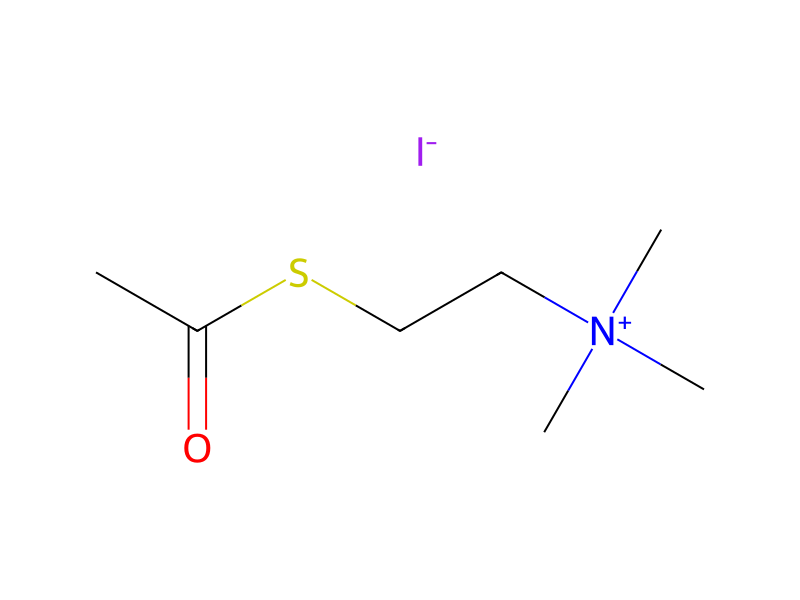
Grundinformationen
- CAS
1866-15-5- Standard-SMILES
CC(=O)SCC[N+](C)(C)C.[I-]- InChIKey
NTBLZMAMTZXLBP-UHFFFAOYSA-M- Summenformel
- C7H16NOS.I
- Durchschnittliche Molmasse
- 289,18 g/mol
- Monoisotopische Masse
- 288,99973
Überblick
structure in first source
Namen und Bezeichner
- Bevorzugter Name
- Acetylthiocholine iodide
- IUPAC
- 2-acetylsulfanylethyl(trimethyl)azanium iodide
- Lokaler Name
- 2-Acetylthioethyltrimethyl-ammoniumiodid
- Englischer Name
- Acetylthiocholine iodide
- Summenformel
- C7H16INOS
- Molmasse
- 289.18
Namen und Synonyme
Acetylthiocholine iodide1866-15-5S-Acetylthiocholine iodide2-Acetylthioethyltrimethylammonium iodide6SKH6P4YRNNSC-44139Ethanaminium, 2-(acetylthio)-N,N,N-trimethyl-, iodide (1:1)DTXSID50883764RefChem:109203DTXCID701023254217-474-1Acetylthiocholine diiodide
Weitere Namen anzeigen
Acetylthiocholine ioacetylthiocholine iodieKamovsky-roots solutionIodine thioacetylcholineIodide thioacetylcholines-acetylthio-choliniodideacetylthiocholinediiodideacethylthiocholine iodide
Ethanaminium, 2-(acetylthio)-N,N,N-trimethyl-, iodideAcetylthiocholinjodid2-(Acetylthio)-N,N,N-trimethylethanaminium iodideMFCD000118192-(Acetylthio)-N,N,N-trimethylethan-1-aminium iodideNSC 44139Acetyl Thiobilineurine Iodide(2-Mercaptoethyl)trimethylammonium iodide acetate
Datenbank-Bezeichner
Eigenschaften
Berechnete Struktureigenschaften
- Polarare Oberfläche (TPSA)
- 42,4 Ų
- H-Brücken-Donoren
- 0
- H-Brücken-Akzeptoren
- 3
- Frei drehbare Bindungen
- 4
- Schwere Atome
- 11
- Formalladung
- 0
- Komplexität
- 117
Physikochemische Eigenschaften
- Schmelzpunkt
- 205 · 205-210 °C(lit.)
- Dichte
- 1.4885 · 1.4885 (estimate)
- storage temp.
- 2 · 2-8°C
- Löslichkeit
- 2 O: · H2O: 100 mg/mL
- Aggregatzustand
- powder
- Farbe
- white
- Wasserlöslichkeit
- 2 O: · H2O: 100mg/mL
- BRN
- 3916578 · 3916578
- InChI
- InChI=1S/C7H16NOS.HI/c1-7(9)10-6-5-8(2,3)4;/h5-6H2,1-4H3;1H/q+1;/p-1
- InChIKey
- NTBLZMAMTZXLBP-UHFFFAOYSA-M
- SMILES
- [N+](C)(C)(C)CCSC(=O)C.[I-]
- CAS Datenbank
- 1866 · 1866-15-5(CAS DataBase Reference)
- EPA chemische Informationen
- 2 · Ethanaminium, 2-(acetylthio)-N,N,N-trimethyl-, iodide (1866-15-5)
Sicherheit und Regulatorisches
Sicherheitsangaben dienen nur zur Orientierung und ersetzen weder das Sicherheitsdatenblatt (SDB) des Lieferanten noch geltende Vorschriften oder eine fachliche Bewertung.
GHS-Klassifizierung
GHS Classification
Danger
H301 (100%): Toxic if swallowed [Danger Acute toxicity, oral]
P261, P262, P264, P264+P265, P270, P271, P280, P301+P316, P302+P352, P304+P340, P305+P351+P338, P316, P319, P321, P330, P332+P317, P337+P317, P361+P364, P362+P364, P403+P233, P405, and P501 (click each P-code to see the statement)
Aggregated GHS information provided per 48 reports by companies from 6 notifications to the ECHA C&L Inventory. Each notification may be associated with multiple companies.
Gefahrenhinweise
Regulatory Information
Chemical: Ethanaminium, 2-(acetylthio)-N,N,N-trimethyl-, iodide
2-Acetylthioethyltrimethylammonium iodide: Does not have an individual approval but may be used under an appropriate group standard
Hazard Classes and CategoriesAcute Tox. 3 (100%)
Sicherheitsdaten
- F
- 3-8-10
- wgk
- 3
- tsca
- TSCA listed
- ridadr
- UN 2811 6.1/PG 3
- hs_code
- 2930909099
- RTECS-Nr.
- FZ9865000
- risk_code
- 21-25-36/37/38
- hazard_code
- T,Xi
- safety_code
- 26-36
- hazard_class
- 6.1
- packing_group
- III
- Speicherklasse
Chemie und Industrie
Verwendung und Herstellung
General Manufacturing InformationEthanaminium, 2-(acetylthio)-N,N,N-trimethyl-, iodide (1:1): ACTIVE
Anwendungen
BeschreibungAcetylthiocholine iodide, also known as ATCI, serves as both an acetylcholinesterase (AChE) substrate and a nicotinic acetylcholine receptor (AChR) agonist. ATCI itself is a colorless and odorless compound. It exhibits solubility in both water and ethanol. It is a synthetic compound extensively employed in laboratory experiments to measure the activity of AChE, a vital enzyme responsible for the breakdown of the neurotransmitter acetylcholine (ACh) in the central and peripheral nervous systems. Additionally, it enables the evaluation of drug effects on AChE activity and facilitates investigations into the impact of toxins on the nervous system. Acetylthiocholine iodide functions as an inhibitor of AChE. By binding to the enzyme′s active site, it prevents AChE from catalyzing the breakdown of ACh. Consequently, ACh accumulates in the synaptic cleft, leading to increased neuron excitability. This inhibition of AChE by ATCI ultimately results in a higher ACh concentration within the synaptic cleft, yielding a range of physiological effects. These effects encompass heightened muscle contraction, increased heart rate and blood pressure, elevated salivation, intensified bronchial secretions, and augmented gastrointestinal activity[1].
VerwendenAcetylthiocholine iodide has been used as a substrate in the preparation of acetylcholine esterase (AChE) assay working solution for AChE activity assay. It has also been used as a component in phosphate buffer (PB) for cholinesterase assay.
Vor- und nachgelagerte Produkte
Vorgelagerte Rohstoffe
Zugehörige Reaktionen
2

Notizen zur Verbindung
Wird geladen…