

Grundinformationen
- Standard-SMILES
O=C(Cl)c1ccc(C(=O)Cl)cc1- InChIKey
LXEJRKJRKIFVNY-UHFFFAOYSA-N- Summenformel
- C8H4Cl2O2
- Durchschnittliche Molmasse
- 203,02 g/mol
- Monoisotopische Masse
- 201,95883473
Überblick
cross-links albumin
Namen und Bezeichner
- Bevorzugter Name
- Terephthaloyl chloride
- IUPAC
- benzene-1,4-dicarbonyl chloride
- Lokaler Name
- Terephtaloyldichlorid
- Englischer Name
- Terephthaloyl chloride
- Summenformel
- C8H4Cl2O2
- Molmasse
- 203.02
Namen und Synonyme
Terephthaloyl chloride100-20-9Terephthaloyl dichloride1,4-BENZENEDICARBONYL DICHLORIDEp-Phthaloyl chlorideTerephthalic acid dichlorideTerephthalic dichloridep-Phthaloyl dichlorideTerephthalyl dichloridep-Phenylenedicarbonyl dichloride1,4-Benzenedicarbonyl chlorideDTXSID7026653
Weitere Namen anzeigen
TCLTerephtaloyl chloridebis(forMaldehyde)TEREPHTHALYL CHLORIDE1,4-dichloroformylbenzenep-PhthaL
NSC-41885G247CO9608DTXCID506653RefChem:4159231,4-phthaloyl dichloride202-829-5Terephthalic acid chloridebenzene-1,4-dicarbonyl chloride
Datenbank-Bezeichner
- CAS
100-20-9- PubChem CID
- 7488
- DTXSID
DTXSID7026653- ChEMBL
CHEMBL1893301- UNII
- G247CO9608
- EC Number
- 202-829-5
- Nikkaji
- J4.979D
Eigenschaften
Berechnete Struktureigenschaften
- XLogP
- 4
- Polarare Oberfläche (TPSA)
- 34,1 Ų
- H-Brücken-Donoren
- 0
- H-Brücken-Akzeptoren
- 2
- Frei drehbare Bindungen
- 2
- Schwere Atome
- 12
- Formalladung
- 0
- Komplexität
- 173
Experimentelle und physikochemische Eigenschaften
Chemical ClassesToxic Gases & Vapors -> Acid Halides
SpringerMaterials PropertiesBoiling point
LogP0.88 (calculated)
Density1.32 g/cm³
Color/FormCOLORLESS NEEDLES
Solubility
SOLUBLE IN ETHER
Solubility in water: reaction
Flash Point
356 °F
180 °C
Boiling Point
259 °C
264 °C
266 °C @760 [mm Hg]
Melting Point
82-84 °C
79.5-84 °C
Vapor PressureVapor pressure, Pa at 20 °C: 320
Food Contact Substances
FCS -> FDA Cumulative Estimated Daily Intake (CEDI)
FCS -> FDA Inventory of Food Contact Substances Listed in 21 CFR
FCS -> FDA Inventory of Effective Food Contact Substance (FCS) Notifications
Physical Description
Large Crystals; Dry Powder
Colorless or white solid with pungent odor; [ICSC] White flakes; [MSDSonline]
WHITE POWDER OR COLOURLESS NEEDLES WITH PUNGENT ODOUR.
Physikochemische Eigenschaften
- Schmelzpunkt
- 79 · 79-81 °C(lit.)
- Siedepunkt
- 266 °C · 266 °C(lit.)
- Dichte
- 1 · 1,34 g/cm3
- Dampfdichte
- 7 · 7 (vs air)
- Dampfdruck
- 0.02 mm · 0.02 mm Hg ( 25 °C)
- Brechungsindex
- 1.5684 · 1.5684 (estimate)
- Flammpunkt
- 356 °F · 356 °F
- storage temp.
- 2 · 2-8°C
- Löslichkeit
- 5 %, · ethanol: 5%, clear
- Aggregatzustand
- flakes
- Farbe
- White to Almost white
- PH
- 0.5 · <0.5 (H2O)
- Explosionsgrenze
- 1.5 · 1.5-8.9%(V)
- Wasserlöslichkeit
- REACTS
- BRN
- 607796 · 607796
- InChI
- 1S/C8H4Cl2O2/c9-7(11)5-1-2-6(4-3-5)8(10)12/h1-4H
- InChIKey
- LXEJRKJRKIFVNY-UHFFFAOYSA-N
- SMILES
- ClC(=O)c1ccc(cc1)C(Cl)=O
- CAS Datenbank
- 100 · 100-20-9(CAS DataBase Reference)
- NIST chemische Informationen
- 1 · 1,4-Benzenedicarbonyl dichloride(100-20-9)
- EPA chemische Informationen
- 1 · 1,4-Benzenedicarbonyl dichloride (100-20-9)
Sicherheit und Regulatorisches
GHS-Klassifizierung
GHS Classification
This chemical does not meet GHS hazard criteria for 88.7% (2008 of 2263) of all reports.
Danger
H314 (11.2%): Causes severe skin burns and eye damage [Danger Skin corrosion/irritation]
P260, P261, P264, P271, P280, P301+P330+P331, P302+P361+P354, P304+P340, P305+P354+P338, P316, P321, P363, P403+P233, P405, and P501 (click each P-code to see the statement)
Aggregated GHS information provided per 2263 reports by companies from 9 notifications to the ECHA C&L Inventory. Each notification may be associated with multiple companies.
Danger
Gefahrenhinweise
Regulatory Information
Chemical: 1,4-Benzenedicarbonyl dichloride
1,4-Benzenedicarbonyl dichloride is listed on the EPA's Chemical Data Reporting (CDR) system. Manufacturers and importers of 1,4-Benzenedicarbonyl dichloride are required to report information about their production and use of this chemical to the EPA under the Toxic Substances Control Act (TSCA). (40 eCFR Part 711)
Status: Active Update: 29-04-2021 https://echa.europa.eu/registration-dossier/-/registered-dossier/13172
Terephthaloyl dichloride: Does not have an individual approval but may be used under an appropriate group standard
Fire HazardsCombustible. Gives off irritating or toxic fumes (or gases) in a fire. Finely dispersed particles form explosive mixtures in air.
Hazards Summary
A reproductive effector; Causes asphyxiation by upper airway obstruction after lethal-dose inhalation studies of mice; [RTECS] Dust/air mixture may be explosive; Reacts with water producing hydrogen chloride; A corrosive substance that can cause injury to the skin, eyes, and respiratory tract; Inhalation may cause upper airway edema and pulmonary edema; [ICSC] A skin irritant; [HSDB] Reacts with water; A corrosive substance that can cause injury to the skin, eyes, and respiratory tract; A lachrymator; Inhalation may cause chemical pneumonitis; Effects in high-dose animal studies include lacrimation, changes in renal tubules and other changes to the brain; [MSDSonline]
Chemical DangersDecomposes on heating. This produces toxic and corrosive fumes. Reacts with strong oxidants. Reacts with water. This produces hydrogen chloride (see ICSC 0163). Attacks many metals in the presence of water.
Physical DangersDust explosion possible if in powder or granular form, mixed with air.
Hazard Classes and Categories
Skin Corr. 1A (11.2%)
Skin corrosion/irritation - Category 1
Skin, Eye, and Respiratory IrritationsSKIN IRRITANT.
Sicherheit und Schutzausrüstung
Fire FightingUse dry sand, powder, carbon dioxide. NO hydrous agents.
First Aid Measures
Fresh air, rest. Half-upright position. Refer for medical attention.
Remove contaminated clothes. Rinse skin with plenty of water or shower. Refer for medical attention .
First rinse with plenty of water for several minutes (remove contact lenses if easily possible), then refer for medical attention.
Rinse mouth. Give one or two glasses of water to drink. Do NOT induce vomiting. Refer for medical attention .
Safe StorageSeparated from strong oxidants. Dry. Well closed. Do NOT store or transport in containers made from metal.
Spillage Disposal
Personal protection: chemical protection suit and particulate filter respirator adapted to the airborne concentration of the substance. Sweep spilled substance into covered plastic containers. Carefully collect remainder. Then store and dispose of according to local regulations.
Eye PreventionWear safety goggles or eye protection in combination with breathing protection.
Fire PreventionNO open flames. Closed system, dust explosion-proof electrical equipment and lighting. Prevent deposition of dust.
Inhalation RiskA harmful concentration of airborne particles can be reached quickly when dispersed.
Skin PreventionProtective clothing. Protective gloves.
Exposure PreventionPREVENT DISPERSION OF DUST!
Ingestion PreventionDo not eat, drink, or smoke during work.
Inhalation PreventionUse local exhaust or breathing protection.
Effects of Short Term ExposureThe substance is corrosive to the eyes, skin and respiratory tract. Corrosive on ingestion. Exposure could cause asphyxiation due to swelling in the throat. Inhalation may cause lung oedema.
Toxikologische Informationen
Adverse EffectsDermatotoxin - Skin burns.
Exposure RoutesSerious by all routes of exposure.
Signs and Symptoms
Cough. Sore throat. Burning sensation. Laboured breathing. Shortness of breath. Symptoms may be delayed.
Redness. Pain. Skin burns.
Redness. Pain. Blurred vision. Severe deep burns.
Abdominal pain. Nausea. Vomiting. Diarrhoea. Shock or collapse.
Toxicity DataLC50 (rat) = 700 mg/m3/4h
Sicherheitsdaten
- wgk
- 3
- tsca
- TSCA listed
- ridadr
- UN 2923 8/PG 3
- hs_code
- 29173980
- RTECS-Nr.
- WZ1797000
- risk_code
- 34-23-35
- hazard_code
- C,T
- safety_code
- 26-27-36/37/39-45-38-28B
- hazard_class
- 6.1
- packing_group
- II
- Speicherklasse
- 6.1A - Combustible acute toxic Cat. 1 and 2very toxic hazardous materials
- Giftige Stoffe Daten
- 100-20-9(Hazardous Substances Data)
- Hazard Classifications
- Acute Tox. 3 InhalationEye Dam. 1Skin Corr. 1ASTOT SE 3
Chemie und Industrie
Verwendung und Herstellung
Uses
Used in dyes, synthetic fibers, resins, films, pharmaceuticals, rubber chemicals, and as a cross-linking agent for polyurethanes and polysulfides; [HSDB]
Textiles (Fiber & Fabric Manufacturing) [Category: Industry]
DYE MANUFACTURE; SYNTHETIC FIBERS, RESINS, FILMS; ULTRAVIOLET ABSORPTION; PHARMACEUTICALS; RUBBER CHEMICALS
CROSS-LINKING AGENT FOR POLYURETHANES AND POLYSULFIDES
U.S. Production2023: 250,000 - <400,000 lb
Consumer UsesNot Known or Reasonably Ascertainable
Industry UsesIntermediate
General Manufacturing Information
Plastics Material and Resin Manufacturing
1,4-Benzenedicarbonyl dichloride: ACTIVE
Anwendungen
VerwendenTerephthaloyl chloride acts as a monomer with p-phenylenediamine used in the preparation of polymer viz. poly paraphenylene terephthalamide. It is an active component in performance polymers and aramid fibers, which gives flame resistance, chemical resistance, temperature stability, light weight, and very high strength. It is also used as an effective water scavenger, utilized to stabilize isocyanates and urethane prepolymers. Further, it is used in the preparation of liquid crystalline thermosets by thermal cyclotrimerization of dicyanate compounds of ring substituted bis(4-hydroxyphenyl) terepthalates. In addition to this, it is involved in the condensation reaction with difunctional alfa, μ-diaminopolystyrene to get chain-extended polystyrene containing amide bonds along the polymer backbone.
Darstellung
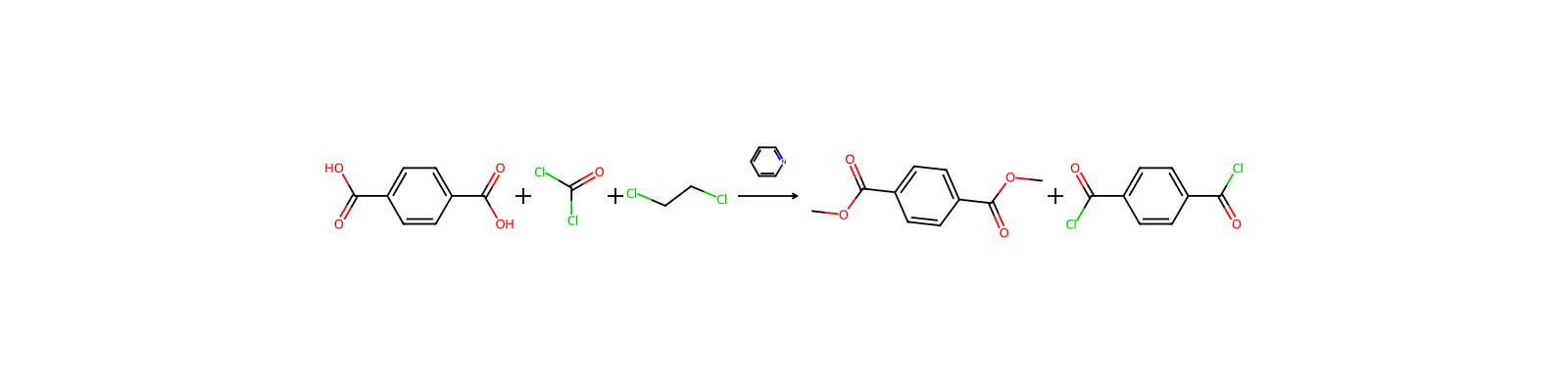
synthetischeSynthesis of terephthaloyl chloride by thionyl chloride method: terephthalic acid is mixed with thionyl chloride, refluxed at 80℃ for 10-12h, then the thionyl chloride is evaporated, and the resulting crude product is distilled under reduced pressure to obtain the finished product.
Vor- und nachgelagerte Produkte
Vorgelagerte Rohstoffe
Nachgelagerte Produkte
Anbieter50 Anbieter
梯希爱(上海)化成工业发展有限公司021-67121386 · [email protected]
上海阿拉丁生化科技股份有限公司400-6206333 13167063860 · [email protected]
Shandong chuangyingchemical Co., Ltd.18853181302 · [email protected]
合肥翰刚医药科技有限公司+8618062405514 · [email protected]
武汉欣扬瑞和化学科技有限公司153-07155313 15307155313 · [email protected]
温州共赢化学有限公司+86-0086-577-64498589 +86-15355981851 · [email protected]
Hebei shuoxi biotechnology co. LTD+8613081092107
河北创海生物科技有限公司+86-86-13131129325 · [email protected]
河北展药生物科技有限公司15369953316 +8615369953316 · [email protected]
山东前元高分子材料有限公司18678041314 18765609661 · [email protected]
Hebei Yanxi Chemical Co., Ltd.+86-17531190177 · [email protected]
科瑞迪化学400-821-5857 021-64326257 · [email protected]
上海迈瑞尔生化科技有限公司4006356688 18621169109 · [email protected]
阿法埃莎(中国)化学有限公司400-6106006 · [email protected]
安耐吉化学&3A(安徽泽升科技股份有限公司)400-0056266 · [email protected]
武汉卡诺斯科技有限公司027-83238443 15327105076 · [email protected]
上海瀚鸿科技股份有限公司021-54306202 13764082696 · [email protected]
河北缤享新材料科技有限公司+8618633865755 · [email protected]
山东洛克化工有限公司17653113209 13065062079 · [email protected]
山东西亚化学有限公司13355009207 13355009207 · [email protected]
玛雅试剂+86 (573) 82222445 (0)18006601000 452520369 · [email protected]
四川库利南科技有限公司400-1166-196 18981987031 · [email protected]
天津希恩思生化科技有限公司400 638 7771 · [email protected]
Xiamen AmoyChem Co., Ltd+86-86-5926051114 · [email protected]
南京化学试剂股份有限公司025-58369808 17895012682 · [email protected]
斯百全化学(上海)有限公司021-021-021-67601398-809-809-809 15221380277 · [email protected]
艾科试剂4008-755-333 18080918076 · [email protected]
上海思域化工科技有限公司86-21-34053660 · [email protected]
赛默飞世尔科技(中国)有限公司800-810-5118 · [email protected]
北京伊诺凯科技有限公司400-810-7969 010-59572699 · [email protected]
上海遐瑞医药科技有限公司+86 21 61551611
TOKYO CHEMICAL INDUSTRY CO., LTD.03-36680489 · [email protected]
上海贤鼎生物科技有限公司4009209199 · [email protected]
越林试剂021-62960152 · [email protected]
无锡中坤生化科技有限公司+86 0510-85629785
北京环宇世纪化学科技有限公司hysj_bj.com
上海将来实业股份有限公司021-61552785 · [email protected]
安徽科迪达化工有限公司0554-2106669 · [email protected]
日照力德士化工有限公司010-51268198 · [email protected]
郑州阿尔法化工有限公司0371-53732842 15981811963 · [email protected]
美岚实业(上海)有限公司021-58958189 · [email protected]
上海爱蝶实业有限公司021-58957966 18930537195 · [email protected]
广拓化学(上海)有限公司021-60899189-8001 18918189673 · [email protected]
上海麦克林生化科技股份有限公司15221275939 15221275939 · [email protected]
杭州杰恒化工有限公司0571-87396432 · [email protected]
上海有朋化工有限公司021-69005955 13701776567 · [email protected]
上海凯赛化工有限公司021-33516722 13701817765 · [email protected]
上海彤源化工有限公司021-021-69182866 13701855675 · [email protected]
成都润泽本土化工有限公司13096311329 028-88469284 616445927 · [email protected]
上海蓝润化学有限公司021-69515658 ; 69515628 13701998368 · [email protected]
Zugehörige Reaktionen
117




Verknüpfte Notizen
Wird geladen…