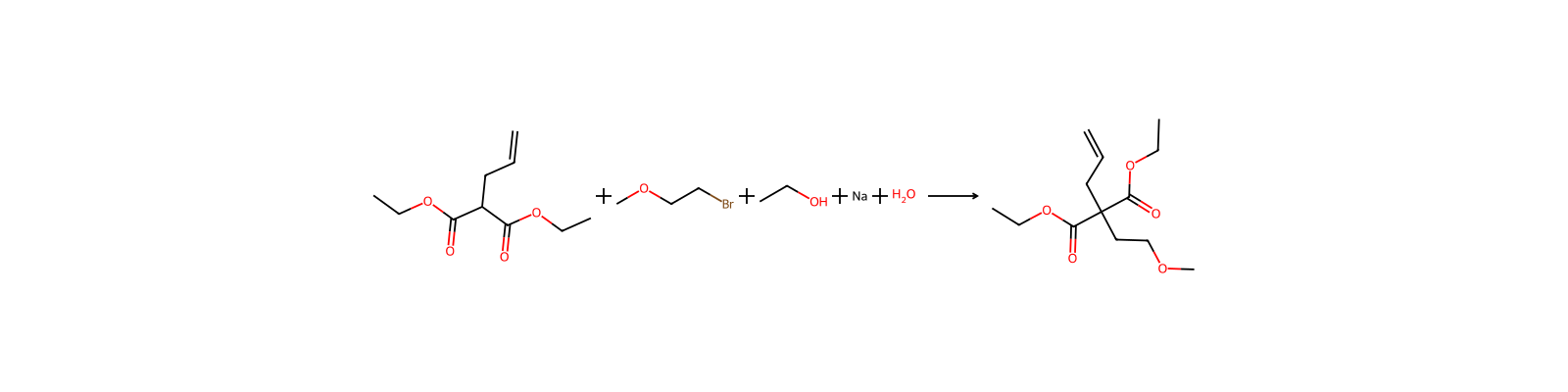
HRID 23570als Edukt
Diethyl allylmalonate

2049-80-1C=CCC(C(=O)OCC)C(=O)OCCGDWAYKGILJJNBB-UHFFFAOYSA-N2049-80-1DTXSID30883787Sicherheitsangaben dienen nur zur Orientierung und ersetzen weder das Sicherheitsdatenblatt (SDB) des Lieferanten noch geltende Vorschriften oder eine fachliche Bewertung.
This chemical does not meet GHS hazard criteria for 2.4% (1 of 41) of reports.
Warning
H315 (97.6%): Causes skin irritation [Warning Skin corrosion/irritation]
P261, P264, P264+P265, P271, P280, P302+P352, P304+P340, P305+P351+P338, P319, P321, P332+P317, P337+P317, P362+P364, P403+P233, P405, and P501 (click each P-code to see the statement)
Aggregated GHS information provided per 41 reports by companies from 4 notifications to the ECHA C&L Inventory. Each notification may be associated with multiple companies.
VerwendenDiethyl allylmalonate is an important intermediates in syntheses of vitamins B1 and B6, barbiturates, non-steroidal anti-inflammatory agents, other numerous pharmaceuticals, agrochemicals and flavors and fragrances compounds.
synthetischeDiethyl allyl malonate is obtained by reacting diethyl malonate with allyl bromide. Under nitrogen atmosphere, to a 500 mL three-neck round bottom flask was added diethyl malonate (20 g), anhydrous potassium carbonate (43 g) and anhydrous CH3CN (200 mL). The reaction mixture was stirred at room temperature for 10 minutes, then allyl bromide (23 g) was slowly added to the reaction mixture at room temperature. The reaction mixture was heated to 80°C for 24 hours. The reaction mixture was cooled to room temperature and filtered through a bed of celite. The celite bed was washed with acetonitrile (100 mL) and the combined filtrates were concentrated to give diethyl allylmalonate (24 g) as a colorless liquid.