
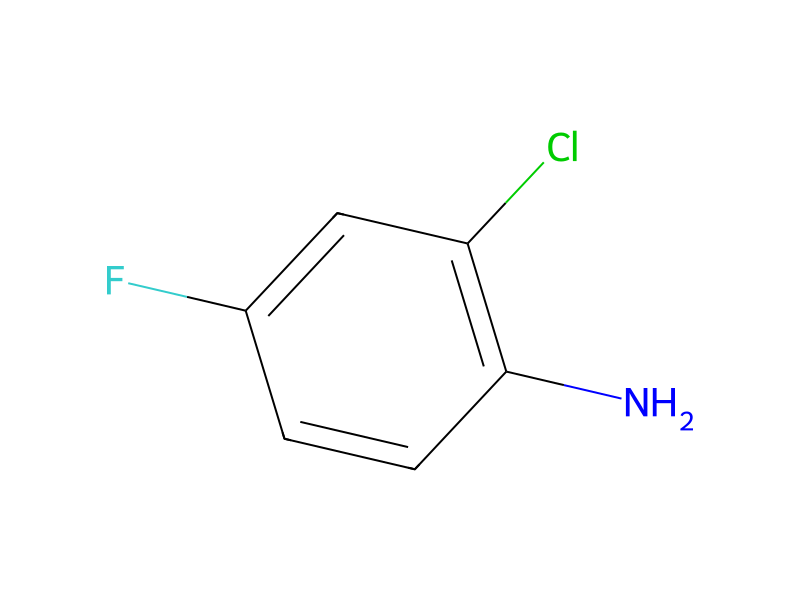
Grundinformationen
- Standard-SMILES
Nc1ccc(F)cc1Cl- InChIKey
XRAKCYJTJGTSMM-UHFFFAOYSA-N- Summenformel
- C6H5ClFN
- Durchschnittliche Molmasse
- 145,56 g/mol
- Monoisotopische Masse
- 145,009455
Namen und Bezeichner
- Bevorzugter Name
- Benzenamine, 2-chloro-4-fluoro-
- IUPAC
- 2-chloro-4-fluoroaniline
- Lokaler Name
- 2-Chlor-4-fluoranilin
- Englischer Name
- 2-Chloro-4-fluoroaniline
- Summenformel
- C6H5ClFN
- Molmasse
- 145.56
Namen und Synonyme
2-Chloro-4-fluoroaniline2106-02-7Benzenamine, 2-chloro-4-fluoro-2-chloro-4-fluorobenzenamineDTXSID5062182EINECS 218-282-0RefChem:561683DTXCID6036419218-282-0MFCD000425302-chloro-4-fluorophenylamine4-fluoro-2-chloroaniline
Weitere Namen anzeigen
2-chloro-4-fluoroaniline hydrochlorideCHLOROFLUOROANILINETIMTEC-BB SBB0041102-Chloro-4-fluoroani2-Chloro-4-fluoroniline2-Chloro-4-fuoroaniline
2-chloro-4-fluoro-aniline2-chloro-4-fluoro-phenylamine2-chloro-4fluoroaniline2-chloro-4-fluroaniline2-chloro-4-fluoro anilineSCHEMBL109905SCHEMBL2318248SCHEMBL7002860
Datenbank-Bezeichner
- CAS
2106-02-7- PubChem CID
- 75013
- DTXSID
DTXSID5062182- ChEMBL
CHEMBL2323849- UNII
- K77X364T56
- EC Number
- 218-282-0
- Nikkaji
- J208.274H
Eigenschaften
Berechnete Struktureigenschaften
- XLogP
- 2,4
- Polarare Oberfläche (TPSA)
- 26 Ų
- H-Brücken-Donoren
- 1
- H-Brücken-Akzeptoren
- 2
- Frei drehbare Bindungen
- 0
- Schwere Atome
- 9
- Formalladung
- 0
- Komplexität
- 99
Physikochemische Eigenschaften
- Siedepunkt
- 192 °C · 192 °C (lit.)
- Dichte
- 1.219 g/mL · 1.219 g/mL at 25 °C (lit.)
- Brechungsindex
- 20 · n20/D 1.554(lit.)
- Flammpunkt
- 209 °F · 209 °F
- storage temp.
- Keep in dark place,Inert atmosphere,Room temperature
- pka
- 2.71 · 2.71±0.10(Predicted)
- Aggregatzustand
- clear liquid
- Farbe
- Colorless to Light yellow to Light orange
- Wichte
- 1.3111 · 1.3111.219
- BRN
- 2802559 · 2802559
- InChI
- InChI=1S/C6H5ClFN/c7-5-3-4(8)1-2-6(5)9/h1-3H,9H2
- InChIKey
- XRAKCYJTJGTSMM-UHFFFAOYSA-N
- SMILES
- C1(N)=CC=C(F)C=C1Cl
- CAS Datenbank
- 2106 · 2106-02-7(CAS DataBase Reference)
- EPA chemische Informationen
- 2 · Benzenamine, 2-chloro-4-fluoro- (2106-02-7)
Sicherheit und Regulatorisches
GHS-Klassifizierung
GHS Classification
Warning
H302 (97.9%): Harmful if swallowed [Warning Acute toxicity, oral];H312 (89.6%): Harmful in contact with skin [Warning Acute toxicity, dermal];H315 (100%): Causes skin irritation [Warning Skin corrosion/irritation];H319 (100%): Causes serious eye irritation [Warning Serious eye damage/eye irritation];H332 (97.9%): Harmful if inhaled [Warning Acute toxicity, inhalation];H335 (89.6%): May cause respiratory irritation [Warning Specific target organ toxicity, single exposure; Respiratory tract irritation];H373 (12.5%): May causes damage to organs through prolonged or repeated exposure [Warning Specific target organ toxicity, repeated exposure]
P260, P261, P264, P264+P265, P270, P271, P280, P301+P317, P302+P352, P304+P340, P305+P351+P338, P317, P319, P321, P330, P332+P317, P337+P317, P362+P364, P403+P233, P405, and P501 (click each P-code to see the statement)
Aggregated GHS information provided per 48 reports by companies from 8 notifications to the ECHA C&L Inventory. Each notification may be associated with multiple companies.;Information may vary between notifications depending on impurities, additives, and other factors. The percentage value in parenthesis indicates the notified classification ratio from companies that provide hazard codes. Only hazard codes with percentage values above 10% are shown. For more detailed information, please visit ECHA C&L website.
Gefahrenhinweise
Hazard Classes and CategoriesAcute Tox. 4 (97.9%);Acute Tox. 4 (89.6%);Skin Irrit. 2 (100%);Eye Irrit. 2 (100%);Acute Tox. 4 (97.9%);STOT SE 3 (89.6%);STOT RE 2 (12.5%)
Sicherheitsdaten
- wgk
- 3
- tsca
- TSCA listed
- ridadr
- 2810
- hs_code
- 29214200
- risk_code
- 20/21/22-36/37/38
- hazard_code
- Xn,T,Xi
- hazard_note
- Toxic
- safety_code
- 26-37/39-36/37/39-36-24/25
- hazard_class
- 6.1
- packing_group
- III
- Speicherklasse
- 10 - Combustible liquids
- Hazard Classifications
- Acute Tox. 4 DermalAcute Tox. 4 InhalationAcute Tox. 4 OralEye Irrit. 2Skin Irrit. 2STOT SE 3
Chemie und Industrie
Verwendung und Herstellung
General Manufacturing InformationBenzenamine, 2-chloro-4-fluoro-: INACTIVE
Vor- und nachgelagerte Produkte
Vorgelagerte Rohstoffe
Nachgelagerte Produkte
Anbieter50 Anbieter
国药集团化学试剂有限公司86-21-63210123 · [email protected]
梯希爱(上海)化成工业发展有限公司021-67121386 · [email protected]
上海阿拉丁生化科技股份有限公司400-6206333 13167063860 · [email protected]
上海策嵘生物科技有限公司[email protected]
合肥翰刚医药科技有限公司+8618062405514 · [email protected]
上海赫文斯化工有限公司15721252604 17321035817 · [email protected]
Dayang Chem (Hangzhou) Co.,Ltd.+86-0571-88938639 17705817739 · [email protected]
Hebei Yanxi Chemical Co., Ltd.+86-17531190177 · [email protected]
科瑞迪化学400-821-5857 021-64326257 · [email protected]
上海迈瑞尔生化科技有限公司4006356688 18621169109 · [email protected]
北京华威锐科化工有限公司0757-86329057 18934348241 · [email protected]
武汉易泰科技有限公司上海分公司18930552037 · [email protected]
阿法埃莎(中国)化学有限公司400-6106006 · [email protected]
安耐吉化学&3A(安徽泽升科技股份有限公司)400-0056266 · [email protected]
武汉凯威斯科技有限公司86-027-67849912 · [email protected]
Allfluoro Pharmaceutical Company Limited+86-400-0216110 +86-15958047586 · [email protected]
艾琪康医药科技(上海)有限公司13661411401 · [email protected]
上海瀚鸿科技股份有限公司021-54306202 13764082696 · [email protected]
Changzhou Helios Biomedical Science and Technology Co.,LTD.+8618961213068;+8618961100976 · [email protected]
上海景颜化工科技有限公司13817811078 · [email protected]
上海隆盛化工有限公司58099637 13585536065 · [email protected]
上海攀鸿化工科技有限公司021-56491756 13512199871 · [email protected]
孝感深远化工有限公司15527621225; 15527621225 · [email protected]
南京维奥化工有限公司Please Send Email 18652950785 · [email protected]
天津津御达化工科技有限公司022-58013646 13011382049 · [email protected]
上海思域化工科技有限公司86-21-34053660 · [email protected]
上海特伯化学科技有限公司+86-21-60341587 · [email protected]
南京诺利斯医药科技有限公司13901585132 · [email protected]
TCI AMERICA800-4238616 · [email protected]
TOKYO CHEMICAL INDUSTRY CO., LTD.03-36680489 · [email protected]
TCI Europe320-37350700 · [email protected]
上海贤鼎生物科技有限公司4009209199 · [email protected]
越林试剂021-62960152 · [email protected]
Clearsynth Labs Limited+91-22-26355700 · [email protected]
北京环宇世纪化学科技有限公司hysj_bj.com
上海湄水化工科技有限公司021-60549325 18616193163
上海将来实业股份有限公司400-0066400 13621662912 · [email protected]
上海毕得医药科技股份有限公司400-164-7117 18317119277 · [email protected]
上海石洋化工有限公司021-56795766 · [email protected]
天津安浩生物科技有限公司[email protected]
上海纳谦化学科技有限公司13598610367 13598610367 · [email protected]
上海嵩爰化工科技有限公司010-1234567 18521000990 · [email protected]
上海有朋化工有限公司021-69005955 13701776567 · [email protected]
北京海力扬化学科技有限公司13718199399 · [email protected]
北京欣赛维化学科技有限公司010-56218822 13717722232 · [email protected]
四川海诺威科技有限公司13708085536 13708085536 · [email protected]
上海凯赛化工有限公司021-33516722 13701817765 · [email protected]
上海彤源化工有限公司021-021-69182866 13701855675 · [email protected]
北京华扬致成科技有限公司13716033033 · [email protected]
上海蓝润化学有限公司021-69515658 ; 69515628 13701998368 · [email protected]
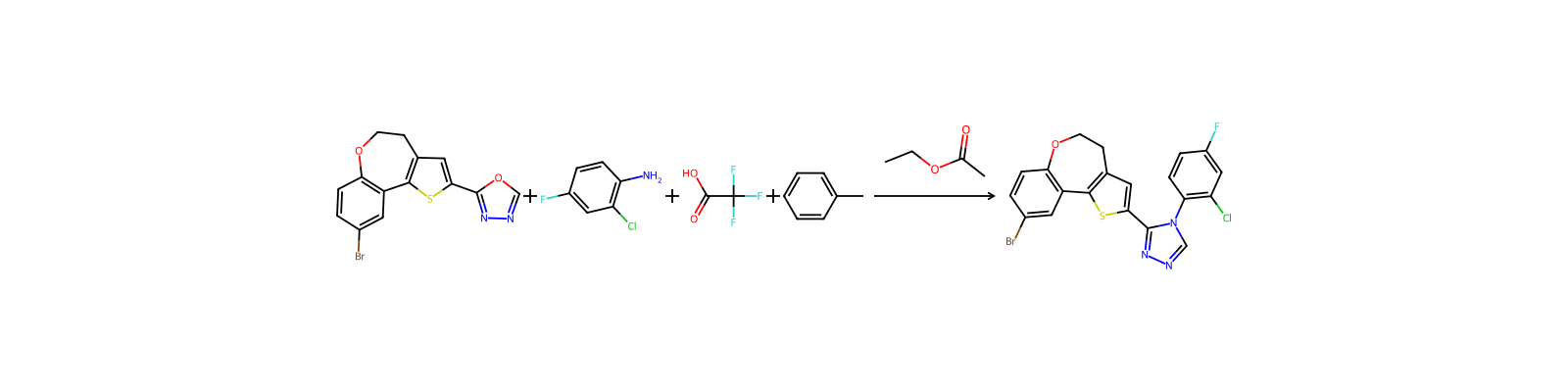
Zugehörige Reaktionen
34



Verknüpfte Notizen
Wird geladen…