Benzylchlorid
BnCl · (Chloromethyl)benzene · Benzile · Benzylchlorid · α-Chlorotoluene · Bzl-Cl · chloromethylbenzene · ALPHA-CHLOROTOLUENE
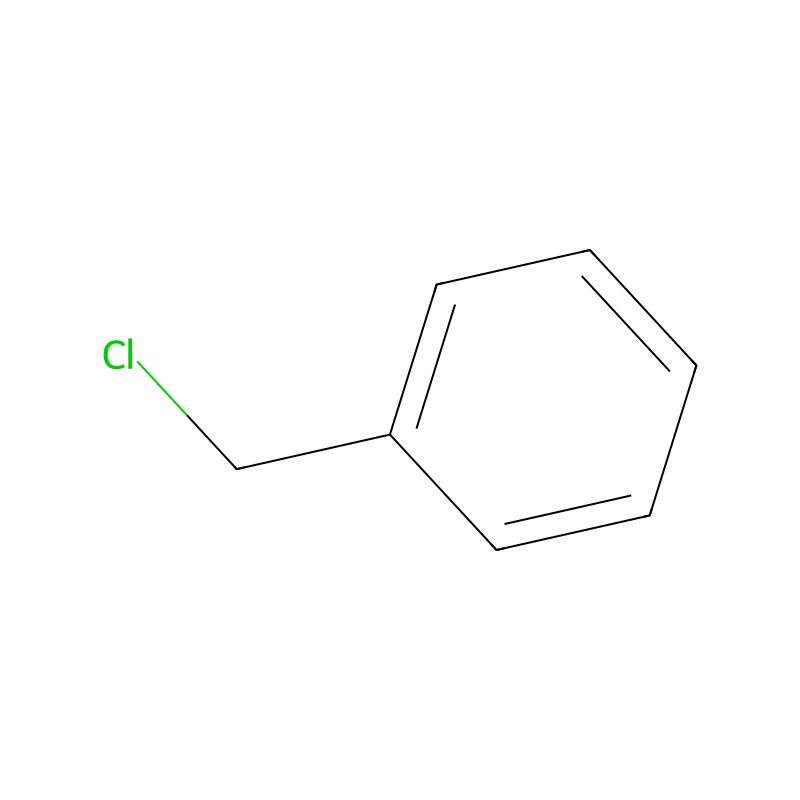
Identifikatoren & physikalische Daten
| CAS No. | 100-44-7 |
|---|---|
| Summenformel | C7H7Cl |
| Durchschnittliche Molmasse | 126,58 g/mol |
| Monoisotopische Masse | 126,0236279 g/mol |
| SMILES | ClCc1ccccc1 |
| InChIKey | KCXMKQUNVWSEMD-UHFFFAOYSA-N |
| PubChem CID | 7503 |
| ChEMBL | CHEMBL498878 |
| ChEBI | CHEBI:615597 |
| EC No. | 202-853-6 |
| DTXSID | DTXSID0020153 |
| Lokaler Name | Benzylchlorid |
Chemische & physikalische Eigenschaften
| XLogP | 2,3 |
|---|---|
| Polarare Oberfläche (TPSA) | 0 |
| H-Brücken-Donoren | 0 |
| H-Brücken-Akzeptoren | 0 |
| Frei drehbare Bindungen | 1 |
| Schwere Atome | 8 |
| Formalladung | 0 |
| Komplexität | 55,4 |
| Stoffklassen | Hazardous Air Pollutants (HAPs)Other Classes -> Halogenated MonoaromaticsCarcinogens |
| SpringerMaterials Properties | 13C nuclear magnetic resonance spectrum |
| Pestizide | Pesticide -> EPA IRIS |
| LogP (Verteilungskoeffizient) | log Kow = 2.30 |
| Geruch | Rather unpleasant, irritating odorPungent, aromatic odor |
| Dichte | 1.1 at 68 °F (EPA, 1998) - Denser than waterwill sink1.1004 g/cu cm at 20 °CRelative density (water = 1): 1.11.1004 @ 20°C1.1 g/mL at 25 °C(lit.) |
| Color/Form | Colorless to slightly yellow liquid |
| Löslichkeit | Reaction (NTP, 1992)In water, 525 mg/L at 25 °CMiscible with ethanol, ethyl ether, chloroformslightly soluble in carbon tetrachlorideMiscible in most organic solventsSoluble in ethanol(>10%), ethyl ether(>10%), and chloroform(>10%)Solubility in water, g/100ml:soluble0.46g/L at 30°C (Decomposes in contact with water)0.3 g/L (20 ºC) |
| Corrosivity | Corrosive to metal ... . |
| Flammpunkt | 153 °F (EPA, 1998)153 °F (67 °C) (closed cup)74 °C (open cup)67 °C c.c.165 °F |
| Endocrine Disruptors | Potential endocrine disrupting compound |
| Siedepunkt | 354 °F at 760 mmHg (EPA, 1998)174 °CBP: 99 °C at 62 mm Hg179 °C179 °C @760 [mm Hg] |
| Schmelzpunkt | -39 °C |
| Dampfdichte | 4.36 (vs air) |
| Dampfdruck | 10.3 mm Hg ( 60 °C) |
| Brechungsindex | n20/D 1.538(lit.) |
| Lagerbedingungen | Store below +30°C. |
| Aggregatzustand | Liquid |
| Farbe | Clear colorless to slightly yellow |
| Geruch | Pungent, irritating. |
| Explosionsgrenze | 1.1-14%(V) |
| Merck | 14,1129 |
| BRN | 471308 |
| Henry-Konstante | (x 10-4 atmm3/mol): 3.57 at 20.00 °C (inert gas stripping, Hovorka and Dohnal, 1997) |
| Dielektrizitätskonstante | 7.0(13℃) |
| Stabilität | Unstable - inhibitors such as propylene oxide or trimethylamine are usually added to prevent polymerization. Combustible. Incompatible with strong oxidizing agents, water, acids, most common metals, dimethyl sulfoxide. Above flash point vapour-air mixtures are explosive within the limits noted above. Contact with water produces toxic fumes. |
| InChI | 1S/C7H7Cl/c8-6-7-4-2-1-3-5-7/h1-5H,6H2 |
| InChIKey | KCXMKQUNVWSEMD-UHFFFAOYSA-N |
| SMILES | ClCc1ccccc1 |
| LogP (Verteilungskoeffizient) | 2.3 at 20℃ and pH7 |
| Oberflächenspannung | 39.36mN/m at 298.15K |
| CAS Datenbank | 100-44-7(CAS DataBase Reference) |
| NIST chemische Informationen | Benzyl chloride(100-44-7) |
| EPA chemische Informationen | Benzyl chloride (100-44-7) |
Sicherheit & Vorschriften
| GHS-Einstufung | DangerH302: Harmful if swallowed [Warning Acute toxicity, oral]P203, P260, P261, P264, P264+P265, P270, P271, P280, P301+P317, P302+P352, P304+P340, P305+P354+P338, P316, P317, P318, P319, P321, P330, P332+P317, P362+P364, P403+P233, P405, and P501 (click each P-code to see the statement)H302 (100%): Harmful if swallowed [Warning Acute toxicity, oral]P203, P260, P261, P264, P264+P265, P270, P271, P272, P280, P301+P317, P302+P352, P304+P340, P305+P354+P338, P316, P317, P318, P319, P321, P330, P332+P317, P333+P317, P362+P364, P403+P233, P405, and P501 (click each P-code to see the statement) |
|---|---|
| Regulatorische Informationen | Chemical: Benzene, (chloromethyl)-Hazard Traits - CarcinogenicityDermatotoxicityOcular ToxicityRespiratory ToxicityList II Chemical: A chemical, other than a List I chemical, specified by regulation that, in addition to legitimate uses, is used in manufacturing a controlled substance in violation of the Act. (21 eCFR 1310.02)Benzene, (chloromethyl)- is listed on the EPA's Chemical Data Reporting (CDR) system. Manufacturers and importers of Benzene, (chloromethyl)- are required to report information about their production and use of this chemical to the EPA under the Toxic Substances Control Act (TSCA). (40 eCFR Part 711)Status: Active Update: 29-05-2013 https://echa.europa.eu/registration-dossier/-/registered-dossier/10666Status: Active Update: 22-08-2022 https://echa.europa.eu/registration-dossier/-/registered-dossier/14202 |
| Weitere Sicherheitsinformationen | IMAP assessments - Benzene, (chloromethyl)-: Human health tier II assessment |
| DOT-Kennzeichnung | Poison Corrosive |
| Brandgefahren | It burns but does not ignite readily. It may ignite combustibles. When heated to decomposition, it emits toxic and corrosive fumes. Some organic chlorides decompose to yield phosgene. Incompatible with active metals such as copper, aluminum, magnesium, iron, zinc, and tin and keep from strong oxidizing agents. Avoid contact with acids or acid fumes. Keep separate from oxidizing materials. May become unstable at elevated temperatures and pressuresmay react with water resulting in some nonviolent release of energy. Polymerizes with evolution of heat and hydrogen chloride when in contact with all common metals except nickel and lead. (EPA, 1998) |
Anwendungen & Verwendung
Beschreibung
Benzylchlorid bildet eine farblose, wasserunlösliche, heftig zu Tränen reizende Flüssigkeit. Die Substanz stellt einen bedeutenden Grundstoff für die organische Synthesechemie dar.
Verwenden
Benzyl chloride is used in the manufacture of benzyl Compounds, dyes, artificial resins, tanning agents, phar maceuticals, plasticizers, synthetic tannins, perfumes, lubricants, and quaternary ammonium compounds. It is also an intermediate in the preparation of phenylacetic acid (precursor to phamaceuticals).
Herstellung & Synthese
synthetische
Benzyl chloride is the starting material for a large number of industrial syntheses. The first preparation of it involved not the chlorination of toluene, however, but the reaction of benzyl alcohol with hydrochloric acid (S. Cannizzaro, 1853). Today, most side-chain chlorination of toluene to produce benzyl chloride. Dibenzyl ether is formed as a byproduct in the alkaline hydrolysis of benzyl chloride to benzyl alcohol. This ether can be re-converted to benzyl chloride by cleavage with hydrogen chloride at a temperature below 100°C.