Chlorphenylmagnesium
Phenylmagnesium chloride
HCID 7513
Grundinformationen
- CAS
100-59-4- Standard-SMILES
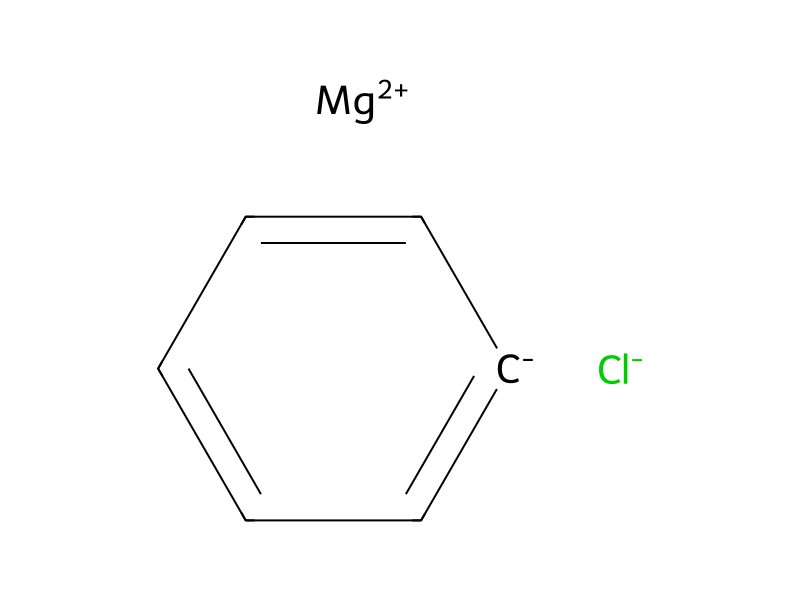
[Cl-].[Mg+2].[c-]1ccccc1- InChIKey
IWCVDCOJSPWGRW-UHFFFAOYSA-M- Summenformel
- C6H5ClMg
- Durchschnittliche Molmasse
- 136,86 g/mol
- Monoisotopische Masse
- 135,9930195
Überblick
Phenylmagnesium chloride is an arylmagnesium halide.
Namen und Bezeichner
- Bevorzugter Name
- Phenylmagnesium chloride
- IUPAC
- magnesium;benzene;chloride
- Lokaler Name
- Chlorphenylmagnesium
- Englischer Name
- Phenylmagnesium chloride
- Summenformel
- C6H5ClMg
- Molmasse
- 136.86
Namen und Synonyme
PHENYLMAGNESIUM CHLORIDE100-59-4Magnesium, chlorophenyl-Chlorophenylmagnesiumchloro(phenyl)magnesiumHSDB 5336EINECS 202-868-8DTXSID8059215CHEBI:51490EC 202-868-8739Y484F5HMagnesium, chlorophenyl
Weitere Namen anzeigen
Phenylmagnesium Chloride 2.0 M In TetrahdyrofuranPhenylmagnesiuChlorphenylmagnesiumchlorophenyl-magnesiuPhenylchloromagnesiumphenylmagnessium chloride
RefChem:861756DTXCID9032456PHENYLMAGNESIUM CHLORIDE [MI]UN3207202-868-8phenyl magnesium chlorideMFCD00000464phenylmagnesiumchloride
Datenbank-Bezeichner
- CAS
100-59-4- PubChem CID
- 7513
- DTXSID
DTXSID8059215- ChEBI
CHEBI:51490- EC Number
- 202-868-8
Eigenschaften
Berechnete Struktureigenschaften
- Polarare Oberfläche (TPSA)
- 0 Ų
- H-Brücken-Donoren
- 0
- H-Brücken-Akzeptoren
- 2
- Frei drehbare Bindungen
- 0
- Schwere Atome
- 8
- Formalladung
- 0
- Komplexität
- 100
Experimentelle und physikochemische Eigenschaften
Chemical ClassesMetals -> Metals, Organic Compounds
DensityA solution which is about 3 molar has an approximate strength of 48%, and a density (20/4 °C) of about 1.15
Color/FormCrystals
Solubility
Reacts with water
Soluble in tetrahydrofuran
Soluble in ether (ethyl ether, other ethers may be used as solvents)
Physical Description
Liquid
Solution in 73% tetrahydrofuran: Dark liquid; [MSDSonline]
Other Experimental PropertiesReacts with water, steam or acids to produce toxic and flammable vapors with evolution of heat.
Physikochemische Eigenschaften
- Schmelzpunkt
- 89 · 89-90℃
- Siedepunkt
- 230 ℃ · 230℃ (8 Torr)
- Dichte
- 1.04 · 1.04
- Flammpunkt
- -17 °C · -17 °C - closed cup
- storage temp.
- 2 · 2-8°C
- Aggregatzustand
- Liquid
- Farbe
- Yellow
- Wasserlöslichkeit
- It reacts violently with water.
- Merck
- 14 · 14,7298
- BRN
- 3587900 · 3587900
- InChI
- InChI=1S/C6H5.ClH.Mg/c1-2-4-6-5-3-1;;/h1-5H;1H;/q;;+1/p-1
- InChIKey
- GQONLASZRVFGHI-UHFFFAOYSA-M
- SMILES
- C1([Mg]Cl)C=CC=CC=1
- CAS Datenbank
- 100 · 100-59-4(CAS DataBase Reference)
- EPA chemische Informationen
- Magnesium, chlorophenyl- (100-59-4)
Sicherheit und Regulatorisches
Sicherheitsangaben dienen nur zur Orientierung und ersetzen weder das Sicherheitsdatenblatt (SDB) des Lieferanten noch geltende Vorschriften oder eine fachliche Bewertung.
GHS-Klassifizierung
GHS Classification
Danger
H225 (77.4%): Highly Flammable liquid and vapor [Danger Flammable liquids]
P210, P233, P240, P241, P242, P243, P260, P264, P264+P265, P280, P301+P330+P331, P302+P361+P354, P303+P361+P353, P304+P340, P305+P354+P338, P316, P317, P321, P363, P370+P378, P403+P235, P405, and P501 (click each P-code to see the statement)
Aggregated GHS information provided per 177 reports by companies from 7 notifications to the ECHA C&L Inventory. Each notification may be associated with multiple companies.
Gefahrenhinweise
Regulatory Information
Chemical: Magnesium, chlorophenyl-
Magnesium, chlorophenyl- is listed on the EPA's Chemical Data Reporting (CDR) system. Manufacturers and importers of Magnesium, chlorophenyl- are required to report information about their production and use of this chemical to the EPA under the Toxic Substances Control Act (TSCA). (40 eCFR Part 711)
REACH registered substance: Chlorophenylmagnesium (EC: 202-868-8)
Fire Potential
Reacts with water, steam or acids to produce toxic and flammable vapors with evolution of heat.
Dangerous fire risk, solution highly flammable.
Hazards Summary
Reacts with water evolving toxic and flammable gases and heat; [Merck Index] Reacts violently with water; Extremely flammable; An irritant; May cause serious eye injury; May cause liver injury; Can be absorbed through skin; [MSDSonline] See Cyclohexylmagnesium chloride and Methylmagnesium chloride.
Hazard Classes and CategoriesFlam. Liq. 2 (77.4%)
Hazardous Reactivities and IncompatibilitiesReacts with water, steam or acids to produce toxic and flammable vapors with evolution of heat
Sicherheit und Schutzausrüstung
Disposal Methods
SRP: Recycle any unused portion of the material for its approved use or return it to the manufacturer or supplier. Ultimate disposal of the chemical must consider: the material's impact on air quality; potential migration in air, soil or water; effects on animal, aquatic and plant life; and conformance with environmental and public health regulations. If it is possible or reasonable use an alternative chemical product with less inherent propensity for occupational harm/injury/toxicity or environmental contamination.
Toxikologische Informationen
Environmental Fate
TERRESTRIAL FATE: Phenylmagnesium chloride reacts violently with water(1) and, therefore, leaching or volatilization in moist soil are not expected to be important fate processes(SRC). Reaction with water will be the dominant fate mechanism(SRC).
AQUATIC FATE: Phenylmagnesium chloride reacts violently with water(1) and, therefore, hydrolysis will be the only important fate mechanism in the aquatic environment(SRC).
ATMOSPHERIC FATE: Relevant vapor pressure data were not available for phenylmagnesium chloride(SRC, 2017). However, phenylmagnesium chloride reacts violently with water(1) and, therefore, both particulate phase and vapor phase phenylmagnesium chloride are expected to react with precipitation, cloud water, fog and possibly water vapor in the atmosphere(SRC).
Adverse EffectsOccupational hepatotoxin - Secondary hepatotoxins: the potential for toxic effect in the occupational setting is based on cases of poisoning by human ingestion or animal experimentation.
Toxicity Summary
IDENTIFICATION AND USE: Phenylmagnesium chloride is used as a Grignard reagent in organic synthesis, especially in the production of hydrocarbons, alcohols, ketones, organic acids, amines, silicones, boranes. HUMAN STUDIES: There are no data available. ANIMAL STUDIES: There are no data available.
Soil Adsorption/MobilityPhenylmagnesium chloride reacts violently with water(1); therefore, leaching in moist soil is not expected to be an important fate process(SRC).
Artificial Pollution Sources
Phenylmagnesium chloride's production and use in organic synthesis and as a Grignard reagent(1,2) may result in its release to the environment through various waste streams(SRC). Phenylmagnesium chloride is on the US DEA (Drug Enforcement Administration) list of special surveillance chemicals used in clandestine drug manufacture(3).
Environmental BioconcentrationPhenylmagnesium chloride reacts violently with water(1); therefore, the potential for bioconcentration in aquatic organisms low or non-existent(SRC).
Volatilization from Water/SoilPhenylmagnesium chloride reacts violently with water(1); therefore, volatilization from water surfaces or moist soil is not expected to be an important fate process(SRC).
Environmental Abiotic Degradation
Phenylmagnesium chloride reacts violently with water(1). Phenylmagnesium chloride reacts with water, steam or acids to produce toxic and flammable vapors(2). Hydrolysis of a phenylmagnesium halide produces benzene with a potential release of hydrogen halide vapors such as hydrochloric acid (HCl) vapors(3). Phenylmagnesium chloride is sensitive to light and exposure to sunlight may cause explosive peroxides to form in the commercially sold tetrahydrofuran solutions of phenylmagnesium chloride(4).
Probable Routes of Human Exposure
Occupational exposure to phenylmagnesium chloride may occur through dermal contact with this compound at workplaces where phenylmagnesium chloride is produced or used(SRC). The general population is not expected to be exposed to phenylmagnesium chloride(SRC). A possible rare exposure to the general population may be possible in the vicinity of its use as a reagent during illicit drug manufacture. Phenylmagnesium chloride is on the US DEA (Drug Enforcement Administration) list of special surveillance chemicals used in clandestine drug manufacture(1).
Environmental Fate/Exposure Summary
Phenylmagnesium chloride's production and use in organic synthesis and as a Grignard reagent may result in its release to the environment through various waste streams. Phenylmagnesium chloride is on the US DEA (Drug Enforcement Administration) list of special surveillance chemicals used in clandestine drug manufacture. Phenylmagnesium chloride reacts violently with water, therefore, hydrolysis will be the dominant fate process in air, soil and water. Occupational exposure to phenylmagnesium chloride may occur through dermal contact with this compound at workplaces where phenylmagnesium chloride is produced or used. The general population is not expected to be exposed to phenylmagnesium chloride. A possible rare exposure to the general population may be possible in the vicinity of its use as a reagent during illicit drug manufacture. (SRC)
Antidote and Emergency Treatment
/SRP:/ Immediate first aid: Ensure that adequate decontamination has been carried out. If patient is not breathing, start artificial respiration, preferably with a demand valve resuscitator, bag-valve-mask device, or pocket mask, as trained. Perform CPR if necessary. Immediately flush contaminated eyes with gently flowing water. Do not induce vomiting. If vomiting occurs, lean patient forward or place on the left side (head-down position, if possible) to maintain an open airway and prevent aspiration. Keep patient quiet and maintain normal body temperature. Obtain medical attention. /Poisons A and B/
/SRP:/ Basic treatment: Establish a patent airway (oropharyngeal or nasopharyngeal airway, if needed). Suction if necessary. Watch for signs of respiratory insufficiency and assist ventilations if needed. Administer oxygen by nonrebreather mask at 10 to 15 L/min. Monitor for pulmonary edema and treat if necessary ... . Monitor for shock and treat if necessary ... . Anticipate seizures and treat if necessary ... . For eye contamination, flush eyes immediately with water. Irrigate each eye continuously with 0.9% saline (NS) during transport ... . Do not use emetics. For ingestion, rinse mouth and administer 5 mL/kg up to 200 mL of water for dilution if the patient can swallow, has a strong gag reflex, and does not drool ... . Cover skin burns with dry sterile dressings after decontamination ... . /Poisons A and B/
/SRP:/ Advanced treatment: Consider orotracheal or nasotracheal intubation for airway control in the patient who is unconscious, has severe pulmonary edema, or is in severe respiratory distress. Positive-pressure ventilation techniques with a bag valve mask device may be beneficial. Consider drug therapy for pulmonary edema ... . Consider administering a beta agonist such as albuterol for severe bronchospasm ... . Monitor cardiac rhythm and treat arrhythmias as necessary ... . Start IV administration of D5W TKO /SRP: "To keep open", minimal flow rate/. Use 0.9% saline (NS) or lactated Ringer's (LR) if signs of hypovolemia are present. For hypotension with signs of hypovolemia, administer fluid cautiously. Watch for signs of fluid overload ... . Treat seizures with diazepam or lorazepam ... . Use proparacaine hydrochloride to assist eye irrigation ... . /Poisons A and B/
Sicherheitsdaten
- F
- 10
- wgk
- 2
- tsca
- TSCA listed
- ridadr
- UN 2924 3/PG 2
- hs_code
- 29319090
- risk_code
- 14-19-20/21/22-34-67-65-63-48/20-11-40-37
- hazard_code
- F,C
- safety_code
- 26-36/37/39-45-62-33-16
- hazard_class
- 8
- packing_group
- II
- Speicherklasse
- 3 - Flammable liquids
- Giftige Stoffe Daten
- 100-59-4(Hazardous Substances Data)
- Hazard Classifications
- Carc. 2Eye Dam. 1Flam. Liq. 2Skin Corr. 1BSTOT SE 3
Chemie und Industrie
Verwendung und Herstellung
Uses
Used as a Grignard reagent and in organic synthesis (hydrocarbons, alcohols, ketones, organic acids, amines, silicones, boranes, pesticides, and organotin compounds); [HSDB]
One of the Grignard reagents. ... In organic synthesis, especially in the production of hydrocarbons, alcohols, ketones, organic acids, amines, silicones, boranes.
CHEM INT FOR PESTICIDES, EG, FENTIN HYDROXIDE
CHEM INT FOR SILICONE INTS, EG, PHENYLTRICHLOROSILANE
CHEM INT FOR ORGANOTIN COMPDS, EG, TETRAPHENYLTIN
U.S. Exports
(1979) No Data
(1981) No Data
U.S. Imports
(1979) No Data
(1981) No Data
U.S. Production
2023: <50,000 lb
(1979) No Data
(1981) No Data
Industry UsesIntermediate
Methods of Manufacturing
Prepared by reacting chlorobenzene with magnesium at reflux temperatures in the presence of catalytic amounts of an organic nitrate.
Chloro-, bromo-, or iodobenzene will react with magnesium metal in ethereal solvents to produce phenylmagnesium chloride, bromide, or iodide (Grignard reagents).
Formulations/PreparationsAvailable dissolved in tetrahydrofuran.
General Manufacturing Information
Synthetic Rubber Manufacturing
Magnesium, chlorophenyl-: ACTIVE
Grignard reagent is basically an organomagnesium halide having a formula of RMgX where X is a halogen, and R is an alkyl or aryl (based on a benzene ring) group. On the event of Grignard Reaction, Grignard reagent is added to a ketone or aldehyde, to form a tertiary or secondary alcohol, respectively. The reaction with formaldehyde leads to a primary alcohol. Grignard reagent can be used for determining the number of halogen atoms present in a halogen compound. ... Used for the chemical analysis of certain triacylglycerols. /Grignard reagent/
Anwendungen
VerwendenPhenylmagnesium chloride (PhMgCl) solution is a common Grignard reagent used in the synthesis of ()-phenserine and stephacidin B. It is employed in a variety of cross-coupling reactions. It can also be used as an electrolyte solution along with aluminium chloride (AlCl3) in the rechargeable magnesium batteries.
Vor- und nachgelagerte Produkte
Vorgelagerte Rohstoffe
Nachgelagerte Produkte
Zugehörige Reaktionen
0
Noch keine zugehörigen Reaktionen