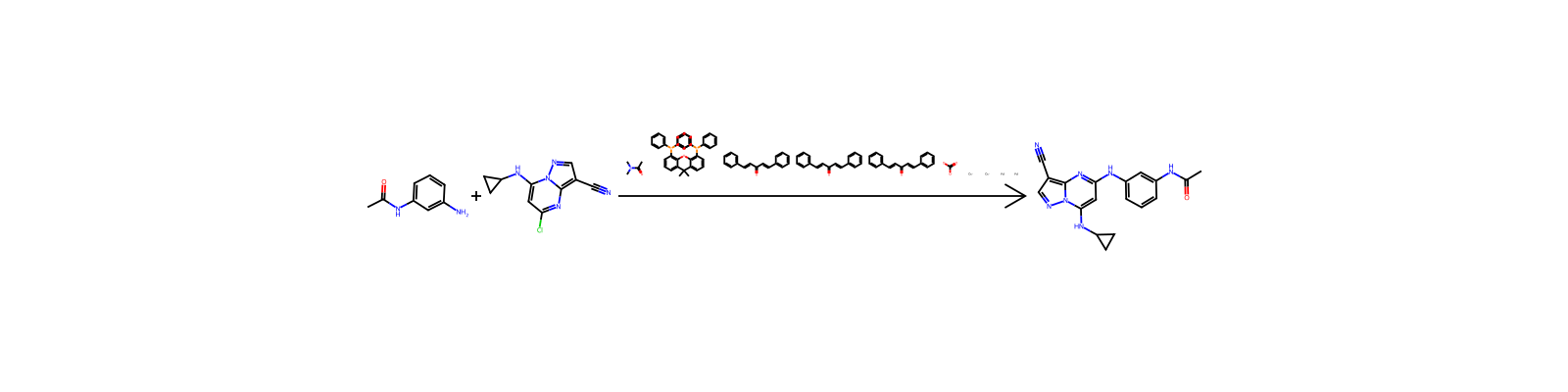
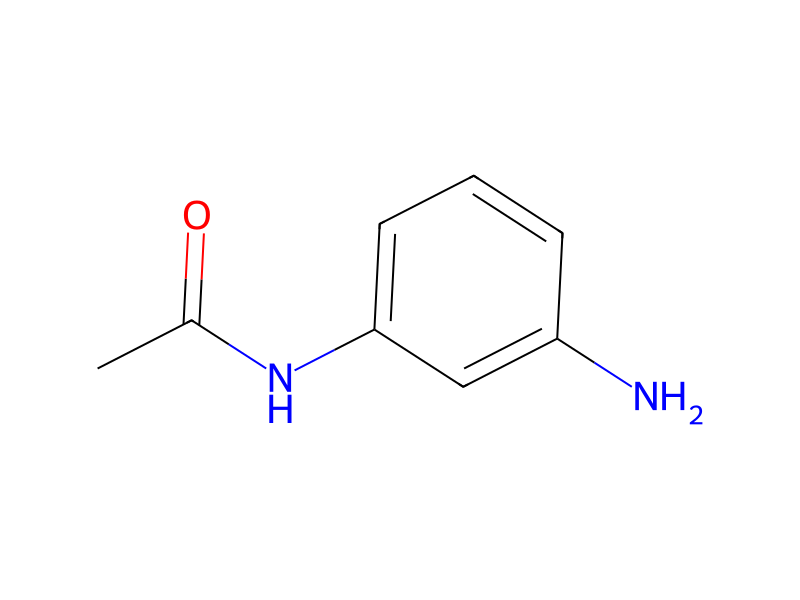
Grundinformationen
- Standard-SMILES
CC(=O)Nc1cccc(N)c1- InChIKey
PEMGGJDINLGTON-UHFFFAOYSA-N- Summenformel
- C8H10N2O
- Durchschnittliche Molmasse
- 150,18 g/mol
- Monoisotopische Masse
- 150,07931294
Überblick
M-aminoacetanilide is a gray solid. (NTP, 1992)
Namen und Bezeichner
- Bevorzugter Name
- m-Aminoacetanilide
- IUPAC
- N-(3-aminophenyl)acetamide
- Lokaler Name
- 3-Aminoacetanilid
- Englischer Name
- N1-(3-Aminophenyl)acetamide
- Summenformel
- C8H10N2O
- Molmasse
- 150.18
Namen und Synonyme
N-(3-Aminophenyl)acetamide102-28-33'-AminoacetanilideM-AMINOACETANILIDE3-AcetamidoanilineAcetamide, N-(3-aminophenyl)-M-Acetaminoanilinem-(Acetylamino)anilineN-Acetyl-m-phenylenediamine3-Amino-N-acetylaniline3-Aminoacetanilid3-Acetylaminoaniline
Weitere Namen anzeigen
META AMINO ACETANILIDE3-AMINOACETANILIDEFR-2203AKOS BB-8162WLN: ZR CMV13-AcetamidoaniLASISCHEM B52481
Acetanilide, 3'-amino-1-Amino-3-(acetylamino)benzene3-Aminoacetanilid [Czech]3-(Acetylamino)anilinem-AcetamidoanilineN-Acetyl-m-fenylendiaminCCRIS 4574NSC 165576
Datenbank-Bezeichner
- CAS
102-28-3- PubChem CID
- 7604
- DTXSID
DTXSID2024454- ChEMBL
CHEMBL1606123- UNII
- Q5K7HYS7JJ
- EC Number
- 203-021-5
- Nikkaji
- J43.351I
Eigenschaften
Berechnete Struktureigenschaften
- XLogP
- 0,9
- Polarare Oberfläche (TPSA)
- 55,1 Ų
- H-Brücken-Donoren
- 2
- H-Brücken-Akzeptoren
- 2
- Frei drehbare Bindungen
- 1
- Schwere Atome
- 11
- Formalladung
- 0
- Komplexität
- 147
Experimentelle und physikochemische Eigenschaften
Chemical ClassesNitrogen Compounds -> Other Aromatics (Nitrogen)
SpringerMaterials Properties13C nuclear magnetic resonance spectrum
Solubility10 to 50 mg/mL at 75 °F (NTP, 1992)
Boiling PointDecomposes at 1449 °F (NTP, 1992)
Melting Point187.7 to 189.5 °F (NTP, 1992)
Physical Description
M-aminoacetanilide is a gray solid. (NTP, 1992)
Gray solid; [CAMEO] Light brown crystalline powder; [Acros Organics MSDS]
Physikochemische Eigenschaften
- Schmelzpunkt
- 86 · 86-88 °C(lit.)
- Siedepunkt
- 271.72 °C · 271.72°C (rough estimate)
- Dichte
- 1.1392 · 1.1392 (rough estimate)
- Brechungsindex
- 1.618 · 1.6180 (estimate)
- storage temp.
- Keep in dark place,Inert atmosphere,Room temperature
- Aggregatzustand
- powder to crystal
- pka
- 14.82 · 14.82±0.70(Predicted)
- Farbe
- White to Gray to Brown
- Wasserlöslichkeit
- 1 · 1-5 g/100 mL at 24 ºC
- InChI
- InChI=1S/C8H10N2O/c1-6(11)10-8-4-2-3-7(9)5-8/h2-5H,9H2,1H3,(H,10,11)
- InChIKey
- PEMGGJDINLGTON-UHFFFAOYSA-N
- SMILES
- C(NC1=CC=CC(N)=C1)(=O)C
- CAS Datenbank
- 102 · 102-28-3(CAS DataBase Reference)
- EPA chemische Informationen
- 3 · 3'-Aminoacetanilide (102-28-3)
Sicherheit und Regulatorisches
GHS-Klassifizierung
GHS Classification
Warning
H302 (21.1%): Harmful if swallowed [Warning Acute toxicity, oral]
P261, P264, P264+P265, P270, P271, P280, P301+P317, P302+P352, P304+P340, P305+P351+P338, P319, P321, P330, P332+P317, P337+P317, P362+P364, P403+P233, P405, and P501 (click each P-code to see the statement)
Aggregated GHS information provided per 57 reports by companies from 8 notifications to the ECHA C&L Inventory. Each notification may be associated with multiple companies.
Gefahrenhinweise
Regulatory InformationStatus: Active Update: 30-05-2016 https://echa.europa.eu/registration-dossier/-/registered-dossier/17428
Fire HazardsFlash point data concerning this compound are not available, however, it is probably combustible. (NTP, 1992)
Health HazardsACUTE/CHRONIC HAZARDS: When heated to decomposition this compound emits toxic fumes. (NTP, 1992)
Hazards SummaryA mild eye irritant; [RTECS] An irritant; [Acros Organics MSDS] See Acetanilide.
Reactive GroupAmides and Imides
Reactivity Profile
Aromatic amines are chemical bases. They neutralize acids to form salts plus water. These acid-base reactions are exothermic. The amount of heat that is evolved per mole of amine in a neutralization is largely independent of the strength of the amine as a base. Amines may be incompatible with isocyanates, halogenated organics, peroxides, phenols (acidic), epoxides, anhydrides, and acid halides. Flammable gaseous hydrogen is generated by amines in combination with strong reducing agents, such as hydrides.
Air and Water ReactionsSoluble in water.
Hazard Classes and CategoriesAcute Tox. 4 (21.1%)
Sicherheit und Schutzausrüstung
Fire FightingFires involving this compound can be controlled using a dry chemical, carbon dioxide or Halon extinguisher. (NTP, 1992)
First Aid
EYES: First check the victim for contact lenses and remove if present. Flush victim's eyes with water or normal saline solution for 20 to 30 minutes while simultaneously calling a hospital or poison control center. Do not put any ointments, oils, or medication in the victim's eyes without specific instructions from a physician. IMMEDIATELY transport the victim after flushing eyes to a hospital even if no symptoms (such as redness or irritation) develop.
Nonfire Spill Response
SMALL SPILLS AND LEAKAGE: If you spill this chemical, you should dampen the solid spill material with water, then transfer the dampened material to a suitable container. Use absorbent paper dampened with water to pick up any remaining material. Seal your contaminated clothing and the absorbent paper in a vapor-tight plastic bag for eventual disposal. Wash all contaminated surfaces with a soap and water solution. Do not reenter the contaminated area until the Safety Officer (or other responsible person) has verified that the area has been properly cleaned.
Personal Protective Equipment (PPE)
RECOMMENDED RESPIRATOR: Where the neat test chemical is weighed and diluted, wear a NIOSH-approved half face respirator equipped with an organic vapor/acid gas cartridge (specific for organic vapors, HCl, acid gas and SO2) with a dust/mist filter. (NTP, 1992)
Sicherheitsdaten
- wgk
- 3
- tsca
- TSCA listed
- hs_code
- 29214200
- RTECS-Nr.
- AD8050000
- risk_code
- 36/37/38
- Toxizität
- mouse,LD50,intravenous,320mg/kg (320mg/kg),U.S. Army Armament Research & Development Command, Chemical Systems Laboratory, NIOSH Exchange Chemicals. Vol. NX#02899,
- hazard_code
- Xi
- safety_code
- 26-36-37/39
- hazard_class
- IRRITANT
- Speicherklasse
- 11 - Combustible Solids
- Hazard Classifications
- Eye Irrit. 2Skin Irrit. 2STOT SE 3
Chemie und Industrie
Verwendung und Herstellung
UsesUsed in organic synthesis; [NTP]
General Manufacturing InformationAcetamide, N-(3-aminophenyl)-: ACTIVE
Anwendungen
Verwenden3'-Aminoacetanilide is mainly used as reaction intermediates dyes and disperse dyes.
Vor- und nachgelagerte Produkte
Vorgelagerte Rohstoffe
Nachgelagerte Produkte
Anbieter50 Anbieter
梯希爱(上海)化成工业发展有限公司021-67121386 · [email protected]
上海阿拉丁生化科技股份有限公司400-6206333 13167063860 · [email protected]
杭州景优化工有限公司87211835 13957193240 · [email protected]
河北创海生物科技有限公司+86-86-13131129325 · [email protected]
爱斯特(成都)生物制药股份有限公司+86-28-85122536 85324413 · [email protected]
Dayang Chem (Hangzhou) Co.,Ltd.+86-0571-88938639 17705817739 · [email protected]
Hebei Yanxi Chemical Co., Ltd.+86-17531190177 · [email protected]
北京安司莫森技术有限公司010-82954736 13391601435 · [email protected]
韶远科技(上海)有限公司021-50795510 4000665055 · [email protected]
科瑞迪化学400-821-5857 021-64326257 · [email protected]
Syntechem Co.,Ltd[email protected]
上海迈瑞尔生化科技有限公司4006356688 18621169109 · [email protected]
北京华威锐科化工有限公司0757-86329057 18934348241 · [email protected]
阿法埃莎(中国)化学有限公司400-6106006 · [email protected]
安耐吉化学&3A(安徽泽升科技股份有限公司)400-0056266 · [email protected]
上海瀚鸿科技股份有限公司021-54306202 13764082696 · [email protected]
上海钰康生物科技有限公司+86-18930848214 +86-021-56762820 · [email protected]
山东西亚化学有限公司13355009207 13355009207 · [email protected]
玛雅试剂+86 (573) 82222445 (0)18006601000 452520369 · [email protected]
四川库利南科技有限公司400-1166-196 18981987031 · [email protected]
天津希恩思生化科技有限公司400 638 7771 · [email protected]
艾科试剂4008-755-333 18080918076 · [email protected]
上海思域化工科技有限公司86-21-34053660 · [email protected]
赛默飞世尔科技(中国)有限公司800-810-5118 · [email protected]
北京伊诺凯科技有限公司400-810-7969 010-59572699 · [email protected]
上海遐瑞医药科技有限公司+86 21 61551611
江苏艾康生物医药研发有限公司025-66113011 13913916777 · [email protected]
TCI AMERICA800-4238616 · [email protected]
TOKYO CHEMICAL INDUSTRY CO., LTD.03-36680489 · [email protected]
TCI Europe320-37350700 · [email protected]
Chempioneer Limited+86-398-3831668 · [email protected]
北京环宇世纪化学科技有限公司hysj_bj.com
上海湄水化工科技有限公司021-60549325 18616193163
上海将来实业股份有限公司400-0066400 13621662912 · [email protected]
上海将来实业股份有限公司021-61552785 · [email protected]
安徽科迪达化工有限公司0554-2106669 · [email protected]
上海毕得医药科技股份有限公司400-164-7117 18317119277 · [email protected]
日照力德士化工有限公司010-51268198 · [email protected]
美岚实业(上海)有限公司021-58958189 · [email protected]
成都零六生物科技有限公司400-1166-196 13458535857 · [email protected]
湖南华腾制药有限公司400-8592883 · [email protected]
上海创赛科技有限公司400-6087598 15021221957 · [email protected]
上海乾劲化工科技有限公司021-20900665 17321230821 · [email protected]
杭州杰恒化工有限公司0571-87396432 · [email protected]
上海洽凡生化科技有限公司+86-021-61654350 · [email protected]
安徽煦鼎化工科技有限公司15215638822 · [email protected]
上海有朋化工有限公司021-69005955 13701776567 · [email protected]
北京海力扬化学科技有限公司13718199399 · [email protected]
四川海诺威科技有限公司13708085536 13708085536 · [email protected]
上海凯赛化工有限公司021-33516722 13701817765 · [email protected]
Zugehörige Reaktionen
105


Verknüpfte Notizen
Wird geladen…