
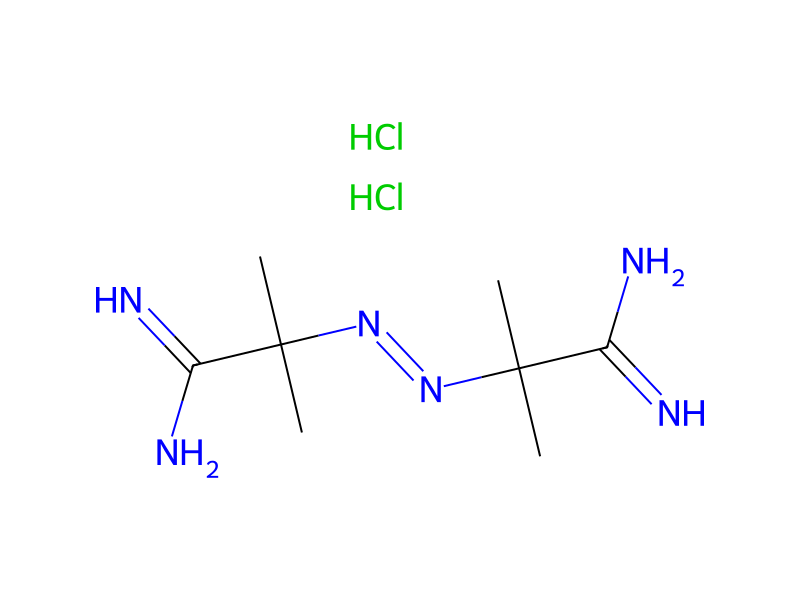
Grundinformationen
- Standard-SMILES
CC(C)(N=NC(C)(C)C(=N)N)C(=N)N.Cl.Cl- InChIKey
LXEKPEMOWBOYRF-UHFFFAOYSA-N- Summenformel
- C8H18N6.2ClH
- Durchschnittliche Molmasse
- 271,19 g/mol
- Monoisotopische Masse
- 270,11265
Überblick
AAPH is a monoazo compound.
Namen und Bezeichner
- Bevorzugter Name
- 2,2'-Azobis(2-methylpropanimidamide) dihydrochloride
- IUPAC
- 2-[(1-amino-1-imino-2-methylpropan-2-yl)diazenyl]-2-methylpropanimidamide;dihydrochloride
- Lokaler Name
- 2,2'-Azobis(2-methylpropion-amidin)dihydrochlorid
- Englischer Name
- 2,2′-Azobis(2-methylpropionamidine) dihydrochloride
- Summenformel
- C8H20Cl2N6
- Molmasse
- 271.19
Namen und Synonyme
2997-92-42,2'-Azobis(2-methylpropionamidine) dihydrochloride2,2'-Azodiisobutyramidine DihydrochloridePropanimidamide, 2,2'-azobis[2-methyl-, dihydrochloride2,2'-Azobis(2-methylpropanimidamide) dihydrochlorideWAKO V-50Propanimidamide, 2,2'-azobis(2-methyl-, dihydrochlorideAzobisisobutyramidinium dichloride2,2'-Azobisisobutyramidinium chlorideAzobis(isobutyramidine) dihydrochloride2,2'-Azobisamidinopropane dihydrochloride2,2'-Azobis(isobutyramidine hydrochloride)
Weitere Namen anzeigen
v50AAPHAIBAProclin2,2'-AZOBIS(2-AMIDINOPROPANE) DIHYDROCHLORIDE2,2'-AZOBIS(2-METHYLPROPIONAMIDINE)ABAPazobis-2-methyl-propanimidamide2,2’-azobis(2-methyl-propanimidamiddihydrochloride
AZOBIS(ISOBUTYL)AMIDINE HYDROCHLORIDE2,2'-azobis(isobutyramidine) dihydrochloride2,2-Azobis(2-amidinopropane) dihydrochlorideNSC-6684162,2'-AZODIISOBUTYLAMIDINE DIHYDROCHLORIDE2,2'-azobis[2-methylpropionamidine] dihydrochloride2,2'-Azobis(propane-2-carboxamidine) dihydrochloridePropanimidamide, 2,2'-(1,2-diazenediyl)bis(2-methyl-, hydrochloride (1:2)
Datenbank-Bezeichner
- CAS
2997-92-4- PubChem CID
- 76344
- DTXSID
DTXSID3049756- ChEMBL
CHEMBL1528605- ChEBI
CHEBI:186632- UNII
- 7381JDR72F
- EC Number
- 221-070-0
Eigenschaften
Berechnete Struktureigenschaften
- Polarare Oberfläche (TPSA)
- 124 Ų
- H-Brücken-Donoren
- 6
- H-Brücken-Akzeptoren
- 4
- Frei drehbare Bindungen
- 4
- Schwere Atome
- 16
- Formalladung
- 0
- Komplexität
- 248
Experimentelle und physikochemische Eigenschaften
Physical DescriptionLarge Crystals
Physikochemische Eigenschaften
- Schmelzpunkt
- 175 · 175-177 °C(lit.)
- Dichte
- 0.42 · 0.42
- Dampfdruck
- 0 Pa · 0Pa at 20℃
- storage temp.
- 0 · 0-6°C
- Löslichkeit
- acetone, dioxane, methanol, ethanol, DMSO and water: soluble
- Aggregatzustand
- granular
- Farbe
- White to off-white
- Wasserlöslichkeit
- 176.2 g/L · 176.2g/L at 20℃
- Stabilität
- Unstable. Sensitive to heat and light. Incompatible with strong oxidizing agents, strong acids.
- InChI
- InChI=1S/C8H18N6.2ClH/c1-7(2,5(9)10)13-14-8(3,4)6(11)12;;/h1-4H3,(H3,9,10)(H3,11,12);2*1H/b14-13+;;
- InChIKey
- LXEKPEMOWBOYRF-QDBORUFSSA-N
- SMILES
- C(C)(C)(/N=N/C(C)(C)C(=N)N)C(=N)N.Cl.Cl
- LogP
- 0.3 at · 0.3 at 25℃
- CAS Datenbank
- 2997 · 2997-92-4(CAS DataBase Reference)
- EPA chemische Informationen
- 2 · Propanimidamide, 2,2'-azobis[2-methyl-, dihydrochloride (2997-92-4)
Sicherheit und Regulatorisches
GHS-Klassifizierung
GHS Classification
Warning
H302: Harmful if swallowed [Warning Acute toxicity, oral]
P261, P264, P270, P272, P280, P301+P317, P302+P352, P321, P330, P333+P317, P362+P364, and P501 (click each P-code to see the statement)
Danger
H242 (24%): Heating may cause a fire [Danger Self-reactive substances and mixtures; Organic peroxides]
P210, P234, P235, P240, P261, P264, P270, P272, P280, P301+P317, P302+P352, P321, P330, P333+P317, P362+P364, P370+P378, P403, P410, P411, P420, and P501 (click each P-code to see the statement)
Gefahrenhinweise
Regulatory Information
Chemical: Propanimidamide, 2,2'-azobis[2-methyl-, dihydrochloride
Propanimidamide, 2,2'-(1,2-diazenediyl)bis[2-methyl-, hydrochloride (1:2) is listed on the EPA's Chemical Data Reporting (CDR) system. Manufacturers and importers of Propanimidamide, 2,2'-(1,2-diazenediyl)bis[2-methyl-, hydrochloride (1:2) are required to report information about their production and use of this chemical to the EPA under the Toxic Substances Control Act (TSCA). (40 eCFR Part 711)
Status: Active Update: 06-07-2022 https://echa.europa.eu/registration-dossier/-/registered-dossier/11995
2,2'-Azobis[2-methylpropionamidine] dihydrochloride: Does not have an individual approval but may be used under an appropriate group standard
Other Safety InformationIMAP assessments - Propanimidamide, 2,2'-azobis[2-methyl-, dihydrochloride: Human health tier I assessment
Hazard Classes and Categories
Self-react. D (24%)
Acute toxicity - category 4
Acute Tox. 4 *
Sicherheitsdaten
- F
- 10-21
- wgk
- 1
- tsca
- TSCA listed
- ridadr
- UN 3226 4.1
- hs_code
- 29270000
- RTECS-Nr.
- UE4575500
- risk_code
- 22-43-5
- Toxizität
- LD50 oral in rat: 410mg/kg
- hazard_code
- Xn
- safety_code
- 24-37
- hazard_class
- 5.1
- packing_group
- III
- Speicherklasse
- 4.2 - Pyrophoric and self-heating hazardous materials
- Hazard Classifications
- Acute Tox. 4 OralAquatic Acute 1Aquatic Chronic 1Eye Irrit. 2Self-heat. 1Skin Sens. 1
Chemie und Industrie
Verwendung und Herstellung
U.S. Production2023: 448,177 lb
Industry UsesPolymerization promoter
General Manufacturing Information
Plastics Material and Resin Manufacturing
Propanimidamide, 2,2'-(1,2-diazenediyl)bis[2-methyl-, hydrochloride (1:2): ACTIVE
Anwendungen
Verwenden2,2'-Azobis(2-methylpropionamidine) dihydrochloride can be used as free radical initiator, apoptosis inducer.
Anbieter50 Anbieter
国药集团化学试剂有限公司86-21-63210123 · [email protected]
上海阿拉丁生化科技股份有限公司400-6206333 13167063860 · [email protected]
爱斯特(成都)生物制药股份有限公司+86-28-85122536 85324413 · [email protected]
上海如吉生物科技发展有限公司+86-21-65211385-8001 36031160 · [email protected]
韶远科技(上海)有限公司021-50795510 4000665055 · [email protected]
科瑞迪化学400-821-5857 021-64326257 · [email protected]
上海将来实业股份有限公司400-0066400 13621662912 · [email protected]
Syntechem Co.,Ltd[email protected]
安耐吉化学&3A(安徽泽升科技股份有限公司)400-0056266 · [email protected]
上海瀚鸿科技股份有限公司021-54306202 13764082696 · [email protected]
济南君合药业有限公司+86-13053355392 +86-13053355392
池州捷峰生物科技有限公司0566-8928158 · [email protected]
武汉丰泰威远科技有限公司027-87465837 19945049750 · [email protected]
南京蓝白化工有限公司025-85499326 15366059326;13813836665 · [email protected]
山东西亚化学有限公司13355009207 13355009207 · [email protected]
玛雅试剂+86 (573) 82222445 (0)18006601000 452520369 · [email protected]
四川库利南科技有限公司400-1166-196 18981987031 · [email protected]
天津希恩思生化科技有限公司400 638 7771 · [email protected]
湖南汇百侍生物科技有限公司0731-85526065 13308475853 · [email protected]
上海源叶生物科技有限公司13636370518 · [email protected]
艾科试剂4008-755-333 18080918076 · [email protected]
上海思域化工科技有限公司86-21-34053660 · [email protected]
赛默飞世尔科技(中国)有限公司800-810-5118 · [email protected]
TOKYO CHEMICAL INDUSTRY CO., LTD.03-36680489 · [email protected]
上海贤鼎生物科技有限公司4009209199 · [email protected]
南京杜莱生物技术有限公司025-84699383-8003;025-846993838003-8003 18013301590 · [email protected]
上海陶素生化科技有限公司021-33632979 · [email protected]
上海倍卓生物科技有限公司021-61119791,13386096464 · [email protected]
北京环宇世纪化学科技有限公司hysj_bj.com
上海将来实业股份有限公司400-0066400 13621662912 · [email protected]
上海将来实业股份有限公司021-61552785 · [email protected]
HBCChem, Inc.+1-510-219-6317 · [email protected]
成都零六生物科技有限公司400-1166-196 13458535857 · [email protected]
雷丁试剂0510-85629785 18013409632 · [email protected]
上海御略医药科技有限公司021-60345187 13671753212 · [email protected]
上海麦克林生化科技股份有限公司15221275939 15221275939 · [email protected]
杭州杰恒化工有限公司0571-87396432 · [email protected]
上海嵩爰化工科技有限公司010-1234567 18521000990 · [email protected]
江苏艾康生物医药研发有限公司025-66028182 17714375163 · [email protected]
成都润泽本土化工有限公司13096311329 028-88469284 616445927 · [email protected]
凯试(上海)科技有限公司021-50135380 · [email protected]
湖北巨胜科技有限公司027-59599241 18871490274 · [email protected]
池州凯隆进出口贸易有限公司[email protected]
Sigma-Aldrich西格玛奥德里奇(上海)贸易有限公司021-61415566 800-8193336 · [email protected]
AN PharmaTech Co Ltd86(21)68097365 · [email protected]
桦特昇生物科技(武汉)有限公司027-59207879 1972026995 18140587686 · [email protected]
TargetMol中国(陶术生物)021-021-33632979 15002134094 · [email protected]
北京诺其雅盛生物科技有限公司4000-819-385 010-62329685 13718666987
杭州鼎燕化工有限公司0571-87157530-8003 18267553885 · [email protected]
郑州阿尔法化工有限公司0371-53765687 18937137882 · [email protected]
Zugehörige Reaktionen
27


Verknüpfte Notizen
Wird geladen…