
4'-Bromacetanilid
4'-Bromoacetanilide
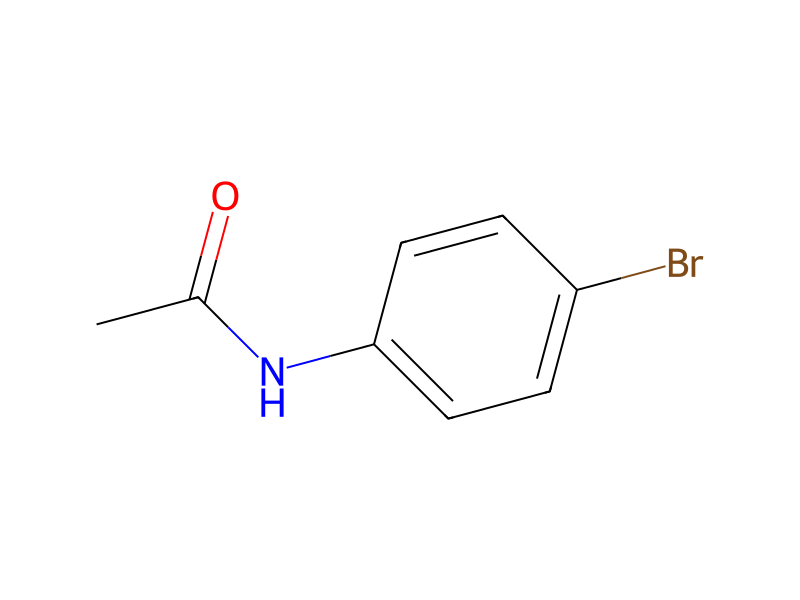
Grundinformationen
- CAS
103-88-8- Standard-SMILES
CC(=O)Nc1ccc(Br)cc1- InChIKey
MSLICLMCQYQNPK-UHFFFAOYSA-N- Summenformel
- C8H8BrNO
- Durchschnittliche Molmasse
- 214,06 g/mol
- Monoisotopische Masse
- 212,97893
Namen und Bezeichner
- Bevorzugter Name
- 4'-Bromoacetanilide
- IUPAC
- N-(4-bromophenyl)acetamide
- Lokaler Name
- 4'-Bromacetanilid
- Englischer Name
- 4'-Bromoacetanilide
- Summenformel
- C8H8BrNO
- Molmasse
- 214.06
Namen und Synonyme
4'-Bromoacetanilide103-88-84-BROMOACETANILIDEN-(4-Bromophenyl)acetamidep-BromoacetanilideBromoanilideAcetamide, N-(4-bromophenyl)-BromoantifebrinAntisepsinAsepsinN-Acetyl-4-bromoanilinep-Bromo-N-acetanilide
Weitere Namen anzeigen
Bromoacetanilide4-BROMOACETOANILIDE4-Bromoacetanilide, 98% PSusafdo-40Bromanilide
1-Bromo-4-acetamidobenzeneAcetanilide, p-bromo-USAF DO-40Acetanilide, 4'-bromo-N-(4-Bromo-phenyl)-acetamideN-Acetyl-p-bromoanilineNSC 105442N-(p-Bromophenyl)acetamide
Datenbank-Bezeichner
- CAS
103-88-8- PubChem CID
- 7683
- DTXSID
DTXSID6059283- ChEMBL
CHEMBL59019- UNII
- 4KB44F25A3
- EC Number
- 203-154-9
- Nikkaji
- J37.694I
Eigenschaften
Berechnete Struktureigenschaften
- XLogP
- 2,3
- Polarare Oberfläche (TPSA)
- 29,1 Ų
- H-Brücken-Donoren
- 1
- H-Brücken-Akzeptoren
- 1
- Frei drehbare Bindungen
- 1
- Schwere Atome
- 11
- Formalladung
- 0
- Komplexität
- 141
Experimentelle und physikochemische Eigenschaften
SpringerMaterials Properties13C nuclear magnetic resonance spectrum
LogP2.14
Physikochemische Eigenschaften
- Schmelzpunkt
- 165 · 165-169 °C(lit.)
- Siedepunkt
- 353.4 °C · 353.4°C (estimate)
- Dichte
- 1.72 · 1.72
- Brechungsindex
- 1.612 · 1.6120 (estimate)
- storage temp.
- 30 °C · Store below +30°C.
- Löslichkeit
- alcohol: moderately soluble
- Aggregatzustand
- Crystalline Powder or Crystals
- pka
- 14.25 · 14.25±0.70(Predicted)
- Farbe
- White to beige or light gray
- Wasserlöslichkeit
- Insoluble
- Merck
- 14 · 14,1399
- BRN
Sicherheit und Regulatorisches
Sicherheitsangaben dienen nur zur Orientierung und ersetzen weder das Sicherheitsdatenblatt (SDB) des Lieferanten noch geltende Vorschriften oder eine fachliche Bewertung.
GHS-Klassifizierung
GHS Classification
Warning
H315 (97.9%): Causes skin irritation [Warning Skin corrosion/irritation]
P261, P264, P264+P265, P271, P280, P302+P352, P304+P340, P305+P351+P338, P319, P321, P332+P317, P337+P317, P362+P364, P403+P233, P405, and P501 (click each P-code to see the statement)
Aggregated GHS information provided per 48 reports by companies from 6 notifications to the ECHA C&L Inventory. Each notification may be associated with multiple companies.
Gefahrenhinweise
Regulatory Information
Chemical: Acetamide, N-(4-bromophenyl)-
Acetamide, N-(4-bromophenyl)-: Does not have an individual approval but may be used under an appropriate group standard
Hazard Classes and CategoriesSkin Irrit. 2 (97.9%)
Sicherheitsdaten
- wgk
- 3
- tsca
- TSCA listed
- ridadr
- 2811
- hs_code
- 29242998
- RTECS-Nr.
- AD9625000
- risk_code
- 36/37/38
- Toxizität
- mouse,LD50,intraperitoneal,250mg/kg (250mg/kg),National Technical Information Service. Vol. AD277-689,
- hazard_code
- Xi
- hazard_note
- Irritant
- safety_code
- 26-36
- hazard_class
- 6.1(b)
Chemie und Industrie
Verwendung und Herstellung
General Manufacturing InformationAcetamide, N-(4-bromophenyl)-: ACTIVE
Anwendungen
Verwenden4'-Bromoacetanilide is used as an internal standard for phenylurea and the respective metabolic products in oysters. It has also been used as a reagent in the production of a new ligand to form a coordination compex between gadolinium(III) and T=titanium(IV) oxide. It was used in the synthesis of new ligand for anchoring Gd(III) chelates onto TiO2 surface.
Darstellung
synthetischePreparation of 4'-Bromoacetanilide from Acetanilide. Principle: Aromatic compounds can be conveniently brominated by the use of brominating agent, which is normally a solution of bromine in acetic acid. Bromination of activated aromatic compounds usually give 2, 4, 6-tribromo derivatives while moderately activating group like anilide give preferably the para bromo product. Reaction: Procedure: Dissolve 0.5 g acetanilide in 0.6 ml glacial acetic acid and add 2.5 ml bromine solution in acetic acid (25% w/v). Shake the mixture for 1 h. After 1 h, pour the mixture on to crushed ice (20 g) with stirring. Filter the separated product and wash with cold water. Dry the product, record the practical yield and re-crystallize it. Re-crystallization: Dissolve the crude product in minimum amount of ethyl alcohol in a beaker by heating on a water bath. Filter the hot solution and cool the filtrate. The crystals of the product separate out. Filter, dry and record the melting point and TLC (using toluene as a solvent).
Vor- und nachgelagerte Produkte
Vorgelagerte Rohstoffe
Zugehörige Reaktionen
56


Notizen zur Verbindung
Wird geladen…