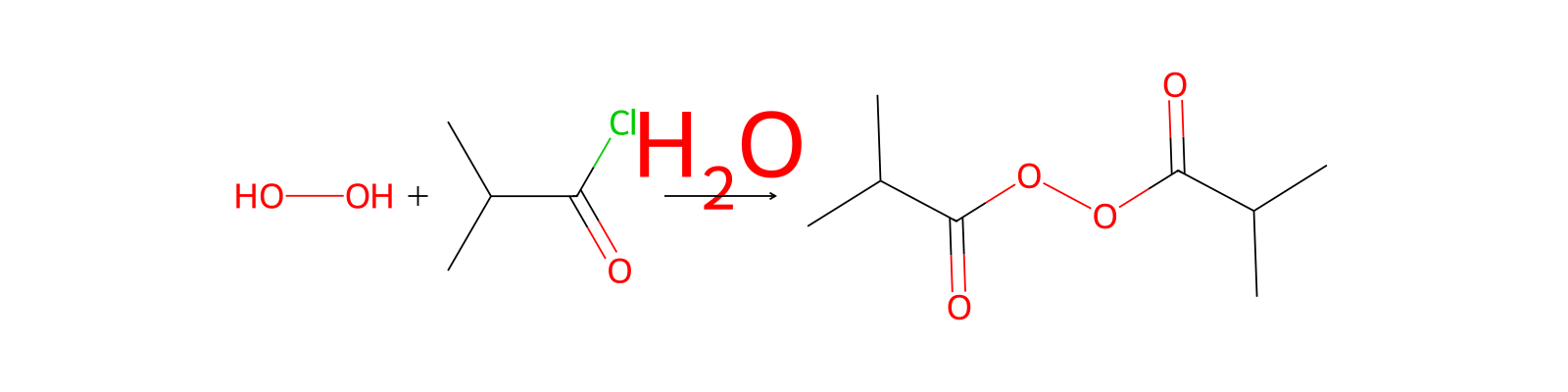
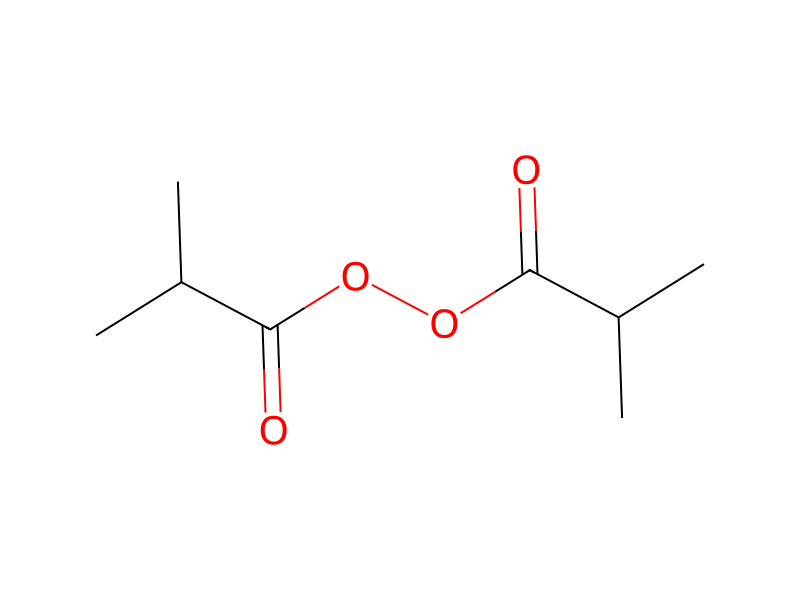
Grundinformationen
- Standard-SMILES
CC(C)C(=O)OOC(=O)C(C)C- InChIKey
RPBWMJBZQXCSFW-UHFFFAOYSA-N- Summenformel
- C8H14O4
- Durchschnittliche Molmasse
- 174,19 g/mol
- Monoisotopische Masse
- 174,08920893
Überblick
This liquid peroxide is particularly sensitive to temperature rises and contamination. Above a given "Control Temperature" they decompose violently.
Namen und Bezeichner
- Bevorzugter Name
- Peroxide, bis(2-methyl-1-oxopropyl)
- IUPAC
- 2-methylpropanoyl 2-methylpropaneperoxoate
- Lokaler Name
- Bisisobutyrylperoxid
- Englischer Name
- Diisobutyryl peroxide
- Summenformel
- C8H14O4
- Molmasse
- 174.19
Namen und Synonyme
Peroxide, bis(2-methyl-1-oxopropyl)3437-84-1isobutyryl peroxidediisobutyryl peroxideBisisobutyryl peroxideEINECS 222-340-0EC 222-340-025V73818UNDTXSID0063024isobutyroyl peroxideRefChem:860356TRIGONOX 187C30
Weitere Namen anzeigen
Diisobutyroyl peroxidediisobutyryl peroxide, 33-52%Bis(2-methyl-1-oxopropyl) peroxidePeroxide,bis(2-methyl-1-oxopropyl)
DTXCID0038833222-340-02-methylpropanoyl 2-methylpropaneperoxoatediisopropylperoxyanhydrideUNII-25V73818UNbis(2-methyl-1-oxopropyl)peroxidediisobutanoyl peroxidedi-iso-butyryl peroxide
Datenbank-Bezeichner
- CAS
3437-84-1- PubChem CID
- 76969
- DTXSID
DTXSID0063024- UNII
- 25V73818UN
- EC Number
- 222-340-0
- Nikkaji
- J1.256D
Eigenschaften
Berechnete Struktureigenschaften
- XLogP
- 2,3
- Polarare Oberfläche (TPSA)
- 52,6 Ų
- H-Brücken-Donoren
- 0
- H-Brücken-Akzeptoren
- 4
- Frei drehbare Bindungen
- 5
- Schwere Atome
- 12
- Formalladung
- 0
- Komplexität
- 152
Experimentelle und physikochemische Eigenschaften
Physical DescriptionThis liquid peroxide is particularly sensitive to temperature rises and contamination. Above a given "Control Temperature" they decompose violently.
Physikochemische Eigenschaften
- Siedepunkt
- 225.17 °C · 225.17°C (rough estimate)
- Dichte
- 1.0817 · 1.0817 (rough estimate)
- Dampfdruck
- 1.2 · 1.2-2.41hPa at 20-25℃
- Brechungsindex
- 1.422 · 1.4220 (estimate)
- Wasserlöslichkeit
- 49.1 g/L · 49.1g/L at 25℃
- InChI
- InChI=1S/C8H14O4/c1-5(2)7(9)11-12-8(10)6(3)4/h5-6H,1-4H3
- InChIKey
- RPBWMJBZQXCSFW-UHFFFAOYSA-N
- SMILES
- O(C(=O)C(C)C)OC(=O)C(C)C
- LogP
- 0.94 · 0.94-2.6 at 20-25℃
- EPA chemische Informationen
- Peroxide, bis(2-methyl-1-oxopropyl) (3437-84-1)
Sicherheit und Regulatorisches
GHS-Klassifizierung
GHS Classification
Danger
H241 (100%): Heating may cause a fire or explosion [Danger Self-reactive substances and mixtures; Organic peroxides]
P210, P234, P235, P240, P260, P261, P264, P264+P265, P272, P280, P301+P316, P301+P330+P331, P302+P352, P302+P361+P354, P304+P340, P305+P351+P338, P305+P354+P338, P316, P321, P331, P333+P317, P337+P317, P362+P364, P363, P370+P380+P375[+P378], P403, P405, P410, P411, P420, and P501 (click each P-code to see the statement)
Aggregated GHS information provided per 5 reports by companies from 2 notifications to the ECHA C&L Inventory. Each notification may be associated with multiple companies.
Gefahrenhinweise
Regulatory InformationStatus: Active Update: 12-06-2019 https://echa.europa.eu/registration-dossier/-/registered-dossier/11632
DOT LabelOrganic Peroxide
Fire HazardsExcerpt from ERG Guide 148 [Organic Peroxides (Heat and Contamination Sensitive / Temperature Controlled)]:
Health HazardsExcerpt from ERG Guide 148 [Organic Peroxides (Heat and Contamination Sensitive / Temperature Controlled)]:
Reactive GroupPeroxides, Organic
Reactivity AlertsExplosive
Reactivity Profile
Most of the isolated diacyl peroxides are solids with relatively low decomposition temperatures, and are explosive, and sensitive to shock, heat, or friction. Several, particularly the lower members, will detonate on the slightest disturbance. Autocatalytic, self-accelerating decomposition, which is promoted by tertiary amines, is involved. A sample of DIISOBUTYRYL PEROXIDE in ether was being evaporated to dryness with a stream of air when it exploded violently, [MCA Case History No. 579]. Can generate electrostatic charges. REF [Handling Chemicals Safely, 1980. p. 250].
Air and Water ReactionsNo rapid reaction with air. No rapid reaction with water.
Hazard Classes and CategoriesOrg. Perox. B (100%)
Sicherheit und Schutzausrüstung
Fire FightingExcerpt from ERG Guide 148 [Organic Peroxides (Heat and Contamination Sensitive / Temperature Controlled)]:
First AidExcerpt from ERG Guide 148 [Organic Peroxides (Heat and Contamination Sensitive / Temperature Controlled)]:
Nonfire Spill ResponseExcerpt from ERG Guide 148 [Organic Peroxides (Heat and Contamination Sensitive / Temperature Controlled)]:
Isolation and EvacuationExcerpt from ERG Guide 148 [Organic Peroxides (Heat and Contamination Sensitive / Temperature Controlled)]:
Personal Protective Equipment (PPE)Excerpt from ERG Guide 148 [Organic Peroxides (Heat and Contamination Sensitive / Temperature Controlled)]:
Sicherheitsdaten
- tsca
- TSCA listed
- ridadr
- 3115
- hazard_class
- 5.2
- packing_group
- II
Chemie und Industrie
Verwendung und Herstellung
General Manufacturing InformationPeroxide, bis(2-methyl-1-oxopropyl): ACTIVE
Vor- und nachgelagerte Produkte
Nachgelagerte Produkte
Anbieter11 Anbieter
Hebei Chuanghai Biotechnology Co., Ltd+86-17732866630 · [email protected]
湖北成丰化工有限公司13125175253 · [email protected]
Baoji Guokang Healthchem co.,ltd+8615604608665 15604608665 · [email protected]
Dayang Chem (Hangzhou) Co.,Ltd.+86-0571-88938639 17705817739 · [email protected]
宝鸡缔都医药化工有限公司029-81145305 17791533577 · [email protected]
PT CHEM GROUP LIMITED+86-85511178; +86-85511178 · [email protected]
湖南秉航新材料有限公司0731-85567275 19313119732 · [email protected]
ANHUI WITOP BIOTECH CO., LTD+8618071025641 · [email protected]
XIAMEN AMITY INDUSTRY AND TRADE CO., LTD.+8618950047208 · [email protected]
CD Chemical Group Limited+86-13651442114 · [email protected]
武汉北国丰化工有限公司027-82886682 18672994909
Zugehörige Reaktionen
3


Verknüpfte Notizen
Wird geladen…