StartseiteMCPWorkbenchSkills
StartseiteWorkbenchBenachrichtigungenMein Bereich
llms.txt · MCP-AnleitungDatenschutz · Nutzungsbedingungen · Supportv1.8.3
  1. Startseite
  2. /Verbindung

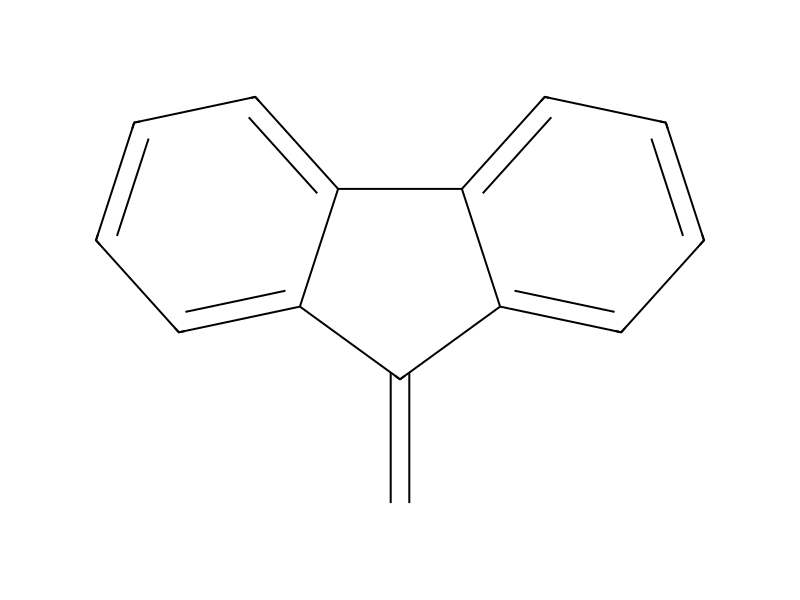
9-Methylene-9H-fluorene

HCID 78147
Neue Reaktion
Drucken
GrundinformationenNamen und BezeichnerEigenschaftenSicherheit und RegulatorischesChemie und IndustrieZugehörige ReaktionenNotizen zur Verbindung
TeilstruktursucheÄhnliche Strukturen suchen

Grundinformationen

CAS
4425-82-5
Standard-SMILES
C=C1c2ccccc2-c2ccccc21
InChIKey
ZYASLTYCYTYKFC-UHFFFAOYSA-N
Summenformel
C14H10
Durchschnittliche Molmasse
178,23 g/mol
Monoisotopische Masse
178,07825032

Namen und Bezeichner

Bevorzugter Name
9-Methylene-9H-fluorene
IUPAC
9-methylidenefluorene
Englischer Name
9-Methylene-9H-fluorene
Summenformel
C14H10
Molmasse
178.23

Namen und Synonyme

4425-82-59-Methylene-9H-fluorene9H-Fluorene, 9-methylene-dibenzofulvene9299E1P3CCDTXSID90196082RefChem:549473DTXCID00118573817-307-89-methylidenefluorene9-methylenefluorene9-Methylene-fluorene
Weitere Namen anzeigen
9-MethylenofluoreneDibenzofulvene (DBF) Oligomer-9-Methylene-9H-fluorene
9-METHYLIDENE-9H-FLUORENEfluorenylidenemethaneMFCD11850122C14H10UNII-9299E1P3CC1,2:3,4-Dibenzofulvene; 9-Methylene-9H-fluorene; 9-Methylenefluorene; Dibenzfulvene; Dibenzofulvene; Fluorenylidenemethane9-Methylene-9H-fluorene #SCHEMBL45149

Datenbank-Bezeichner

CAS
4425-82-5
PubChem CID
78147
DTXSID
DTXSID90196082
UNII
9299E1P3CC
EC Number
817-307-8
Nikkaji
J131.545E

Eigenschaften

Berechnete Struktureigenschaften

XLogP
3,7
Polarare Oberfläche (TPSA)
0 Ų
H-Brücken-Donoren
0
H-Brücken-Akzeptoren
0
Frei drehbare Bindungen
0
Schwere Atome
14
Formalladung
0
Komplexität
216

Physikochemische Eigenschaften

Schmelzpunkt
46 · 46-48 °C
Siedepunkt
305.9 · 305.9±12.0 °C(Predicted)
Dichte
1.12 · 1.12±0.1 g/cm3(Predicted)
storage temp.
-20 °C · Keep in dark place,Inert atmosphere,Store in freezer, under -20°C
Löslichkeit
Chloroform (Slightly), Ethyl Acetate (Slightly)
Aggregatzustand
Solid
Farbe
Off-White to Pale Beige
Stabilität
Light Sensitive
InChI
InChI=1S/C14H10/c1-10-11-6-2-4-8-13(11)14-9-5-3-7-12(10)14/h2-9H,1H2
InChIKey
ZYASLTYCYTYKFC-UHFFFAOYSA-N
SMILES
C1(=C)C2=C(C=CC=C2)C2=C1C=CC=C2

Sicherheit und Regulatorisches

Sicherheitsangaben dienen nur zur Orientierung und ersetzen weder das Sicherheitsdatenblatt (SDB) des Lieferanten noch geltende Vorschriften oder eine fachliche Bewertung.

GHS-Klassifizierung

GHS Classification · 4 Einträge

Warning

H315 (100%): Causes skin irritation [Warning Skin corrosion/irritation]

P261, P264, P264+P265, P271, P280, P302+P352, P304+P340, P305+P351+P338, P319, P321, P332+P317, P337+P317, P362+P364, P403+P233, P405, and P501 (click each P-code to see the statement)

Aggregated GHS information provided per 3 reports by companies from 3 notifications to the ECHA C&L Inventory. Each notification may be associated with multiple companies.

Gefahrenhinweise

Hazard Classes and CategoriesSkin Irrit. 2 (100%)

Sicherheitsdaten

hs_code
2902909000

Chemie und Industrie

Anwendungen · 2 Einträge

Beschreibung9-Methylene-9H-fluorene is a fluorescent probe that can be used to detect the presence of hydroxyl groups in vitro. It reacts with the hydroxyl group on the substrate film and emits light, which is then detected using a fluorometer. The reaction mechanism is shown below. Fluorophores are often used for sample preparation because they are relatively stable and can be easily removed from the final product. 9-Methylene-9H-fluorene has been shown to enhance cationic polymerization, which can lead to improved efficacy in some applications.

Verwenden9-Methylidenefluorene is an analog of 9-Methylfluorene (M305335); a compound that has been shown to be mutagenic in Salmonella typhimurium TA98 and TA100 in the presence of 9000 X g supernantant from Aroclor-induced rats.

Darstellung · 1 Eintrag

synthetischeA suspension of methyl triphenylphosphonium bromide (31.22 g; 87.3 mmol) in 500 mL of ether was added at -30°C. 10M n-butyllithium in hexane (8.73 mL; 87.3 mmol) was added to the mixture, and the mixture was stirred at room temperature for 1-2 hours. To the above mixture, 15 g (83.2 mmol) of 9-fluorenone in 50 mL of tetrahydrofuran was added, and the mixture was refluxed for 1 hour. After cooling the above mixture to 0°C, 9-Methylene-9H-fluorene was obtained after purification.

Vor- und nachgelagerte Produkte

Vorgelagerte Rohstoffe

Carbonic acid, 9H-fluoren-9-ylmethyl 4-nitrophenyl esterSpiro[cyclopropane-1,9'-[9H]fluorene], 2-cyclopropyl-2-methyl-4,5-Dichloro-3,6-dihydroxy-1,4-cyclohexadiene-1,2-dicarbonitrile

Zugehörige Reaktionen

9
Reaktionsaufzeichnung erstellen
Reaktionsgleichung von HRID 362129
HRID 362129als Produkt
Reaktionsgleichung von HRID 742471
HRID 742471als Produkt
Reaktionsgleichung von HRID 842405
HRID 842405als Produkt
Reaktionsgleichung von HRID 842410
HRID 842410als Produkt
Reaktionsgleichung von HRID 850871
HRID 850871als Produkt
Reaktionsgleichung von HRID 1275871
HRID 1275871als Produkt
Reaktionsgleichung von HRID 1275872
HRID 1275872als Edukt
Reaktionsgleichung von HRID 2253256
HRID 2253256als Produkt
ZurückSeite 1 von 2

Notizen zur Verbindung

Auf dieser SeiteGrundinformationenNamen und BezeichnerEigenschaftenSicherheit und RegulatorischesChemie und IndustrieZugehörige ReaktionenNotizen zur Verbindung
Sodium p-chlorobenzoate
(Fluoren-9-yl)methanol
Fluoren-9-on
4,5-Dichlor-3,6-dioxocyclohexa-1,4-dien-1,2-dicarbonitril
Methyltriphenylphosphoniumbromid

Nachgelagerte Produkte

Piperidine, 1-(9H-fluoren-9-ylmethyl)-3-Methyloxazolidin-2-on