
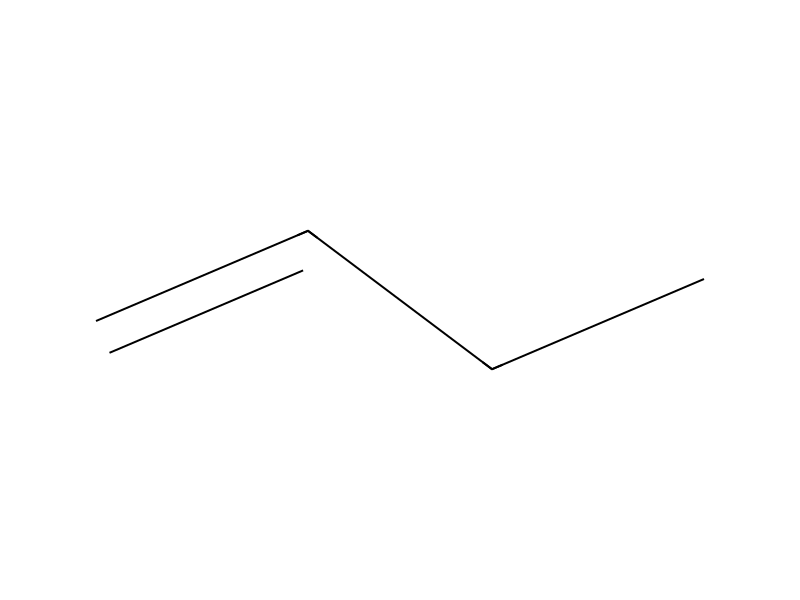
Grundinformationen
- Standard-SMILES
C=CCC- InChIKey
VXNZUUAINFGPBY-UHFFFAOYSA-N- Summenformel
- C4H8
- Durchschnittliche Molmasse
- 56,11 g/mol
- Monoisotopische Masse
- 56,06260026
Überblick
1-butene is a colorless gas. (NTP, 1992)
Namen und Bezeichner
- Bevorzugter Name
- 1-Butene
- IUPAC
- but-1-ene
- Lokaler Name
- But-1-en
- Englischer Name
- 1-BUTENE
- Summenformel
- C4H8
- Molmasse
- 56.11
Namen und Synonyme
1-BUTENEBut-1-eneEthylethylene106-98-91-Butylenealpha-ButyleneButene-1alpha-ButeneLY001N554LDTXSID1026746CHEBI:48362RefChem:6715
Weitere Namen anzeigen
N-BUTENE-Butylenen-Buten-11-N-BUTENE
DTXCID606746203-449-2BUTENE1-Butene-1-13C.alpha.-Butene.alpha.-Butylene1-C4H8Isotactic poly(1-butene)
Datenbank-Bezeichner
- CAS
106-98-9、25167-67-3、9003-28-5- PubChem CID
- 7844
- DTXSID
DTXSID1026746- ChEMBL
CHEMBL117210- ChEBI
CHEBI:48362- UNII
- LY001N554L
- EC Number
- 203-449-2、246-689-3
- Nikkaji
- J1.899.010E、J4.042H
Eigenschaften
Berechnete Struktureigenschaften
- XLogP
- 2,4
- Polarare Oberfläche (TPSA)
- 0 Ų
- H-Brücken-Donoren
- 0
- H-Brücken-Akzeptoren
- 0
- Frei drehbare Bindungen
- 1
- Schwere Atome
- 4
- Formalladung
- 0
- Komplexität
- 14
Experimentelle und physikochemische Eigenschaften
Chemical ClassesFlammable agents - 4th degree
SpringerMaterials PropertiesCoriolis coupling
LogPlog Kow = 2.40
Odor
Slightly aromatic odor
Gassy, slightly aromatic odor
Density
0.6255 at 19.9 °F (NTP, 1992) - Less dense than water; will float
0.588 g/cu cm at 25 °C, 1 atm
Density of liquid 10.47 mol/L at 298.15 K; critical volume 0.240 L/mol
0.557 @25 °C
Color/FormColorless gas
Solubility
Insoluble (NTP, 1992)
In water, 221 mg/L at 25 °C
Soluble in benzene; very soluble in alcohol, ether
Flash Point-110 °F (NTP, 1992)
Boiling Point
21 °F at 760 mmHg (NTP, 1992)
-6.47 °C at 760 mm Hg
-6.3 °C @760 [mm Hg]
DecompositionWhen heated to decomposition it emits acrid smoke and fumes.
Melting Point
-301.5 °F (NTP, 1992)
-185.33 °C
-185.3 °C
Vapor Density
1.93 (NTP, 1992) - Heavier than air; will sink (Relative to Air)
1.93 (Air = 1)
Physikochemische Eigenschaften
- Schmelzpunkt
- 185 °C · −185 °C(lit.)
- Siedepunkt
- 6.3 °C · −6.3 °C(lit.)
- Dichte
- 0.5951 · 0.5951
- Dampfdichte
- 1.93 · 1.93 (vs air)
- Dampfdruck
- 1939 mm · 1939 mm Hg ( 21.1 °C)
- Brechungsindex
- 1.3962 · 1.3962
- Flammpunkt
- 80 · 80
- storage temp.
- -20 °C · -20°C Freezer
- Löslichkeit
- Soluble in alcohol, benzene, and ether (Weast, 1986)
- pka
- 14 · >14 (Schwarzenbach et al., 1993)
- Aggregatzustand
- gas
- Farbe
- Colorless to Almost colorless
- Geruch (Odor)
- Slightly aromatic
- Odor Threshold
- 0.36 ppm · 0.36ppm
- Explosionsgrenze
- 9.3 % · 9.3%
- Wasserlöslichkeit
- 222 mg/kg · 222 mg/kg at 25 °C (shake flask-GC, McAuliffe, 1966)
- Spezifische Wärmekapazität
- 2.1 J/ · Cp(liquid): 2.1 J/(g·K), at 25℃
- Merck
- 14 · 14,1519
- BRN
- 1098262 · 1098262
- Henry's Law Constant
- (atmm3/mol): 0.25 at 25 °C (Hine and Mookerjee, 1975)
- Stabilität
- Volatile
- InChIKey
- VXNZUUAINFGPBY-UHFFFAOYSA-N
- LogP
- 2.35 at · 2.35 at 20℃
- CAS Datenbank
- 106 · 106-98-9(CAS DataBase Reference)
- EPA chemische Informationen
- 1 · 1-Butene (106-98-9)
Sicherheit und Regulatorisches
GHS-Klassifizierung
GHS Classification
Danger
H220: Extremely flammable gas [Danger Flammable gases]
P203, P210, P222, P280, P377, P381, and P403 (click each P-code to see the statement)
This chemical does not meet GHS hazard criteria for 0.1% (2 of 1383) of reports.
Danger
H220 (99.6%): Extremely flammable gas [Danger Flammable gases]
Gefahrenhinweise
Regulatory Information
Chemical: 1-Butene
Chemical: Butene
Butene is listed on the EPA's Chemical Data Reporting (CDR) system. Manufacturers and importers of Butene are required to report information about their production and use of this chemical to the EPA under the Toxic Substances Control Act (TSCA). (40 eCFR Part 711)
1-Butene is listed on the EPA's Chemical Data Reporting (CDR) system. Manufacturers and importers of 1-Butene are required to report information about their production and use of this chemical to the EPA under the Toxic Substances Control Act (TSCA). (40 eCFR Part 711)
Status: Active Update: 17-05-2023 https://echa.europa.eu/registration-dossier/-/registered-dossier/15510
Status: Active Update: 06-04-2022 https://echa.europa.eu/registration-dossier/-/registered-dossier/14810
Other Safety Information
IMAP assessments - Butene: Human health tier I assessment
IMAP assessments - 1-Butene: Human health tier I assessment
DOT LabelFlammable Gas
Fire HazardsThis chemical is flammable. Vapor is heavier than air and may travel long distances to an ignition source and flash back. (NTP, 1992)
Fire PotentialVery dangerous fire hazard when exposed to heat, flame, or oxidizers.
Health HazardsSYMPTOMS: This compound may be an asphyxiant or a slight anesthetic at high concentrations. It may also cause eye irritation.
Reactive GroupHydrocarbons, Aliphatic Unsaturated
Reactivity AlertsHighly Flammable
Reactivity Profile
The unsaturated aliphatic hydrocarbons, such as 1-BUTENE, are generally much more reactive than the alkanes. Strong oxidizers may react vigorously with them. Reducing agents can react exothermically to release gaseous hydrogen. In the presence of various catalysts (such as acids) or initiators, compounds in this class can undergo very exothermic addition polymerization reactions. May react with oxidizing materials. Aluminum borohydride reacts with alkenes and in the presence of oxygen, combustion is initiated even in the absence of moisture.
Atmospheric Standards
This action promulgates standards of performance for equipment leaks of Volatile Organic Compounds (VOC) in the Synthetic Organic Chemical Manufacturing Industry (SOCMI). The intended effect of these standards is to require all newly constructed, modified, and reconstructed SOCMI process units to use the best demonstrated system of continuous emission reduction for equipment leaks of VOC, considering costs, non air quality health and environmental impact and energy requirements. 1-Butene is produced, as an intermediate or a final product, by process units covered under this subpart.
Flammable LimitsLower flammable limit: 1.6% by volume; Upper flammable limit: 10.0% by volume
DOT Emergency Guidelines
/GUIDE 115 GASES - FLAMMABLE (Including Refrigerated Liquids)/ Fire or Explosion: EXTREMELY FLAMMABLE. Will be easily ignited by heat, sparks or flames. Will form explosive mixtures with air. Vapors from liquefied gas are initially heavier than air and spread along ground. CAUTION: Hydrogen (UN1049), Deuterium (UN1957), Hydrogen, refrigerated liquid (UN1966) and Methane (UN1971) are lighter than air and will rise. Hydrogen and Deuterium fires are difficult to detect since they burn with an invisible flame. Use an alternate method of detection (thermal camera, broom handle, etc.) Vapors may travel to source of ignition and flash back. Cylinders exposed to fire may vent and release flammable gas through pressure relief devices. Containers may explode when heated. Ruptured cylinders may rocket. /Butylene/
/GUIDE 115 GASES - FLAMMABLE (Including Refrigerated Liquids)/ Health: Vapors may cause dizziness or asphyxiation without warning. Some may be irritating if inhaled at high concentrations. Contact with gas or liquefied gas may cause burns, severe injury and/or frostbite. Fire may produce irritating and/or toxic gases. /Butylene/
/GUIDE 115 GASES - FLAMMABLE (Including Refrigerated Liquids)/ Public Safety: CALL Emergency Response Telephone Number on Shipping Paper first. If Shipping Paper not available or no answer, refer to appropriate telephone number listed on the inside back cover. As an immediate precautionary measure, isolate spill or leak area for at least 100 meters (330 feet) in all directions. Keep unauthorized personnel away. Stay upwind, uphill and/or upstream. Many gases are heavier than air and will spread along ground and collect in low or confined areas (sewers, basements, tanks). /Butylene/
/GUIDE 115 GASES - FLAMMABLE (Including Refrigerated Liquids)/ Protective Clothing: Wear positive pressure self-contained breathing apparatus (SCBA). Structural firefighters' protective clothing will only provide limited protection. Always wear thermal protective clothing when handling refrigerated/cryogenic liquids. /Butylene/
For more DOT Emergency Guidelines (Complete) data for 1-Butene (8 total), please visit the HSDB record page.
Sicherheit und Schutzausrüstung
Fire FightingFires involving this material can be controlled with a dry chemical, carbon dioxide or Halon extinguisher. Vapor is heavier than air and may travel long distances to an ignition source and flash back. (NTP, 1992)
First Aid
EYES: First check the victim for contact lenses and remove if present. Flush victim's eyes with water or normal saline solution for 20 to 30 minutes while simultaneously calling a hospital or poison control center. Do not put any ointments, oils, or medication in the victim's eyes without specific instructions from a physician. IMMEDIATELY transport the victim after flushing eyes to a hospital even if no symptoms (such as redness or irritation) develop.
Firefighting HazardsSpecial hazards arising from the substance or mixture: Carbon oxides
Fire Fighting Procedures
Suitable extinguishing media: Use water spray, alcohol-resistant foam, dry chemical or carbon dioxide. Advice for firefighters: Wear self-contained breathing apparatus for firefighting if necessary. Further information: Use water spray to cool unopened containers.
To fight fire, stop flow of gas.
Storage ConditionsKeep container tightly closed in a dry and well-ventilated place. Contents under pressure. Storage class (TRGS 510): Gases
Cleanup Methods
ACCIDENTAL RELEASE MEASURES; Personal precautions, protective equipment and emergency procedures: Avoid breathing vapors, mist or gas. Ensure adequate ventilation. Remove all sources of ignition. Evacuate personnel to safe areas. Beware of vapors accumulating to form explosive concentrations. Vapors can accumulate in low areas. Environmental precautions: Prevent further leakage or spillage if safe to do so. Do not let product enter drains. Methods and materials for containment and cleaning up: Clean up promptly by sweeping or vacuum.
Nonfire Spill Response
SMALL SPILLS AND LEAKAGE: This chemical should be used in a fume hood. If a leak should occur, the main valve of the gas cylinder should be turned off and all personnel evacuated. Do not reenter the area until the Safety Officer (or other responsible person) has verified that the area has been properly ventilated.
Disposal Methods
SRP: Recycle any unused portion of the material for its approved use or return it to the manufacturer or supplier. Ultimate disposal of the chemical must consider: the material's impact on air quality; potential migration in air, soil or water; effects on animal, aquatic and plant life; and conformance with environmental and public health regulations. If it is possible or reasonable use an alternative chemical product with less inherent propensity for occupational harm/injury/toxicity or environmental contamination.
Product: Burn in a chemical incinerator equipped with an afterburner and scrubber but exert extra care in igniting as this material is highly flammable. Offer surplus and non-recyclable solutions to a licensed disposal company. Contact a licensed professional waste disposal service to dispose of this material. Contaminated packaging: Dispose of as unused product.
Preventive Measures
Gloves must be inspected prior to use. Use proper glove removal technique (without touching glove's outer surface) to avoid skin contact with this product. Dispose of contaminated gloves after use in accordance with applicable laws and good laboratory practices. Wash and dry hands.
Handle in accordance with good industrial hygiene and safety practice. Wash hands before breaks and at the end of workday.
Avoid inhalation of vapor or mist. Use explosion-proof equipment.Keep away from sources of ignition - No smoking.Take measures to prevent the build up of electrostatic charge.
ACCIDENTAL RELEASE MEASURES; Personal precautions, protective equipment and emergency procedures: Avoid breathing vapors, mist or gas. Ensure adequate ventilation. Remove all sources of ignition. Evacuate personnel to safe areas. Beware of vapors accumulating to form explosive concentrations. Vapors can accumulate in low areas. Environmental precautions: Prevent further leakage or spillage if safe to do so. Do not let product enter drains.
SRP: The scientific literature for the use of contact lenses by industrial workers is inconsistent. The benefits or detrimental effects of wearing contact lenses depend not only upon the substance, but also on factors including the form of the substance, characteristics and duration of the exposure, the uses of other eye protection equipment, and the hygiene of the lenses. However, there may be individual substances whose irritating or corrosive properties are such that the wearing of contact lenses would be harmful to the eye. In those specific cases, contact lenses should not be worn. In any event, the usual eye protection equipment should be worn even when contact lenses are in place.
Isolation and EvacuationExcerpt from ERG Guide 115 [Gases - Flammable (Including Refrigerated Liquids)]:
Threshold Limit Values (TLV)
8 hr Time Weighted Avg (TWA): 250 ppm. /Butenes, all isomers/
Peak Exposure Recommendation: Transient increases in workers' exposure levels may exceed 3 times the value of the TLV-TWA level for no more than 15 minutes at a time, on no more than 4 occasions spaced 1 hour apart during a workday, and under no circumstances should they exceed 5 times the value of the TLV-TWA level. In addition, the 8-hour TWA is not to be exceeded for an 8-hour work period. /Butenes, all isomers/
Protective Action Criteria (PAC)
750 [ppm]
2900 [ppm]
17000 [ppm]
Toxikologische Informationen
Body Burden1-Butene has been detected in human expired air(1) at measured concentrations in exhaled breath up to 495 ppb, and an average emission of 36 ppb (140 ug/m cu)(2).
Environmental Fate
TERRESTRIAL FATE: Based on a classification scheme(1), an estimated Koc value of 120(SRC), determined from a log Kow of 2.40(2) and a regression-derived equation(3), indicates that 1-butene is expected to have high mobility in soil(SRC). Volatilization of 1-butene from moist soil surfaces is expected to be an important fate process(SRC) given a Henry's Law constant of 2.33X10⁻¹ atm-cu m/mole(4). 1-Butene is expected to volatilize from dry soil surfaces(SRC) based upon a vapor pressure of 2250 at 25 °C(5). Utilizing the Japanese MITI test, 3% of the Theoretical BOD was reached in 4 weeks(6) indicating that biodegradation is not an important environmental fate process in soil(SRC). However, alkenes can be utilized by a wide range of microorganisms and are catabolized via several routes, resulting in the unsaturated alcohol, aldehyde and fatty acid or the formation of epoxide, diol compounds and possibly hydroxyacids(7).
AQUATIC FATE: Based on a classification scheme(1), an estimated Koc value of 120(SRC), determined from a log Kow of 2.40(2) and a regression-derived equation(3), indicates that 1-butene is not expected to adsorb to suspended solids and sediment(SRC). Volatilization from water surfaces is expected(4) based upon a Henry's Law constant of 2.33X10⁻¹ atm-cu m/mole(5). Using this Henry's Law constant and an estimation method(4), volatilization half-lives for a model river and model lake are 2 hours and 3 days, respectively(SRC). According to a classification scheme(6), an estimated BCF of 18(SRC), from its log Kow(2) and a regression-derived equation(3), suggests the potential for bioconcentration in aquatic organisms is low(SRC). Utilizing the Japanese MITI test, 3% of the Theoretical BOD was reached in 4 weeks(7) indicating that biodegradation is not an important environmental fate process in water(SRC). However, alkenes can be utilized by a wide range of microorganisms and are catabolized via several routes, resulting in the unsaturated alcohol, aldehyde and fatty acid or the formation of epoxide, diol compounds and possibly hydroxyacids(8).
ATMOSPHERIC FATE: According to a model of gas/particle partitioning of semivolatile organic compounds in the atmosphere(1), 1-butene, which has a vapor pressure of 2.25X10+3 mm Hg at 25 °C(2), is expected to exist solely as a gas in the ambient atmosphere. Gas-phase 1-butene is degraded in the atmosphere by reaction with photochemically-produced hydroxyl radicals(SRC); the half-life for this reaction in air is estimated to be 12 hours(SRC), calculated from its rate constant of 3.14X10⁻¹¹ cu cm/molecule-sec at 25 °C(3). The rate constant for the vapor-phase reaction of 1-butene with ozone has been estimated as 1.2X10⁻¹⁷ cu cm/molecule-sec at 25 °C(SRC) that was derived using a structure estimation method(4). This corresponds to an atmospheric half-life of about 23 hours at an atmospheric concentration of 7X10+11 ozone molecules per cu cm(5). Products from this reaction are formic and propionic acid(6). Based on a half-life of 149 hours, from and average rate constant of 5.4X10⁻¹⁵ cu cm/molec-sec(7,8), night-time degradation by the reaction with nitrate radicals is not expected to be a significant removal process. 1-Butene does not contain chromophores that absorb at wavelengths >290 nm(9) and, therefore, is not expected to be susceptible to direct photolysis by sunlight(SRC).
Food Survey ValuesThe volatile vapor fraction emitted during the heating of four oils (rapeseed, Canola, peanut and soybean) was analyzed to determine its composition. 1-Butene was detected, concentration not specified, in all four heated oils(1).
Toxicity Summary
IDENTIFICATION AND USE: 1-Butene is a colorless gas. It is is used for the production of a wide variety of chemicals in the gasoline and rubber processing areas. Most 1-butene is used as a comonomer for linear low-density polyethylene, which contains up to 10%. However, 1-butene is also used as a comonomer for modifying high-density polyethylene, which contains up to 4%. HUMAN STUDIES: 1-Butene is a simple asphyxiant and may be a CNS depressant in high concentrations. It has a low acute toxicity and is mildly irritating to the eye. On direct eye and skin contact liquid butene can cause burns and frostbite. The treatment of human peripheral blood mononuclear cells (PBMCs) and promyelocytic leukemia cells (HL60) for 24 hr resulted in an increase of DNA damage. HL60 cells were more resistant than PBMCs to the DNA damage. ANIMAL STUDIES: Exposure to 1-butene at target concentrations of 500, 2000, 8000 ppm (approximately 1147, 4589, 18359 mg/cu m) did not induce systemic toxicity in male and female rats exposed for 28 days or in pregnant female rats exposed for 14 days pre-mating, through mating and gestation to day 19. There were no treatment-related effects on the development of pups. As an anesthetic, it is 4.5 times more potent than ethylene. Exposure of mice to concentrations of 15% butene resulted in reversible signs of incoordination, confusion, and hyperexcitability; at 20% deep anesthesia in 8 to 15 min, with subsequent respiratory failure in 2 hr; and at 30% in 2 to 4 min and 40 min, respectively. A concentration of 40% resulted in profound anesthesia in 30 sec, with no CNS symptoms but with death in 10 to 15 min. ECOTOXICITY STUDIES: Tomato: epinasty in petiole: 50,000 ppm, 2 days.
Ecotoxicity Excerpts/PLANTS/ Tomato: epinasty in petiole: 50,000 ppm, 2 days.
Plant Concentrations
Experiments were conducted in 1993 to monitor the hydrocarbon emissions from a mixed deciduous forest approximately 80 km northwest of Toronto, Canada(1). 1-Butene was the fourth most abundantly measured hydrocarbon above the Borden forest from April 29-June 3, 1993(1).
Effluent Concentrations
1-Butene was detected at concentrations ranging from 30-58 ppb in the smoke of a wood stove burning oak(1). 1-Butene was detected in the gas phase of smoke emissions from a residential chimney upon combustion of pine firewood at 90.7 mg/kg of wood burned(2). 1-Butene was detected in 16 of 16 various fuel/stove combinations using coal, wood, residues and gas as fuel sources with emission rates ranging between 0.023-113 mg/kg dry fuel(3). 1-Butene was detected at 360 ug/cu m in emissions from the incineration of waste-plastics using a medium-scale waste incinerator(4). In a paper published in 1998, 1-butene was detected with isobutene at a combined concentration of 0.92 ppmv in landfill gas monitored at the Fresh Kills Landfill in New York(5). In December 2011, 1-butene was detected at less than 1% of all gaseous pollutants profiled at 3 process-locations in a municipal solid waste biological treatment plant(6).
1-Butene has been detected in automobile exhaust at 380 ppb(1). The exhaust gas from 10 small four-stroke lawn mowers using two different gasolines was studied(2). When a 1990 national average blend of gasoline was used, 1-butene was detected in the exhaust gas as 0.33% of the total organic gases emitted while when a California Phase 2 gasoline was used, 1-butene was identified as 0.29% of the total organic gases released(2). The average concentration of 1-butene in the exhaust of 67 Australian gasoline vehicles was 0.9% w/w of non-methane hydrocarbons(3). 1-Butene was detected as an emission from jet engines operating under simulated high-altitude supersonic flight conditions(4) and as a stack emission from a waste incinerator(5).
1-Butene was measured directly in car exhaust from the UK at 1217 ppb but only at 10 ppb in air samples collected on a London street(1). Motor vehicle emissions were sampled in canisters beside a roadway in a tunnel-like underpass during periods of heavy traffic from Aug 23-27, 1990 in Atlanta, Georgia(2). 1-Butene and isobutylene were found to be 1.181 ppbC% of total non-methane organic compounds(2). Air samples were also collected within Atlanta's Hartsfield International Airport on August 27, 1990(2). 1-Butene and isobutylene were found to be 0.41 ppbC% of total non-methane organic compounds(2). The estimated total yearly emission for 1-butene in Belgium was 423 tons/yr in 1991(3). 1-Butene was detected from 1979-80 in urban air samples taken from Australia at 1.0 ppb(4). On August 28, 1987, the average concentration of 1-butene in the atmosphere from eight sites in the Los Angeles Air Basin was 2.56 ug/cu m(5). Average ambient concentration of 1-butene in the city of Porto Alegre, Brazil from March 20, 1996-April 16, 1997 was 3.8 mg/cu m(6). In August 1995, measurements of various non-methane hydrocarbons were studied within the Vancouver's Cassiar Connector highway tunnel(7). The average mass fraction of 1-butene/isobutene detected in the tunnel was 0.031(8). The median concentration of 1-butene measured between 6 and 9 am during the summers of 1984-86 in 39 U.S. cities located between 26 deg N and 43 deg N latitude was 2.95 ppb(8). In a study to acquire a baseline concentration of volatile organic compounds found in urban air samples considered as non-industrial areas, 1-butene/isobutene was detected 76.79% of the time at a mean concentration of 0.67 ppbv from March 12, 1990 to March 11, 1991(9). In a study of light-duty vehicle emissions in the Caldecott Tunnel in San Francisco, 1-butene was detected in August and October 1994 at 0.48 and 0.43% by weight of total volatile organic compounds, respectively(10). 1-Butene/isobutene were detected in Vienna, Austria in May, 1987, Sydney, Australia from September 1979-June 1980, and in Washington D.C., U.S.A from July-August 1980 at 10.1, 9.6, and 4 ppb, respectively(11). 1-Butene was detected, average emission factor of 113.9 mg/kg, in the Maria Maluf road tunnel, located in Brazil, monitored from May 4-6, 2004(12).
1-Butene was estimated as 0.49% of all volatile organic compounds, excluding methane, released by the United Kingdom in 1990(1). The estimated annual emissions of 1-butene from gasoline powered vehicles in the UK, 1983, is 2.19 kt(2). The hydrocarbon content emitted from a two-stroke moped engine for an alkylate-based fuel and a conventional reformate-based fuel was studied(3). When the moped was operated at 30 km/hr on alkylate fuel, 1-butene was detected in the exhaust as 0.20% by weight of total non-methane hydrocarbons and when the moped used conventional reformate-based fuel, 1-butene was detected in the exhaust as 0.22% by weight of total non-methane hydrocarbons(3). Initially, the alkylate fuel did not contain 1-butene while the reformate-based fuel contained 1-butene as 0.03% of total non-methane hydrocarbons(3). Emissions from nine late-model motor vehicles with four-cylinder engines were characterized at three test temperatures to simulate summer driving(4). The vehicles were tested at temperatures of 75, 90, and 105 °F with unleaded gasoline(4). 1-Butene was detected at 0.46, 0.51, and 0.54% by weight of hydrocarbon emissions from throttle body injection vehicles at 75, 90, and 105 °F, respectively(4). Comparatively, 1-butene was detected at 0.46, 0.50, and 0.46% by weight of hydrocarbon emissions from port fuel injection vehicles at 75, 90, and 105 °F, respectively(4). 1-Butene has been detected, but not quantified, in diesel exhaust(5). A 1999 air quality study in Cairo, Egypt found 1-butene in a median concentration of 1.85 and 1.59 in an unspecified number of roadway and motorcycle emission air samples(6).
Soil Adsorption/Mobility
The Koc of 1-butene is estimated as 120(SRC), using a log Kow of 2.40(1) and a regression-derived equation(2). According to a classification scheme(3), this estimated Koc value suggests that 1-butene is expected to have high mobility in soil.
Natural Pollution SourcesIn general butenes are considered anthropogenic compounds and not known to occur naturally(1). However, 1-butene is a reported plant emission from mixed deciduous forests(2).
Atmospheric Concentrations
URBAN/SUBURAN: In a paper published in 1985, 1-butene was identified, but not quantified in U.S. roadside air samples(1). In winter 1986-87, the average concentration of 1-butene collected at two sites, in Boise, ID, was 1.7 ppbC(2). In 1977, 1-butene was detected at concentrations ranging from 5.0-5.5 ug/cu-m at the top of an 82-story building at noon in New York City(3). In summer 1977, the maximum concentration of 1-butene measured in 780 samples from Houston, TX, was 45 ppbC(4). In July 1973, the concentration of 1-butene in downtown Houston obtained during two day-long sampling expeditions ranged from not detected to 0.01 ppm and from not detected to 0.022 ppm in three sampling expeditions in Pasadena, TX(5). In 1965-66, the concentration of 1-butene in two rooftop samples taken in Riverside, CA, were 6.4 and 2.0 ppb, respectively(6). The percent of 1-butene measured at 6 sites along Highway 70 in Raleigh, NC, May 1983, ranged from 0.25-0.67% of the total non-methane hydrocarbons(7). On January 29, 1997, 1-butene was detected at estimated concentrations ranging from 0.1-2.1 ppbv (average = 0.9 ppbv) in air samples collected over a 1-hour period in Taipei, Taiwan(8).
URBAN/SUBURBAN: In 1983, the mean concentration of 1-butene in urban, rural, and polluted rural locations in NW England was 11, <0.5 and 5.0 ppbC, respectively(1). The estimated annual mean concentration of 1-butene in London, England, is 1 ug/cu m(2). The observed annual concentration of 1-butene in European cities ranged from 1.6-5.3 ug/cu m, and the observed background level in Sidney, Australia, was 2.4 ug/cu m(2). The average concentration of 1-butene in Sidney, Australia, 1979-1980, was 1.0 ppb(3). The average concentration of 1-butene in air samples taken over Tokyo, Japan, 1980, was 0.1 ppb(4).
RURAL/REMOTE: 1-Butene was detected from 1979-80 in rural air samples taken from Brazil at 0.47 ppb(1). During the spring of 1989, 1-butene was detected at the tropospheric boundary layer near Alert, North West Territory, Canada ranging from 1-79 parts per trillion volume (pptV) with a mean concentration of 30 pptV(2). 1-Butene was detected at an air quality monitoring site in Chao-Chou, Taiwan, at an average concentration of 5 ug/m cu, samples were collected over 5 day periods in December 1998 and May 1999(3).
SOURCE DOMINATED: A fluid catalytic unit in a petroleum refinery produces an alkene-rich petrol fraction and is therefore likely to emit volatile hydrocarbons with a high proportion of alkenes to the air(1). At 100 m downwind of a fluid catalytic unit in Sweden, 1-butene was detected ranging from 1.1-2.0% by weight of all C2-C8 hydrocarbons released in 1992(1). Six service stations, two in Cincinnati, Ohio, two in Phoenix, Arizona and two in Los Angeles, California, were studied to determine the exposure level of various volatile organic compounds released during self-serve fill-up operations from October-November, 1990(2). During this investigation, 1-butene was detected ranging from 0.04-2.3 mg/cu m and 0.04-5.1 mg/cu m from the two Cincinnati, Ohio service stations(2). From two Phoenix, Arizona service stations, 1-butene was detected ranging from 0.04-2.7 and 0.04-0.7 mg/cu m(2). Finally, 1-butene was detected ranging from 0.04-2.7 and 0.04-2.2 mg/cu m from the two service stations in Los Angeles, California(2). The concentration of 1-butene downwind of a chemical manufacturing plant in North Cheshire, England, 1978, ranged from <1-24 ppb (10 sites), downwind of a refinery <1-13 ppb (5 sites), a fertilizer plant 14 ppb (1 site), and in background areas: populated 1-21 ppb (5 sites) and rural <1-12 ppb (22 sites)(3).
Human Toxicity Excerpts
/SIGNS AND SYMPTOMS/ Butene is a simple asphyxiant and classified as nontoxic. At concentrations above the flammability range, it is an anesthetic.
/SIGNS AND SYMPTOMS/ as an anesthetic, it is 4.5 times more potent than ethene.
/SIGNS AND SYMPTOMS/ It has a low acute toxicity and is mildly irritating to the eye. On direct eye and skin contact liquid butene can cause burns and frostbite.
/GENOTOXICITY/ Volatile organic compounds (VOCs) exert their carcinogenic activity through the production of epoxide metabolites. Because of their high reactivity some epoxides are also produced in the chemical industry for the synthesis of other compounds. Therefore, human exposure to VOCs epoxides does occur and may be an important human health concern. In this study, the in vitro genotoxic potential of epoxides originating from 1,3-butadiene (3,4-epoxy-1-butene: EB; 1,2:3,4-diepoxybutane: DEB), isoprene (3,4-epoxy-2-methyl-1-butene: IO), styrene (styrene-7,8-oxide: SO), propylene (propylene oxide: PO) and 1-butene (1,2-epoxy-butane: BO) in human peripheral blood mononuclear cells (PBMCs) and promyelocytic leukemia cells (HL60) was measured with the comet assay (single-cell gel electrophoresis, SCGE). The effect of inclusion of fetal calf serum (FCS, 5%) in the cell-culture medium and different durations of exposure (2 hr, 24 hr) were also investigated. All epoxides tested produced DNA damage in a concentration range that did not reduce cell viability. HL60 cells were more resistant than PBMCs to the DNA damage induced by the different epoxides. With the exception of IO, the treatment for 24 hr resulted in an increase of DNA damage. FCS slightly protected PBMCs from the genotoxic effects induced by IO and BO, whilst no such effect was noted for the other compounds. Overall, the dose-dependent effects that were seen allowed us to define a genotoxicity scale for the different epoxides as follows: SO>EB>DEB>IO>PO>BO, which is in partial agreement with the International Agency for Research on Cancer (IARC) classification of the carcinogenic hazards.
Artificial Pollution Sources
1-Butene's production and use as a comonomer for low and high-density linear polyethylene compounds(1) and in gasoline and rubber compounds(2) may result in its release to the environment through various waste streams(SRC). 1-Butene has been widely detected in the exhaust gas of vehicles using gasoline(3) and diesel(4) and from jet engines(5). It may also be released into the environment from fluid catalytic units in petroleum refineries(6), through the burning of waste plastics(7), as a volatile emission from gasoline(8) and from the burning of wood(9). 1-Butene has been identified as a constituent of tobacco smoke(10). 1-Butene has also been detected in the volatile organic fraction emitted during the heating of soybean, rapeseed, peanut, and Canola oils(11).
1-Butene occurs in oil and coal gas(1). Anthropogenic sources include diesel exhaust gas (1.8%), expected ground level concentrations in US urban air are 1-20 ppb, in exhaust of gasoline engines 6.0 vol%, in evaporate from gasoline fuel tank 4.6 vol%, and evaporate from carburetors 0-0.3 vol%(2).
Regulatorische Informationen
Atmospheric Standards
This action promulgates standards of performance for equipment leaks of Volatile Organic Compounds (VOC) in the Synthetic Organic Chemical Manufacturing Industry (SOCMI). The intended effect of these standards is to require all newly constructed, modified, and reconstructed SOCMI process units to use the best demonstrated system of continuous emission reduction for equipment leaks of VOC, considering costs, non air quality health and environmental impact and energy requirements. 1-Butene is produced, as an intermediate or a final product, by process units covered under this subpart.
DHS Chemicals of Interest (COI)
Butene
1
10000
Flammable chemical that can be released at a facility.
1-Butene
1
Sicherheitsdaten
- F
- 4.5-31
- wgk
- -
- tsca
- TSCA listed
- ridadr
- UN 1012
- hs_code
- 2901230000
- risk_code
- 12
- hazard_code
- F+,F
- hazard_note
- Extremely Flammable
- safety_code
- 9-16-33
- hazard_class
- 2.1
- DOT Classification
- 2.1 (Flammable gas)
- Giftige Stoffe Daten
- 106-98-9(Hazardous Substances Data)
- Selbstentzündungstemperatur
- 723 °F
Chemie und Industrie
Pharmakologische Informationen
Metabolism/Metabolites
Conjugation with glutathione appears to be an important excretion route for butene metabolites.
Butene is metabolized slowly through its 1-hydroxy derivative.
Butene is liberated from tetra- and tributyl-lead or tin during oxidative dealkylation by hepatic microsomes.
Absorption, Distribution and Excretion
The absorption, distribution, elimination, hemoglobin adduct formation and DNA adduct formation of individual C2-C8 1-alkenes was studied in the rat after exposure to 300 ppm (688mg/cu m), 12 hr a day for 3 consecutive days. The concentrations of the alkenes were measured in blood, lung, brain, liver, kidney and peri-renal fat immediately after each exposure and 12 hr after the third exposure. DNA adducts were determined by (32)P-postlabeling in liver. Hemoglobin adducts were determined in erythrocytes by GC/MS and GC/MS/MS. Concentrations of 1-alkenes in blood and organs reached a steady-state level after the first 12 hr exposure, and the concentrations 12 hr after the last exposure were generally low, except in fat. Concentrations of 1-alkenes in blood and the different tissues increased with increasing number of carbon atoms. However, DNA adducts and hemoglobin adducts decreased with increasing number of carbon atoms with the most pronounced decrease being from C2 to C3. The decrease in hemoglobin adducts was more pronounced than DNA adducts. All 1-alkenes caused formation of detectable levels of hemoglobin and DNA adducts, although the levels of hemoglobin adducts after C4-C8 exposure were low. These results also indicate that extrapolation within the homologous series is possible. /1-Alkenes/
Verwendung und Herstellung
Uses
/1-Butene/ is used for the production of a wide variety of chemicals in the gasoline and rubber processing industries.
Most high-purity 1-butene is used as a comonomer for linear low-density polyethylene (LLDPE) and for modifying high-density polyethylene (HDPE), which contains up to 4%.
COMONOMER FOR HIGH DENSITY POLYETHYLENE FOR BLOW-MOLDING RESINS; MONOMER FOR POLYBUTENE USED IN PLASTIC PIPE & FILM; INT FOR 1,2-BUTYLENE OXIDE
U.S. Production
2023: 1,000,000,000 - <2,500,000,000 lb
2023: 1,000,000,000 - <2,500,000,000 lb
(1984) 1.20X10+11 g
(1991) 7.30x10+8 lb
(1986) 441,473 lbs
(1987) 461,831 lbs
Consumption Patterns
Polyethylene comonomer, 45%; (96% linear low-density polyethylene (LLDPE), 4% HDPE); exports (for LLDPE and HDPE), 35%; valeraldehyde, 9%; polybutene-1, 8%; butylene oxide, 1%; other (including mercaptans, sec-butylphenols and solvents), 2%.
CHEMICAL PROFILE: Butene-1. Demand: 1987: 470 million lb; 1988: 490 million lb; 1992 /projected/: 600 million lb (Includes exports; imports are negligible).
Polyethylene comonomer, 65%; (90% LLDPE, 10% HDPE); valeraldehyde, 10%; polybutene-1, 14%; butylene oxide, 5%; other (including mercaptans, sec-butylphenols and solvents), 6%.
Demand: 1996: 460 million lb; 1997: 475 million lb; 2001: 550 million lb (does not include exports; imports currently negligible)
For more Consumption Patterns (Complete) data for 1-Butene (6 total), please visit the HSDB record page.
Consumer Uses
Not Known or Reasonably Ascertainable
Fuel
Industry Uses
Fuel
Intermediate
Methods of Manufacturing
There are two important sources for the commercial production of butylenes: catalytic or thermal cracking, and steam cracking. In these two processes, butylenes are always produced as by-products. /Butylenes/
In the Institut Francais du Petrole process, ethylene is dimerized into polymer-grade 1-butene (99.5% purity) suitable for the manufacture of linear low density polyethylene. It uses a homogeneous catalyst system that eliminates some of the drawbacks of heterogeneous catalysts. It also inhibits the isomerization of 1-butene to 2-butene, thus eliminating the need for superfractionation of the product. The process also uses low operating temperatures, 50-608 °C, and pressures.
Alphabutol Process (1-Butene). ... ethylene is selectively dimerized to 1-butene by employing a homogeneous titanium catalyst at 50-60 °C and 2.3-2.7 MPa ethylene pressure. ... the proposed mechanism does not involve metal hydrides but a titanium(IV) cyclopentane species that decomposes via beta-hydrogen elimination to 1-butene.
Obtained by cracking of petroleum oils and by thermal decomposition of butane or pentane or isopentane. ... From butyl alcohol by treatment with concentrated H2SO4 ... .
General Manufacturing Information
Petroleum Refineries
Plastics Material and Resin Manufacturing
1-Butene: ACTIVE
Butene: ACTIVE
Butylenes are C4H8 mono-olefin isomers: 1-butene, cis-2-butene, trans-2-butene, and isobutylene (2-methylpropene). These isomers are usually coproduced as a mixture and are commonly referred to as the C4 fraction. These C4 fractions are usually obtained as by-products from petroleum refinery and petrochemical complexes that crack petroleum fractions and natural gas liquids. Since the C4 fractions almost always contain butanes, it is also known as the B-B stream. The linear isomers are referred to as butenes.
Butenes are unsaturated olefinic hydrocarbons, C4H8, MW 56.1080, existing in four isomers: 1) 1-butene; 2) cis-2-butene; 3) trans-2-butene; and 4) 2-methylpropene (isobutene). In everyday use, the IUPAC nomenclature is less common than the use of older designations. Especially the branched-chain isomer 4 is commonly referred to as "isobutene" or "isobutylene" instead of the IUPAC name "2-methylpropene". The three linear chain isomers 1, 2, and 3 are usually referred to as "n-butenes" and often occur as mixtures during chemical processing. The old name "butylenes" is still in use for butenes.
Anwendungen
Beschreibung1-Butene is a colourless, stable but polymerises exothermically, extremely flammable liquefied gas with an aromatic odour. It is insoluble in water and is one of the isomers of butane. 1-Butene readily forms explosive mixtures with air. It is incompatible with strong oxidising agents, halogens, halogen acids, metal salts, boron trifluoride, fluorine, and nitrogen oxides. 1-Butene of high purity is made by cracking naphtha and separating it from other products by an extra-high-purity distillation column. It is an important organic compound in the production of several industrial materials – for instance, linear low-density polyethylene (LLDPE), a more flexible and resilient polyethylene, and a range of polypropylene resins – and in the production of polybutene, butylene oxide, and the C4 solvents secondary butyl alcohol (SBA) and MEK. The vapour of 1-butene is heavier than air and may travel long distances to an ignition source and flash back.
VerwendenButenes are used extensively in gasoline production to produce high-octane gasoline compounds.Another large use of normal butenes in the petrochemical industry is in the production of 1,3-butadiene. Butene is used in the plastics industry to make both homopolymers and copolymers. Another use of 1-butene is in the production of solvents containing four carbons such as secondary butyl alcohol and methyl ethyl ketone (MEK).
Vor- und nachgelagerte Produkte
Vorgelagerte Rohstoffe
Nachgelagerte Produkte
Ergänzende Hinweise
DefinitionChEBI: A butene with unsaturation at position 1.
Zugehörige Reaktionen
114


Verknüpfte Notizen
Wird geladen…