
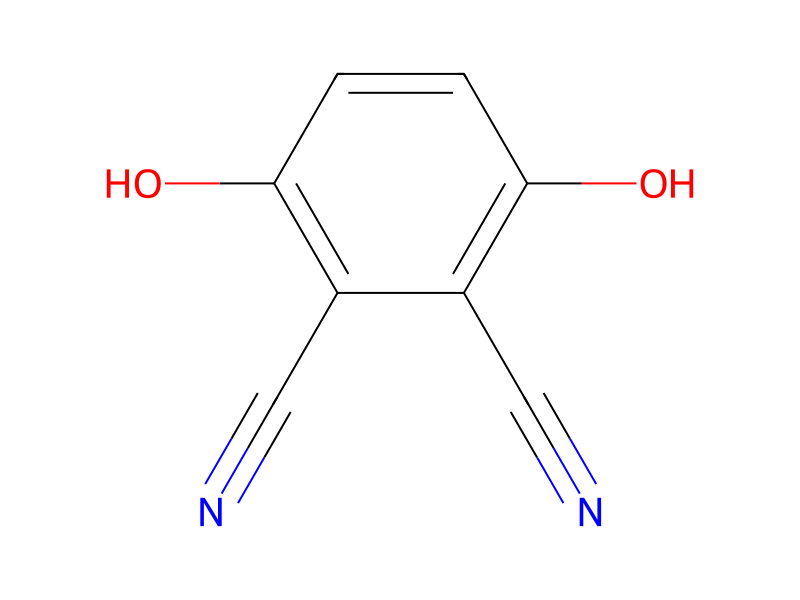
Grundinformationen
- Standard-SMILES
N#Cc1c(O)ccc(O)c1C#N- InChIKey
MPAIWVOBMLSHQA-UHFFFAOYSA-N- Summenformel
- C8H4N2O2
- Durchschnittliche Molmasse
- 160,13 g/mol
- Monoisotopische Masse
- 160,02727738
Namen und Bezeichner
- Bevorzugter Name
- 2,3-Dicyanohydroquinone
- IUPAC
- 3,6-dihydroxybenzene-1,2-dicarbonitrile
- Lokaler Name
- 3,6-Dihydroxyphthalonitril
- Englischer Name
- 3,6-Dihydroxyphthalonitrile
- Summenformel
- C8H4N2O2
- Molmasse
- 160.13
Namen und Synonyme
2,3-Dicyanohydroquinone3,6-Dihydroxyphthalonitrile4733-50-01,2-Benzenedicarbonitrile, 3,6-dihydroxy-Phthalonitrile, 3,6-dihydroxy-TTR9Y6YSS82,3-dicyano-hydroquinoneNSC-435541,4-dihydroxyphthalonitrile3,6-Dihydroxy-1,2-benzenedicarbonitrileDTXSID80197109RefChem:442078
Weitere Namen anzeigen
DCHDCHQRARECHEM AQ BD 00153,6-DihydroxyphthaloN#Cc1c(O)ccc(O)c1C#N2,3-dicyanohydroquinme2,3-Dicynohydroquinone3,6-DIHYDROXYPHTHONITRILE2,3-Dicyanohydroquinone>
1,4-DHPN2,3-DCHQDTXCID40119600225-241-03,6-dihydroxybenzene-1,2-dicarbonitrile2,3-Dicyano-p-hydroquinone3,6-Dihydroxyphthalodinitrile2,3-Dicyanobenzene-1,4-diol
Datenbank-Bezeichner
- CAS
4733-50-0- PubChem CID
- 78467
- DTXSID
DTXSID80197109- UNII
- TTR9Y6YSS8
- EC Number
- 225-241-0
- Nikkaji
- J30.864A
Eigenschaften
Berechnete Struktureigenschaften
- XLogP
- 1,8
- Polarare Oberfläche (TPSA)
- 88 Ų
- H-Brücken-Donoren
- 2
- H-Brücken-Akzeptoren
- 4
- Frei drehbare Bindungen
- 0
- Schwere Atome
- 12
- Formalladung
- 0
- Komplexität
- 231
Physikochemische Eigenschaften
- Schmelzpunkt
- 230 °C · >230 °C (dec.) (lit.)
- Siedepunkt
- 286.01 °C · 286.01°C (rough estimate)
- Dichte
- 1.3848 · 1.3848 (rough estimate)
- Brechungsindex
- 1.49 · 1.4900 (estimate)
- storage temp.
- 30 °C · Store below +30°C.
- pka
- 6.21 · 6.21±0.23(Predicted)
- Aggregatzustand
- Crystalline Powder or Needles
- Farbe
- Khaki to brown
- Wasserlöslichkeit
- Soluble in hot water
- BRN
- 2101249 · 2101249
- InChI
- InChI=1S/C8H4N2O2/c9-3-5-6(4-10)8(12)2-1-7(5)11/h1-2,11-12H
- InChIKey
- MPAIWVOBMLSHQA-UHFFFAOYSA-N
- SMILES
- C1(C#N)=C(O)C=CC(O)=C1C#N
- CAS Datenbank
- 4733 · 4733-50-0(CAS DataBase Reference)
Sicherheit und Regulatorisches
GHS-Klassifizierung
GHS Classification
Warning
H315 (100%): Causes skin irritation [Warning Skin corrosion/irritation];H319 (100%): Causes serious eye irritation [Warning Serious eye damage/eye irritation];H335 (89.1%): May cause respiratory irritation [Warning Specific target organ toxicity, single exposure; Respiratory tract irritation]
P261, P264, P264+P265, P271, P280, P302+P352, P304+P340, P305+P351+P338, P319, P321, P332+P317, P337+P317, P362+P364, P403+P233, P405, and P501 (click each P-code to see the statement)
Aggregated GHS information provided per 46 reports by companies from 5 notifications to the ECHA C&L Inventory. Each notification may be associated with multiple companies.;Information may vary between notifications depending on impurities, additives, and other factors. The percentage value in parenthesis indicates the notified classification ratio from companies that provide hazard codes. Only hazard codes with percentage values above 10% are shown. For more detailed information, please visit ECHA C&L website.
Gefahrenhinweise
Regulatory Information2,3-Dicyanohydroquinone: Does not have an individual approval but may be used under an appropriate group standard
Hazard Classes and CategoriesSkin Irrit. 2 (100%);Eye Irrit. 2 (100%);STOT SE 3 (89.1%)
Regulatorische Informationen
Regulatory Information2,3-Dicyanohydroquinone: Does not have an individual approval but may be used under an appropriate group standard
Sicherheitsdaten
- wgk
- 3
- ridadr
- UN 2811 6.1/PG III
- hs_code
- 29269090
- risk_code
- 36/37/38-20/21/22
- hazard_code
- Xi,Xn
- safety_code
- 26-37/39-36/37/39
- hazard_class
- 6.1
- packing_group
- III
- Speicherklasse
- 11 - Combustible Solids
- Hazard Classifications
- Eye Irrit. 2Skin Irrit. 2
Chemie und Industrie
Anwendungen
Verwenden2,3-Dicyanohydroquinone was used in the synthesis of phthalonitrile-3,6-ditriflate. It is a fluorescent dye and was used in determination of intracellular pH and calcium in avian neural crest cells.
Vor- und nachgelagerte Produkte
Vorgelagerte Rohstoffe
Nachgelagerte Produkte
Anbieter50 Anbieter
国药集团化学试剂有限公司86-21-63210123 · [email protected]
梯希爱(上海)化成工业发展有限公司021-67121386 · [email protected]
上海麦克林生化科技股份有限公司021-50706066 15221275939 · [email protected]
湖北成丰化工有限公司13125175253 · [email protected]
杭州奥得科技有限公司0571-88772972-0 15057128248 · [email protected]
杭州品高化工有限公司0571-87658025 · [email protected]
温州共赢化学有限公司+86-0086-577-64498589 +86-15355981851 · [email protected]
INTATRADE GmbH+49 3493/605464 · [email protected]
Dayang Chem (Hangzhou) Co.,Ltd.+86-0571-88938639 17705817739 · [email protected]
科瑞迪化学400-821-5857 021-64326257 · [email protected]
衢州明锋化工有限公司0570-3062502 13819002126;13819008176 · [email protected]
Syntechem Co.,Ltd[email protected]
上海迈瑞尔生化科技有限公司4006356688 18621169109 · [email protected]
安耐吉化学&3A(安徽泽升科技股份有限公司)400-0056266 · [email protected]
广东云星生物技术有限公司0751-18902340975/189023400307 18902340307 · [email protected]
上海瀚鸿科技股份有限公司021-54306202 13764082696 · [email protected]
南京诺利斯医药科技有限公司13901585132 · [email protected]
上海隆盛化工有限公司58099637 13585536065 · [email protected]
Nanjing jinheyou Trading Co., Ltd.15705188088 · [email protected]
山东西亚化学有限公司13355009207 13355009207 · [email protected]
玛雅试剂+86 (573) 82222445 (0)18006601000 452520369 · [email protected]
四川库利南科技有限公司400-1166-196 18981987031 · [email protected]
天津希恩思生化科技有限公司400 638 7771 · [email protected]
Xiamen AmoyChem Co., Ltd+86-86-5926051114 · [email protected]
南京维奥化工有限公司Please Send Email 18652950785 · [email protected]
上海思域化工科技有限公司86-21-34053660 · [email protected]
赛默飞世尔科技(中国)有限公司800-810-5118 · [email protected]
北京伊诺凯科技有限公司400-810-7969 010-59572699 · [email protected]
南京诺利斯医药科技有限公司13901585132 · [email protected]
TCI AMERICA800-4238616 · [email protected]
TOKYO CHEMICAL INDUSTRY CO., LTD.03-36680489 · [email protected]
TCI Europe320-37350700 · [email protected]
金瓯生物医药(南京)有限公司13000000000 · [email protected]
北京环宇世纪化学科技有限公司hysj_bj.com
安徽科迪达化工有限公司0554-2106669 · [email protected]
日照力德士化工有限公司010-51268198 · [email protected]
郑州阿尔法化工有限公司0371-53732842 15981811963 · [email protected]
美岚实业(上海)有限公司021-58958189 · [email protected]
上海爱蝶实业有限公司021-58957966 18930537195 · [email protected]
成都零六生物科技有限公司400-1166-196 13458535857 · [email protected]
广拓化学(上海)有限公司021-60899189-8001 18918189673 · [email protected]
上海鑫圭生物科技有限公司15121041756 · [email protected]
上海嵩爰化工科技有限公司010-1234567 18521000990 · [email protected]
上海有朋化工有限公司021-69005955 13701776567 · [email protected]
上海凯赛化工有限公司021-33516722 13701817765 · [email protected]
上海彤源化工有限公司021-021-69182866 13701855675 · [email protected]
上海蓝润化学有限公司021-69515658 ; 69515628 13701998368 · [email protected]
上海容立化学科技有限公司021-69992220 13701886816 · [email protected]
上海康拓化工有限公司021-69185552 13701777608 · [email protected]
池州凯隆进出口贸易有限公司[email protected]
Zugehörige Reaktionen
21


Verknüpfte Notizen
Wird geladen…