
9-Borabicyclo[3.3.1]nonan
9-Borabicyclo(3.3.1)nonane
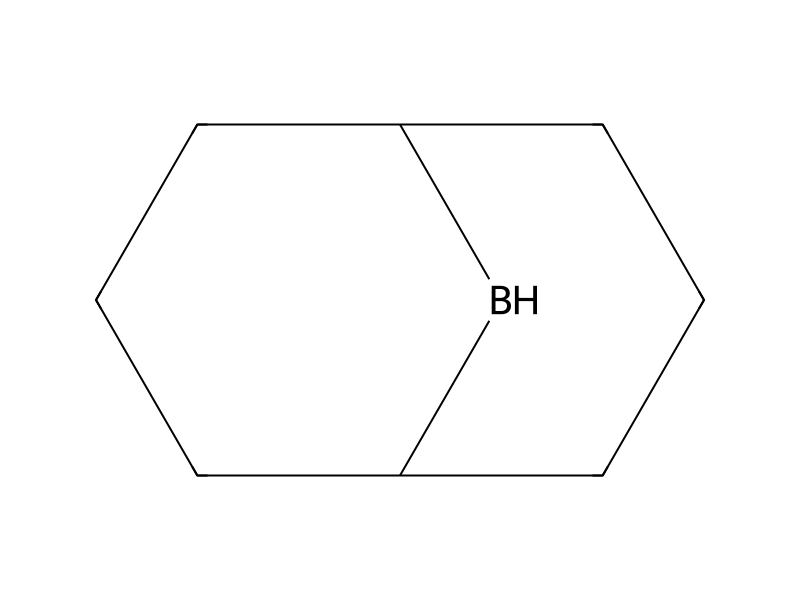
Grundinformationen
- CAS
280-64-8- Standard-SMILES
B1C2CCCC1CCC2- InChIKey
FEJUGLKDZJDVFY-UHFFFAOYSA-N- Summenformel
- C8H15B
- Durchschnittliche Molmasse
- 122,02 g/mol
- Monoisotopische Masse
- 122,1266806
Überblick
an amino acid protecting group
Namen und Bezeichner
- Bevorzugter Name
- 9-Borabicyclo(3.3.1)nonane
- IUPAC
- 9-borabicyclo[3.3.1]nonane
- Lokaler Name
- 9-Borabicyclo[3.3.1]nonan
- Englischer Name
- 9-Borabicyclo[3.3.1]nonane
- Summenformel
- C8H15B
- Molmasse
- 122.02
Namen und Synonyme
9-BBN compound9-BBN cpd9-Borabicyclo3.3.1nonaneRefChem:549220DTXCID2037760206-000-9280-64-84K4J8L1OG99-Borabicyclo(3,3,1)nonane9-Borabicyclo(3.3.1)nonane9-borabicyclononaneDTXSID3074781
Weitere Namen anzeigen
9-BBN9-BBN, 0.4M SOLUTION IN HEXANESKseal9-BorabicycL9-BBN monomero[3.3.1]nonane9-BBN(0.5M in toluene)9-Borabicyclo[3.3.1]nona9-Borabicyclo[3.3.1]none9-BBN MonoMer, 0.5M in THF
(1beta,5beta)-9-Borabicyclo[3.3.1]nonane9-Borabicyclo[3.3.1]nonane, 0.5M solution in THF
Datenbank-Bezeichner
- CAS
280-64-8- PubChem CID
- 78966
- DTXSID
DTXSID3074781- EC Number
- 206-000-9
Eigenschaften
Berechnete Struktureigenschaften
- Polarare Oberfläche (TPSA)
- 0 Ų
- H-Brücken-Donoren
- 0
- H-Brücken-Akzeptoren
- 0
- Frei drehbare Bindungen
- 0
- Schwere Atome
- 9
- Formalladung
- 0
- Komplexität
- 80,7
Experimentelle und physikochemische Eigenschaften
Chemical ClassesMetals -> Metalloid Compounds (Boron)
Physical DescriptionWhite solid; [Acros Organics MSDS]
Physikochemische Eigenschaften
- Schmelzpunkt
- 140 · 140-142 °C
- Siedepunkt
- 68 · 68-70 °C
- Dichte
- 0.894 g/mL · 0.894 g/mL at 25 °C
- Flammpunkt
- 1 °F · 1 °F
- storage temp.
- Flammables area
- Löslichkeit
- Miscible with ether, hexane, benzene, toluene, carbon tetrachloride, chloroform, dimethylsulfide and dichloromethane. Slightly miscible with cyclohexane, dimethoxyethane, diglyme and dioxane.
- Aggregatzustand
- liquid
- Wasserlöslichkeit
- reacts
- BRN
- 605509 · 605509
- InChI
- InChI=1S/C8H15B/c1-3-7-5-2-6-8(4-1)9-7/h7-9H,1-6H2
- InChIKey
- FEJUGLKDZJDVFY-OCAPTIKFSA-N
Sicherheit und Regulatorisches
Sicherheitsangaben dienen nur zur Orientierung und ersetzen weder das Sicherheitsdatenblatt (SDB) des Lieferanten noch geltende Vorschriften oder eine fachliche Bewertung.
GHS-Klassifizierung
GHS Classification
Danger
H250 (72.6%): Catches fire spontaneously if exposed to air [Danger Pyrophoric liquids]
P210, P222, P223, P231, P231+P232, P233, P260, P264, P280, P301+P330+P331, P302+P335+P334, P302+P361+P354, P304+P340, P305+P354+P338, P316, P321, P363, P370+P378, P402+P404, P405, and P501 (click each P-code to see the statement)
Aggregated GHS information provided per 146 reports by companies from 4 notifications to the ECHA C&L Inventory. Each notification may be associated with multiple companies.
Gefahrenhinweise
Regulatory Information
PMN - indicates a commenced PMN (Pre-Manufacture Notices) substance.
REACH registered substance: 9-borabicyclo[3.3.1]nonane (EC: 206-000-9)
9-Borabicyclo3.3.1nonane: Does not have an individual approval but may be used under an appropriate group standard
Hazards SummaryReacts with water; May cause irritation; [Acros Organics MSDS]
Hazard Classes and CategoriesPyr. Sol. 1 (72.6%)
Sicherheitsdaten
- F
- 1-10-34
- wgk
- 3
- tsca
- TSCA listed
- ridadr
- UN 3399 4.3/PG 1
- hs_code
- 29319090
- risk_code
- 14-20/21/22-36/37/38-36/37-19-14/15-11-67-65-62-51/53-48/20-38-40
- hazard_code
- F,Xn,Xi,N
- safety_code
- 16-26-36/37/39-45-43-33-62-61-36/37-29-7/8-37/39
Chemie und Industrie
Verwendung und Herstellung
General Manufacturing Information9-Borabicyclo[3.3.1]nonane: ACTIVE
Anwendungen
Verwenden9-BBN monomer acts as a selective hydroboration reagent in synthetic organic chemistry. It is employed in Suzuki reactions as well as in the preparation of terminal alcohols by the region selective addition of alkenes followed by oxidative cleavage using hydrogen peroxide. It is also used in copper-catalyzed cross-coupling reactions of organoboron compounds with primary alkyl halides and pseudohalides. It acts as a protecting group for alkenes. Further, it is used as a reactant for Hetero-Diels-Alder reaction for the synthesis of spirocyclic alkaloids. In addition to this, it is used in intramolecular insertion of alkenes into palladium-nitrogen bonds.
Vor- und nachgelagerte Produkte
Nachgelagerte Produkte
Zugehörige Reaktionen
759





Notizen zur Verbindung
Wird geladen…