
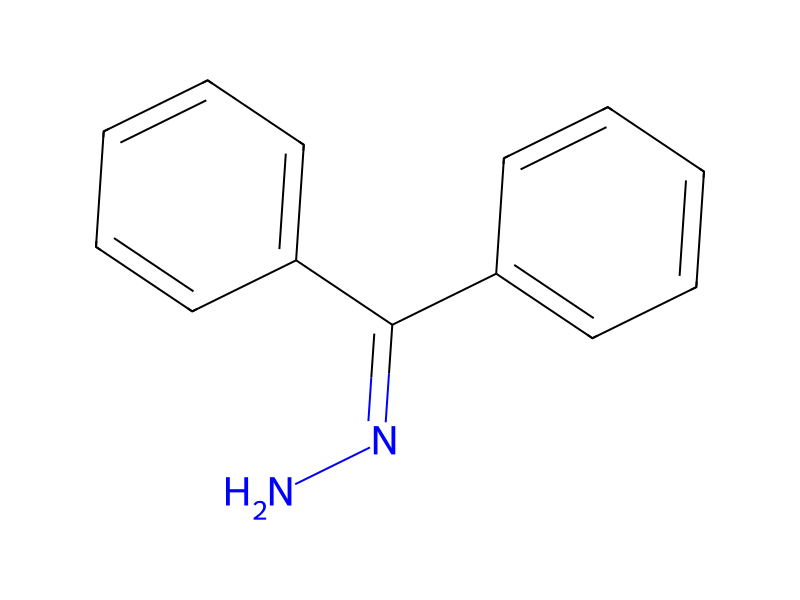
Grundinformationen
- Standard-SMILES
NN=C(c1ccccc1)c1ccccc1- InChIKey
QYCSNMDOZNUZIT-UHFFFAOYSA-N- Summenformel
- C13H12N2
- Durchschnittliche Molmasse
- 196,25 g/mol
- Monoisotopische Masse
- 196,10004839
Namen und Bezeichner
- Bevorzugter Name
- Diphenylmethylidenehydrazine
- IUPAC
- benzhydrylidenehydrazine
- Lokaler Name
- Benzophenonhydrazon
- Englischer Name
- Benzophenone hydrazone
- Summenformel
- C13H12N2
- Molmasse
- 196.25
Namen und Synonyme
Benzophenone hydrazone5350-57-2(diphenylmethylene)hydrazineMethanone, diphenyl-, hydrazoneDiphenylmethanone hydrazoneBenzophenonehydrazoneBenzophenone, hydrazoneDiphenyl ketone hydrazoneNSC 43DiphenylmethylidenehydrazineS2WWI81YALEINECS 226-321-8
Weitere Namen anzeigen
Tazobactam Impurity 15Di(phenyl)methylidenehydrazine3-iodo-N-[[2-[4-(2-methyl-1-oxopropyl)-1-piperazinyl]anilino]-sulfanylidenemethyl]benzamideBP hydrazoneBenzophenone hTIMTEC-BB SBB007642Benzophenone hydrazodiphenylketohydrazoneBENZOPHENONE HYDROZONE
NSC-43AI3-52536BENZOPHENONHYDRAZONEDTXSID6063806N-(DIPHENYLMETHYLENE)HYDRAZINEBenzophenone, hydrazone (6CI,7CI,8CI)RefChem:588935Methanone, diphenyl, hydrazone
Datenbank-Bezeichner
- CAS
5350-57-2- PubChem CID
- 79304
- DTXSID
DTXSID6063806- ChEMBL
CHEMBL1881268- UNII
- S2WWI81YAL
- EC Number
- 226-321-8
- Nikkaji
- J1.834A
Eigenschaften
Berechnete Struktureigenschaften
- XLogP
- 2,8
- Polarare Oberfläche (TPSA)
- 38,4 Ų
- H-Brücken-Donoren
- 1
- H-Brücken-Akzeptoren
- 2
- Frei drehbare Bindungen
- 2
- Schwere Atome
- 15
- Formalladung
- 0
- Komplexität
- 191
Experimentelle und physikochemische Eigenschaften
Solubility8.1 [ug/mL] (The mean of the results at pH 7.4)
Vapor Pressure0.000151 [mmHg]
Physical DescriptionWhite to yellow powder; [Acros Organics MSDS]
Physikochemische Eigenschaften
- Schmelzpunkt
- 95 · 95-98 °C (lit.)
- Siedepunkt
- 225 · 225-230 °C/55 mmHg (lit.)
- Dichte
- 1.1 · 1.1
- Brechungsindex
- 1.5014 · 1.5014 (estimate)
- Flammpunkt
- 146 °C · 146°C
- storage temp.
- 2 · 2-8°C
- Löslichkeit
- Soluble in ether, benzene, chloroform and other organic solvents.
- pka
- 1.44 · 1.44±0.70(Predicted)
- Aggregatzustand
- Crystalline Needles or Crystalline Powder
- Farbe
- White to yellow
- BRN
- 1910177 · 1910177
- InChI
- 1S/C13H12N2/c14-15-13(11-7-3-1-4-8-11)12-9-5-2-6-10-12/h1-10H,14H2
- InChIKey
- QYCSNMDOZNUZIT-UHFFFAOYSA-N
- SMILES
- N\N=C(/c1ccccc1)c2ccccc2
- CAS Datenbank
- 5350 · 5350-57-2(CAS DataBase Reference)
- NIST chemische Informationen
- Methanone, diphenyl-, hydrazone(5350-57-2)
- EPA chemische Informationen
- Methanone, diphenyl-, hydrazone (5350-57-2)
Sicherheit und Regulatorisches
GHS-Klassifizierung
GHS Classification
This chemical does not meet GHS hazard criteria for 10% (1 of 10) of reports.
Danger
H301 (80%): Toxic if swallowed [Danger Acute toxicity, oral];H302 (10%): Harmful if swallowed [Warning Acute toxicity, oral];H317 (80%): May cause an allergic skin reaction [Warning Sensitization, Skin];H401 (10%): Toxic to aquatic life [Hazardous to the aquatic environment, acute hazard];H411 (80%): Toxic to aquatic life with long lasting effects [Hazardous to the aquatic environment, long-term hazard]
P261, P264, P270, P272, P273, P280, P301+P316, P301+P317, P302+P352, P321, P330, P333+P317, P362+P364, P391, P405, and P501 (click each P-code to see the statement)
Aggregated GHS information provided per 10 reports by companies from 5 notifications to the ECHA C&L Inventory. Each notification may be associated with multiple companies.;Reported as not meeting GHS hazard criteria per 1 of 10 reports by companies.;There are 4 notifications provided by 9 of 10 reports by companies with hazard statement code(s).;Information may vary between notifications depending on impurities, additives, and other factors. The percentage value in parenthesis indicates the notified classification ratio from companies that provide hazard codes. Only hazard codes with percentage values above 10% are shown. For more detailed information, please visit ECHA C&L website.
Gefahrenhinweise
Regulatory Information
Chemical: Methanone, diphenyl-, hydrazone
Status: Active Update: 06-03-2019 https://echa.europa.eu/registration-dossier/-/registered-dossier/21208
Benzophenone hydrazone: Does not have an individual approval but may be used under an appropriate group standard
Hazards SummaryIntraperitoneal LD50 (mouse) = 134 mg/kg; [RTECS] May cause irritation; [Acros Organics MSDS]
Hazard Classes and CategoriesAcute Tox. 3 (80%);Acute Tox. 4 (10%);Skin Sens. 1 (80%);Aquatic Acute 2 (10%);Aquatic Chronic 2 (80%)
Regulatorische Informationen
Regulatory Information
Chemical: Methanone, diphenyl-, hydrazone
Status: Active Update: 06-03-2019 https://echa.europa.eu/registration-dossier/-/registered-dossier/21208
Benzophenone hydrazone: Does not have an individual approval but may be used under an appropriate group standard
Sicherheitsdaten
- wgk
- 3
- tsca
- TSCA listed
- hs_code
- 29280090
- RTECS-Nr.
- PC4954487
- Speicherklasse
- 11 - Combustible Solids
- Hazard Classifications
- Acute Tox. 4 Oral
Chemie und Industrie
Verwendung und Herstellung
General Manufacturing InformationMethanone, diphenyl-, hydrazone: ACTIVE
Anwendungen
VerwendenAn important compound in organic photochemistry and perfumery as well as in organic synthesis. Used in the antibiotics synthesis of 6-APA and 7-ACA of the carboxyl protecting groups and other organic compounds. Used as organic pigment and medical intermediate. It is used as a photoinitiator of UV-curing applications in inks, adhesive, coatings and optical fiber.
Vor- und nachgelagerte Produkte
Vorgelagerte Rohstoffe
Nachgelagerte Produkte
Anbieter50 Anbieter
湖北瑞凯兴科技股份有限公司0086-13795397680
国药集团化学试剂有限公司86-21-63210123 · [email protected]
梯希爱(上海)化成工业发展有限公司021-67121386 · [email protected]
衢州润东化工有限公司0570-8789886 18892685668 · [email protected]
上海阿拉丁生化科技股份有限公司400-6206333 13167063860 · [email protected]
爱斯特(成都)生物制药股份有限公司+86-28-85122536 85324413 · [email protected]
上海赫文斯化工有限公司15721252604 17321035817 · [email protected]
南京兰亚化工贸易有限公司+86-25-8331-5620 · [email protected]
韶远科技(上海)有限公司021-50795510 4000665055 · [email protected]
科瑞迪化学400-821-5857 021-64326257 · [email protected]
Syntechem Co.,Ltd[email protected]
上海迈瑞尔生化科技有限公司4006356688 18621169109 · [email protected]
Wuhan EnTai Technology Development Co,.Ltd86-27-82330560 · [email protected]
武汉易泰科技有限公司上海分公司18930552037 · [email protected]
大连美仑生物技术有限公司0411-62910999 13889544652 · [email protected]
阿法埃莎(中国)化学有限公司400-6106006 · [email protected]
安耐吉化学&3A(安徽泽升科技股份有限公司)400-0056266 · [email protected]
上海瀚鸿科技股份有限公司021-54306202 13764082696 · [email protected]
上海尚饮思生化医药有限公司021-021-57872719 13761402923 · [email protected]
嘉兴市艾森化工有限公司0573-85285100 18627885956 · [email protected]
Pure Chemistry Scientific Inc.001-857-928-2050 or 1-888-588-9418 · [email protected]
孝感深远化工有限公司15527621225; 15527621225 · [email protected]
山东西亚化学有限公司13355009207 13355009207 · [email protected]
玛雅试剂+86 (573) 82222445 (0)18006601000 452520369 · [email protected]
四川库利南科技有限公司400-1166-196 18981987031 · [email protected]
上海耐士化工科技有限公司400-188-0725 +86 21 34310725 13611771617
天津希恩思生化科技有限公司400 638 7771 · [email protected]
Syntor Fine Chemicals Ltd.+44 (0) 1928 579865 · [email protected]
北京泰亚杰科技有限公司021-33690831-8001 13552411790;18616022633 · [email protected]
上海源叶生物科技有限公司13636370518 · [email protected]
上海思域化工科技有限公司86-21-34053660 · [email protected]
赛默飞世尔科技(中国)有限公司800-810-5118 · [email protected]
南京精瑞久安生物技术有限公司025-58196018 800028039 · [email protected]
北京伊诺凯科技有限公司400-810-7969 010-59572699 · [email protected]
上海遐瑞医药科技有限公司+86 21 61551611
江苏艾康生物医药研发有限公司025-66113011 13913916777 · [email protected]
上海健超生物科技有限公司150-2103-5486 18017383231 · [email protected]
TCI AMERICA800-4238616 · [email protected]
TOKYO CHEMICAL INDUSTRY CO., LTD.03-36680489 · [email protected]
TCI Europe320-37350700 · [email protected]
上海贤鼎生物科技有限公司4009209199 · [email protected]
深圳市茵诺圣生物科技有限公司0755-28351685 18503098468 · [email protected]
深圳振强药物研发有限公司0755-66853366 13670046396 · [email protected]
深圳康特腾科技有限公司86-0755-86635001 · [email protected]
山东博洛达生物科技有限公司0531-68659041 · [email protected]
上海倍卓生物科技有限公司021-61119791,13386096464 · [email protected]
襄阳润通达化工有限公司0710-3535121 13508666631 · [email protected]
北京环宇世纪化学科技有限公司hysj_bj.com
上海湄水化工科技有限公司021-60549325 18616193163
上海将来实业股份有限公司400-0066400 13621662912 · [email protected]
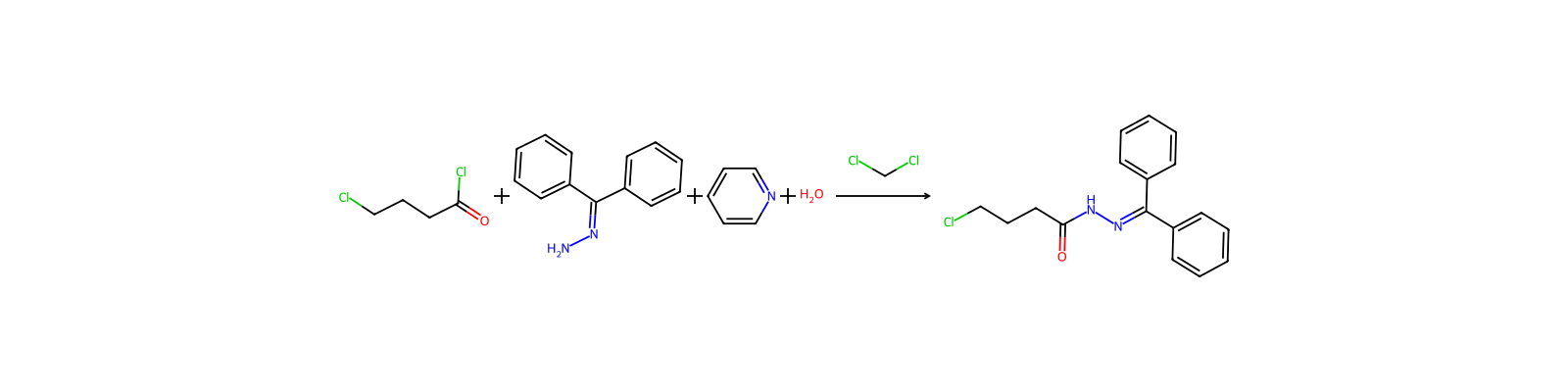
Zugehörige Reaktionen
156


Verknüpfte Notizen
Wird geladen…