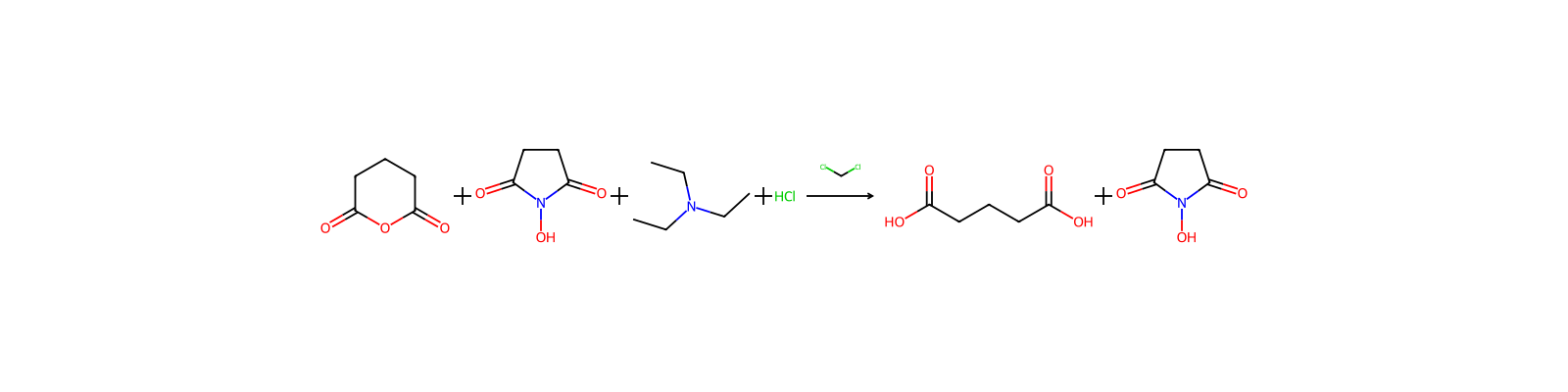
Glutarsureanhydrid
Glutaric anhydride
Daten werden ergänzt – lade die Seite später neu, um den aktuellen Stand zu sehen

Grundinformationen
- CAS
108-55-4- Standard-SMILES
O=C1CCCC(=O)O1- InChIKey
VANNPISTIUFMLH-UHFFFAOYSA-N- Summenformel
- C5H6O3
- Durchschnittliche Molmasse
- 114,1 g/mol
- Monoisotopische Masse
- 114,03169405
Überblick
Glutaric anhydride is a cyclic dicarboxylic anhydride that is oxane which carries oxo groups at positions 2 and 6. It is used as an intermediate in the production of pharmaceuticals, corrosion inhibitors, and polymers (E.g. epoxy polyesters). It is a cyclic dicarboxylic anhydride and a member of oxanes. It is functionally related to a glutaric acid.
Namen und Bezeichner
- Bevorzugter Name
- Glutaric anhydride
- IUPAC
- oxane-2,6-dione
- Lokaler Name
- Glutarsureanhydrid
- Englischer Name
- Glutaric anhydride
- Summenformel
- C5H6O3
- Molmasse
- 114.1
Namen und Synonyme
GLUTARIC ANHYDRIDE108-55-4Dihydro-2H-pyran-2,6(3H)-dioneoxane-2,6-dionePentanedioic anhydrideGlutaric acid anhydridePyroglutaric acid2H-Pyran-2,6(3H)-dione, dihydro-Pentanedioic acid anhydrideAnhydrid kyseliny glutaroveDTXSID504436263OFI15S80
Weitere Namen anzeigen
GANGlutamic AnhydrideTETRAHYDROPYRAN-2,6-DIONEutaric anhydrideGlutaric anhydridpyroglutaricacidGlutarsureanhydrid
NSC-166402H-Pyran-2,6(3H)-dione, dihydroDTXCID3024362CHEBI:167482RefChem:143700203-593-6MFCD00006679dihydro-3H-pyran-2,6-dione
Datenbank-Bezeichner
- CAS
108-55-4- PubChem CID
- 7940
- DTXSID
DTXSID5044362
Eigenschaften
Berechnete StruktureigenschaftenWird ergänzt
- XLogP
- -0,1
- Polarare Oberfläche (TPSA)
- 43,4 Ų
- H-Brücken-Donoren
- 0
- H-Brücken-Akzeptoren
- 3
- Frei drehbare Bindungen
- 0
- Schwere Atome
- 8
- Formalladung
- 0
- Komplexität
- 114
Experimentelle und physikochemische Eigenschaften
PolymersPlastics & Rubber -> Acid Anhydrides, Cyclic
SpringerMaterials PropertiesBoiling point
Physical Description
CBI; Dry Powder
Off-white flakes or crystals; [Alfa Aesar MSDS]
Physikochemische Eigenschaften
- Schmelzpunkt
- 50 · 50-55 °C (lit.)
- Siedepunkt
- 150 °C/10 · 150 °C/10 mmHg (lit.)
- Dichte
- 1 · 1,411 g/cm3
- Dampfdruck
- 0.05 hPa · 0.05 hPa (50 °C)
- Brechungsindex
- 1.463 · 1.4630 (estimate)
- Flammpunkt
- 230 °F · >230 °F
- storage temp.
- 30 °C · Store below +30°C.
- Löslichkeit
- Chloroform, Ethyl Acetate
Sicherheit und Regulatorisches
Sicherheitsangaben dienen nur zur Orientierung und ersetzen weder das Sicherheitsdatenblatt (SDB) des Lieferanten noch geltende Vorschriften oder eine fachliche Bewertung.
GHS-Klassifizierung
GHS Classification
This chemical does not meet GHS hazard criteria for 0.4% (1 of 270) of reports.
Danger
H302 (98.5%): Harmful if swallowed [Warning Acute toxicity, oral]
P261, P264, P264+P265, P270, P271, P280, P301+P317, P302+P352, P304+P340, P305+P354+P338, P317, P319, P321, P330, P332+P317, P362+P364, P403+P233, P405, and P501 (click each P-code to see the statement)
Aggregated GHS information provided per 270 reports by companies from 13 notifications to the ECHA C&L Inventory. Each notification may be associated with multiple companies.
Gefahrenhinweise
Regulatory Information
Chemical: 2H-Pyran-2,6(3H)-dione, dihydro-
2H-Pyran-2,6(3H)-dione, dihydro- is listed on the EPA's Chemical Data Reporting (CDR) system. Manufacturers and importers of 2H-Pyran-2,6(3H)-dione, dihydro- are required to report information about their production and use of this chemical to the EPA under the Toxic Substances Control Act (TSCA). (40 eCFR Part 711)
Status: Active Update: 27-09-2021 https://echa.europa.eu/registration-dossier/-/registered-dossier/11130
Glutaric anhydride: Does not have an individual approval but may be used under an appropriate group standard
Hazards Summary
Causes somnolence, necrotic gastrointestinal changes, and diffuse hepatitis in oral lethal-dose studies of rats; [RTECS] An irritant that may cause serious eye injury; Toxic by ingestion and skin absorption; [Alfa Aesar MSDS] See Acid Anhydrides.
Hazard Classes and CategoriesAcute Tox. 4 (98.5%)
Toxikologische Informationen
Chemie und Industrie
Verwendung und Herstellung
UsesUsed to make fine chemicals; [ExPub: ECHA REACH Registrations]
U.S. Production2023: 75,000 - <500,000 lb
Consumer UsesFragrance
Industry UsesNot Known or Reasonably Ascertainable
General Manufacturing Information
Not Known or Reasonably Ascertainable
2H-Pyran-2,6(3H)-dione, dihydro-: ACTIVE
Vor- und nachgelagerte Produkte
Vorgelagerte Rohstoffe
Nachgelagerte Produkte
Zugehörige Reaktionen
292



Notizen zur Verbindung
Wird geladen…