
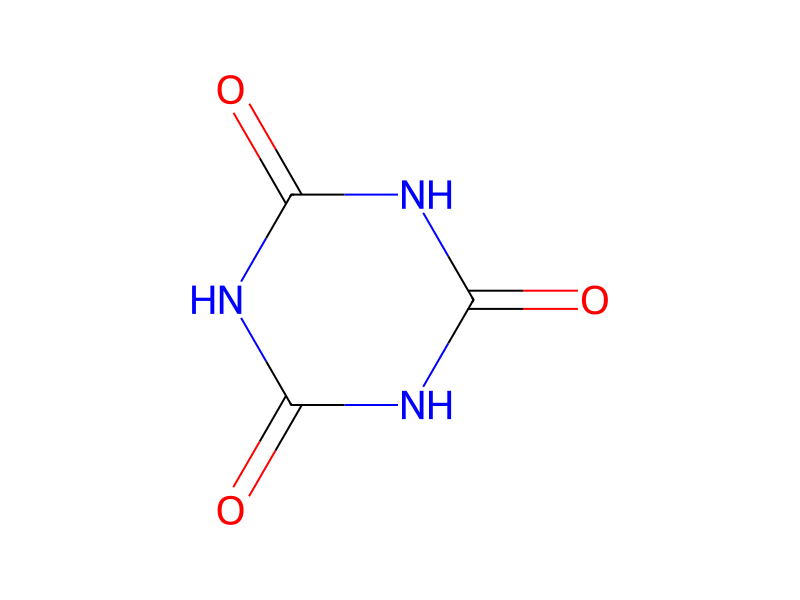
Grundinformationen
- Standard-SMILES
O=c1[nH]c(=O)[nH]c(=O)[nH]1- InChIKey
ZFSLODLOARCGLH-UHFFFAOYSA-N- Summenformel
- C3H3N3O3
- Durchschnittliche Molmasse
- 129,07 g/mol
- Monoisotopische Masse
- 129,01744096
Überblick
Crystals. (NTP, 1992)
Namen und Bezeichner
- Bevorzugter Name
- Cyanuric acid
- IUPAC
- 1,3,5-triazinane-2,4,6-trione
- Lokaler Name
- Cyanursure
- Englischer Name
- Cyanuric acid
- Summenformel
- C3H3N3O3
- Molmasse
- 129.07
Namen und Synonyme
CYANURIC ACID108-80-51,3,5-Triazine-2,4,6-triolIsocyanuric acidTrihydroxycyanidineTricyanic acid1,3,5-triazinane-2,4,6-trionesym-TriazinetriolPseudocyanuric acidIsocyanurate acid1,3,5-Triazine-2,4,6(1H,3H,5H)-trione2,4,6-Trihydroxy-1,3,5-triazine
Weitere Namen anzeigen
TriuretCyanauric AcidCyanuric acid 98%Cyanuric acid-15N3Lamotrigine Impurity 13
s-Triazine-2,4,6-triolKyselina kyanurovas-2,4,6-TriazinetriolTrihydroxytriazines-Triazine-2,4,6(1H,3H,5H)-trioneDTXSID7024873sym-triazine-2,4,6-triol2,4,6-Trihydroxy-S-triazine
Datenbank-Bezeichner
- CAS
108-80-5- PubChem CID
- 7956
- DTXSID
DTXSID7024873- ChEMBL
CHEMBL243087- ChEBI
CHEBI:38028- UNII
- H497R4QKTZ
- EC Number
- 203-618-0
- Nikkaji
- J2.429E
Eigenschaften
Berechnete Struktureigenschaften
- XLogP
- -1,2
- Polarare Oberfläche (TPSA)
- 87,3 Ų
- H-Brücken-Donoren
- 3
- H-Brücken-Akzeptoren
- 3
- Frei drehbare Bindungen
- 0
- Schwere Atome
- 9
- Formalladung
- 0
- Komplexität
- 135
Experimentelle und physikochemische Eigenschaften
Chemical ClassesNitrogen Compounds -> Triazines
Polymers
Plastics -> Flame retardants
Plastics -> Polyolefin-I; Polyolefin-II
pHpH of saturated aqueous solution @ room temperature = 4.8
OdorOdorless
TasteSlightly bitter
Density
2.5 at 68 °F (NTP, 1992) - Denser than water; will sink
1.75 deg 25 °C/4 °C 9 (anhydride); 1.66 at 25 °C/4 °C (dihydrate)
2.5 g/cm³
1.75 @25 °C
Flame RetardantsFlame retardants
Color/Form
White crystalline solid
CRYSTALLINE POWDER
Solubility
0.5 mL (NTP, 1992)
Slightly soluble in common organic solvents such as acetone, benzene, diethyl ether, ethanol, hexane. Solubility (%): dimethylformamide 7.2; diemthyl sulfoxide 17.4.
Soluble in hot alcohols, pyridine, concentrated HCL without decomposition; in aqueous solutions of NaOH and KOH. Insoluble in cold methanol, ether acetone, benzene chloroform.
Solubility in 96% H2SO4 (25 °C): 14.1%
Solubility in water (%): 0.2 at 25 °C; 2.6 at 90 °C; 10.0 at 150 °C
For more Solubility (Complete) data for CYANURIC ACID (6 total), please visit the HSDB record page.
Boiling Point
DECOMPOSES (NTP, 1992)
Sublimes and dissociates to isocyanuric acid at higher />330 °C/ temperatures
Decomposition
The substance decomposes on heating above 320-350 °C producing (highly) toxic fumes including nitrogen oxides and cyanic acid.
>320 °C. This produces toxic fumes including nitrogen oxides and isocyanic acid. Reacts with chlorine. This generates explosion hazard.
Melting Point
greater than 680 °F (DEC.) (NTP, 1992)
360 °C
360 °C
360 °C
Physikochemische Eigenschaften
- Schmelzpunkt
- 360 °C · 360 °C
- Siedepunkt
- 74 °C · 74 °C
- Dichte
- 1.56 · 1.56
- Dampfdruck
- 0.0001 Pa · <0.0001 Pa (25 °C)
- Brechungsindex
- 1.45 · 1.4500 (estimate)
- storage temp.
- 30 °C · Store below +30°C.
- Löslichkeit
- Soluble in sulfuric acid, dimethylformamide, sodium hydroxide, potassium hydroxide and diemthyl sulfoxide. Slightly soluble in acetone, benzene, diethyl ether, ethanol and hexane. Insoluble in cold methanol, benzene and chloroform.
- Aggregatzustand
- Crystalline Powder or Lumps
- pka
- 6.88 · 6.88, 11.40, 13.5(at 25℃)
- Farbe
- White to light beige
- PH
- 3.8 · 3.8-4.0 (H2O, 20℃)(saturated solution)
- Geruch (Odor)
- off-wh. cryst., odorless
- Wasserlöslichkeit
- 0.3 g/100mL · 0.3 g/100mL (25 ºC)
- Merck
- 14 · 14,2698
- BRN
- 126982 · 126982
- Henry's Law Constant
- 1.1 · 1.1×109 mol/(m3Pa) at 25℃, HSDB (2015)
- Stabilität
- Stable. Incompatible with strong oxidizing agents.
- InChI
- 1S/C3H3N3O3/c7-1-4-2(8)6-3(9)5-1/h(H3,4,5,6,7,8,9)
- InChIKey
- ZFSLODLOARCGLH-UHFFFAOYSA-N
- SMILES
- O=C1NC(=O)NC(=O)N1
- LogP
- -1.31 at · -1.31 at 25℃
- CAS Datenbank
- 108 · 108-80-5(CAS DataBase Reference)
- NIST chemische Informationen
- 1 · 1,3,5-Triazine-2,4,6(1H,3H,5H)-trione(108-80-5)
- EPA chemische Informationen
- Cyanuric acid (108-80-5)
Sicherheit und Regulatorisches
GHS-Klassifizierung
GHS Classification
This chemical does not meet GHS hazard criteria for 73.2% (208 of 284) of all reports.
Warning
H319 (26.8%): Causes serious eye irritation [Warning Serious eye damage/eye irritation]
P264+P265, P280, P305+P351+P338, and P337+P317 (click each P-code to see the statement)
Aggregated GHS information provided per 284 reports by companies from 10 notifications to the ECHA C&L Inventory.
Gefahrenhinweise
Regulatory Information
Chemical: 1,3,5-Triazine-2,4,6(1H,3H,5H)-trione
Regulation (EC) No 178/2002 (amended)
1,3,5-Triazine-2,4,6(1H,3H,5H)-trione is listed on the EPA's Chemical Data Reporting (CDR) system. Manufacturers and importers of 1,3,5-Triazine-2,4,6(1H,3H,5H)-trione are required to report information about their production and use of this chemical to the EPA under the Toxic Substances Control Act (TSCA). (40 eCFR Part 711)
Status: Active Update: 06-08-2018 https://echa.europa.eu/registration-dossier/-/registered-dossier/15028
Cyanuric acid: Does not have an individual approval but may be used under an appropriate group standard
Other Safety InformationIMAP assessments - 1,3,5-Triazine-2,4,6(1H,3H,5H)-trione: Human health tier I assessment
Fire HazardsGives off irritating or toxic fumes (or gases) in a fire.
Health HazardsSYMPTOMS: Symptoms of exposure to this compound include, local irritation of the eyes.
Hazards Summary
An eye and respiratory tract irritant; [HSDB] A mild eye irritant; Ingestion of large quantity may cause kidney injury; [ICSC] An irritant; [MSDSonline] Classified as essentially nontoxic; Avoid ingestion, inhalation of dust, and contact with eyes; [Ullmann] Causes crystals that can damage urinary tract in animals fed high doses; [AIHA]
Reactive GroupAmides and Imides
Special Reports
Hammond BG et al; Environ Health Perspect 69: 287-92 (1986). Chlorinated cyanurates are added to swimming pools as disinfectants. In the presence of water, these materials hydrolyze to yield cyanurate and hypochlorous acid. To evaluate the safety of exposure to these materials, a comprehensive testing program was undertaken. This review summarizes the results of the acute, subchronic, reproduction, metabolism, mutagenesis, and carcinogenicity tests on cyanurate are also summarized. Results from these tests indicate that chlorinated isocyanurates are safe for use in swimming pools.
FIFRA Requirements
As the federal pesticide law FIFRA directs, EPA is conducting a comprehensive review of older pesticides to consider their health and environmental effects and make decisions about their future use. Under this pesticide reregistration program, EPA examines health and safety data for pesticide active ingredients initially registered before November 1, 1984, and determines whether they are eligible for reregistration. In addition, all pesticides must meet the new safety standard of the Food Quality Protection Act of 1996. Cyanuric acid is found on List A, which contains most food use pesticides and consists of the 194 chemical cases (or 350 individual active ingredients) for which EPA issued registration standards prior to FIFRA, as amended in 1988. Case No: 0569; Pesticide type: antimicrobial; Registration Standard Date: 05/20/88; Case Status: RED Approved 09/92; OPP has made a decision that some/all uses of the pesticide are eligible for reregistration, as reflected in a Reregistration Eligibility Decision (RED) document.; Active ingredient (AI): Cyanuric acid; AI Status: The active ingredient is no longer contained in any registered pesticide products ... "cancelled."
Reactivity Profile
An amide and amine. Organic amides/imides react with azo and diazo compounds to generate toxic gases. Flammable gases are formed by the reaction of organic amides/imides with strong reducing agents. Amides are very weak bases (weaker than water). Imides are less basic yet and in fact react with strong bases to form salts. That is, they can react as acids. Mixing amides with dehydrating agents such as P2O5 or SOCl2 generates the corresponding nitrile. The combustion of these compounds generate mixed oxides of nitrogen (NOx)
Atmospheric Standards
This action promulgates standards of performance for equipment leaks of Volatile Organic Compounds (VOC) in the Synthetic Organic Chemical Manufacturing Industry (SOCMI). The intended effect of these standards is to require all newly constructed, modified, and reconstructed SOCMI process units to use the best demonstrated system of continuous emission reduction for equipment leaks of VOC, considering costs, non air quality health and environmental impact and energy requirements. Cyanuric acid is produced, as an intermediate or a final product, by process units covered under this subpart.
Chemical DangersDecomposes at >320 °C. This produces toxic fumes including nitrogen oxides and isocyanic acid. Reacts with chlorine. This generates explosion hazard.
Air and Water ReactionsSoluble in hot water [Hawley].
Sicherheit und Schutzausrüstung
Fire Fighting
This compound is not very flammable but any fire involving this compound may produce dangerous vapors. You should evacuate the area. All firefighters should wear full-body protective clothing and use self-contained breathing apparatuses. You should extinguish any fires involving this chemical with a dry chemical, carbon dioxide, foam, or halon extinguisher. (NTP, 1992)
Use water spray, alcohol-resistant foam, powder, carbon dioxide. In case of fire: keep drums, etc., cool by spraying with water.
First Aid Measures
Fresh air, rest.
Rinse and then wash skin with water and soap.
Rinse with plenty of water for several minutes (remove contact lenses if easily possible).
Rinse mouth.
First Aid
EYES: First check the victim for contact lenses and remove if present. Flush victim's eyes with water or normal saline solution for 20 to 30 minutes while simultaneously calling a hospital or poison control center. Do not put any ointments, oils, or medication in the victim's eyes without specific instructions from a physician. IMMEDIATELY transport the victim after flushing eyes to a hospital even if no symptoms (such as redness or irritation) develop.
Safe StorageDry. Well closed. Separated from chlorine.
Fire Fighting ProceduresWater spray, alcohol resistant foam, powder, carbon dioxide.
Storage Conditions
Cyanuric acid should be stored in a dry place. Silos and pneumatic conveyors should be grounded to prevent electrostatic discharges.
...MATERIALS WHICH ARE TOXIC AS STORED OR WHICH CAN DECOMP INTO TOXIC COMPONENTS DUE TO CONTACT WITH...MOISTURE, ACIDS, OR ACID FUMES...STORED IN COOL, WELL-VENTILATED PLACE, OUT OF DIRECT RAYS OF SUN, AWAY FROM...FIRE HAZARD, &...PERIODICALLY INSPECTED & MONITORED. INCOMPATIBLE MATERIALS...ISOLATED...
Cleanup Methods
Alkali and thermal treatment in filtration and precipitation was used to remove cyanuric acid from wastewaters.
Dissolved cyanurate salts are removed from water by treatment with an aq soln of sodium hypochlorite, whereby most of the cyanurate is converted to nitrogen, carbon dioxide, and sodium chloride. The treatment is carried out at pH 9.0-10.0 and 25 deg to 55 °C, the contact time being 2-6 hr. The mol ratio of sodium hypochlorite and cyanurate is kept between 6:1 and 8:1.
SODIUM HYPOCHLORITE IS USED IN REMOVAL OF CYANURATES FROM WASTE STREAMS.
Nonfire Spill Response
SMALL SPILLS AND LEAKAGE: If you spill this chemical, you should dampen the solid spill material with water, then transfer the dampened material to a suitable container. Use absorbent paper dampened with water to pick up any remaining material. Seal your contaminated clothing and the absorbent paper in a vapor-tight plastic bag for eventual disposal. Wash all contaminated surfaces with a strong soap and water solution. Do not reenter the contaminated area until the Safety Officer (or other responsible person) has verified that the area has been properly cleaned.
Disposal Methods
SRP: The most favorable course of action is to use an alternative chemical product with less inherent propensity for occupational exposure or environmental contamination. Recycle any unused portion of the material for its approved use or return it to the manufacturer or supplier. Ultimate disposal of the chemical must consider: the material's impact on air quality; potential migration in soil or water; effects on animal, aquatic, and plant life; and conformance with environmental and public health regulations.
Spillage Disposal
Personal protection: particulate filter respirator adapted to the airborne concentration of the substance. Sweep spilled substance into covered containers. Carefully collect remainder. Then store and dispose of according to local regulations.
Preventive Measures
Impervious protective clothing must be used whenever skin contact is likely. Contaminated work clothing can be cleaned at the facility or sent outside to a contract industrial laundry that has been informed of the potential hazards. Routine washing of hands, face and neck prior to breaks or lunch must be emphasized. Daily showers at the end of the work shift are required. Showers should be immediate for unplanned situations in which overt overexposures can occur such as spills or leaks.
Eye PreventionWear safety spectacles.
Toxikologische Informationen
Interactions
The major pet food recall associated with acute renal failure in dogs and cats focused initially on melamine as the suspect toxicant. In the course of the investigation, cyanuric acid was identified in addition to melamine in the offending food. The purpose of this study was to characterize the toxicity potential of melamine, cyanuric acid, and a combination of melamine and cyanuric acid in cats. In this pilot study, melamine was added to the diet of 2 cats at 0.5% and 1%, respectively. Cyanuric acid was added to the diet of 1 cat at increasing doses of 0.2%, 0.5%, and 1% over the course of 10 days. Melamine and cyanuric acid were administered together at 0%, 0.2%, 0.5%, and 1% to 1 cat per dose group. No effect on renal function was observed in cats fed with melamine or cyanuric acid alone. Cats dosed with a combination were euthanized at 48 hours after dosing because of acute renal failure. Urine and touch impressions of kidneys from all cats dosed with the combination revealed the presence of fan-shaped, birefringent crystals. Histopathologic findings were limited to the kidneys and included crystals primarily within tubules of the distal nephron, severe renal interstitial edema, and hemorrhage at the corticomedullary junction. The kidneys contained estimated melamine concentrations of 496 to 734 mg/kg wet weight and estimated cyanuric acid concentrations of 487 to 690 mg/kg wet weight. The results demonstrate that the combination of melamine and cyanuric acid is responsible for acute renal failure in cats.
Ecotoxicity Values
LC50 Salmo gairdneri 1080 mg/L/96 hr. /Conditions of bioassay not specified in source examined/
LC50 Pimephales promelas >2100 mg/L/96 hr; static. /Conditions of bioassay not specified in source examined/
LC50 Lepomis macrochirus 1400 mg/L/96 hr. /Conditions of bioassay not specified/
LC50 Lepomis macrochirus >1000 mg/L/96 hr; static.
For more Ecotoxicity Values (Complete) data for CYANURIC ACID (11 total), please visit the HSDB record page.
Environmental Fate
TERRESTRIAL FATE: Based on a classification scheme(1), an estimated Koc value of 58(SRC), determined from a water solubility of 2,593 mg/L(2) and a regression-derived equation(3), indicates that cyanuric acid is expected to have high mobility in soil(SRC). The pKa of cyanuric acid is 6.88(4), indicating that this compound will partially exist in the anion form in the environment and anions generally do not adsorb more strongly to soils containing organic carbon and clay than their neutral counterparts(5). Volatilization of cyanuric acid from moist soil surfaces is not expected to be an important fate process(SRC) given an estimated Henry's Law constant of 8.74X10⁻¹⁵ atm-cu m/mole(SRC), using a fragment constant estimation method(6). Cyanuric acid is not expected to volatilize from dry soil surfaces(SRC) based upon an estimated vapor pressure of 4.4X10⁻¹¹ mm Hg(SRC), determined from a fragment constant method(7). Cyanuric acid biodegrades readily under a wide variety of natural conditions, and particularly well in systems of either low or zero dissolved- oxygen levels, such as anaerobic activated sludge and sewage, soils, muds, and muddy streams and river waters, as well as ordinary aerated activated sludge systems with typically low (1 to 3 ppm) dissolved-oxygen levels(8).
AQUATIC FATE: Based on a classification scheme(1), an estimated Koc value of 58(SRC), determined from a water solubility of 2,593 mg/L(2) and a regression-derived equation(3), indicates that cyanuric acid is not expected to adsorb to suspended solids and sediment(SRC). Volatilization from water surfaces is not expected(3) based upon an estimated Henry's Law constant of 8.7X10⁻¹⁵ atm-cu m/mole(SRC), developed using a fragment constant estimation method(4). According to a classification scheme(5), BCF values of <0.5(6), suggest the potential for bioconcentration in aquatic organisms is low(SRC). Cyanuric acid biodegrades readily under a wide variety of natural conditions, and particularly well in systems of either low or zero dissolved- oxygen levels, such as anaerobic activated sludge and sewage, soils, muds, and muddy streams and river waters, as well as ordinary aerated activated sludge systems with typically low (1 to 3 ppm) dissolved-oxygen levels(7).
ATMOSPHERIC FATE: According to a model of gas/particle partitioning of semivolatile organic compounds in the atmosphere(1), cyanuric acid, which has an estimated vapor pressure of 4.4X10⁻¹¹ mm Hg at 25 °C(SRC), determined from a fragment constant method(2), is expected to exist solely in the particulate phase in the ambient atmosphere. Particulate-phase cyanuric acid may be removed from the air by wet or dry deposition(SRC). Cyanuric acid does not absorb light at wavelengths >290 nm(4) and therefore is not expected to be susceptible to direct photolysis by sunlight(SRC).
Adverse EffectsNephrotoxin - The chemical is potentially toxic to the kidneys in the occupational setting.
Exposure RoutesThe substance can be absorbed into the body by inhalation.
Ecotoxicity Excerpts/PLANTS/ Very toxic to certain types of barley and radishes..
Signs and Symptoms
Cough. Sore throat.
Redness.
Sore throat. Abdominal pain.
Soil Adsorption/Mobility
The Koc of cyanuric acid is estimated as 58(SRC), using a water solubility of 2,593 mg/L(1) and a regression-derived equation(2). According to a classification scheme(3), this estimated Koc value suggests that cyanuric acid is expected to have high mobility in soil. The pKa of cyanuric acid is 6.88(4), indicating that this compound will partially exist in the anion form in the environment and anions generally do not adsorb more strongly to soils containing organic carbon and clay than their neutral counterparts(5).
Artificial Pollution Sources
Cyanuric acid's production and use as a convenient lab source of cyanic acid gas, in the preparation of melamine, sponge rubber, herbicides, dyes resins, antimicrobial agents and as a stabilizer and disinfectant in swimming pool water(1) may result in its release to the environment through various waste streams(SRC). Its former use as a herbicide(2) resulted in its direct release to the environment(SRC).
Environmental Biodegradation
AEROBIC: A study using a Warburg respirometer with acclimated sewage sludge and 100 mg cyanuric acid found that cyanuric acid was inhibitory to biodegradation(1). Another study using COD, TOC, and UV with activated sludge found no degradation with cyanuric acid even with acclimated sludge(2). Cyanuric acid completely degraded in a study using s-triazine herbicide production wastes, HPLC and mixed (aerobic and anaerobic) bacteria cultures(4). Biodegradation of cyanuric acid by aerated activated sludge ranges from 14% at 8.7 mg/L DO and 5 hours, to 100% at 2.5 mg/L DO and 10 hours(5). After 16 days, 87% of labeled cyanuric acid had evolved as 14-CO2 and after 192 days, the percentage had increased to 99% in grab samples of aerobic soils (cyanuric acid concN 2.5 ppm)(3). In grab samples of saturated soil, 83% of labeled cyanuric acid had evolved as 14CO2 after 66 days, and after 375 days, the percentage increased to 99% (cyanuric acid concN 2.5 ppm)(3).
AEROBIC: Cyanuric acid biodegrades readily under a wide variety of natural conditions, and particularly well in systems of either low or zero dissolved- oxygen levels, such as anaerobic activated sludge and sewage, soils, muds, and muddy streams and river waters, as well as ordinary aerated activated sludge systems with typically low (1 to 3 ppm) dissolved-oxygen levels(1). For example: CO2 evolution from 14C-labeled cyanuric acid on soils, muds and in natural waters ranges from 1% at 8 days to 116% at 23 days at room temperature(1). Cyanuric acid is a biodegradation product of melamine when the latter is subjected to a biodegradation test using Pseudomonas strain A(2).
ANAEROBIC: At a concentration of 10 ug/mL cyanuric acid in anaerobic sewage, cyanuric acid degraded by 25-50% in 48 hours, and 100% within 72-96 hours(1). In an anaerobic mixed liquor, CO2 evolution occurred at 4% within 7 hours, 11% in 17 hours, and 82% in 17 days(1). However, cyanuric acid exhibited 0% methane production following a one-year incubation in anoxic aquifer slurries(2).
STUDIES WERE CONDUCTED IN GREENFIELD SANDY LOAM SOIL & IN PURE CULTURE. 87% OF LABELED CYANURIC ACID HAD EVOLVED AS (14)CO2 AFTER 16 DAYS INCR TO 96% AFTER 32 DAYS.
For more Environmental Biodegradation (Complete) data for CYANURIC ACID (7 total), please visit the HSDB record page.
Environmental Bioconcentration
BCF values of <0.1 and <0.5 were derived for cyanuric acid at concentrations of 10 and 1 mg/L, respectively, and using orange-red killifish (Oryzias latipes) which were exposed over an 6-week period(1). According to a classification scheme(2), this BCF range suggests bioconcentration in aquatic organisms is low(SRC).
Volatilization from Water/Soil
The Henry's Law constant for cyanuric acid is estimated as 8.7X10⁻¹⁵ atm-cu m/mole(SRC) using a fragment constant estimation method(1). This Henry's Law constant indicates that cyanuric acid is expected to be essentially nonvolatile from water surfaces(2). Cyanuric acid is not expected to volatilize from dry soil surfaces(SRC) based upon an estimated vapor pressure of 4.4X10⁻¹¹ mm Hg(SRC), determined from a fragment constant method(3).
Regulatorische Informationen
FIFRA Requirements
As the federal pesticide law FIFRA directs, EPA is conducting a comprehensive review of older pesticides to consider their health and environmental effects and make decisions about their future use. Under this pesticide reregistration program, EPA examines health and safety data for pesticide active ingredients initially registered before November 1, 1984, and determines whether they are eligible for reregistration. In addition, all pesticides must meet the new safety standard of the Food Quality Protection Act of 1996. Cyanuric acid is found on List A, which contains most food use pesticides and consists of the 194 chemical cases (or 350 individual active ingredients) for which EPA issued registration standards prior to FIFRA, as amended in 1988. Case No: 0569; Pesticide type: antimicrobial; Registration Standard Date: 05/20/88; Case Status: RED Approved 09/92; OPP has made a decision that some/all uses of the pesticide are eligible for reregistration, as reflected in a Reregistration Eligibility Decision (RED) document.; Active ingredient (AI): Cyanuric acid; AI Status: The active ingredient is no longer contained in any registered pesticide products ... "cancelled."
Atmospheric Standards
This action promulgates standards of performance for equipment leaks of Volatile Organic Compounds (VOC) in the Synthetic Organic Chemical Manufacturing Industry (SOCMI). The intended effect of these standards is to require all newly constructed, modified, and reconstructed SOCMI process units to use the best demonstrated system of continuous emission reduction for equipment leaks of VOC, considering costs, non air quality health and environmental impact and energy requirements. Cyanuric acid is produced, as an intermediate or a final product, by process units covered under this subpart.
Sicherheitsdaten
- wgk
- WGK 1
- tsca
- TSCA listed
- hs_code
- 29339900
- RTECS-Nr.
- XZ1800000
- Toxizität
- LD50 orally in rats: >5.00 g/kg (Canelli)
- Speicherklasse
- 11 - Combustible Solids
- Giftige Stoffe Daten
- 108-80-5(Hazardous Substances Data)
Chemie und Industrie
Pharmakologische Informationen
Biological Half-Life90% excreted within 12 hours, and of this 99% is excreted unchanged as cyanuric acid; [HSDB]
Metabolism/Metabolites
(14)C-Labeled cyanuric acid...liberated 13.2 & 7.9% of absorbed radioactivity as (14)CO2 from corn & alfalfa, respectively /after an uptake period lasting from 4 days to 2 wk followed by a depletion period of up to 6 wk. The mechanism involved is triazine ring cleavage./
Approx 90% of the administered dose is reported to be excreted in urine within 12 hr and 99% of this is identified as cyanuric acid.
Absorption, Distribution and ExcretionCyanuric acid, when given to rats, was rapidly excreted in an unchanged form.
Verwendung und Herstellung
Uses
Used in labs as a source of cyanic acid gas and in swimming pools as a disinfectant; Also used to make melamine, sponge rubber, herbicides, dyes, resins, scouring powders, household bleaches, institutional and industrial cleansers, automatic dishwasher compounds, general sanitizers, and antimicrobial agents; [HSDB]
Using Disinfectants or Biocides [Category: Clean]
For cyanuric acid (USEPA/OPP Pesticide Code: 81402) 0 ACTIVE products with label matches. /SRP: Registered for use in the U.S. but approved pesticide uses may change periodically and so federal, state and local authorities must be consulted for currently approved uses./
The active ingredient is no longer contained in any registered pesticide products ... "cancelled."
Cyanuric acid is a selective molluscicide. /Former/
Convenient lab source of cyanic acid gas. In preparation of melamine, sponge rubber, herbicides, dyes resins, antimicrobial agents. As stabilizer and disinfectant in swimming pool water.
ImpuritiesAmmelide, 1% Max
U.S. Exports(1986) No Data
U.S. Imports(1986) No Data
U.S. Production
2023: 100,000,000 - <250,000,000 lb
(1986) No Data
Production volumes for non-confidential chemicals reported under the Inventory Update Rule. [Table#4220]
This chemical is listed as a High Production Volume (HPV) (65FR81686). Chemicals listed as HPV were produced in or imported into the U.S. in >1 million pounds in 1990 and/or 1994. The HPV list is based on the 1990 Inventory Update Rule. (IUR) (40 CFR part 710 subpart B; 51FR21438).
Consumption PatternsWorld capacity for cyanuric acid is estimated to be 80 000 t/a (1997), more than 90% of which is used to make N-chlorinated isocyanurates
Consumer UsesUV stabilizer
Industry UsesIntermediate
Methods of Manufacturing
PREPARED FROM CARBONYLDIUREA OR FROM CARBONYLDIBIURET BY HEATING, BY BOILING WITH ALKALIES OR BY HEATING IN EXCESS PHOSGENE @ 150 °C: SCHMIDT; J PRAKT CHEM 2 (5): 41-52 (1872); FROM ALLANTOIN BY OXIDATION WITH HYDROGEN PEROXIDE IN SLIGHTLY ALKALINE SOLN @ 80 °C: VENABLE, MOORE; J AM CHEM SOC 39: 1752 (1917).
...OBTAINED...BY THE ACTION OF WATER ON CYANURIC CHLORIDE... /DIHYDRATE/
Pyrolysis of solid urea in kilns is virtually the exclusive method of large-volume manufacture
Acid digestion of aminotriazines, eg, melamine, is used in the laboratory to produce cyanuric acid
On a commercial scale cyanuric acid is manufactured by pyrolysis of urea between 200 and 300 °C to give ammonia and cyanuric acid.
Formulations/Preparations
Cyanuric acid is available as solid in powdered form or mainly in coarse granular form, > or = to 85% 10 - 100 mesh.
Coarse granulation, minimum of ca 85% 0.14-2 mm (-10 to 100 mesh). Typical commercial products containing greater than 98.5% cyanuric acid
Household ProductsInformation on 5 consumer products that contain Isocyanuric acid in the following categories is provided:
Use Classification
Plastics -> Flame retardants
Plastics -> Polymer Type -> Polyolefin-I; Polyolefin-II
Anwendungen
VerwendenCyanuric acid is used in chemical synthesis (see Section 31.0), as an intermediate for chlorinated bleaches, as a selective herbicide, and as a whitening agent. The parent compound and salts, chlorinated salts, and chlorinated acids are used to disinfect swimming pools, restaurants, and barns. Chlorinated salts hydrolyze in water to form cyanurate and hypochlorous acid. Other monomeric isocyanurates (e.g., triallyl cyanurate) are used as cross-linking components for producing polyurethanes, polyesters, and alkyd resins. Tris (2-hydroxyethyl)isocyanurate is used in wire lacquers. Cyanuric acid is produced in the United States.
Vor- und nachgelagerte Produkte
Vorgelagerte Rohstoffe
Nachgelagerte Produkte
Anbieter50 Anbieter
国药集团化学试剂有限公司86-21-63210123 · [email protected]
梯希爱(上海)化成工业发展有限公司021-67121386 · [email protected]
上海阿拉丁生化科技股份有限公司400-6206333 13167063860 · [email protected]
上海如吉生物科技发展有限公司+86-21-65211385-8001 36031160 · [email protected]
上海迈瑞尔生化科技有限公司4006356688 18621169109 · [email protected]
天津中信凯泰化工有限公司022-66880623 · [email protected]
阿法埃莎(中国)化学有限公司400-6106006 · [email protected]
安耐吉化学&3A(安徽泽升科技股份有限公司)400-0056266 · [email protected]
上海瀚鸿科技股份有限公司021-54306202 13764082696 · [email protected]
上海柯维化学技术有限公司021-64609169 18901607656 · [email protected]
上海诗丹德标准技术服务有限公司021-021-57127007-6622-6622 17621252073 · [email protected]
山东洛克化工有限公司17653113209 13065062079 · [email protected]
合肥天健化工有限公司551-65418679 15856988503;15837135945 · [email protected]
上海忆嵘生物科技有限公司18049974220 · [email protected]
山东西亚化学有限公司13355009207 13355009207 · [email protected]
玛雅试剂+86 (573) 82222445 (0)18006601000 452520369 · [email protected]
四川库利南科技有限公司400-1166-196 18981987031 · [email protected]
天津希恩思生化科技有限公司400 638 7771 · [email protected]
斯百全化学(上海)有限公司021-021-021-67601398-809-809-809 15221380277 · [email protected]
艾科试剂4008-755-333 18080918076 · [email protected]
上海思域化工科技有限公司86-21-34053660 · [email protected]
赛默飞世尔科技(中国)有限公司800-810-5118 · [email protected]
北京伊诺凯科技有限公司400-810-7969 010-59572699 · [email protected]
江苏艾康生物医药研发有限公司025-66113011 13913916777 · [email protected]
TCI AMERICA800-4238616 · [email protected]
TOKYO CHEMICAL INDUSTRY CO., LTD.03-36680489 · [email protected]
TCI Europe320-37350700 · [email protected]
上海贤鼎生物科技有限公司4009209199 · [email protected]
深圳振强药物研发有限公司0755-66853366 13670046396 · [email protected]
上海湄水化工科技有限公司021-60549325 18616193163
上海将来实业股份有限公司400-0066400 13621662912 · [email protected]
上海将来实业股份有限公司021-61552785 · [email protected]
天津阿尔塔科技有限公司022-65378550-8551 · [email protected]
HBCChem, Inc.+1-510-219-6317 · [email protected]
上海笛柏生物科技有限公司400-008-9730,021-54359730 400-008-9730 · [email protected]
成都零六生物科技有限公司400-1166-196 13458535857 · [email protected]
上海创赛科技有限公司400-6087598 15021221957 · [email protected]
上海麦克林生化科技股份有限公司15221275939 15221275939 · [email protected]
杭州杰恒化工有限公司0571-87396432 · [email protected]
上海孚一生物科技有限公司+86 (21) 61124340
成都润泽本土化工有限公司13096311329 028-88469284 616445927 · [email protected]
凯试(上海)科技有限公司021-50135380 · [email protected]
湖北巨胜科技有限公司027-59599241 18871490274 · [email protected]
溧阳市瑞普新材料有限公司+86-0519-82038123,18951201333
池州凯隆进出口贸易有限公司[email protected]
Sigma-Aldrich西格玛奥德里奇(上海)贸易有限公司021-61415566 800-8193336 · [email protected]
桦特昇生物科技(武汉)有限公司027-59207879 1972026995 18140587686 · [email protected]
天津阿尔塔科技有限公司022-6537-8550 15522853686 · [email protected]
TargetMol中国(陶术生物)021-021-33632979 15002134094 · [email protected]
Ring Specialty Chemicals Inc.+1 416 493 6870 · [email protected]
Ergänzende Hinweise
DefinitionChEBI: The keto tautomer of cyanuric acid.
Zugehörige Reaktionen
38


Verknüpfte Notizen
Wird geladen…