
HRID 28234als Produkt
Butyl butyrate
Daten werden ergänzt – lade die Seite später neu, um den aktuellen Stand zu sehen
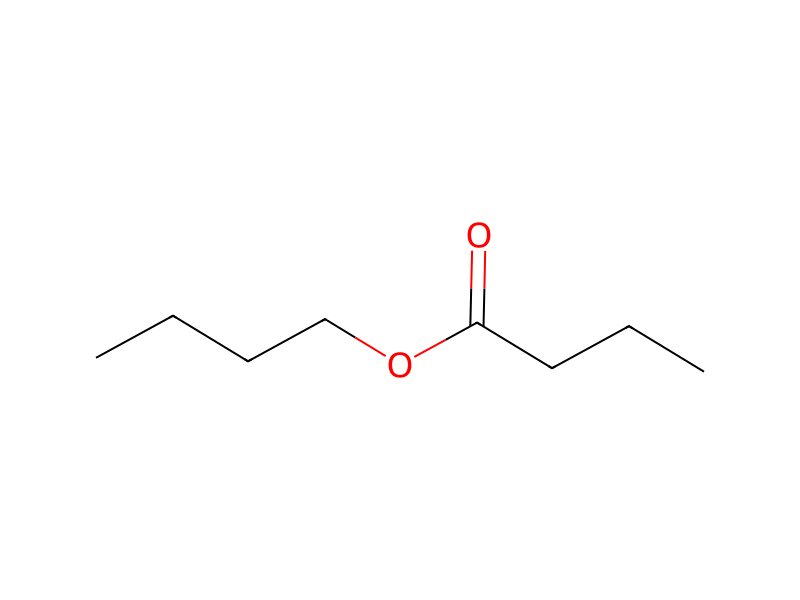
109-21-7CCCCOC(=O)CCCXUPYJHCZDLZNFP-UHFFFAOYSA-NButyl butyrate appears as a colorless liquid. Insoluble in water. A marine pollutant. Poses a threat to the aquatic environment. Immediate steps should be taken to prevent spread to the environment. May penetrate soils and contaminate groundwater and nearby waterways. Mildly irritates the eyes and skin.
109-21-7DTXSID7041702CHEBI:874290.872 at 68 °F (USCG, 1999) - Less dense than water; will float
0.867-0.871
0.872
0.872 @ 20°C
0.5 mg/mL at 20 °C
miscible with alcohol, ether, most vegetable oils; slightly soluble in propylene glycol, water
1 ml in 3 ml 70% alcohol (in ethanol)
128 °F (USCG, 1999)
128 °F
332 °F at 760 mmHg (USCG, 1999)
166.00 °C. @ 760.00 mm Hg
165 °C
332 °F
166 °C @760 [mm Hg]
-133 °F (USCG, 1999)
-91.5 °C
-133 °F
10.34 mmHg (USCG, 1999)
1.81 [mmHg]
10.34 mmHg
Sicherheitsangaben dienen nur zur Orientierung und ersetzen weder das Sicherheitsdatenblatt (SDB) des Lieferanten noch geltende Vorschriften oder eine fachliche Bewertung.
Warning
H226: Flammable liquid and vapor [Warning Flammable liquids]
P210, P233, P240, P241, P242, P243, P280, P303+P361+P353, P370+P378, P403+P235, and P501 (click each P-code to see the statement)
Warning
H226 (100%): Flammable liquid and vapor [Warning Flammable liquids]
P210, P233, P240, P241, P242, P243, P280, P303+P361+P353, P370+P378, P403+P235, and P501 (click each P-code to see the statement)
Chemical: Butanoic acid, butyl ester
Butanoic acid, butyl ester is listed on the EPA's Chemical Data Reporting (CDR) system. Manufacturers and importers of Butanoic acid, butyl ester are required to report information about their production and use of this chemical to the EPA under the Toxic Substances Control Act (TSCA). (40 eCFR Part 711)
REACH registered substance: Butyl butyrate (EC: 203-656-8)
Butyl butyrate: Does not have an individual approval but may be used under an appropriate group standard
A moderate skin irritant; [RTECS] A mild skin and eye irritant; [CAMEO] A skin and eye irritant; Inhalation or ingestion may cause headache, dizziness, nausea, vomiting, and narcosis; [CHRIS] A moderate eye, mucous membrane, and respiratory tract irritant; [OSHA] Safe when used as a flavoring agent in food; [JECFA] An irritant; Vapors may cause dizziness or suffocation; Narcotic in high concentrations; [Acros Organics MSDS]
BUTYL BUTYRATE reacts with acids to liberate heat along with butyl alcohol and butyric acid. Strong oxidizing acids may cause a vigorous reaction that is sufficiently exothermic to ignite the reaction products. Heat is also generated by interaction with caustic solutions. Flammable hydrogen is generated by mixing with alkali metals and hydrides. May attack some forms of plastics (USCG, 1999).
1 - Materials that, under emergency conditions, can cause significant irritation.
2 - Materials that must be moderately heated or exposed to relatively high ambient temperatures before ignition can occur. Materials would not under normal conditions form hazardous atmospheres with air, but under high ambient temperatures or under moderate heating could release vapor in sufficient quantities to produce hazardous atmospheres with air.
0 - Materials that in themselves are normally stable, even under fire conditions.
Flam. Liq. 3 (100%)
Flammable liquid - category 3
Flammable liquids - Category 3
Flam. Liq. 3
14 [mg/m3]
150 [mg/m3]
910 [mg/m3]
Fragrance Ingredients
Flavouring Agent -> FLAVOURING_AGENT -> JECFA Functional Classes
Flavoring Agents -> JECFA Flavorings Index
All Other Basic Organic Chemical Manufacturing
Butanoic acid, butyl ester: ACTIVE
OccurrenceReported found in fresh apple, apple juice, banana, orange juice, orange peel oil, melon, strawberry, Passiflora mollisima, soybean, honey and blue cheese.
VerwendenButyl butyrate can be used as a reactant to synthesize:N-(Phenylmethyl)butanamide by reacting with benzylamine via ester-amide exchange reaction in the presence of supported graphene oxide catalyst.Cyclohexyl butyrate by acylation reaction with cyclohexanol using a ruthenium pincer PNN complex catalyst.Butyl ether by triiron dodecacarbonyl catalyzed hydrosilylation reaction.
synthetischeBy passing vapors of n-butyl alcohol over MnO2 or ZnO at 400°C, also by passing vapors of n-butyl alcohol over CuO-VO at 180 to 200°C.
DefinitionChEBI: A butanoate ester of butan-1-ol.


