
N,N-Dimethyl-1,3-diaminopropan
N,N-Dimethyl-1,3-propanediamine
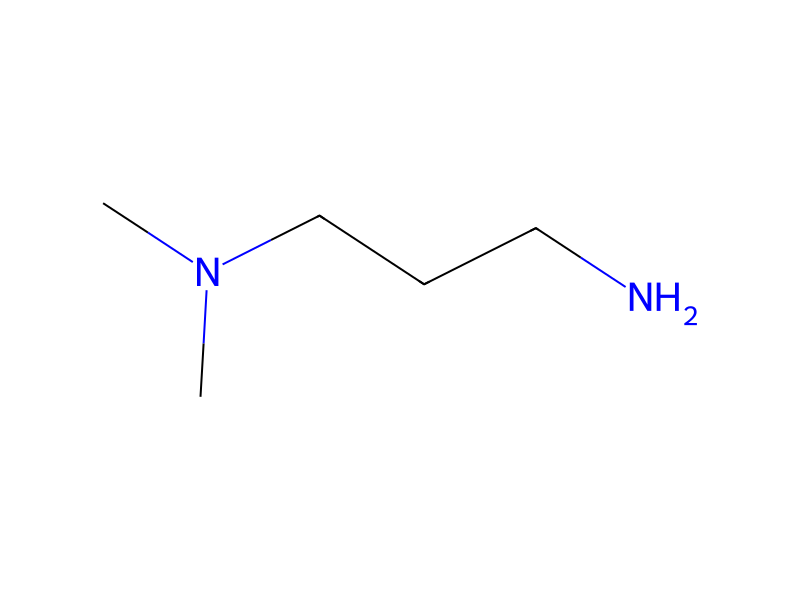
Grundinformationen
- CAS
109-55-7- Standard-SMILES
CN(C)CCCN- InChIKey
IUNMPGNGSSIWFP-UHFFFAOYSA-N- Summenformel
- C5H14N2
- Durchschnittliche Molmasse
- 102,18 g/mol
- Monoisotopische Masse
- 102,11569845
Überblick
Dimethylaminopropylamine is a colorless liquid. (NTP, 1992)
Namen und Bezeichner
- Bevorzugter Name
- N,N-Dimethyl-1,3-propanediamine
- IUPAC
- N',N'-dimethylpropane-1,3-diamine
- Lokaler Name
- N,N-Dimethyl-1,3-diaminopropan
- Englischer Name
- 3-Dimethylaminopropylamine
- Summenformel
- C5H14N2
- Molmasse
- 102.18
Namen und Synonyme
109-55-73-DimethylaminopropylamineN,N-DIMETHYL-1,3-PROPANEDIAMINE3-(Dimethylamino)propylamine3-(Dimethylamino)-1-propylamineN,N-Dimethyltrimethylenediamine1,3-Propanediamine, N,N-dimethyl-N,N-Dimethyl-1,3-propylenediamineN,N-Dimethyl-1,3-diaminopropaneN,N-Dimethylpropylenediamine3-(Dimethylamino)-1-propanamine1-(Dimethylamino)-3-aminopropane
Weitere Namen anzeigen
DMAPADIMETHYLAMINOPROPYLAMINEDMPDA3-Aminopropyldimethylamine3-DIMETHYLAMINO-1-PROPYLAMINEN,N-DimethylaminopropylamineFENTAMINE DMAPA3-Dimethylaminopopylamine
3-Amino-1-(dimethylamino)propane1-Amino-3-dimethylaminopropaneN,N-Dimethyl-N-(3-aminopropyl)amineDTXSID5025102Propylamine, 3-(N,N-dimethylamino)-gamma-(Dimethylamino)propylamineI98I2UEC03NSC-1067
Datenbank-Bezeichner
- CAS
109-55-7- PubChem CID
- 7993
- DTXSID
DTXSID5025102- ChEMBL
CHEMBL1232234- UNII
- I98I2UEC03
- EC Number
- 203-680-9
- Nikkaji
- J50.732F
Eigenschaften
Berechnete Struktureigenschaften
- XLogP
- -0,3
- Polarare Oberfläche (TPSA)
- 29,3 Ų
- H-Brücken-Donoren
- 1
- H-Brücken-Akzeptoren
- 2
- Frei drehbare Bindungen
- 3
- Schwere Atome
- 7
- Formalladung
- 0
- Komplexität
- 35,1
Experimentelle und physikochemische Eigenschaften
Chemical Classes
Nitrogen Compounds -> Amines, Aliphatic
Flammable agents - 3rd degree
SpringerMaterials PropertiesBoiling point
LogP-0.352
OdorAmmoniacal odor
Density
0.81 (NTP, 1992) - Less dense than water; will float
0.8100 @ 30 °C
Relative density (water = 1): 0.81
0.8100 @ 30°C
Viscosity1.1 cP
Color/FormColorless liquid
Solubility
Soluble (NTP, 1992)
Sol in water and org solvents
Soluble in oxygenated solvents
Solubility in water: miscible
Flash Point
60 °F (NTP, 1992)
[ICSC] 90 °F
95 °F CC
35 °C c.c.
Boiling Point
253 °F at 760 mmHg (NTP, 1992)
123 °C
135 °C
123 °C @760 [mm Hg]
DecompositionWhen heated to decomposition it emits toxic fumes of nitroxides.
Melting Point
less than -94 °F (NTP, 1992)
FP: -70 °C
Physikochemische Eigenschaften
- Schmelzpunkt
- -60 °C · -60 °C
- Siedepunkt
- 133 °C · 133 °C(lit.)
- Dichte
- 0.812 g/mL · 0.812 g/mL at 25 °C(lit.)
- Dampfdichte
- 3.6 · 3.6 (vs air)
- Dampfdruck
- 5 mm · 5 mm Hg ( 20 °C)
- Brechungsindex
- 20 · n20/D 1.435(lit.)
- Flammpunkt
- 90 °F · 90 °F
- storage temp.
- 30 °C · Store below +30°C.
- Aggregatzustand
- Liquid
- pka
- 10.13 · 10.13±0.10(Predicted)
- Farbe
- Clear
- Geruch (Odor)
- ammoniacal odor
- PH
- 12.7 · 12.7 (100g/l, H2O, 20℃)
- Explosionsgrenze
- 2.3 · 2.3-12.35%(V)
- Wasserlöslichkeit
- SOLUBLE
- BRN
- 605293 · 605293
- InChI
- 1S/C5H14N2/c1-7(2)5-3-4-6/h3-6H2,1-2H3
- InChIKey
- IUNMPGNGSSIWFP-UHFFFAOYSA-N
- SMILES
- CN(C)CCCN
- LogP
- -0.352 at · -0.352 at 25℃
- CAS Datenbank
- 109 · 109-55-7(CAS DataBase Reference)
- NIST chemische Informationen
- 1 · 1,3-Propanediamine, N,N-dimethyl-(109-55-7)
- EPA chemische Informationen
- 3 · 3-(Dimethylamino)propylamine (109-55-7)
Sicherheit und Regulatorisches
Sicherheitsangaben dienen nur zur Orientierung und ersetzen weder das Sicherheitsdatenblatt (SDB) des Lieferanten noch geltende Vorschriften oder eine fachliche Bewertung.
GHS-Klassifizierung
GHS Classification
Danger
H226: Flammable liquid and vapor [Warning Flammable liquids]
P210, P233, P240, P241, P242, P243, P260, P261, P264, P270, P272, P280, P301+P317, P301+P330+P331, P302+P352, P302+P361+P354, P303+P361+P353, P304+P340, P305+P354+P338, P316, P321, P330, P333+P317, P362+P364, P363, P370+P378, P403+P235, P405, and P501 (click each P-code to see the statement)
This chemical does not meet GHS hazard criteria for < 0.1% (1 of 1360) of reports.
Danger
H226 (> 99.9%): Flammable liquid and vapor [Warning Flammable liquids]
Gefahrenhinweise
Regulatory Information
Chemical: 1,3-Propanediamine, N,N-dimethyl-
1,3-Propanediamine, N1,N1-dimethyl- is listed on the EPA's Chemical Data Reporting (CDR) system. Manufacturers and importers of 1,3-Propanediamine, N1,N1-dimethyl- are required to report information about their production and use of this chemical to the EPA under the Toxic Substances Control Act (TSCA). (40 eCFR Part 711)
Status: Active Update: 11-07-2022 https://echa.europa.eu/registration-dossier/-/registered-dossier/14823
3-Dimethylaminopropylamine: Does not have an individual approval but may be used under an appropriate group standard
The New Jersey Worker and Community Right to Know Act requires public and private employers to provide information about hazardous substances at their workplaces. (N.J.S.A. 34:5A-1 et. seq.)
Other Safety InformationIMAP assessments - 1,3-Propanediamine, N,N-dimethyl-: Human health tier II assessment
DOT LabelCorrosive Flammable Liquid
Fire Hazards
This compound is flammable. (NTP, 1992)
Flammable. Gives off irritating or toxic fumes (or gases) in a fire. Above 35 °C explosive vapour/air mixtures may be formed.
Fire Potential
FLAMMABLE, MODERATE FIRE RISK.
Very flammable when exposed to heat, flame, or oxidizers.
Health HazardsSYMPTOMS: Symptoms of exposure to this compound include strong local irritation of tissue, lacrimation.
Hazards Summary
Occupational asthma reported in workers manufacturing skis; [Malo] Allergic contact dermatitis has been reported in workers handling epoxy resins or using products containing cocamidopropyl betaine. DMAPA is a contaminant in such products and the responsible allergen. [Kanerva, p. 1785] A corrosive substance that can cause pulmonary edema; A skin sensitizer; [ICSC] A lachrymator; [CHEMINFO]
Reactive GroupAmines, Phosphines, and Pyridines
EC ClassificationSymbol: C; R: 10-22-34-43; S: (1/2)-26-36/37/39-45
UN ClassificationUN Hazard Class: 8; UN Subsidiary Risks: 3; UN Pack Group: II
Reactivity AlertsHighly Flammable
Reactivity Profile
DIMETHYLAMINOPROPYLAMINE neutralizes acids in exothermic reactions to form salts plus water. May be incompatible with isocyanates, halogenated organics, peroxides, phenols (acidic), epoxides, anhydrides, and acid halides. Flammable gaseous hydrogen may be generated in combination with strong reducing agents, such as hydrides.
Sicherheit und Schutzausrüstung
Fire Fighting
This compound is not very flammable but any fire involving this compound may produce dangerous vapors. You should evacuate the area. All firefighters should wear full-body protective clothing and use self-contained breathing apparatuses. You should extinguish any fires involving this chemical with a dry chemical, carbon dioxide, foam, or halon extinguisher. (NTP, 1992)
Use water spray, powder, carbon dioxide, alcohol-resistant foam. In case of fire: keep drums, etc., cool by spraying with water.
First Aid Measures
Fresh air, rest. Half-upright position. Refer for medical attention.
Remove contaminated clothes. Rinse skin with plenty of water or shower. Refer for medical attention .
First rinse with plenty of water for several minutes (remove contact lenses if easily possible), then refer for medical attention.
Rinse mouth. Do NOT induce vomiting. Give one or two glasses of water to drink. Refer for medical attention .
First Aid
EYES: First check the victim for contact lenses and remove if present. Flush victim's eyes with water or normal saline solution for 20 to 30 minutes while simultaneously calling a hospital or poison control center. Do not put any ointments, oils, or medication in the victim's eyes without specific instructions from a physician. IMMEDIATELY transport the victim after flushing eyes to a hospital even if no symptoms (such as redness or irritation) develop.
Safe StorageFireproof. Separated from strong oxidants, strong acids and food and feedstuffs. Well closed.
Fire Fighting ProceduresTo fight fire, use alcohol foam, carbon dioxide, dry chemical.
Nonfire Spill Response
SMALL SPILLS AND LEAKAGE: If you should spill this chemical, use absorbent paper to pick up all liquid spill material. Seal the absorbent paper, as well as any of your clothing which may be contaminated, in a vapor-tight plastic bag for eventual disposal. Wash any surfaces you may have contaminated with a strong soap and water solution. Do not reenter the contaminated area until the Safety Officer (or other responsible person) has verified that the area has been properly cleaned.
Disposal Methods
SRP: At the time of review, criteria for land treatment or burial (sanitary landfill) disposal practices are subject to significant revision. Prior to implementing land disposal of waste residue (including waste sludge), consult with environmental regulatory agencies for guidance on acceptable disposal practices.
Spillage Disposal
Ventilation. Collect leaking and spilled liquid in sealable containers as far as possible. Wash away remainder with plenty of water. Personal protection: chemical protection suit including self-contained breathing apparatus. Do NOT let this chemical enter the environment.
Preventive Measures
A) PREVENT CONTACT WITH ALIPHATIC AMINES ... PROCESS THEM IN CLOSED VESSELS. B) ... USE SUITABLE BARRIER CREAMS /ON HANDS/. C) DECR CONCN OF ... VAPORS BY GOOD VENTILATION ... AMINES WITH HEAVY VAPORS ... SHOULD BE DRAWN OFF BY DESCENT. /ALIPHATIC AMINES/
SRP: The scientific literature for the use of contact lenses in industry is conflicting. The benefit or detrimental effects of wearing contact lenses depend not only upon the substance, but also on factors including the form of the substance, characteristics and duration of the exposure, the uses of other eye protection equipment, and the hygiene of the lenses. However, there may be individual substances whose irritating or corrosive properties are such that the wearing of contact lenses would be harmful to the eye. In those specific cases, contact lenses should not be worn. In any event, the usual eye protection equipment should be worn even when contact lenses are in place.
Isolation and EvacuationExcerpt from ERG Guide 132 [Flammable Liquids - Corrosive]:
Eye PreventionWear face shield or eye protection in combination with breathing protection.
Fire PreventionNO open flames, NO sparks and NO smoking. Above 35 °C use a closed system, ventilation and explosion-proof electrical equipment.
Toxikologische Informationen
Adverse EffectsDermatotoxin - Skin burns.
Exposure RoutesThe substance can be absorbed into the body by inhalation of its vapour, through the skin and by ingestion.
Signs and Symptoms
Sore throat. Cough. Burning sensation. Shortness of breath. Laboured breathing. Symptoms may be delayed.
Pain. Redness. Serious skin burns.
Pain. Blurred vision. Severe deep burns.
Burning sensation. Abdominal pain. Shock or collapse.
ICSC Environmental DataThe substance is harmful to aquatic organisms.
Medical SurveillanceD) EMPLOYEES PRONE TO SENSITIZATION OR WITH LIVER DEFICIENCY SHOULD BE REMOVED FROM ... /EXPOSURE/. WORKMEN ... SHOULD BE MEDICALLY EXAMINED AT REGULAR INTERVALS. /ALIPHATIC AMINES/
TSCA Test Submissions
3-Dimethylaminopropylamine (CAS # 109-55-7) was evaluated for subchronic oral toxicity in groups of Wistar rats (5/sex/group) administered doses of 0, 10, 50, and 250 mg/kg-day by oral gavage for 28 days. Due to a high rate of mortality (3/5) among the 250 mg/kg females during the initial study, a second trial in 5 female rats receiving 250 mg/kg was conducted with data combined for 10 high-dose females. All animals were necropsied on the 29th day of study. Females of the high dose group only (4/10) died during the 28-day treatment period. Clinical signs, observed intermittently in this group between study days 11 and 24 and mainly among the intercurrent decedents, included hypoactivity, stilted gait, swollen abdomen, and labored breathing. A solitary high-dose male demonstrated impaired respiration. Bodyweights, organ weights, food and water consumption, urinalyses, and hematological and clinical chemistry evaluations did not deviate significantly from those of controls in any dose group. Upon necropsy, discolored lungs with surface red spots and foamy content, and a solitary small spleen characterized the gross pathology, identified solely in the decedent females. Microscopic examination revealed distinct lesions among these animals, which included organ congestion, hemorrhagic and/or edematous lungs, and profound loss and atrophy of splenic lymphatic follicles and lymphoid sheath, respectively. One symptomatic male of a 250 mg/kg dose group exhibited focal epithelial degeneration of the forestomach which authors claimed was likely due to an irritative effect of the compound.
N,N-Dimethyl-1,3-propanediamine (CAS # 109-55-7) was evaluated for dermal sensitization in 15 female Hartley guinea pigs by maximization test. Induction consisted of 3 pairs of 0.1 mL intradermal injections flanking the dorsal midline upon the clipped shoulder area, the respective twin injections including a 1-5% v/v solution in distilled water (unspecified pretest concentration that produces neither local or systemic reactions), a 1-5% v/v solution in Freunds Complete Adjuvant (FCA), and FCA alone. Following the 7-day induction, 48-hour challenge was administered with a 0.3 mL topical application of 1% solution in distilled water under occluded patch covering the entire test area. A second 48-hour challenge was performed 21 days later with a 0.3 mL topical application of 5% solution and another of vehicle alone, each on either side of the dorsal midline to cover triplet test sites. Although pretest irritation results were not provided, the authors concluded that positive reaction in 93% (14/15) of the test animals, relative to 0% response (0/6) in the vehicle/FCA control group and 100% response in the dinitrochlorobenzene (positive control) group following 5% N,N-dimethyl-1,3-propanediamine second challenge, established a maximization grading of "extreme" sensitization.
Human Toxicity Excerpts
... VAPOR HAS CAUSED CORNEAL DISTURBANCE & BLURRED VISION. WORKERS EXPOSED TO CONCN THOUGHT TO BE ABOUT 30 PPM IN AIR NOTED DURING SEVERAL DAYS THAT VISION BECAME BLURRED TOWARD END OF WORK DAY, SOMETIMES WITH APPEARANCE OF HALOES AROUND LIGHTS, PAIN, PHOTOPHOBIA & HEADACHE, USUALLY BETTER BY NEXT DAY.
IN THREE WORKERS WHO HAD SYMPTOMS PERSISTING TWO TO THREE DAYS AFTER EXPOSURE, THE CORNEAL EPITHELIUM WAS SEEN TO BE EDEMATOUS, BUT NO OTHER OCULAR ABNORMALITIES WERE OBSERVED.
DURING 1974 A GROUP OF 25 WORKERS WERE EXPOSED TO AN EPOXY RESIN SYSTEM IN MOLD ROOM OF SKI MFR PLANT. 3-DIMETHYLAMINO PROPYLAMINE (3-DMAPA) WAS ONLY VOLATILIZED SUBSTANCE. ASSEMBLERS (A SUBGROUP) IN HIGHEST BREATHING ZONE (0.9 PPM) HAD HIGHEST PREVELANCE OF SYMPTOMS & SIGNIFICANT DECR IN LUNG FUNCTION OVER WORKSHIFT. EXTENSIVE IMPROVEMENTS IN LOCAL VENTILATION REDUCED AVG BREATHING ZONE EXPOSURE TO NEARLY 1/7 OF CONCN. CROSS-SECTIONAL STUDY IN 1977 SHOWED THAT AT THIS LEVEL THERE WAS MARKED REDUCTION IN SYMPTOMS & EXPIRATORY FUNCTION OF ASSEMBLERS NO LONGER DECR OVER WORKSHIFT. LONGITUDINAL COMPARISON OF LUNG FUNCTION OF WORKERS EXPOSED MORE THAN 2 YR SHOWED EVIDENCE OF DECR FROM 1975 TO 1977, BUT NONE FROM 1977 TO 1978.
TOXIC BY INGESTION & INHALATION, STRONG IRRITANT.
For more Human Toxicity Excerpts (Complete) data for N,N-DIMETHYL-1,3-PROPANEDIAMINE (8 total), please visit the HSDB record page.
Environmental Biodegradation
WASTEWATERS FROM PETROLEUM CHEM PLANTS & OIL REFINERIES CONTAIN N,N-DIMETHYL-1,3-PROPANEDIAMINE. IN RELATION TO PURIFICATION OF WASTEWATER CONTAINING THIS COMPD, CONCN SOLN WERE OBTAINED IN LAB. BIOLOGICAL OXIDIZABILITY (BO) WAS DETERMINED AS RATIO BOD20/COD. BIOLOGICAL TREATMENT SCHEME IS DESCRIBED THROUGH USE OF ACTIVATED SLUDGE IN AERATION LAGOONS. DURING BIODEGRADATION, INCR IN CONTENT OF NH3-N WAS OBSERVED WHICH IS ALSO USED IN STABILIZATION OF PH. BIOLOGICAL OXIDIZABILITY OVER WIDE PH INTERVAL IS RELATED TO CONCN IN ORIGINAL WASTEWATER. MAX CONTENTS NOT AFFECTING BIOLOGICAL OXIDIZABILITY UNDER OPTIMUM CONDITIONS WAS 800 MG/L (COD 2.14 G O2/L); AFTER BIOLOGICAL OXIDATION IT WAS REDUCED TO 16.4 MG/L.
Non-Human Toxicity Excerpts
A 1:100 AQUEOUS SOLN AT PH 12 ... CAUSED SEVERE ALKALI-TYPE CORNEAL INJURY IN RABBITS, BUT 1:100000 SOLN AT PH 7.6 CAUSED ALMOST NO INJURY.
3-Dimethylaminopropylamine was evaluated for mutagenicity in the Salmonella/microsome preincubation assay using a standard protocol approved by the National Toxicology Program. DMP doses of 0, 33, 100, 333, 1000, 1666, 3333, 6666, and 10,000 ug/plate were tested in four Salmonella typhimurium strains (TA98, TA100, TA1535, and TA1537) in the presence and absence of Aroclor-induced rat or hamster liver S9. These tests were negative and the highest ineffective dose level tested in all four Salmonella tester strains under all treatment conditions was 3333 ug/plate. A slight clearing of the background lawn was reported at this dose level when tested in the presence of hamster liver S9. Data were not shown for all four strains with the two highest dose levels.
Non-Human Toxicity ValuesLD50 Rabbit skin 600 ul/kg
Sicherheitsdaten
- wgk
- 2
- tsca
- TSCA listed
- ridadr
- UN 2733 3/PG 3
- hs_code
- 29212900
- RTECS-Nr.
- TX7525000
- risk_code
- 10-22-34-43-21/22
- Toxizität
- LD50 orally in Rabbit: 1640 mg/kg
- hazard_code
- C
- safety_code
- 26-36/37/39-45
- hazard_class
- 8
- packing_group
- II
- Speicherklasse
- 3 - Flammable liquids
- Giftige Stoffe Daten
- 109-55-7(Hazardous Substances Data)
- Hazard Classifications
- Acute Tox. 4 DermalAcute Tox. 4 OralEye Dam. 1Flam. Liq. 3Skin Corr. 1BSkin Sens. 1STOT SE 3
- Selbstentzündungstemperatur
- 215 °C
Chemie und Industrie
Verwendung und Herstellung
Uses
Used as curing agent for epoxy resins and polyurethanes; used as chemical intermediate in the production of surface active agents for water treatment, motor oil additives, fabric softeners, etc. [HSDB]
Sewer and Wastewater Treatment [Category: Industry]
Used as a chemical intermediate in the synthesis of Basic Blue 22; behenamidopropyldimethylamine; cocoamidopropyldimethylamine; dimethylaminopropyl methacrylamide; isostearamidopropyldimethylamine; lauramidopropyldimethylamine; myristylamidopropyldimethylamine; oleamidopropyldimethylamine; propamocarb; stearamidopropyldimethylamine; tallowamidopropyldimethylammonium-3-sulfopropyl betaine; N,N',N"-tris-(dimethylaminopropyl)hexahydro-1,3,5-triazine
Corrosion inhibitor (aviation gasoline); cold-cured epoxy resin curing agent
Surfactants, liquid soaps, water treatment
U.S. Production
2023: 70,000,000 - <85,000,000 lb
(1979) PROBABLY GREATER THAN 2.27X10+6 GRAMS
(1981) PROBABLY GREATER THAN 4.54X10+6 GRAMS
Consumer UsesNot Known or Reasonably Ascertainable
Industry UsesSurfactant (surface active agent)
Methods of ManufacturingProduction: dimethylamine + acrylonitrile (cyanoethylation/nitrile reduction)
Household ProductsInformation on 3 consumer products that contain 3-(Dimethylamino)propylamine in the following categories is provided:
General Manufacturing Information
Paint and Coating Manufacturing
1,3-Propanediamine, N1,N1-dimethyl-: ACTIVE
ANTITHROMBOGENIC MATERIAL IS PRODUCED BY TREATING POLYAMIDES WITH NONSYMMETRIC ALKYLDIAMINES, FOLLOWED BY QUATERNIZATION WITH ALKYL HALIDES & TREATMENT WITH ANIONIC ANTITHROMBOGENIC COMPOUNDS. PRODUCT IS SUITABLE FOR MAKING SURGICAL PROSTHETICS.
HIGHLY PURIFIED ALBUMINS ARE OBTAINED IN IMPROVED YIELDS FROM DIL BLOOD SERUM OR PLASMA BY NEARLY QUANTITATIVE ADSORPTION OF PROTEIN FRACTION BY A POLYELECTROLYTE POLYMER RESIN. THE RESIN IS PREPD BY COPOLYMERIZATION OF 1:1 ETHYLENE-MALEIC ANHYDRIDE & POST-TREATMENT WITH DIMETHYLAMINOPROPYLAMINE. PREPN ARE USEFUL IN SHOCK THERAPY & AS PLASMA EXPANDERS.
Anwendungen
BeschreibungDimethylaminopropylamine is an aliphatic amine present in amphoteric surfactants such as liquid soaps and shampoos. It is present as an impurity responsible for allergy from cocamidopropylbetaine. It is structurally similar to diethylaminopropylamine. It is also used as a curing agent for epoxy res ins and as an organic intermediate in chemical syntheses (ion exchangers, additives for flocculants, cosmetics and fuel additives, dyes and pesticides).
VerwendenN,N-Dimethyl-1,3-propylenediamine is a useful catalyst for Knoevenagel condensation. It is also a useful hardening agent for expoxy resin.
Vor- und nachgelagerte Produkte
Vorgelagerte Rohstoffe
Nachgelagerte Produkte
Zugehörige Reaktionen
616




Notizen zur Verbindung
Wird geladen…