Propyl chloroformate
NPCF · propyl carbonochloridate · N-PROPYL CHLOROFORMATE · PROPYL CHLOROCARBONATE · chloro-formicacipropylester · Propyl chloroforMat · PROPYL CHLOROFORMATE · Proply chloroformate
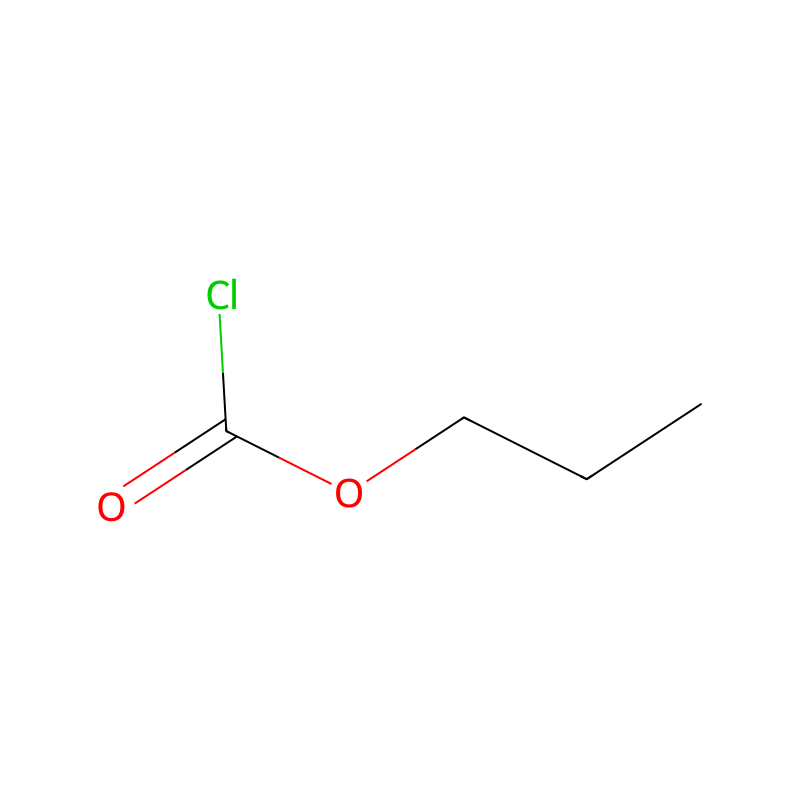
Identifikatoren & physikalische Daten
| CAS No. | 109-61-5 |
|---|---|
| Summenformel | C4H7ClO2 |
| Durchschnittliche Molmasse | 122,55 g/mol |
| Monoisotopische Masse | 122,01345714 g/mol |
| SMILES | CCCOC(=O)Cl |
| InChIKey | QQKDTTWZXHEGAQ-UHFFFAOYSA-N |
| PubChem CID | 7998 |
| EC No. | 203-687-7 |
| DTXSID | DTXSID3042342 |
| Lokaler Name | n-Propylchlorformiat |
Chemische & physikalische Eigenschaften
| XLogP | 2,3 |
|---|---|
| Polarare Oberfläche (TPSA) | 26,3 |
| H-Brücken-Donoren | 0 |
| H-Brücken-Akzeptoren | 2 |
| Frei drehbare Bindungen | 3 |
| Schwere Atome | 7 |
| Formalladung | 0 |
| Komplexität | 62,7 |
| Stoffklassen | Toxic Gases & Vapors -> Acid HalidesFlammable agents - 3rd degree |
| SpringerMaterials Properties | Dielectric constant |
| LogP (Verteilungskoeffizient) | 1.12 |
| Dichte | 1.09 at 68 °F (EPA, 1998) - Denser than waterwill sink1.091 AT 20 °C/4 °C1.09 g/cm³Relative density of the vapour/air-mixture at 20 °C (air = 1): 1.061.09 @25 °C1.09 g/mL at 25 °C(lit.) |
| Viscosity | 0.80 cP @ 20 °C |
| Color/Form | COLORLESS LIQUID |
| Löslichkeit | MISCIBLE WITH BENZENE, CHLOROFORM, ETHERInsoluble in waterSolubility in water: reactionbenzene: miscible(lit.) |
| Flammpunkt | -58 °F (EPA, 1998)-50 °C (-58 °F)26 °C c.c.84 °F |
| Siedepunkt | 237 to 241 °F at 760 mmHg (EPA, 1998)112.4 °C115 °C105-106 °C(lit.) |
| Dampfdichte | 4.2 (EPA, 1998) - Heavier than airwill sink (Relative to Air)4.2 (AIR= 1)Relative vapor density (air = 1): 4.23 |
| Dampfdruck | 20.0 [mmHg]20 mm Hg @ 25.3 °CVapor pressure, kPa at 20 °C: 2.60.87 psi ( 20 °C) |
| Brechungsindex | INDEX OF REFRACTION: 1.4045 @ 20 °Cn20/D 1.404(lit.) |
| Lagerbedingungen | 2-8°C |
| Aggregatzustand | Oil |
| Farbe | Colourless |
| Wichte | 1.09 |
| Merck | 13,7940 |
| Dielektrizitätskonstante | 11.2(20℃) |
| Stabilität | Volatile |
| InChIKey | QQKDTTWZXHEGAQ-UHFFFAOYSA-N |
| LogP (Verteilungskoeffizient) | 1.385 (est) |
| CAS Datenbank | 109-61-5(CAS DataBase Reference) |
| NIST chemische Informationen | n-Propylchloroformate(109-61-5) |
| EPA chemische Informationen | Propyl chloroformate (109-61-5) |
Sicherheit & Vorschriften
| GHS-Einstufung | DangerH225: Highly Flammable liquid and vapor [Danger Flammable liquids]P210, P233, P240, P241, P242, P243, P260, P261, P264, P271, P280, P301+P330+P331, P302+P361+P354, P303+P361+P353, P304+P340, P305+P354+P338, P316, P321, P363, P370+P378, P403+P233, P403+P235, P405, and P501 (click each P-code to see the statement)H225 (100%): Highly Flammable liquid and vapor [Danger Flammable liquids]P210, P233, P240, P241, P242, P243, P260, P261, P264, P264+P265, P270, P271, P280, P284, P301+P317, P301+P330+P331, P302+P361+P354, P303+P361+P353, P304+P340, P305+P354+P338, P316, P317, P320, P321, P330, P363, P370+P378, P403+P233, P403+P235, P405, and P501 (click each P-code to see the statement) |
|---|---|
| Hazards Identification | Toxic/poison by inhalation (TIH/PIH) |
| Regulatorische Informationen | Status: Active Update: 05-10-2022 https://echa.europa.eu/registration-dossier/-/registered-dossier/1891Carbonochloridic acid, propyl ester: Does not have an individual approval but may be used as a component in a product covered by a group standard. It is not approved for use as a chemical in its own right.The New Jersey Worker and Community Right to Know Act requires public and private employers to provide information about hazardous substances at their workplaces. (N.J.S.A. 34:5A-1 et. seq.) |
| DOT-Kennzeichnung | Poison Inhalation Hazard Flammable Liquid Corrosive |
| Brandgefahren | When heated to decomposition, it emits toxic fumes of chlorine containing compounds. Propyl chloroformate is a flammable/combustible materialit may be ignited by heat, sparks or flames. Vapors may travel to a source of ignition and flash back. Container may explode in heat or fire. Vapor explosion and poison hazard indoors, outdoors or in sewers. Runoff to sewer may create fire or explosion hazard. Runoff from fire control or dilution water may cause pollution. Gradually decomposed by water and alcohol. Unstable, decomposes spontaneously to form hydrochloric acid and other products. Avoid moist air. (EPA, 1998)· HIGHLY FLAMMABLE: Will be easily ignited by heat, sparks or flames.Flammable. Gives off irritating or toxic fumes (or gases) in a fire. Above 26 °C explosive vapour/air mixtures may be formed. |
| Gesundheitsgefahren | Strongly irritating to eyes and mucous membranes. Poisonousmay be fatal if inhaled, swallowed or absorbed through skin. (EPA, 1998)· TOXIC and/or CORROSIVEinhalation, ingestion or contact (skin, eyes) with vapors, dusts or substance may cause severe injury, burns or death. |
| Gefahrenübersicht | A corrosive substance that can cause injury to the skin, eyes, and respiratory tractInhalation can cause pulmonary edema[ICSC] A strong eye and mucous membrane irritant[HSDB] See CHLOROFORMATES. |
| DOT-Nummer und Handbuch | 2740 155 |
| Reaktive Gruppe | Acyl Halides, Sulfonyl Halides, and Chloroformates |
| EG-Einstufung | Symbol: TR: 10-23-34S: (1/2)-26-36-45 |
| UN-Einstufung | UN Hazard Class: 6.1UN Subsidiary Risks: 3 and 8UN Pack Group: I |
| Reactivity Alerts | Highly Flammable |
| Reactivity Profile | Unstable, decomposes spontaneously to form hydrochloric acid and other products. Avoid moist air. [EPA, 1998]. May react vigorously or explosively if mixed with diisopropyl ether or other ethers in the presence of trace amounts of metal salts [J. Haz. Mat., 1981, 4, 291]. |
| Brandbekämpfung | Keep unnecessary people awayisolate hazard area and deny entry. Stay upwindkeep out of low areas. Wear positive pressure breathing apparatus and special protective clothing. Isolate for 1/2 mile in all directions if tank car or truck is involved in fire.NO water. Use dry powder, carbon dioxide, alcohol-resistant foam. In case of fire: keep drums, etc., cool by spraying with water. NO direct contact with water. |
| Erste-Hilfe-Maßnahmen | Fresh air, rest. Half-upright position. Artificial respiration may be needed. Refer for medical attention.Remove contaminated clothes. Rinse skin with plenty of water or shower. Refer for medical attention .First rinse with plenty of water for several minutes (remove contact lenses if easily possible), then refer for medical attention.Rinse mouth. Do NOT induce vomiting. Give one or two glasses of water to drink. Refer for medical attention . |
| Freisetungsmaßnahmen | · CALL 911. Then call emergency response telephone number on shipping paper. If shipping paper not available or no answer, refer to appropriate telephone number listed on the inside back cover.· ELIMINATE all ignition sources (no smoking, flares, sparks or flames) from immediate area. |
| Erste Hilfe | Warning: Propyl chloroformate is strongly irritating to eyes and mucous membranes. Caution is advised.General First Aid: |
| Sichere Lagerung | Fireproof. Provision to contain effluent from fire extinguishing. Separated from acids, alcohols, amines, bases, oxidants and food and feedstuffs. Dry. Well closed. Store in an area without drain or sewer access. |
| Expositionsschutz und Persönliche Schutzausrüstung | · Wear positive pressure self-contained breathing apparatus (SCBA).TIH (Toxic Inhalation Hazard) - Term used to describe gases and volatile liquids that are toxic when inhaled. Some are TIH materials themselves, e.g., chlorine, and some release TIH gases when spilled in water, e.g., chlorosilanes. [ERG 2016]. |
| Brandbekämpfungsverfahren | If material on fire or involved in fire: Do not extinguish fire unless flow can be stopped. Use water in flooding quantities as fog. Solid streams of water may be ineffective. Apply water from as far a distance as possible. Use "alcohol" foam, carbon dioxide or dry chemical. Keep run-off water out of sewers and water sources. |
| Lagerbedingungen | OWING TO THE FACT THAT THESE COMPOUNDS DECOMP EASILY, STORAGE CONTAINERS SHOULD BE VENTED. /CHLOROFORMATES/ |
| Freisetung ohne Brand | Excerpt from ERG Guide 155 [Substances - Toxic and/or Corrosive (Flammable / Water-Sensitive)]: |
| Verschüttetes entsorgen | Evacuate danger area! Consult an expert! Personal protection: chemical protection suit including self-contained breathing apparatus. Do NOT let this chemical enter the environment. Collect leaking and spilled liquid in sealable dry plastic containers as far as possible. Absorb remaining liquid in dry sand or inert absorbent. Then store and dispose of according to local regulations. |
| Preventive Measures | SRP: The scientific literature for the use of contact lenses in industry is conflicting. The benefit or detrimental effects of wearing contact lenses depend not only upon the substance, but also on factors including the form of the substance, characteristics and duration of the exposure, the uses of other eye protection equipment, and the hygiene of the lenses. However, there may be individual substances whose irritating or corrosive properties are such that the wearing of contact lenses would be harmful to the eye. In those specific cases, contact lenses should not be worn. In any event, the usual eye protection equipment should be worn even when contact lenses are in place. |
| Isolation and Evacuation | Excerpt from ERG Guide 155 [Substances - Toxic and/or Corrosive (Flammable / Water-Sensitive)]:Immediate precautionary measureSmall spill: |
| Unerwünschte Wirkungen | Dermatotoxin - Skin burns. |
| Expositionspfade | The substance can be absorbed into the body by inhalation of its vapour and by ingestion. |
| Signs and Symptoms | Sore throat. Burning sensation. Cough. Laboured breathing. Shortness of breath. Symptoms may be delayed.Redness. Pain. Skin burns.Redness. Pain. Severe deep burns.Abdominal pain. Burning sensation. Shock or collapse. |
| ICSC Environmental Data | The substance is toxic to aquatic organisms. |
| Human Toxicity Excerpts | THE VAPORS ARE STRONGLY IRRITATING TO THE EYES & MUCOUS MEMBRANES. |
| Toxicity Data | LC50 (mice) = 319 ppm/1h |
| CERCLA-Meldepflichtmengen | Releases of CERCLA hazardous substances are subject to the release reporting requirement of CERCLA section 103, codified at 40 CFR part 302, in addition to the requirements of 40 CFR part 355. Propyl chloroformate is an extremely hazardous substance (EHS) subject to reporting requirements when stored in amounts in excess of its threshold planning quantity (TPQ) of 500 lbs. |
| DHS Chemicals of Interest (COI) | Propyl chloroformate1.0010,000Flammable chemical that can be released at a facility. |
| Wassergefährdungsklasse (WGK) | 1 |
| TSCA-Inventar-Status | TSCA listed |
| UN-Transportnummer | UN 2740 |
| Zollcode | 29151300 |
| RTECS-Nr. | LQ6830000 |
| R-Sätze (R) | 10-23-34-22-11 |
| Toxizität | mouse,LC50,inhalation,319ppm/1H (319ppm),"Kirk-Othmer Encyclopedia of Chemical Technology," 3rd ed., Grayson, M., and D. Eckroth, eds. New York, John Wiley & Sons, Inc., 1978Vol. 4, Pg. 758, 1978. |
| Gefahrensymbole | T,F |
| Sicherheitshinweise (S) | 26-36-45-16 |
| Gefahrenklasse | 6.1 |
| Verpackungsgruppe | I |
| Gefahrstoffdaten | 109-61-5(Hazardous Substances Data) |
Anwendungen & Verwendung
Verwenden
Propyl Chloroformate is used as a dramatizing agent for the determination of morphine, codeine and 6-acetyl morphine in urine and blood using direct aqueous derivatization.
Herstellung & Synthese
synthetische
Synthesis of Propyl chloroformate: Add n-propanol to the phosgene-passing kettle, start stirring, and then pass phosgene through the phosgene flowmeter. The phosgene-passing temperature is about 30 °C, and continue to pass the phosgene for several hours. When the end point is approached, sample and analyze, and stop when the standard is reached. Pass phosgene, cool, and then pass nitrogen to drive away phosgene and hydrogen chloride, destroy phosgene, and sample and analyze it as a product. Reaction equation: CH3CH2CH2OH+COCl2→ClCOOCH2CH2CH3