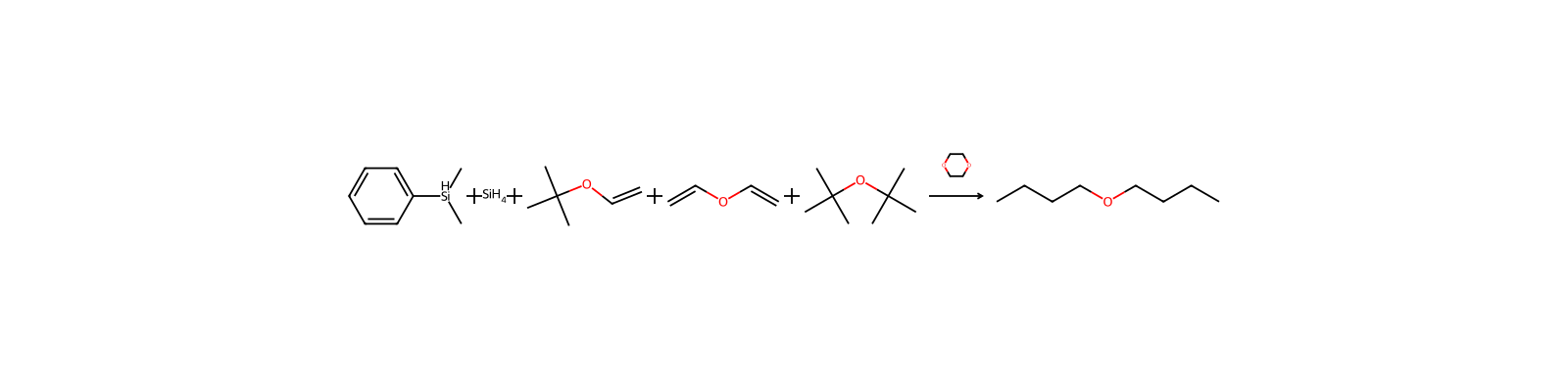

Grundinformationen
- Standard-SMILES
C=COC=C- InChIKey
QYKIQEUNHZKYBP-UHFFFAOYSA-N- Summenformel
- C4H6O
- Durchschnittliche Molmasse
- 70,09 g/mol
- Monoisotopische Masse
- 70,04186481
Namen und Bezeichner
- Bevorzugter Name
- Vinyl ether
- IUPAC
- ethenoxyethene
- Lokaler Name
- Divinylether
- Englischer Name
- Vinyl ether
- Summenformel
- C4H6O
- Molmasse
- 70.09
Namen und Synonyme
Vinyl etherDIVINYL ETHERDivinyl oxideEthenyloxyethene109-93-3Ether, divinyl(ethenyloxy)ethene2H2T044E11ether, vinylRefChem:194318203-720-5ethenoxyethene
Weitere Namen anzeigen
(vinyloxy)ethenevinyloxyethylene1,1'-oxybisethene
VinetherVinidylVinydanVinestheneVinesthesinVinethenVinetheneEthene, 1,1'-oxybis-
Datenbank-Bezeichner
- CAS
109-93-3- PubChem CID
- 8024
- DTXSID
DTXSID5074555- ChEMBL
CHEMBL2105883- ChEBI
CHEBI:81293- UNII
- 2H2T044E11
- EC Number
- 203-720-5
- Nikkaji
- J2.441D
Eigenschaften
Berechnete Struktureigenschaften
- XLogP
- 1,3
- Polarare Oberfläche (TPSA)
- 9,2 Ų
- H-Brücken-Donoren
- 0
- H-Brücken-Akzeptoren
- 1
- Frei drehbare Bindungen
- 2
- Schwere Atome
- 5
- Formalladung
- 0
- Komplexität
- 32
Experimentelle und physikochemische Eigenschaften
Flash Pointless than -22 °F (NFPA, 2010)
Physical Description
Divinyl ether, stabilized appears as a clear colorless liquid with a characteristic odor. Less dense than water. Vapors heavier than air. Toxic by inhalation.
Colorless liquid; [CAMEO]
Kovats Retention Index480
Physikochemische Eigenschaften
- Schmelzpunkt
- -101.1 °C · -101.1°C
- Siedepunkt
- 28.4 ° · bp 28.4°
- Dichte
- 2020 · d2020 0.774; d420 0.773
- Brechungsindex
- 20 · nD20 1.3989
- Wasserlöslichkeit
- 5.25 g/L · 5.25g/L(37 ºC)
- Henry's Law Constant
- 5.4 · 5.4×10-4 mol/(m3Pa) at 25℃, Steward et al. (1973)
- Dielectric constant
- 3.9 · 3.9(20℃)
- EPA chemische Informationen
- 1 · Ethene, 1,1'-oxybis- (109-93-3)
Sicherheit und Regulatorisches
Gefahrenhinweise
Regulatory InformationThe New Jersey Worker and Community Right to Know Act requires public and private employers to provide information about hazardous substances at their workplaces. (N.J.S.A. 34:5A-1 et. seq.)
DOT LabelFlammable Liquid
Fire Hazards
Excerpt from ERG Guide 128 [Flammable Liquids (Water-Immiscible); polymerization hazard]:;HIGHLY FLAMMABLE: Will be easily ignited by heat, sparks or flames. Vapors may form explosive mixtures with air. Vapors may travel to source of ignition and flash back. Most vapors are heavier than air. They will spread along the ground and collect in low or confined areas (sewers, basements, tanks, etc.). Vapor explosion hazard indoors, outdoors or in sewers. Those substances designated with a (P) may polymerize explosively when heated or involved in a fire. Runoff to sewer may create fire or explosion hazard. Containers may explode when heated. Many liquids will float on water. Substance may be transported hot. For hybrid vehicles, ERG Guide 147 (lithium ion or sodium ion batteries) or ERG Guide 138 (sodium batteries) should also be consulted. If molten aluminum is involved, refer to ERG Guide 169. (ERG, 2024)
· HIGHLY FLAMMABLE: Will be easily ignited by heat, sparks or flames.;· Vapors may form explosive mixtures with air.;· Vapors may travel to source of ignition and flash back.;· Most vapors are heavier than air. They will spread along the ground and collect in low or confined areas (sewers, basements, tanks, etc.).;· Vapor explosion hazard indoors, outdoors or in sewers.;· Those substances designated with a (P) may polymerize explosively when heated or involved in a fire.;· Runoff to sewer may create fire or explosion hazard.;· Containers may explode when heated.;· Many liquids will float on water.;· Substance may be transported hot.;· For hybrid vehicles, GUIDE 147 (lithium ion or sodium ion batteries) or GUIDE 138 (sodium batteries) should also be consulted.;· If molten aluminum is involved, refer to GUIDE 169.
Health Hazards
Excerpt from ERG Guide 128 [Flammable Liquids (Water-Immiscible); polymerization hazard]:;CAUTION: Petroleum crude oil (UN1267) may contain TOXIC hydrogen sulphide gas. Inhalation or contact with material may irritate or burn skin and eyes. Fire may produce irritating, corrosive and/or toxic gases. Vapors may cause dizziness or asphyxiation, especially when in closed or confined areas. Runoff from fire control or dilution water may cause environmental contamination. (ERG, 2024)
CAUTION: Petroleum crude oil (UN1267) may contain TOXIC hydrogen sulphide gas.;· Inhalation or contact with material may irritate or burn skin and eyes.;· Fire may produce irritating, corrosive and/or toxic gases.;· Vapors may cause dizziness or asphyxiation, especially when in closed or confined areas.;· Runoff from fire control or dilution water may cause environmental contamination.
Hazards SummaryMay irritate or burn skin and eyes; Inhalation can cause dizziness and suffocation; [CAMEO] Divinyl ether, stabilized (UN1167) has warning of explosive polymerization. [ERG 2016] See Ethyl vinyl ether.
DOT ID and Guide1167 128P
Reactive GroupEthers;Hydrocarbons, Aliphatic Unsaturated;Polymerizable Compounds
Reactivity AlertsHighly Flammable;Polymerizable;Peroxidizable Compound
Reactivity Profile
Ethers, such as DIVINYL ETHER, can act as bases. They form salts with strong acids and addition complexes with Lewis acids. The complex between diethyl ether and boron trifluoride is an example. Ethers may react violently with strong oxidizing agents. In other reactions, which typically involve the breaking of the carbon-oxygen bond, ethers are relatively inert. It is miscible with alcohol, acetone, chloroform and ether and must be protected from light [Hawley].
DOT Hazard Classification
Divinyl ether, stabilized
UN1167
Class 3 Flammable and combustible liquid (49 eCFR § 173.120)
PG I: the degree of danger presented by the material is great;For more information about the packing group assignment, please visit 49 eCFR § 173
Air and Water ReactionsHighly flammable. Slightly soluble in water. Oxidizes readily in air to form unstable peroxides that may explode spontaneously [Bretherick, 1979 p.151-154, 164].
Peroxide Forming Chemical
Divinyl ether
D*: Other compounds that may form peroxides
Bretherick's
Anon., Chemist & Druggist, 1947, 157, 258
Sicherheit und Schutzausrüstung
Fire Fighting
Excerpt from ERG Guide 128 [Flammable Liquids (Water-Immiscible); polymerization hazard]:;CAUTION: The majority of these products have a very low flash point. Use of water spray when fighting fire may be inefficient. CAUTION: For mixtures containing alcohol or polar solvent, alcohol-resistant foam may be more effective.;SMALL FIRE: Dry chemical, CO2, water spray or regular foam. If regular foam is ineffective or unavailable, use alcohol-resistant foam.;LARGE FIRE: Water spray, fog or regular foam. If regular foam is ineffective or unavailable, use alcohol-resistant foam. Avoid aiming straight or solid streams directly onto the product. If it can be done safely, move undamaged containers away from the area around the fire.;FIRE INVOLVING TANKS, RAIL TANK CARS OR HIGHWAY TANKS: Fight fire from maximum distance or use unmanned master stream devices or monitor nozzles. Cool containers with flooding quantities of water until well after fire is out. For petroleum crude oil, do not spray water directly into a breached tank car. This can lead to a dangerous boil over. Withdraw immediately in case of rising sound from venting safety devices or discoloration of tank. ALWAYS stay away from tanks in direct contact with flames. For massive fire, use unmanned master stream devices or monitor nozzles; if this is impossible, withdraw from area and let fire burn. (ERG, 2024)
Accidental Release Measures
· CALL 911. Then call emergency response telephone number on shipping paper. If shipping paper not available or no answer, refer to appropriate telephone number listed on the inside back cover.;· Keep unauthorized personnel away.;· Stay upwind, uphill and/or upstream.;· Ventilate closed spaces before entering, but only if properly trained and equipped.
· ELIMINATE all ignition sources (no smoking, flares, sparks or flames) from immediate area.;· All equipment used when handling the product must be grounded.;· Do not touch or walk through spilled material.;· Stop leak if you can do it without risk.;· Prevent entry into waterways, sewers, basements or confined areas.;· A vapor-suppressing foam may be used to reduce vapors.;· Absorb or cover with dry earth, sand or other non-combustible material and transfer to containers.;· Use clean, non-sparking tools to collect absorbed material.;Large Spill;· Dike far ahead of liquid spill for later disposal.;· Water spray may reduce vapor, but may not prevent ignition in closed spaces.
First Aid
Excerpt from ERG Guide 128 [Flammable Liquids (Water-Immiscible); polymerization hazard]:;Refer to the "General First Aid" section. Specific First Aid: Wash skin with soap and water. In case of burns, immediately cool affected skin for as long as possible with cold water. Do not remove clothing if adhering to skin. (ERG, 2024)
General First Aid:;· Call 911 or emergency medical service.;· Ensure that medical personnel are aware of the material(s) involved, take precautions to protect themselves and avoid contamination.;· Move victim to fresh air if it can be done safely.;· Administer oxygen if breathing is difficult.;· If victim is not breathing:;-- DO NOT perform mouth-to-mouth resuscitation; the victim may have ingested or inhaled the substance.;-- If equipped and pulse detected, wash face and mouth, then give artificial respiration using a proper respiratory medical device (bag-valve mask, pocket mask equipped with a one-way valve or other device).;-- If no pulse detected or no respiratory medical device available, provide continuous compressions. Conduct a pulse check every two minutes or monitor for any signs of spontaneous respirations.;· Remove and isolate contaminated clothing and shoes.;· For minor skin contact, avoid spreading material on unaffected skin.;· In case of contact with substance, remove immediately by flushing skin or eyes with running water for at least 20 minutes.;· For severe burns, immediate medical attention is required.;· Effects of exposure (inhalation, ingestion, or skin contact) to substance may be delayed.;· Keep victim calm and warm.;· Keep victim under observation.;· For further assistance, contact your local Poison Control Center.;· Note: Basic Life Support (BLS) and Advanced Life Support (ALS) should be done by trained professionals.;Specific First Aid:;· Wash skin with soap and water.
Exposure Control and Personal Protection· Wear positive pressure self-contained breathing apparatus (SCBA).;· Structural firefighters' protective clothing provides thermal protection but only limited chemical protection.
Nonfire Spill Response
Excerpt from ERG Guide 128 [Flammable Liquids (Water-Immiscible); polymerization hazard]:;ELIMINATE all ignition sources (no smoking, flares, sparks or flames) from immediate area. All equipment used when handling the product must be grounded. Do not touch or walk through spilled material. Stop leak if you can do it without risk. Prevent entry into waterways, sewers, basements or confined areas. A vapor-suppressing foam may be used to reduce vapors. Absorb or cover with dry earth, sand or other non-combustible material and transfer to containers. Use clean, non-sparking tools to collect absorbed material.;LARGE SPILL: Dike far ahead of liquid spill for later disposal. Water spray may reduce vapor, but may not prevent ignition in closed spaces. (ERG, 2024)
Isolation and Evacuation
Excerpt from ERG Guide 128 [Flammable Liquids (Water-Immiscible); polymerization hazard]:;IMMEDIATE PRECAUTIONARY MEASURE: Isolate spill or leak area for at least 50 meters (150 feet) in all directions.;LARGE SPILL: Consider initial downwind evacuation for at least 300 meters (1000 feet).;FIRE: If tank, rail tank car or highway tank is involved in a fire, ISOLATE for 800 meters (1/2 mile) in all directions; also, consider initial evacuation for 800 meters (1/2 mile) in all directions. (ERG, 2024)
Immediate precautionary measure;· Isolate spill or leak area for at least 50 meters (150 feet) in all directions.;Large Spill;· Consider initial downwind evacuation for at least 300 meters (1000 feet).;Fire;· If tank, rail tank car or highway tank is involved in a fire, ISOLATE for 800 meters (1/2 mile) in all directions; also, consider initial evacuation for 800 meters (1/2 mile) in all directions.
Personal Protective Equipment (PPE)
Excerpt from ERG Guide 128 [Flammable Liquids (Water-Immiscible); polymerization hazard]:;Wear positive pressure self-contained breathing apparatus (SCBA). Structural firefighters' protective clothing provides thermal protection but only limited chemical protection. (ERG, 2024)
Emergency Response Planning Guidelines
CAUTION: The majority of these products have a very low flash point. Use of water spray when fighting fire may be inefficient.;CAUTION: For mixtures containing alcohol or polar solvent, alcohol-resistant foam may be more effective.;Small Fire;· Dry chemical, CO2, water spray or regular foam. If regular foam is ineffective or unavailable, use alcohol-resistant foam.;Large Fire;· Water spray, fog or regular foam. If regular foam is ineffective or unavailable, use alcohol-resistant foam.;· Avoid aiming straight or solid streams directly onto the product.;· If it can be done safely, move undamaged containers away from the area around the fire.;Fire Involving Tanks, Rail Tank Cars or Highway Tanks;· Fight fire from maximum distance or use unmanned master stream devices or monitor nozzles.;· Cool containers with flooding quantities of water until well after fire is out.;· For petroleum crude oil, do not spray water directly into a breached tank car. This can lead to a dangerous boil over.;· Withdraw immediately in case of rising sound from venting safety devices or discoloration of tank.;· ALWAYS stay away from tanks in direct contact with flames.;· For massive fire, use unmanned master stream devices or monitor nozzles; if this is impossible, withdraw from area and let fire burn.
Toxikologische Informationen
Adverse EffectsNeurotoxin - Acute solvent syndrome;Dermatotoxin - Skin burns.
Regulatorische Informationen
Regulatory InformationThe New Jersey Worker and Community Right to Know Act requires public and private employers to provide information about hazardous substances at their workplaces. (N.J.S.A. 34:5A-1 et. seq.)
Sicherheitsdaten
- ridadr
- UN 1167 (DIVINYL ETHER, STABILIZED)
- Toxizität
- LC50 (3 hr in air) in mice, rats (mg/l): 146.8, 386.5 (Molitor)
- hazard_class
- 3
- packing_group
- I
Chemie und Industrie
Pharmakologische Informationen
ATC Code
N - Nervous system;N01 - Anesthetics;N01A - Anesthetics, general;N01AA - Ethers;N01AA02 - Vinyl ether
QN - Nervous system;QN01 - Anesthetics;QN01A - Anesthetics, general;QN01AA - Ethers;QN01AA02 - Vinyl ether
MeSH Pharmacological Classification
Agents capable of inducing a total or partial loss of sensation, especially tactile sensation and pain. They may act to induce general ANESTHESIA, in which an unconscious state is achieved, or may act locally to induce numbness or lack of sensation at a targeted site.
Anwendungen
VerwendenVinyl ether is used as an anesthetic and inorganic synthesis.
Vor- und nachgelagerte Produkte
Vorgelagerte Rohstoffe
Nachgelagerte Produkte
Zugehörige Reaktionen
48


Verknüpfte Notizen
Wird geladen…