
Benzamidiniumchlorid
Benzamidine, hydrochloride
Daten werden ergänzt – lade die Seite später neu, um den aktuellen Stand zu sehen

Grundinformationen
- CAS
1670-14-0- Standard-SMILES
Cl.N=C(N)c1ccccc1- InChIKey
LZCZIHQBSCVGRD-UHFFFAOYSA-N- Summenformel
- C7H8N2.ClH
- Durchschnittliche Molmasse
- 156,61 g/mol
- Monoisotopische Masse
- 156,04542597
Namen und Bezeichner
- Bevorzugter Name
- Benzamidine, hydrochloride
- IUPAC
- benzenecarboximidamide;hydrochloride
- Lokaler Name
- Benzamidiniumchlorid
- Englischer Name
- Benzamidine hydrochloride
- Summenformel
- C7H9ClN2
- Molmasse
- 156.61
Namen und Synonyme
Benzamidine hydrochloride1670-14-0Benzenecarboximidamide, monohydrochlorideAmidinobenzene hydrochlorideBenzamidine, hydrochlorideBenzamidine, monohydrochlorideAmidinobenzene hydrochloride (1:1)DTXSID9044401Benzenecarboximidamide, hydrochloride (1:1)NSC-20200G112W4L27DTXCID7024401
Weitere Namen anzeigen
benzamidine hydroxychlorides-dimethylesterBENZAMIDE HCL H2OBenzamidine hydrochlbenzamidiniumchlorideenzamidine hydrochloride
RefChem:563020216-795-4Benzimidamide hydrochlorideBENZAMIDINE HCLBenzenecarboximidamide hydrochlorideBenzamidinium chloride477904-89-5MFCD00013025
Datenbank-Bezeichner
- CAS
1670-14-0- PubChem CID
- 80289
- DTXSID
DTXSID9044401- ChEMBL
CHEMBL537204- UNII
- 0G112W4L27
- EC Number
- 216-795-4
Eigenschaften
Berechnete StruktureigenschaftenWird ergänzt
- Polarare Oberfläche (TPSA)
- 49,9 Ų
- H-Brücken-Donoren
- 3
- H-Brücken-Akzeptoren
- 1
- Frei drehbare Bindungen
- 1
- Schwere Atome
- 10
- Formalladung
- 0
- Komplexität
- 103
Experimentelle und physikochemische Eigenschaften
Chemical ClassesNitrogen Compounds -> Other Aromatics (Nitrogen)
Vapor Pressure0.02 [mmHg]
Physical DescriptionBeige crystalline solid; [Sigma-Aldrich MSDS]
Physikochemische Eigenschaften
- Schmelzpunkt
- 86 · 86-88 °C(lit.)
- storage temp.
- 2 · 2-8°C
- Löslichkeit
- 25 mg/mlDMSO: · DMF: 25 mg/mlDMSO: 25 mg/mlEthanol: 10 mg/mlPBS (pH 7.2): 3 mg/ml
- Aggregatzustand
- Powder
- Farbe
- White to off-white
- PH
- 4 to · 4.0 to 6.5(50g/L, 25 ℃)
- Wasserlöslichkeit
- soluble
- BRN
- 3594959 · 3594959
- Stabilität
- 2 years · Stable for 2 years from date of purchase as supplied. Solutions are not stable and must be prepared fresh daily
Sicherheit und Regulatorisches
Sicherheitsangaben dienen nur zur Orientierung und ersetzen weder das Sicherheitsdatenblatt (SDB) des Lieferanten noch geltende Vorschriften oder eine fachliche Bewertung.
GHS-Klassifizierung
GHS Classification
Warning
H315 (100%): Causes skin irritation [Warning Skin corrosion/irritation]
P261, P264, P264+P265, P271, P280, P302+P352, P304+P340, P305+P351+P338, P319, P321, P332+P317, P337+P317, P362+P364, P403+P233, P405, and P501 (click each P-code to see the statement)
Aggregated GHS information provided per 166 reports by companies from 12 notifications to the ECHA C&L Inventory. Each notification may be associated with multiple companies.
Gefahrenhinweise
Regulatory Information
Chemical: Benzenecarboximidamide, monohydrochloride
Status: Active Update: 24-06-2021 https://echa.europa.eu/registration-dossier/-/registered-dossier/24030
Benzenecarboximidamide, monohydrochloride: Does not have an individual approval but may be used under an appropriate group standard
Hazards SummaryCauses somnolence and lung changes in intraperitoneal lethal-dose studies of mice (LD50 = 580 mg/kg); [RTECS] A skin and strong eye irritant; [Sigma-Aldrich MSDS] See Pentamidine isethionate.
Hazard Classes and CategoriesSkin Irrit. 2 (100%)
Sicherheitsdaten
- F
- 3-21
- wgk
- 3
- tsca
- TSCA listed
- hs_code
- 29252900
- RTECS-Nr.
- CV6260000
- risk_code
- 36/37/38
- hazard_code
- Xi
Chemie und Industrie
Pharmakologische Informationen
MeSH Pharmacological ClassificationExogenous or endogenous compounds which inhibit SERINE ENDOPEPTIDASES.
Verwendung und Herstellung
General Manufacturing InformationBenzenecarboximidamide, hydrochloride (1:1): ACTIVE
Anwendungen
BeschreibungBenzamidine hydrochloride is a reversible inhibitor of trypsin, trypsin-like enzymes, and serine proteases. A concentration of approximately 1 mM is used for general protease inhibition. To inhibit proteases from yeast, a range of 0.5 to 4.0 mM is used and it is for the most part interchangeable with pepstatin A.In addition to being a strong competitive inhibitor of trypsin, benzamidine HCl has been also shown to be a strong competitive inhibitor of thrombin and plasmin. It was also found to be as effective as aprotinin in the prevention of glucagon degradation in human plasma.
VerwendenBenzamidine is a reversible inhibitor of serine proteases, including trypsin, plasmin, and thrombin (Kis = 35, 350, and 220 μM, respectively). In addition to its use as a general serine protease inhibitor, benzamidine is used, when immobilized, to purify novel proteases.
Darstellung
synthetischeTo a stainless steel rocking autoclave equipped with a stirrer is added 103.0 gm (1.0 mole) of benzonitrile, 214.0 gm (4.0 mole) of ammonium chloride, and 306.0 gm (18.0 mole) of ammonia is introduced by means of a transfer bomb. The reaction mixture is heated at 150°C for 18 hr (pressure: 1300-6500 psig), cooled, and, with appropriate precautions for the safe control of the excess ammonia, is vented to atmospheric pressure. The reaction mixture is extracted with ether to remove approximately 5% unreacted benzonitrile, and then extracted with hot acetonitrile or ethanol to separate the amidine hydrochloride from the unreacted ammonium chloride. Concentration of the latter affords 120.5 gm (77%) of benzamidine hydrochloride, m.p. 161-163°C.
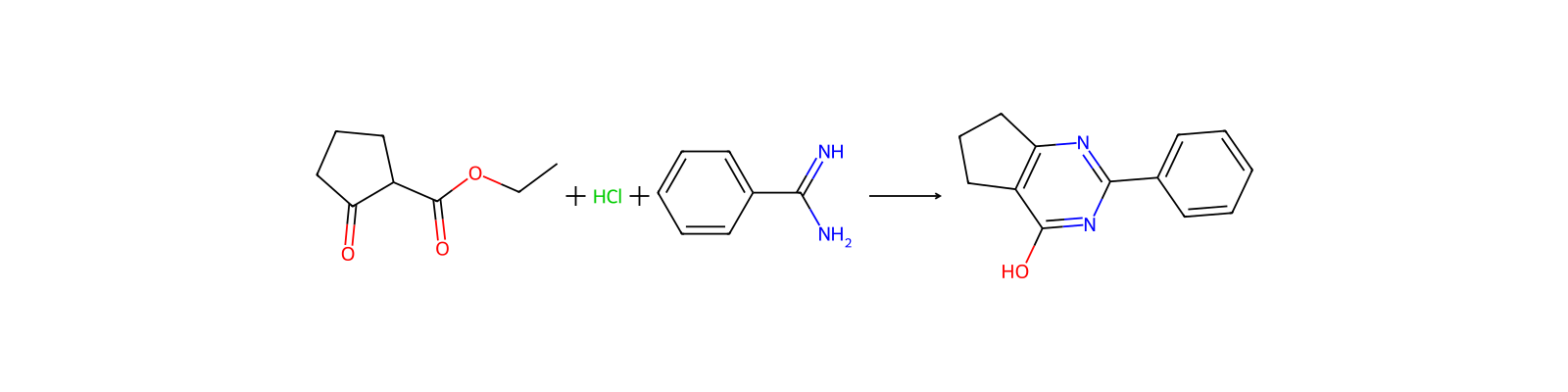
Zugehörige Reaktionen
95



Notizen zur Verbindung
Wird geladen…