

Grundinformationen
- Standard-SMILES
C1=CCCCC1- InChIKey
HGCIXCUEYOPUTN-UHFFFAOYSA-N- Summenformel
- C6H10
- Durchschnittliche Molmasse
- 82,14 g/mol
- Monoisotopische Masse
- 82,07825032
Namen und Bezeichner
- Bevorzugter Name
- Cyclohexene
- IUPAC
- cyclohexene
- Lokaler Name
- Cyclohexen
- Englischer Name
- Cyclohexene
- Summenformel
- C6H10
- Molmasse
- 82.14
Namen und Synonyme
CYCLOHEXENE110-83-8TetrahydrobenzeneCyclohex-1-eneBenzene tetrahydride1,2,3,4-TetrahydrobenzeneBenzenetetrahydrideHexanaphthyleneCykloheksenBenzene, tetrahydro-3,4,5,6-Tetrahydrobenzene12L0P8F7GN
Weitere Namen anzeigen
CyclohexenHXcykloheksen(polish)Cyclohexene, pure, 99%Hxl3ohexeneM100081
DTXSID9038717NSC-24835CHEBI:36404RefChem:129655DTXCID7018717203-807-81-CyclohexeneZyklohexen
Datenbank-Bezeichner
- CAS
110-83-8- PubChem CID
- 8079
- DTXSID
DTXSID9038717- ChEMBL
CHEMBL16396- ChEBI
CHEBI:36404- UNII
- 12L0P8F7GN
- EC Number
- 203-807-8
- Nikkaji
- J1.313.727G、J1.443.311B、J1.464.503I、J38.186A
Eigenschaften
Berechnete Struktureigenschaften
- XLogP
- 2,9
- Polarare Oberfläche (TPSA)
- 0 Ų
- H-Brücken-Donoren
- 0
- H-Brücken-Akzeptoren
- 0
- Frei drehbare Bindungen
- 0
- Schwere Atome
- 6
- Formalladung
- 0
- Komplexität
- 45
Experimentelle und physikochemische Eigenschaften
LogP
log Kow = 2.86
2.86
OdorSweet odor
Density
0.81 (NIOSH, 2024) - Less dense than water; will float
0.8110 at 20 °C/4 °C
Relative density (water = 1): 0.81
0.81
0.8102 @25 °C
0.81
Viscosity0.625 mPa.s at 25 °C
Color/FormColorless liquid
Solubility
Insoluble (NIOSH, 2024)
MISCIBLE IN BENZENE, CARBON TETRACHLORIDE, PETROLEUM ETHER
Miscible with ethanol, ether, acetone, and benzene
In water, 213 mg/L at 25 °C
Solubility in water: none
Insoluble
Flash Point
11 °F (NIOSH, 2024)
11 °F
<20 °F (<-7 °C) (Closed cup)
11 °F CC
-6 °C c.c.
11 °F
Boiling Point
181 °F at 760 mmHg (NIOSH, 2024)
83 °C at 760 mm Hg
83 °C
181 °F
83 °C @760 [mm Hg]
181 °F
Melting Point
-154 °F (NIOSH, 2024)
-103.5 °C
-104 °C
-154 °F
-103.7 °C
-154 °F
Vapor Density
2.8 (Air = 1)
Relative vapor density (air = 1): 2.8
Odor Threshold
Odor Threshold Low: 0.18 [ppm];Odor threshold from AIHA
Detection: 0.6 mg/cu m
Polymerization/Cyclohexene/ may polymerize under certain conditions.
Physikochemische Eigenschaften
- Schmelzpunkt
- -104 °C · -104 °C (lit.)
- Siedepunkt
- 83 °C · 83 °C (lit.)
- Dichte
- 0.811 g/mL · 0.811 g/mL at 25 °C (lit.)
- Dampfdichte
- 2.8 · 2.8 (vs air)
- Dampfdruck
- 160 mm · 160 mm Hg ( 20 °C)
- Brechungsindex
- 20 · n20/D 1.446(lit.)
- Flammpunkt
- 10 °F · 10 °F
- storage temp.
- 30 °C · Store below +30°C.
- Löslichkeit
- water: insoluble
- Aggregatzustand
- Liquid
- Farbe
- Clear colorless
- Wichte
- 0.811 · 0.811
- PH
- 7 · 7-8 (0.2g/l, H2O, 20℃)
- Explosionsgrenze
- 1.2 · 1.2-7.7%(V)
- Wasserlöslichkeit
- insoluble
- Spezifische Wärmekapazität
- 1.81 J/ · Cp(liquid): 1.81 J/(g·K), at 25℃
- Merck
- 14 · 14,2727
- BRN
- 906737 · 906737
- Henry's Law Constant
- 3.85 x · 3.85 x 10-2 atmm3/mol at 25 °C (Nielsen et al., 1994)
- Dielectric constant
- 18.3 · 18.3(20℃)
- Stabilität
- Stable in the absence of air - may form peroxides in storage. Incompatible with oxidizing agents. Highly flammable.
- Major Application
- environmentalpetroleum
- InChI
- 1S/C6H10/c1-2-4-6-5-3-1/h1-2H,3-6H2
- InChIKey
- HGCIXCUEYOPUTN-UHFFFAOYSA-N
- SMILES
- C1CCC=CC1
- LogP
- 2.99 at · 2.99 at 25℃
- CAS Datenbank
- 110 · 110-83-8(CAS DataBase Reference)
- NIST chemische Informationen
- Cyclohexene(110-83-8)
- EPA chemische Informationen
- Cyclohexene (110-83-8)
Sicherheit und Regulatorisches
GHS-Klassifizierung
GHS Classification
Danger
H225 (100%): Highly Flammable liquid and vapor [Danger Flammable liquids];H302 (100%): Harmful if swallowed [Warning Acute toxicity, oral];H304 (95.2%): May be fatal if swallowed and enters airways [Danger Aspiration hazard];H311 (39.4%): Toxic in contact with skin [Danger Acute toxicity, dermal];H411 (57.7%): Toxic to aquatic life with long lasting effects [Hazardous to the aquatic environment, long-term hazard]
P210, P233, P240, P241, P242, P243, P262, P264, P270, P273, P280, P301+P316, P301+P317, P302+P352, P303+P361+P353, P316, P321, P330, P331, P361+P364, P370+P378, P391, P403+P235, P405, and P501 (click each P-code to see the statement)
Aggregated GHS information provided per 104 reports by companies from 12 notifications to the ECHA C&L Inventory. Each notification may be associated with multiple companies.;Information may vary between notifications depending on impurities, additives, and other factors. The percentage value in parenthesis indicates the notified classification ratio from companies that provide hazard codes. Only hazard codes with percentage values above 10% are shown. For more detailed information, please visit ECHA C&L website.
Gefahrenhinweise
Regulatory Information
Chemical: Cyclohexene
Status: Active Update: 09-08-2021 https://echa.europa.eu/registration-dossier/-/registered-dossier/12717
Cyclohexene: HSNO Approval: HSR001113 Approved with controls
The New Jersey Worker and Community Right to Know Act requires public and private employers to provide information about hazardous substances at their workplaces. (N.J.S.A. 34:5A-1 et. seq.)
DOT LabelFlammable Liquid
Fire Hazards
Excerpt from ERG Guide 130 [Flammable Liquids (Water-Immiscible / Noxious)]:;HIGHLY FLAMMABLE: Will be easily ignited by heat, sparks or flames. Vapors may form explosive mixtures with air. Vapors may travel to source of ignition and flash back. Most vapors are heavier than air. They will spread along the ground and collect in low or confined areas (sewers, basements, tanks, etc.). Vapor explosion hazard indoors, outdoors or in sewers. Those substances designated with a (P) may polymerize explosively when heated or involved in a fire. Runoff to sewer may create fire or explosion hazard. Containers may explode when heated. Many liquids will float on water. (ERG, 2024)
· HIGHLY FLAMMABLE: Will be easily ignited by heat, sparks or flames.;· Vapors may form explosive mixtures with air.;· Vapors may travel to source of ignition and flash back.;· Most vapors are heavier than air. They will spread along the ground and collect in low or confined areas (sewers, basements, tanks, etc.).;· Vapor explosion hazard indoors, outdoors or in sewers.;· Those substances designated with a (P) may polymerize explosively when heated or involved in a fire.;· Runoff to sewer may create fire or explosion hazard.;· Containers may explode when heated.;· Many liquids will float on water.
Highly flammable. Vapour/air mixtures are explosive.
Fire Potential
Highly flammable.
Dangerous; keep away from heat and open flame.
Health Hazards
Excerpt from ERG Guide 130 [Flammable Liquids (Water-Immiscible / Noxious)]:;May cause toxic effects if inhaled or absorbed through skin. Inhalation or contact with material may irritate or burn skin and eyes. Fire will produce irritating, corrosive and/or toxic gases. Vapors may cause dizziness or asphyxiation, especially when in closed or confined areas. Runoff from fire control or dilution water may cause environmental contamination. (ERG, 2024)
· May cause toxic effects if inhaled or absorbed through skin.;· Inhalation or contact with material may irritate or burn skin and eyes.;· Fire will produce irritating, corrosive and/or toxic gases.;· Vapors may cause dizziness or asphyxiation, especially when in closed or confined areas.;· Runoff from fire control or dilution water may cause environmental contamination.
Hazards Summary
TLV Basis = Liver effects; No human studies available; [ACGIH] Exposed laboratory animals show loss of righting reflex and staggering gait. [HSDB] A skin, eye, and respiratory tract irritant; Inhalation of high concentrations may cause CNS effects; [ICSC]
DOT ID and Guide
2256 130
2256 130
Reactive GroupHydrocarbons, Aliphatic Unsaturated;Polymerizable Compounds
UN ClassificationUN Hazard Class: 3; UN Pack Group: II
TSCA Requirements
Section 8(a) of TSCA requires manufacturers of this chemical substance to report preliminary assessment information concerned with production, exposure, and use to EPA as cited in the preamble in 51 FR 41329.
Pursuant to section 8(d) of TSCA, EPA promulgated a model Health and Safety Data Reporting Rule. The section 8(d) model rule requires manufacturers, importers, and processors of listed chemical substances and mixtures to submit to EPA copies and lists of unpublished health and safety studies. Cyclohexene is included on this list.
Reactivity AlertsHighly Flammable;Polymerizable;Peroxidizable Compound
OSHA StandardsPermissible Exposure Limit: Table Z-1 8-hr Time Weighted Avg: 300 ppm (1015 mg/cu m).
Sicherheit und Schutzausrüstung
Fire Fighting
Excerpt from ERG Guide 130 [Flammable Liquids (Water-Immiscible / Noxious)]:;CAUTION: The majority of these products have a very low flash point. Use of water spray when fighting fire may be inefficient.;SMALL FIRE: Dry chemical, CO2, water spray or regular foam. If regular foam is ineffective or unavailable, use alcohol-resistant foam.;LARGE FIRE: Water spray, fog or regular foam. If regular foam is ineffective or unavailable, use alcohol-resistant foam. Avoid aiming straight or solid streams directly onto the product. If it can be done safely, move undamaged containers away from the area around the fire.;FIRE INVOLVING TANKS, RAIL TANK CARS OR HIGHWAY TANKS: Fight fire from maximum distance or use unmanned master stream devices or monitor nozzles. Cool containers with flooding quantities of water until well after fire is out. Withdraw immediately in case of rising sound from venting safety devices or discoloration of tank. ALWAYS stay away from tanks in direct contact with flames. For massive fire, use unmanned master stream devices or monitor nozzles; if this is impossible, withdraw from area and let fire burn. (ERG, 2024)
Use water spray, powder, foam, carbon dioxide. In case of fire: keep drums, etc., cool by spraying with water.
First Aid Measures
Fresh air, rest.
Remove contaminated clothes. Rinse and then wash skin with water and soap.
First rinse with plenty of water for several minutes (remove contact lenses if easily possible), then refer for medical attention.
Rinse mouth. Do NOT induce vomiting. Refer for medical attention .
Accidental Release Measures
· CALL 911. Then call emergency response telephone number on shipping paper. If shipping paper not available or no answer, refer to appropriate telephone number listed on the inside back cover.;· Keep unauthorized personnel away.;· Stay upwind, uphill and/or upstream.;· Ventilate closed spaces before entering, but only if properly trained and equipped.
· ELIMINATE all ignition sources (no smoking, flares, sparks or flames) from immediate area.;· All equipment used when handling the product must be grounded.;· Do not touch or walk through spilled material.;· Stop leak if you can do it without risk.;· Prevent entry into waterways, sewers, basements or confined areas.;· A vapor-suppressing foam may be used to reduce vapors.;· Absorb or cover with dry earth, sand or other non-combustible material and transfer to containers.;· Use clean, non-sparking tools to collect absorbed material.;Large Spill;· Dike far ahead of liquid spill for later disposal.;· Water spray may reduce vapor, but may not prevent ignition in closed spaces.
First Aid
Excerpt from NIOSH Pocket Guide for Cyclohexene:;Eye: IRRIGATE IMMEDIATELY - If this chemical contacts the eyes, immediately wash (irrigate) the eyes with large amounts of water, occasionally lifting the lower and upper lids. Get medical attention immediately.;Skin: SOAP WASH PROMPTLY - If this chemical contacts the skin, promptly wash the contaminated skin with soap and water. If this chemical penetrates the clothing, promptly remove the clothing and wash the skin with soap and water. Get medical attention promptly.;Breathing: RESPIRATORY SUPPORT - If a person breathes large amounts of this chemical, move the exposed person to fresh air at once. If breathing has stopped, perform artificial respiration. Keep the affected person warm and at rest. Get medical attention as soon as possible.;Swallow: MEDICAL ATTENTION IMMEDIATELY - If this chemical has been swallowed, get medical attention immediately. (NIOSH, 2024)
General First Aid:;· Call 911 or emergency medical service.;· Ensure that medical personnel are aware of the material(s) involved, take precautions to protect themselves and avoid contamination.;· Move victim to fresh air if it can be done safely.;· Administer oxygen if breathing is difficult.;· If victim is not breathing:;-- DO NOT perform mouth-to-mouth resuscitation; the victim may have ingested or inhaled the substance.;-- If equipped and pulse detected, wash face and mouth, then give artificial respiration using a proper respiratory medical device (bag-valve mask, pocket mask equipped with a one-way valve or other device).;-- If no pulse detected or no respiratory medical device available, provide continuous compressions. Conduct a pulse check every two minutes or monitor for any signs of spontaneous respirations.;· Remove and isolate contaminated clothing and shoes.;· For minor skin contact, avoid spreading material on unaffected skin.;· In case of contact with substance, remove immediately by flushing skin or eyes with running water for at least 20 minutes.;· For severe burns, immediate medical attention is required.;· Effects of exposure (inhalation, ingestion, or skin contact) to substance may be delayed.;· Keep victim calm and warm.;· Keep victim under observation.;· For further assistance, contact your local Poison Control Center.;· Note: Basic Life Support (BLS) and Advanced Life Support (ALS) should be done by trained professionals.;Specific First Aid:;· Wash skin with soap and water.
(General first aid procedures);Eye: Irrigate immediately - If this chemical contacts the eyes, immediately wash (irrigate) the eyes with large amounts of water, occasionally lifting the lower and upper lids. Get medical attention immediately.;Skin: Soap wash promptly - If this chemical contacts the skin, promptly wash the contaminated skin with soap and water. If this chemical penetrates the clothing, promptly remove the clothing and wash the skin with soap and water. Get medical attention promptly.;Breathing: Respiratory support;Swallow: Medical attention immediately - If this chemical has been swallowed, get medical attention immediately.
Safe StorageFireproof. Separated from strong oxidants. Cool. Well closed. Store only if stabilized.
Firefighting Hazards
The vapour is heavier than air and may travel along the ground; distant ignition possible. As a result of flow, agitation, etc, electrostatic charges can be generated.
A harmful contamination of the air will be reached rather slowly on evaporation of this substance at 20 °C.
Exposure Control and Personal Protection· Wear positive pressure self-contained breathing apparatus (SCBA).;· Structural firefighters' protective clothing provides thermal protection but only limited chemical protection.
Fire Fighting Procedures
If material on fire or involved in fire: Do not extinguish fire unless flow can be stopped or safely confined. Use water in flooding quantities as fog. Solid streams of water may be ineffective. Cool all affected containers with flooding quantities of water. Use foam, dry chemical, or carbon dioxide. Keep run-off water out of sewers and water sources.
Evacuation: If fire becomes uncontrollable or container is exposed to direct flame - consider evacuation of one-half (1/2) mile radius.
Storage Conditions
Fireproof. Separated from strong oxidants. Cool. Well closed. Store only if stabilized.
A harmful contamination of the air will be reached rather slowly on evaporation of this substance at 20 °C.
Cleanup Methods
Remove all ignition sources. Collect leaking and spilled liquid in sealable containers as far as possible. Absorb remaining liquid in sand or inert absorbent and remove to safe place. Do NOT wash away into sewer. Filter respirator for organic gases and vapours.
Nonfire Spill Response
Excerpt from ERG Guide 130 [Flammable Liquids (Water-Immiscible / Noxious)]:;ELIMINATE all ignition sources (no smoking, flares, sparks or flames) from immediate area. All equipment used when handling the product must be grounded. Do not touch or walk through spilled material. Stop leak if you can do it without risk. Prevent entry into waterways, sewers, basements or confined areas. A vapor-suppressing foam may be used to reduce vapors. Absorb or cover with dry earth, sand or other non-combustible material and transfer to containers. Use clean, non-sparking tools to collect absorbed material.;LARGE SPILL: Dike far ahead of liquid spill for later disposal. Water spray may reduce vapor, but may not prevent ignition in closed spaces. (ERG, 2024)
Disposal Methods
SRP: The most favorable course of action is to use an alternative chemical product with less inherent propensity for occupational exposure or environmental contamination. Recycle any unused portion of the material for its approved use or return it to the manufacturer or supplier. Ultimate disposal of the chemical must consider: the material's impact on air quality; potential migration in soil or water; effects on animal, aquatic, and plant life; and conformance with environmental and public health regulations.
Toxikologische Informationen
Target OrgansEyes, skin, respiratory system, central nervous system
Ecotoxicity Values
EC50; Species: Daphnia magna (Water flea); Conditions: freshwater; /conditions of bioassay not specified/; Concentration: = 720 mg/L for 24 hr; Effect: behavior, equilibrium /formulated product/
EC50; Species: Daphnia magna (Water flea); Conditions: freshwater; renewal; Concentration: 2900 ug/L for 15 d; Effect: reproduction, reproduction, general /active ingredient/
EC50; Species: Daphnia magna (Water flea); Conditions: freshwater; static; Concentration: 5300 ug/L for 48 hr; Effect: intoxication, immobile /active ingredient/
LC50; Species: Daphnia magna (Water flea); Conditions: freshwater; static; Concentration: > 50000 ug/L for 24 hr /formulated product/
For more Ecotoxicity Values (Complete) data for CYCLOHEXENE (9 total), please visit the HSDB record page.
Environmental Fate
TERRESTRIAL FATE: Based on a classification scheme(1), an estimated Koc value of 850(SRC), determined from a log Kow of 2.86(2) and a regression-derived equation(3), indicates that cyclohexene is expected to have low mobility in soil(SRC). Volatilization of cyclohexene from moist soil surfaces is expected to be an important fate process(SRC) given a Henry's Law constant of 4.55X10⁻² atm-cu m/mole(4). Cyclohexene is expected to volatilize from dry soil surfaces(SRC) based upon an extrapolated vapor pressure of 89 mm Hg(5). A 0% theoretical BOD in 4 weeks using an activated sludge inoculum and the Japanese MITI test(6), suggests that biodegradation is not a fast process in soil(SRC).
AQUATIC FATE: Based on a classification scheme(1), an estimated Koc value of 850(SRC), determined from a log Kow of 2.86(2) and a regression-derived equation(3), indicates that cyclohexene is expected to adsorb to suspended solids and sediment(SRC). Volatilization from water surfaces is expected(3) based upon a Henry's Law constant of 4.55X10⁻² atm-cu m/mole(4). Using this Henry's Law constant and an estimation method(3), volatilization half-lives for a model river and model lake are 1 hour and 4 days, respectively(SRC). According to a classification scheme(5), BCF values ranging from 23-45 measured in fish(6), suggests bioconcentration in aquatic organisms is low to moderate(SRC). A 0% theoretical BOD in 4 weeks using an activated sludge inoculum and the Japanese MITI test(6), suggests that biodegradation is not a fast process in water(SRC).
ATMOSPHERIC FATE: According to a model of gas/particle partitioning of semivolatile organic compounds in the atmosphere(1), cyclohexene, which has a an extrapolated vapor pressure of 89 mm Hg at 25 °C(2), is expected to exist solely as a vapor in the ambient atmosphere. Vapor-phase cyclohexene is degraded in the atmosphere by reaction with photochemically-produced hydroxyl radicals, ozone, and nitrate radicals(SRC). The half-life for the reaction with hydroxyl radicals is estimated to be 6 hours(SRC), calculated from its rate constant of 6.77X10⁻¹¹ cu cm/molecule-sec(3). The half-life for the reaction with ozone is estimated to be 2 hours(SRC), calculated from its rate constant of 2.04X10⁻¹⁶ cu-cm/molec-sec(4). The half-life for the reaction with nitrate radicals is estimated to be 4 hours(SRC), calculated from its rate constant of 1.9X10⁻¹² cu-cm/molec-sec(5).
Adverse EffectsNeurotoxin - Acute solvent syndrome;Occupational hepatotoxin - Secondary hepatotoxins: the potential for toxic effect in the occupational setting is based on cases of poisoning by human ingestion or animal experimentation.
Exposure Routes
The substance can be absorbed into the body by inhalation and by ingestion.
inhalation, ingestion, skin and/or eye contact
Signs and Symptoms
Cough. Drowsiness.
Redness. Dry skin.
Redness.
Drowsiness. Laboured breathing. Nausea.
irritation eyes, skin, respiratory system; drowsiness
Effluent Concentrations
Cyclohexene has been detected in 2 of 46 US industrial effluent samples; electronics effluent at 83 ng/uL and at 1476 ng/uL(1). Cyclohexene was qualitatively detected in roadside ambient air samples(2), and air samples taken in the Allegheny Mountain Tunnel of the Pennsylvania Turnpike, 1979(3), and in roadway samples in Raleigh, NC, May 1983(4). Cyclohexene was detected at a concentration of 0.19 mg/cu m in the vicinity of an oil fire(5).
Soil Adsorption/Mobility
The Koc of cyclohexene is estimated as 850 (SRC), using a log Kow of 2.86(1) and a regression-derived equation(2). According to a classification scheme(3), this estimated Koc value suggests that cyclohexene is expected to have low mobility in soil(SRC).
Human Toxicity Excerpts
/SIGNS AND SYMPTOMS/ Hydrophobic hydrocarbons of this type would be expected to induce pulmonary damage, transient CNS depression of excitement, and secondary effects of hypoxia, infection, pneumatocele formation, and chronic lung dysfunction. Cardiac complications are rare.[Bingham, E.; Cohrssen, B.; Powell, C.H.; Patty's Toxicology Volumes 1-9 5th ed. John Wiley & Sons. New York, N.Y. (2001)., p. 4:178]
/SIGNS AND SYMPTOMS/ ACUTE ... SYMPTOMS: Inhalation--cough and drowsiness; Skin--redness and dry skin; Eyes--redness; Ingestion--drowsiness, labored breathing and nausea.[IPCS, CEC; International Chemical Safety Card on Cyclohexene. (October 1999). Available from, as of October 04, 2006: http://www.inchem.org/documents/icsc/icsc/eics1054.htm]
/SIGNS AND SYMPTOMS/ EFFECTS OF SHORT-TERM EXPOSURE: /Cyclohexene/ irritates the eyes, the skin and the respiratory tract. Swallowing the liquid may cause aspiration into the lungs with the risk of chemical pneumonitis ... /It/ may cause effects on the central nervous system. EFFECTS OF LONG-TERM OR REPEATED EXPOSURE: The liquid defats the skin.[IPCS, CEC; International Chemical Safety Card on Cyclohexene. (October 1999). Available from, as of October 04, 2006: http://www.inchem.org/documents/icsc/icsc/eics1054.htm]
/BIOMONITORING/ Hydroxylated and conjugated metabolites are eliminated in the urine and may be quantitated by gas or high pressure liquid chromatography.[Bingham, E.; Cohrssen, B.; Powell, C.H.; Patty's Toxicology Volumes 1-9 5th ed. John Wiley & Sons. New York, N.Y. (2001)., p. 4:177]
/OTHER TOXICITY INFORMATION/ Toxicity ... is low, although it is an irritant, and defats the skin on direct contact. It is an anesthetic and CNS depressant. When ingested, it represents a low to moderate pulmonary aspiration hazard.[Bingham, E.; Cohrssen, B.; Powell, C.H.; Patty's Toxicology Volumes 1-9 5th ed. John Wiley & Sons. New York, N.Y. (2001)., p. 4:177]
Artificial Pollution Sources
Cyclohexene's production and use as an intermediate in the manufacture of adipic acid, maleic acid, and hexahydrobenzoic acid(1) may result in its release to the environment through various waste streams(SRC).
OCCURS IN COAL TAR.
Environmental Biodegradation
AEROBIC: Cyclohexene, present at 100 mg/L, reached 0% of its theoretical BOD in 4 weeks using an activated sludge inoculum at 30 mg/L and the Japanese MITI test(1). Approximately 20% of THOD was observed when cyclohexene was incubated with activated sewage sludge acclimated to benzene(2). Cyclohexene did not support growth of two strains of Cladosporium resinae isolated from aircraft jet fuels systems when used as the sole carbon source(3,4). 2- and 3-cyclohexene-1-ol were produced in the oxidation of cyclohexene by Pseudomonas oleovorans(5).
Sediment/Soil Concentrations
SEDIMENT: Cyclohexene was detected in sediment samples taken off the coast of South Africa, Dec to Jan 1975-76, at 10 ng/g dry weight at 8-12 cm depth and 0.1 ng/g at 36-40 cm depth; it was not detected at samples depths of 4-8 or 8-36 cm(1).
Regulatorische Informationen
Regulatory Information
Chemical: Cyclohexene
Status: Active Update: 09-08-2021 https://echa.europa.eu/registration-dossier/-/registered-dossier/12717
Cyclohexene: HSNO Approval: HSR001113 Approved with controls
The New Jersey Worker and Community Right to Know Act requires public and private employers to provide information about hazardous substances at their workplaces. (N.J.S.A. 34:5A-1 et. seq.)
TSCA Requirements
Section 8(a) of TSCA requires manufacturers of this chemical substance to report preliminary assessment information concerned with production, exposure, and use to EPA as cited in the preamble in 51 FR 41329.
Pursuant to section 8(d) of TSCA, EPA promulgated a model Health and Safety Data Reporting Rule. The section 8(d) model rule requires manufacturers, importers, and processors of listed chemical substances and mixtures to submit to EPA copies and lists of unpublished health and safety studies. Cyclohexene is included on this list.
Atmospheric Standards
This action promulgates standards of performance for equipment leaks of Volatile Organic Compounds (VOC) in the Synthetic Organic Chemical Manufacturing Industry (SOCMI). The intended effect of these standards is to require all newly constructed, modified, and reconstructed SOCMI process units to use the best demonstrated system of continuous emission reduction for equipment leaks of VOC, considering costs, non air quality health and environmental impact and energy requirements. Cyclohexene is produced, as an intermediate or a final product, by process units covered under this subpart.
Sicherheitsdaten
- OEB
- A
- OEL
- TWA: 300 ppm (1015 mg/m3)
- wgk
- 1
- IDLA
- 2,000 ppm
- tsca
- TSCA listed
- ridadr
- UN 2256
- hs_code
- 29021990
- RTECS-Nr.
- GW2500000
- risk_code
- 11-21/22-65
- Toxizität
- LD50 orally in Rabbit: 1300 mg/kg
- hazard_code
- F,Xn
- safety_code
- 16-29-33-36/37-62
- hazard_class
- 3
- packing_group
- II
- Speicherklasse
- 3 - Flammable liquids
- Giftige Stoffe Daten
- 110-83-8(Hazardous Substances Data)
- Hazard Classifications
- Acute Tox. 4 OralAquatic Chronic 2Asp. Tox. 1Flam. Liq. 2
- Selbstentzündungstemperatur
- 590 °F
Chemie und Industrie
Pharmakologische Informationen
Metabolism/Metabolites
Following incubation of Aspergillus niger with cyclohexene, 3 transformation products were isolated: 2-cyclohexen-1-one, (+)-2-cyclohexen-1-ol, and (+)-3-cyclohexene-1,2-cis-diol.
Microsomal oxidases have been detected in the rabbit liver, which readily hydroxylate cyclohexene and a number of related aromatic compounds to the corresponding dihydroxy derivatives.
Hydroxylation of cyclohexene @ allylic position occurred in hepatic microsomes & 9000 g supernatant fractions of rats & rabbits. Formation of product, 2-cyclohexen-1-ol, required presence of NADPH-generating system, was inhibited by CO, and induced by phenobarbital.
In the rabbit, hydroxylation and conjugation occur, with the formation of sulfur-containing metabolites.
Hydroxylated and conjugated metabolites are eliminated in the urine ...
Absorption, Distribution and Excretion
Cyclohexene is readily adsorbed following skin, eye, or respiratory exposure or following ingestion.
These hydrocarbons are poorly absorbed from the GI tract and do not cause appreciable systemic toxicity by this route unless aspiration has occurred.
... Two male Holtzman rats were each given 0.1 mL (81.1 mg/kg bw) of cyclohexene by stomach tube ... The urine sample for 24 hr contained 2-cyclohexen-1-one (0.1 % of the oral dose) but 2-cyclohexen-1-ol was not detected even by beta-glucuronidase treatment.
In an inhalation study, male F344/N rats were exposed nose-only to gaseous cyclohexene at 600 ppm (2,015 mg/cu m) for 60 minutes ... During exposure, the blood levels of cyclohexene increased up to 2 ug/g blood.
Verwendung und Herstellung
Uses
Used in organic synthesis and as a solvent for oil extraction and catalysts; [ACGIH]
Petroleum Production and Refining [Category: Industry]
ALKYLATION COMPONENT; IN MFR OF ADIPIC ACID, MALEIC ACID, HEXAHYDROBENZOIC ACID AND ALDEHYDE. TO PREPARE BUTADIENE IN THE LABORATORY.
Catalyst solvent; oil extraction
Cyclohexene ... is used as stabilizer for high octane gasoline ...
... Used in the prepn of butadiene in lab ... Inorganic synth ...
U.S. Imports
(1972) 3.85X10+7 GRAMS (PRINCPL CUSTMS DISTS)
(1975) 1.2X10+7 GRAMS
(1983) 3.40X10+5 g
U.S. Production
(1972) PROBABLY GREATER THAN 4.54X10+5 GRAMS
(1975) GREATER THAN 1.4X10+6 GRAMS
Production volumes for non-confidential chemicals reported under the Inventory Update Rule. [Table#3366]
Methods of Manufacturing
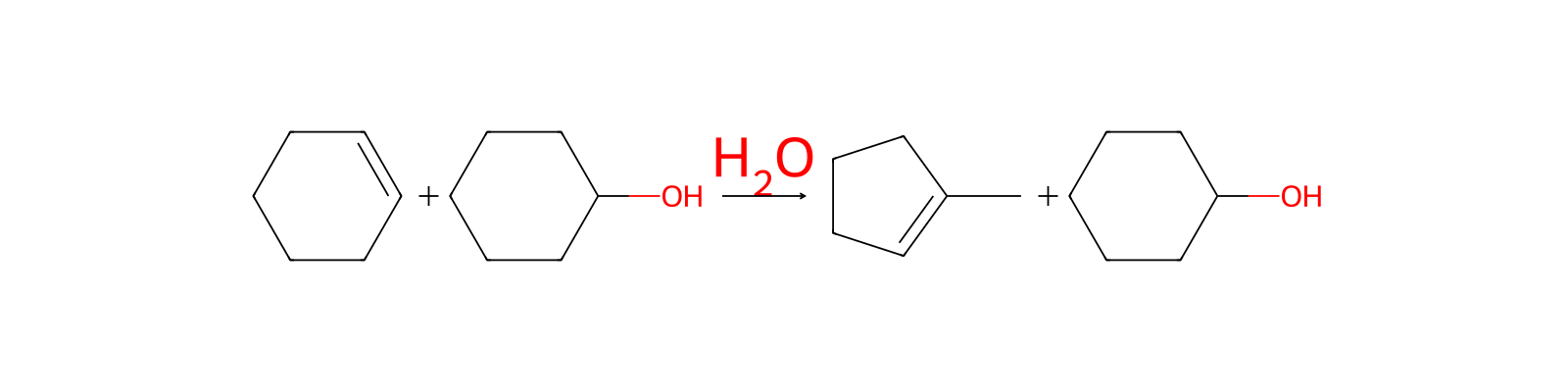
Cyclohexene is prepared by dehydration of cyclohexanol by thermal reaction of a ethylene-propylene-butadiene mixture.
Prepared by dehydration of cyclohexanol at high temps over various catalysts.
In Japan, cyclohexene is synthesized in a closed system by catalytic hydrogenation of benzene, isolated by fractionation.
Formulations/Preparations
Grade: Technical 95%; 99%; research 99.9 mole%.
CYCLOHEXENE: 99+% (GOLD LABEL), 99%; BOTH INHIBITED WITH 0.01% 2,6-DI-TERT-BUTYL-4 METHYLPHENOL
CYCLOHEXENE: 99.5% ASSAY; INHIBITOR-SODIUM HYDROXIDE
Household ProductsInformation on 1 consumer products that contain Cyclohexene in the following categories is provided:;• Personal Care
General Manufacturing Information
Cyclohexene: ACTIVE
Cyclohexene occurs in coal tar.
In Japan, cyclohexene is synthesized in a closed system by catalytic hydrogenation of benzene, isolated by fractionation, stored temporarily in storage tanks and used solely as an intermediate for cyclohexanol synthesis in the same factory. Workers take quality control samples of fractionated cyclohexene once a day and stored cyclohexene once a month. ... Workers wear goggles and protecting gloves during sampling, exposure through dermal contact is therefore expected to be minimal.
Anwendungen
BeschreibungCyclohexene is a hydrocarbon, mostly obtained from the hydrogenation of benzene.
VerwendenIt occurs in coal tar and is obtained by catalyticdehydration of cyclohexanol and dehydrogenationof cyclohexane. Cyclohexene isused in making adipic acid, maleic acid,and butadiene; in oil extraction; as a stabilizerfor high-octane gasoline; and in organicsynthesis.
Vor- und nachgelagerte Produkte
Vorgelagerte Rohstoffe
Nachgelagerte Produkte
Ergänzende Hinweise
DefinitionChEBI: A cycloalkene that is cylohexane with a single double bond.
Zugehörige Reaktionen
885




Verknüpfte Notizen
Wird geladen…