
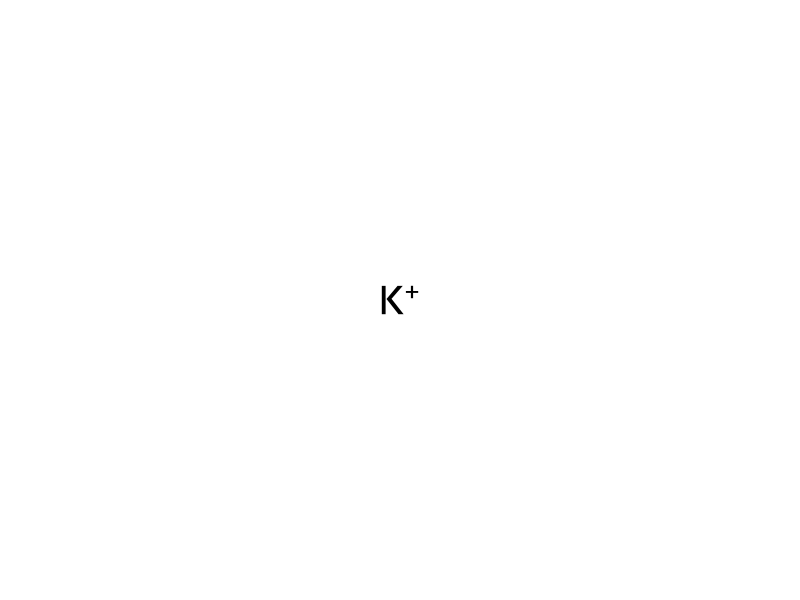
Potassium Cation
Grundinformationen
- CAS
125352-08-1- Standard-SMILES
[K+]- InChIKey
NPYPAHLBTDXSSS-UHFFFAOYSA-N- Summenformel
- K+
- Durchschnittliche Molmasse
- 39,0983 g/mol
- Monoisotopische Masse
- 38,96370648
Überblick
Potassium(1+) is a monoatomic monocation obtained from potassium. It has a role as a cofactor and a human metabolite. It is a monoatomic monocation, an alkali metal cation, an elemental potassium and a monovalent inorganic cation.
Namen und Bezeichner
- Bevorzugter Name
- Potassium Cation
- IUPAC
- potassium(1+)
- Englischer Name
- Amines, N-C12-22-alkyltrimethylenedi-, ethoxylated
- Molmasse
- 0
Namen und Synonyme
Potassium cationpotassium(1+)24203-36-9potassium(I) cationpotassium(I)UNII-295O53K152K+295O53K152DTXSID9042671CHEBI:29103K(+)Skin Affections
Weitere Namen anzeigen
Amines, C12-22-alkyltrimethylenedi-, ethoxylatedAmines, N-C12-22-alkyltrimethylenedi-, ethoxylated
Nasel congestionPotassium+Colds Dry CoughRunny Nose WartsHeadache NervousnessSore Throat 911RefChem:55890DTXCID7022671
Datenbank-Bezeichner
- CAS
125352-08-1、24203-36-9、7440-09-7- PubChem CID
- 813
- DTXSID
DTXSID9042671- ChEMBL
CHEMBL1233793- ChEBI
CHEBI:29103- UNII
- 295O53K152
- EC Number
- 603-061-7
- Nikkaji
- J365.253J
Eigenschaften
Berechnete Struktureigenschaften
- Polarare Oberfläche (TPSA)
- 0 Ų
- H-Brücken-Donoren
- 0
- H-Brücken-Akzeptoren
- 0
- Frei drehbare Bindungen
- 0
- Schwere Atome
- 1
- Formalladung
- 1
- Komplexität
- 0
Experimentelle und physikochemische Eigenschaften
Melting Point63.2 °C
Physical DescriptionSolid
Sicherheit und Regulatorisches
Sicherheitsangaben dienen nur zur Orientierung und ersetzen weder das Sicherheitsdatenblatt (SDB) des Lieferanten noch geltende Vorschriften oder eine fachliche Bewertung.
GHS-Klassifizierung
GHS Classification
Warning
H302 (42.1%): Harmful if swallowed [Warning Acute toxicity, oral]
P264, P264+P265, P270, P273, P280, P301+P317, P305+P351+P338, P330, P337+P317, P391, and P501 (click each P-code to see the statement)
Aggregated GHS information provided per 19 reports by companies from 2 notifications to the ECHA C&L Inventory. Each notification may be associated with multiple companies.
Gefahrenhinweise
Regulatory InformationAmines, N-C12-22-alkyltrimethylenedi-, ethoxylated: Does not have an individual approval but may be used as a component in a product covered by a group standard. It is not approved for use as a chemical in its own right.
Hazard Classes and CategoriesAcute Tox. 4 (42.1%)
Toxikologische Informationen
Carcinogen ClassificationNo indication of carcinogenicity to humans (not listed by IARC).
Sicherheitsdaten
- Alarmwort
- Achtung
- Gefahrenhinweise
- Code Gefahrenhinweise Gefahrenklasse Abteilung Alarmwort Symbol P-Code H302
Chemie und Industrie
Pharmakologische Informationen
Mechanism of Action
Potassium is the major cation (positive ion) inside animal cells, while sodium is the major cation outside animal cells. The concentration differences of these charged particles causes a difference in electric potential between the inside and outside of cells, known as the membrane potential. The balance between potassium and sodium is maintained by ion pumps in the cell membrane. The cell membrane potential created by potassium and sodium ions allows the cell generate an action potential—a "spike" of electrical discharge. The ability of cells to produce electrical discharge is critical for body functions such as neurotransmission, muscle contraction, and heart function. Potassium is also an essential mineral needed to regulate water balance, blood pressure and levels of acidity.
FDA Pharmacological Classification
295O53K152
POTASSIUM CATION
Chemical Structure [CS] - Potassium Compounds
Established Pharmacologic Class [EPC] - Potassium Salt
Established Pharmacologic Class [EPC] - Osmotic Laxative
Physiologic Effects [PE] - Increased Large Intestinal Motility
Absorption, Distribution and ExcretionMostly urine but also skin and feces.
Cellular LocationsExtracellular
Metabolite Pathways3-Methylthiofentanyl Action Pathway
Verwendung und Herstellung
UsesThis is an endogenously produced metabolite found in the human body. It is used in metabolic reactions, catabolic reactions or waste generation.
Zugehörige Reaktionen
45.546


Notizen zur Verbindung
Wird geladen…