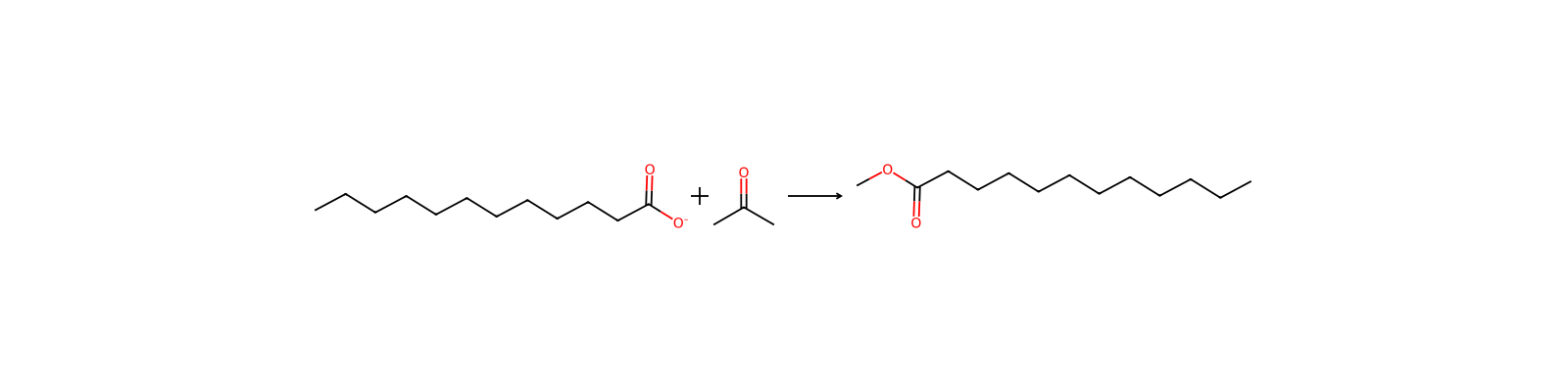
Methyl Laurate
111-82-0CCCCCCCCCCCC(=O)OCUQDUPQYQJKYHQI-UHFFFAOYSA-NMethyl laurate is a fatty acid methyl ester of lauric acid. It has a role as a metabolite. It is a fatty acid methyl ester and a dodecanoate ester.
111-82-0DTXSID5026889CHEMBL1894365CHEBI:87494log Kow= 5.41
5.41
5.41
FATTY, FLORAL ODOR REMINISCENT OF WINE
OILY, WINEY, FATTY ODOR
0.8702 @ 20 °C/4 °C
0.863-0.872
Sicherheitsangaben dienen nur zur Orientierung und ersetzen weder das Sicherheitsdatenblatt (SDB) des Lieferanten noch geltende Vorschriften oder eine fachliche Bewertung.
This chemical does not meet GHS hazard criteria for 12.2% (52 of 426) of reports.
Warning
H400 (74.6%): Very toxic to aquatic life [Warning Hazardous to the aquatic environment, acute hazard]
P273, P391, and P501 (click each P-code to see the statement)
Aggregated GHS information provided per 426 reports by companies from 10 notifications to the ECHA C&L Inventory. Each notification may be associated with multiple companies.
Warning
Chemical: Dodecanoic acid, methyl ester
Dodecanoic acid, methyl ester is listed on the EPA's Chemical Data Reporting (CDR) system. Manufacturers and importers of Dodecanoic acid, methyl ester are required to report information about their production and use of this chemical to the EPA under the Toxic Substances Control Act (TSCA). (40 eCFR Part 711)
REACH registered substance: Methyl laurate (EC: 203-911-3)
Methyl laurate: Does not have an individual approval but may be used under an appropriate group standard
Methyl laurate is a food additive permitted for direct addition to food for human consumption as a synthetic flavoring substance and adjuvant in accordance with the following conditions: a) they are used in the minimum quantity required to produce their intended effect, and otherwise in accordance with all the principles of good manufacturing practice, and 2) they consist of one or more of the following, used alone or in combination with flavoring substances and adjuvants generally recognized as safe in food, prior-sanctioned for such use, or regulated by an appropriate section in this part.
Made from coconut oil; [Hawley] Used as a flavoring agent and as an intermediate for detergents, emulsifiers, wetting agents, stabilizers, lubricants, plasticizers, textiles, alkanolamides, fatty alcohols, and acids; [HSDB]
Intermediate for detergents, emulsifiers, wetting agents, stabilizers, lubricants, plasticizers, textiles, flavoring
CHEM INT-EG, FOR ALKANOLAMIDES, FATTY ALCOHOLS & ACIDS
FLAVORING AGENT, EG, IN BAKED GOODS & ICE CREAM
EPA Safer Chemical Functional Use Classes -> Emollients;Skin Conditioning Agents;Solvents
Safer Chemical Classes -> Green circle - The chemical has been verified to be of low concern
Fragrance Ingredients
Flavouring Agent -> FLAVOURING_AGENT -> JECFA Functional Classes
Flavoring Agents -> JECFA Flavorings Index
Cosmetics -> Emollient; Skin conditioning
Pesticide, Fertilizer, and Other Agricultural Chemical Manufacturing
Dodecanoic acid, methyl ester: ACTIVE
Wird geladen…
COLORLESS LIQUID
Water-white liquid
Aquatic Acute 1 (74.6%)
Skin corrosion/irritation - Category 2
Hazardous to the aquatic environment (Acute) - Category 1
Specific target organ toxicity - Single exposure - Category 3 (Narcotic effects)
SRP: At the time of review, criteria for land treatment or burial (sanitary landfill) disposal practices are subject to significant revision. Prior to implementing land disposal of waste residue (including waste sludge), consult with environmental regulatory agencies for guidance on acceptable disposal practices.
Linear saturated fatty acid methyl esters were comitogenic with lectins for mouse lymphocytes, the degree of comitogenicity being strongly dependent on the length of the acyl group, and maximal for methyl tetradecanoate. Lesser effects were found for analogs with 10, 12, or 16 acyl carbon atoms, whereas those with fewer than 10 or more than 16 were inactive. /Methyl esters/
TERRESTRIAL FATE: Based on a classification scheme(1), an estimated Koc value of 1,600(SRC), determined from a structure estimation method(2), indicates that methyl dodecanoate is expected to be immobile in soil(SRC). Volatilization of methyl dodecanoate from moist soil surfaces is expected to be an important fate process(SRC) given an estimated Henry's Law constant of 0.003 atm-cu m/mole(SRC), using a fragment constant estimation method(3). However, adsorption to soil is expected to attenuate volatilization(SRC). Methyl dodecanoate is not expected to volatilize from dry soil surfaces(SRC) based upon a vapor pressure of 0.004 mm Hg(4). Methyl dodecanoate is expected to rapidly biodegrade in aerobic soils by analogy to structurally similar long-chain fatty acid esters(5-7).
AQUATIC FATE: Based on a classification scheme(1), an estimated Koc value of 1,600(SRC), determined from a structure estimation method(2), indicates that methyl dodecanoate is expected to adsorb to suspended solids and sediment in water(SRC). Volatilization from water surfaces is expected(3) based upon an estimated Henry's Law constant of 0.003 atm-cu m/mole(SRC), developed using a fragment constant estimation method(4). Volatilization half-lives for a model river and model lake are 5 hours and 6 days, respectively(SRC), using an estimation method(3). However, volatilization from water surfaces is expected to be attenuated by adsorption to suspended solids and sediment in the water column(SRC). The volatilization half-life from a model pond is estimated to be about 56 hours ignoring adsorption; when considering maximum adsorption the volatilization half-life increases to 14 days(5). According to a classification scheme(6), an estimated BCF of 290(SRC) from its log Kow of 5.41(12) and a regression-derived equation(7), suggests the potential for bioconcentration in aquatic organisms is high although it may be lower than that indicated due to the expected rapid metabolism rate for this compound(9). Methyl dodecanoate is expected to rapidly biodegrade in aerobic soils by analogy to structurally similar long-chain fatty acid esters(8-10). An estimated base-catalyzed second-order hydrolysis rate constant of 0.030 L/mole-sec(9,SRC) corresponds to half-lives of 7.3 years and 270 days at pH values of 7 and 8, respectively(11).
ATMOSPHERIC FATE: According to a model of gas/particle partitioning of semivolatile organic compounds in the atmosphere(1), methyl dodecanoate, which has a vapor pressure of 0.0041 mm Hg at 25 °C(2), will exist in solely as a vapor in the ambient atmosphere. Vapor-phase methyl dodecanoate is degraded in the atmosphere by reaction with photochemically-produced hydroxyl radicals(SRC); the half-life for this reaction in air is estimated to be 29 hours(SRC) from its estimated rate constant of 1.3X10⁻¹¹ cu cm/molecule-sec at 25 °C(3).
Using a structure estimation method based on molecular connectivity indices(1), the Koc for methyl dodecanoate can be estimated to be about 1600(SRC). According to a classification scheme(2), this estimated Koc value suggests that methyl dodecanoate is expected to have low mobility in soil.
An estimated BCF of 290 was calculated for methyl dodecanoate(SRC) using a log Kow of 5.41(1) and a regression-derived equation(2). According to a classification scheme(3), the estimated BCF suggests the potential for bioconcentration in aquatic organisms is high. However, bioconcentration studies on compounds which are structurally similar(4,5) suggests that bioconcentration may be lower than that indicated by the regression-derived equation due to the ability of aquatic organisms to readily metabolize this class of compounds(SRC).
The Henry's Law constant for methyl dodecanoate is estimated as 0.003 atm-cu m/mole(SRC) using a fragment constant estimation method(1). This Henry's Law constant indicates that methyl dodecanoate is expected to volatilize from water surfaces(2). Based on this Henry's Law constant, the volatilization half-life from a model river (1 m deep, flowing 1 m/sec, wind velocity of 3 m/sec)(2) is estimated as approximately 5 hours(SRC). The volatilization half-life from a model lake (1 m deep, flowing 0.05 m/sec, wind velocity of 0.5 m/sec)(2) is estimated as approximately 6 days(SRC). The volatilization half-life from a model pond 2 m deep is estimated to be about 56 hours ignoring adsorption; when considering maximum adsorption the volatilization half-life increases to 14 days(3). Methyl dodecanoate's Henry's Law constant(1) indicates that volatilization from moist soil surfaces may occur although adsorption is expected to attenuate this process(SRC). Methyl dodecanoate is not expected to volatilize from dry soil surfaces(SRC) based upon a vapor pressure of 0.0041 mm Hg(4).
USING DEPRESSED GROWTH RESPONSE AS A CRITERION, THE EFFECTS OF METHYL ESTERS OF FATTY ACIDS OF CHAIN LENGTH 4 TO 18 CARBONS ON ESSENTIAL FATTY ACID DEFICIENCY WERE STUDIED. HIGH MORTALITY WAS OBSERVED IN RATS FED METHYL LAURATE. IT ACCENTUATED THE ESSENTIAL FATTY ACID DEFICIENCY BECAUSE SUPPLEMENTATION RESULTED IN AN INCR ACCUMULATION OF HEPATIC CHOLESTEROL ESTERS.
INTRAVENOUS INJECTION OF 1.2 MG METHYL LAURATE PRODUCED IMMEDIATE DEATH IN MICE.
The rate constant for the vapor-phase reaction of methyl dodecanoate with photochemically-produced hydroxyl radicals has been estimated as 1.3X10⁻¹¹ cu cm/molecule-sec at 25 °C(SRC) using a structure estimation method(1). This corresponds to an atmospheric half-life of about 29 hours at an atmospheric concentration of 5X10+5 hydroxyl radicals per cu cm(1). A base-catalyzed second-order hydrolysis rate constant of 0.030 L/mole-sec(SRC) was estimated using a structure estimation method(2); this corresponds to half-lives of 7.3 years and 270 days at pH values of 7 and 8, respectively(2). Methyl dodecanoate is not expected to directly photolyze due to the lack of absorption in the environmental UV spectrum(3).
Methyl laurate is a food additive permitted for direct addition to food for human consumption as a synthetic flavoring substance and adjuvant in accordance with the following conditions: a) they are used in the minimum quantity required to produce their intended effect, and otherwise in accordance with all the principles of good manufacturing practice, and 2) they consist of one or more of the following, used alone or in combination with flavoring substances and adjuvants generally recognized as safe in food, prior-sanctioned for such use, or regulated by an appropriate section in this part.
Method of purification: vacuum fractional distillation.
NON-ALCOHOLIC BEVERAGES 0.50-5.0 PPM; ICE CREAM, ICES, ETC 0.50-5.0 PPM; CANDY 0.02-0.50 PPM; BAKED GOODS 1.0 PPM.
USEFUL IN FATTY FLAVORS, COCONUT, NUT.
BeschreibungMethyl laurate has a fatty, floral odor reminiscent of wine. May be prepared by prolonged boiling of lauric acid with methanol in the presence of sulfuric acid. Methyl Laurate is a flavour ketone produced in a reaction biocatalyzed by microencapsulated fungal spores. Also used in production of biodiesel.
OccurrenceReported found in orris absolute, strawberry, apple, bilberry, rum, coconut, grapes, melon, papaya, pineapple, blackberry, mustard, cheeses, hop oil, cognac, white wine, cocoa, oats, plumcot, elderberry juice, loquat, babaco fruit (Carica pentagona Heilborn), Bourbon vanilla, mountain papaya, Chinese cabbage, mussels, cape gooseberry, pawpaw, banana, berries and blue cheese
VerwendenMethyl laurate has been used in selective synthesis of the secondary amide surfactant, N-methyl lauroylethanolamide.
DefinitionChEBI: A fatty acid methyl ester of lauric acid.