
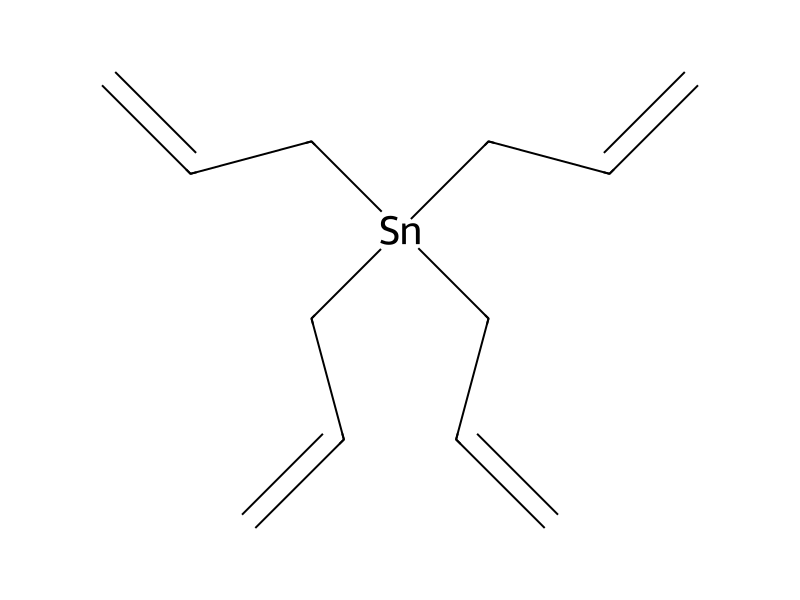
Grundinformationen
- Standard-SMILES
C=C[CH2][Sn]([CH2]C=C)([CH2]C=C)[CH2]C=C- InChIKey
XJPKDRJZNZMJQM-UHFFFAOYSA-N- Summenformel
- C12H20Sn
- Durchschnittliche Molmasse
- 283 g/mol
- Monoisotopische Masse
- 284,058703
Namen und Bezeichner
- Bevorzugter Name
- Tetrallylstannane
- IUPAC
- tetrakis(prop-2-enyl)stannane
- Lokaler Name
- Tetrallylstannan
- Englischer Name
- Tetraallyltin
- Summenformel
- C12H20Sn
- Molmasse
- 283
Namen und Synonyme
Tetraallyltin7393-43-3Tetrallylstannanetetrakis(prop-2-enyl)stannaneStannane, tetra-2-propenyl-EINECS 230-987-568PK869PUTAI3-28455DTXSID80224580TETRAKIS(2-PROPENYL)STANNANETETRA-2-PROPEN-1-YLSTANNANESTANNANE, TETRA-2-PROPEN-1-YL-
Weitere Namen anzeigen
SKL1137TETRAALLYLTIN(IV)Tetraallyltin 97%Tetraallyltin,97%Tetraallyltin, 95+%Tetraallyltin,min.95%
RefChem:897301DTXCID10147071230-987-5TetraallylstannaneStannane, tetraallyl-MFCD00008637TetraallylltinSn(allyl)4
Datenbank-Bezeichner
- CAS
7393-43-3- PubChem CID
- 81878
- DTXSID
DTXSID80224580- UNII
- 68PK869PUT
- EC Number
- 230-987-5
- Nikkaji
- J128.959D
Eigenschaften
Berechnete Struktureigenschaften
- Polarare Oberfläche (TPSA)
- 0 Ų
- H-Brücken-Donoren
- 0
- H-Brücken-Akzeptoren
- 0
- Frei drehbare Bindungen
- 8
- Schwere Atome
- 13
- Formalladung
- 0
- Komplexität
- 146
Physikochemische Eigenschaften
- Siedepunkt
- 69 · 69-70 °C1.5 mm Hg(lit.)
- Dichte
- 1.179 g/mL · 1.179 g/mL at 25 °C(lit.)
- Brechungsindex
- 20 · n20/D 1.539(lit.)
- Flammpunkt
- 167 °F · 167 °F
- Löslichkeit
- 2 O · sol common organic solvents; insol H2O.
- Aggregatzustand
- Liquid
- Wichte
- 1.179 · 1.179
- Farbe
- Clear colorless
- Wasserlöslichkeit
- Not miscible in water or difficult to mix.
- BRN
- 3536269 · 3536269
- InChI
- 1S/4C3H5.Sn/c4*1-3-2;/h4*3H,1-2H2;
- InChIKey
- XJPKDRJZNZMJQM-UHFFFAOYSA-N
- SMILES
- C=CC[Sn](CC=C)(CC=C)CC=C
- CAS Datenbank
- 7393 · 7393-43-3(CAS DataBase Reference)
Sicherheit und Regulatorisches
GHS-Klassifizierung
GHS Classification
Danger
H301 (100%): Toxic if swallowed [Danger Acute toxicity, oral];H311 (100%): Toxic in contact with skin [Danger Acute toxicity, dermal];H315 (66.7%): Causes skin irritation [Warning Skin corrosion/irritation];H319 (66.7%): Causes serious eye irritation [Warning Serious eye damage/eye irritation];H330 (66.7%): Fatal if inhaled [Danger Acute toxicity, inhalation];H331 (33.3%): Toxic if inhaled [Danger Acute toxicity, inhalation];H400 (66.7%): Very toxic to aquatic life [Warning Hazardous to the aquatic environment, acute hazard];H410 (66.7%): Very toxic to aquatic life with long lasting effects [Warning Hazardous to the aquatic environment, long-term hazard]
P260, P261, P262, P264, P264+P265, P270, P271, P273, P280, P284, P301+P316, P302+P352, P304+P340, P305+P351+P338, P316, P320, P321, P330, P332+P317, P337+P317, P361+P364, P362+P364, P391, P403+P233, P405, and P501 (click each P-code to see the statement)
Aggregated GHS information provided per 6 reports by companies from 2 notifications to the ECHA C&L Inventory. Each notification may be associated with multiple companies.;Information may vary between notifications depending on impurities, additives, and other factors. The percentage value in parenthesis indicates the notified classification ratio from companies that provide hazard codes. Only hazard codes with percentage values above 10% are shown. For more detailed information, please visit ECHA C&L website.
Gefahrenhinweise
Hazard Classes and CategoriesAcute Tox. 3 (100%);Acute Tox. 3 (100%);Acute Tox. 3 (33.3%)
Sicherheitsdaten
- F
- 10-23
- wgk
- 3
- tsca
- No
- ridadr
- UN 2788 6.1/PG 3
- hs_code
- 29310099
- risk_code
- 23/24/25
- hazard_code
- T
- safety_code
- 23-24/25-45-36/37
- hazard_class
- 6.1
- packing_group
- II
- Speicherklasse
- 10 - Combustible liquids
Chemie und Industrie
Anwendungen
VerwendenApplied as allyl transfer reagent.
Darstellung
synthetischeTetraallyltin is synthesized by the reaction of Allylmagnesium Bromide with Tin(IV) Chloride in THF.
Vor- und nachgelagerte Produkte
Vorgelagerte Rohstoffe
Nachgelagerte Produkte
Anbieter50 Anbieter
梯希爱(上海)化成工业发展有限公司021-67121386 · [email protected]
Hebei Chuanghai Biotechnology Co., Ltd+86-17732866630 · [email protected]
上海麦克林生化科技股份有限公司021-50706066 15221275939 · [email protected]
Henan Rane Chemical Co., Ltd.+86-18738066252 · [email protected]
INTATRADE GmbH+49 3493/605464 · [email protected]
上海仲因实业有限公司2537653158 16621191650 · [email protected]
Dayang Chem (Hangzhou) Co.,Ltd.+86-0571-88938639 17705817739 · [email protected]
常州凯瑞化学科技有限公司+86 (519) 8689-6136 · [email protected]
Syntechem Co.,Ltd[email protected]
上海迈瑞尔生化科技有限公司4006356688 18621169109 · [email protected]
阿法埃莎(中国)化学有限公司400-6106006 · [email protected]
安耐吉化学&3A(安徽泽升科技股份有限公司)400-0056266 · [email protected]
上海瀚鸿科技股份有限公司021-54306202 13764082696 · [email protected]
四川库利南科技有限公司400-1166-196 18981987031 · [email protected]
天津希恩思生化科技有限公司400 638 7771 · [email protected]
艾科试剂4008-755-333 18080918076 · [email protected]
赛默飞世尔科技(中国)有限公司800-810-5118 · [email protected]
江苏艾康生物医药研发有限公司025-66113011 13913916777 · [email protected]
TOKYO CHEMICAL INDUSTRY CO., LTD.03-36680489 · [email protected]
天成化工(江苏)有限公司0512-66387919 18662433356 · [email protected]
台州市易康化工有限公司0576-88501337 18057652630 · [email protected]
Chongqing jooe co., ltd+86-15223382610 · [email protected]
Sigma-Aldrich西格玛奥德里奇(上海)贸易有限公司021-61415566 800-8193336 · [email protected]
西安美川生物科技有限公司029-89275612 +8618991951683 · [email protected]
上海阿拉丁生化科技股份有限公司6206333 13167063860 · [email protected]
陕西缔都医药化工有限公司+86-29-81139210 +86-17392587031 · [email protected]
上海源叶生物科技有限公司13636370518 · [email protected]
湖北齐飞医药化工有限公司027-59322506 18071128681 · [email protected]
山东西亚化学有限公司4009903999 13395398332 · [email protected]
烟台盛凯伦化学科技有限公司13356901049 · [email protected]
广州市金华大化学试剂有限公司020-84383047 · [email protected]
上海贤鼎生物科技有限公司021-021-52271985 17721149837 · [email protected]
河南威梯希化工科技有限公司0371-53732842 13383863444 · [email protected]
杭州洁汉化工有限公司+86-571-86217390; +8618058761490 · [email protected]
厦门盈融达化工有限公司+86-0592-6210733 · [email protected]
天津希恩思生化科技有限公司400-6387771-6039 18920764717 · [email protected]
career henan chemical co+86-0371-86658258 · [email protected]
陕西缔都医药化工有限公司029-88380327 17691182729 · [email protected]
TCI Chemicals (India) Pvt. Ltd.[email protected]
Aladdin Scientific[email protected]
重庆博涛生物科技有限公司15223382610 · [email protected]
XIAMEN AMITY INDUSTRY AND TRADE CO., LTD.+8618950047208 · [email protected]
SHANGHAI KEAN TECHNOLOGY CO., LTD.+8613817748580 · [email protected]
重庆卡兰医药有限公司[email protected]
北京百灵威科技有限公司18210857532 18210857532 · [email protected]
烟台盛凯伦化学科技有限公司开发区第一分公司13356901049 · [email protected]
Hefei TNJ Chemical Industry Co.,Ltd.+86-0551-65418671 +86-189 4982 3763 · [email protected]
宝鸡福诺康实业有限公司0917-3236817 13220096790 · [email protected]
亚索试剂400-873-6778 18660992876 · [email protected]
Henan Fengda Chemical Co., Ltd+86-371-86557731 +86-13613820652 · [email protected]
Zugehörige Reaktionen
5


Verknüpfte Notizen
Wird geladen…