
HRID 98920als Edukt
Daten werden ergänzt – lade die Seite später neu, um den aktuellen Stand zu sehen
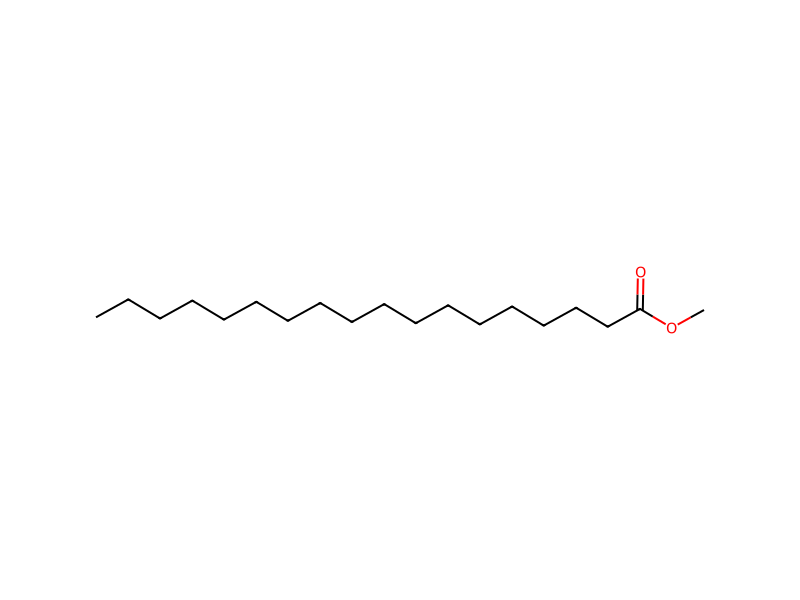
112-61-8CCCCCCCCCCCCCCCCCC(=O)OCHPEUJPJOZXNMSJ-UHFFFAOYSA-NMethyl stearate appears as white crystals or chunky solid. (NTP, 1992)
112-61-8DTXSID2047640CHEBI:69188log Kow= 8.35
8.35
8.35
0.8498 at 104 °F (NTP, 1992) - Less dense than water; will float
0.8498 @ 40 °C/4 °C
White crystals
Semisolid
less than 1 mg/mL at 72 °F (NTP, 1992)
Insol in water; sol in alcohol or ether.
Very sol in ether and chloroform
307 °F (NTP, 1992)
307 °F (153 °C)
828 to 829 °F at 747 mmHg (NTP, 1992)
443 °C
Boiling point: 215 °C @ 15 mm Hg
181.00 to 182.00 °C. @ 4.00 mm Hg
Sicherheitsangaben dienen nur zur Orientierung und ersetzen weder das Sicherheitsdatenblatt (SDB) des Lieferanten noch geltende Vorschriften oder eine fachliche Bewertung.
This chemical does not meet GHS hazard criteria for 99.5% (186 of 187) of all reports.
Not Classified
Aggregated GHS information provided per 187 reports by companies from 3 notifications to the ECHA C&L Inventory.
Chemical: Octadecanoic acid, methyl ester
Commission Regulation (EC) No 1565/2000 (Repealed by Com. Implementing Reg. (EU) No 872/2012)
Octadecanoic acid, methyl ester is listed on the EPA's Chemical Data Reporting (CDR) system. Manufacturers and importers of Octadecanoic acid, methyl ester are required to report information about their production and use of this chemical to the EPA under the Toxic Substances Control Act (TSCA). (40 eCFR Part 711)
REACH registered substance: Methyl stearate (EC: 203-990-4)
Methyl stearate: Does not have an individual approval but may be used under an appropriate group standard
METHYL STEARATE is an ester. Esters react with acids to liberate heat along with alcohols and acids. Strong oxidizing acids may cause a vigorous reaction that is sufficiently exothermic to ignite the reaction products. Heat is also generated by the interaction of esters with caustic solutions. Flammable hydrogen is generated by mixing esters with alkali metals and hydrides.
0 - Materials that, under emergency conditions, would offer no hazard beyond that of ordinary combustible materials.
1 - Materials that must be preheated before ignition can occur. Materials require considerable preheating, under all ambient temperature conditions, before ignition and combustion can occur.
0 - Materials that in themselves are normally stable, even under fire conditions.
... Can react with oxidizing materials.
Incompatible with nitrates. /Esters/
EYES: First check the victim for contact lenses and remove if present. Flush victim's eyes with water or normal saline solution for 20 to 30 minutes while simultaneously calling a hospital or poison control center. Do not put any ointments, oils, or medication in the victim's eyes without specific instructions from a physician. IMMEDIATELY transport the victim after flushing eyes to a hospital even if no symptoms (such as redness or irritation) develop.
TO FIGHT FIRE, USE CARBON DIOXIDE, DRY CHEMICAL.
WATER OR FOAM MAY CAUSE FROTHING.
SMALL SPILLS AND LEAKAGE: Should a spill occur while you are handling this chemical, FIRST REMOVE ALL SOURCES OF IGNITION, then you should dampen the solid spill material with 60-70% ethanol and transfer the dampened material to a suitable container. Use absorbent paper dampened with 60-70% ethanol to pick up any remaining material. Seal the absorbent paper, and any of your clothes, which may be contaminated, in a vapor-tight plastic bag for eventual disposal. Solvent wash all contaminated surfaces with 60-70% ethanol followed by washing with a soap and water solution. Do not reenter the contaminated area until the Safety Officer (or other responsible person) has verified that the area has been properly cleaned.
SRP: At the time of review, criteria for land treatment or burial (sanitary landfill) disposal practices are subject to significant revision. Prior to implementing land disposal of waste residue (including waste sludge), consult with environmental regulatory agencies for guidance on acceptable disposal practices.
8 hr Time Weighted Avg (TWA): 10 mg/cu m. /Stearates; does not include stearates of toxic metals/
Excursion Limit Recommendation: Excursions in worker exposure levels may exceed 3 times the TLV-TWA for no more than a total of 30 minutes during a work day, and under no circumstances should they exceed 5 times the TLV-TWA, provided that the TLV-TWA is not exceeded. /Stearates; does not include stearates of toxic metals/
A4; Not classifiable as a human carcinogen. /Stearates; does not include stearates of toxic metals/
RECOMMENDED RESPIRATOR: Where the neat test chemical is weighed and diluted, wear a NIOSH-approved half face respirator equipped with an organic vapor/acid gas cartridge (specific for organic vapors, HCl, acid gas and SO2) with a dust/mist filter. (NTP, 1992)
TERRESTRIAL FATE: Based on a classification scheme(1), an estimated Koc value of 62,000(SRC), determined from a structure estimation method(2), indicates that methyl stearate is expected to be immobile in soil(SRC). Volatilization of methyl stearate from moist soil surfaces is expected to be an important fate process(SRC) given an estimated Henry's Law constant of 0.016 atm-cu m/mole(SRC), using a fragment constant estimation method(3). However, adsorption to soil is expected to attenuate volatilization(SRC). Methyl stearate is not expected to volatilize from dry soil surfaces(SRC) based upon a vapor pressure of 1.36X10⁻⁵ mm Hg(4). Methyl stearate is expected to rapidly biodegrade in aerobic soils as suggested by biodegradation in an aqueous biodegradation screening test(5).
AQUATIC FATE: Based on a classification scheme(1), an estimated Koc value of 62,000(SRC), determined from a structure estimation method(2), indicates that methyl stearate is expected to adsorb to suspended solids and sediment in water(SRC). Volatilization from water surfaces is expected(3) based upon an estimated Henry's Law constant of 0.016 atm-cu m/mole(SRC), developed using a fragment constant estimation method(4). Volatilization half-lives for a model river and model lake are 5 and 164 hours, respectively(SRC), using an estimation method(3). However, volatilization from water surfaces is expected to be attenuated by adsorption to suspended solids and sediment in the water column(SRC). The volatilization half-life from a model pond is estimated to be about 61 hours ignoring adsorption; when considering maximum adsorption the volatilization half-life increases to 17 months(5). According to a classification scheme(5), a /an estimated BCF of W29(SRC), from a log Kow of 8.35(10) and a regression-derived equation(7), suggests the potential for bioconcentration in aquatic organisms is low. Methyl stearate is expected to rapidly biodegrade in aerobic waters based on screening study results(8). An estimated base-catalyzed second-order hydrolysis rate constant of 0.030 L/mole-sec(9,SRC) corresponds to half-lives of 7.3 years and 266 days at pH values of 7 and 8, respectively(9).
ATMOSPHERIC FATE: According to a model of gas/particle partitioning of semivolatile organic compounds in the atmosphere(1), methyl stearate, which has a vapor pressure of 1.36X10⁻⁵ mm Hg at 25 °C(2), will exist in both the vapor and particulate phases in the ambient atmosphere. Vapor-phase methyl stearate is degraded in the atmosphere by reaction with photochemically-produced hydroxyl radicals(SRC); the half-life for this reaction in air is estimated to be 18 hours(SRC) from its estimated rate constant of 2.1X10⁻¹¹ cu cm/molecule-sec at 25 °C(3). Particulate-phase methyl stearate may be removed from the air by wet and dry deposition(SRC).
Methyl stearate was identified in raw beef samples, concn not provided(1). It was detected as a flavoring constituent of cassava, gari, and farine(2). Methyl stearate was identified as a volatile flavor componenent of clove essential oil(3).
Using a structure estimation method based on molecular connectivity indices(1), the Koc for methyl stearate can be estimated to be about 62,000(SRC). According to a classification scheme(2), this estimated Koc value suggests that methyl stearate is expected to be immobile in soil.
AEROBIC: Methyl stearate was found to partially biodegrade within 24 hours when inoculated with a mixed activated sludge in a Warburg respirator(1). A close structural analog to methyl stearate, ethyl stearate, was listed as biodegradable in the Japanese MITI test(2).
An estimated BCF of 29 was calculated for methyl stearate(SRC) using a log Kow of 8.35(1) and a regression-derived equation(2). According to a classification scheme(3), this BCF suggests the potential for bioconcentration in aquatic organisms is low.
The Henry's Law constant for methyl stearate is estimated as 0.016 atm-cu m/mole(SRC) using a fragment constant estimation method(1). This Henry's Law constant indicates that methyl stearate is expected to volatilize rapidly from water surfaces(2). Based on this Henry's Law constant, the volatilization half-life from a model river (1 m deep, flowing 1 m/sec, wind velocity of 3 m/sec)(2) is estimated as approximately 5 hours(SRC). The volatilization half-life from a model lake (1 m deep, flowing 0.05 m/sec, wind velocity of 0.5 m/sec)(2) is estimated as approximately 164 hours(SRC). The volatilization half-life from a model pond 2 m deep is estimated to be about 61 hours ignoring adsorption; when considering maximum adsorption the volatilization half-life increases to 17 months(3). Methyl stearate's Henry's Law constant(1) indicates that volatilization from moist soil surfaces may occur although adsorption may attenuate this process(SRC). Methyl stearate is not expected to volatilize from dry soil surfaces(SRC) based upon a vapor pressure of 1.36X10⁻⁵ mm Hg(4).
Found in raw beef and as flavoring component of cassava, gari, farine, and clove; Used to make stearic acid detergents, emulsifiers, wetting agents, stabilizers, resins, and plasticizers; Also used as a lubricant in textile and molding trades and in lipstick, nail varnishes, and ointments; [HSDB]
Molding and Core Making [Category: Foundry]
Intermediate for stearic acid detergents, emulsifiers, wetting agents, stabilizers, resins, lubricants, plasticizers.
LUBRICATING OIL COMPONENT; LUBRICANT IN TEXTILE & MOLDING TRADE; COMPONENT IN LIPSTICK, NAIL VARNISHES, & OINTMENTS; CHEMICAL INTERMEDIATE FOR DETERGENTS & EMULSIFIERS
2023: 1,000,000 - <2,500,000 lb
(1972) PROBABLY GREATER THAN 4.54X10+5 GRAMS
(1975) PROBABLY GREATER THAN 4.54X10+5 GRAMS
Method of purification: vacuum fraction distillation.
Esterification of stearic acid with methanol or stearin with methanol.
Fragrance Ingredients
Cosmetics -> Emollient; Skin conditioning
All Other Basic Organic Chemical Manufacturing
Octadecanoic acid, methyl ester: ACTIVE
VerwendenMethyl Stearate is used as a nonionic surfactant in various experiments in helping solubilize a variety of chemical species by dissociating aggregates and unfolding proteins.
DefinitionChEBI: A natural product found in Neolitsea daibuensis.


