
Butan-1,4-diylbis[diphenylphosphin]
1,4-Bis(diphenylphosphino)butane
Daten werden ergänzt – lade die Seite später neu, um den aktuellen Stand zu sehen
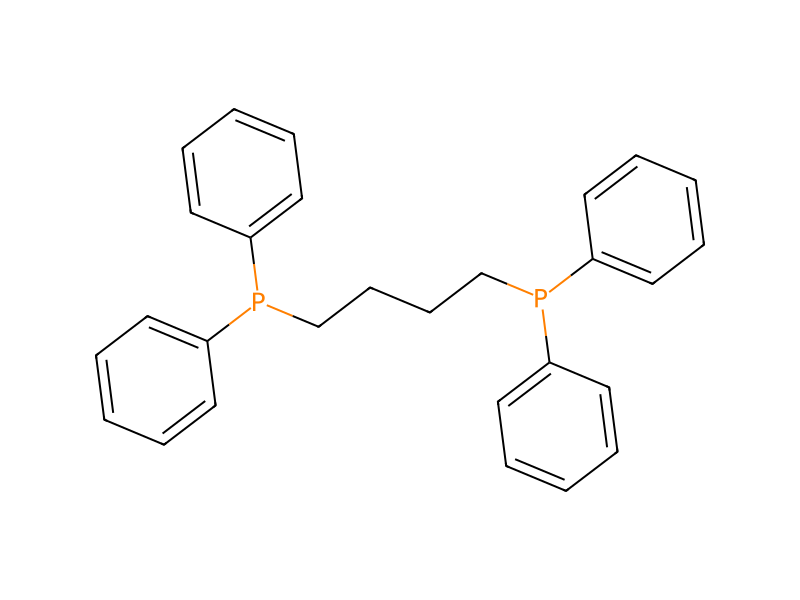
Grundinformationen
- CAS
7688-25-7- Standard-SMILES
c1ccc(P(CCCCP(c2ccccc2)c2ccccc2)c2ccccc2)cc1- InChIKey
BCJVBDBJSMFBRW-UHFFFAOYSA-N- Summenformel
- C28H28P2
- Durchschnittliche Molmasse
- 426,5 g/mol
- Monoisotopische Masse
- 426,16662416
Namen und Bezeichner
- Bevorzugter Name
- 1,4-Bis(diphenylphosphino)butane
- IUPAC
- 4-diphenylphosphanylbutyl(diphenyl)phosphane
- Lokaler Name
- Butan-1,4-diylbis[diphenylphosphin]
- Englischer Name
- 1,4-Bis(diphenylphosphino)butane
- Summenformel
- C28H28P2
- Molmasse
- 426.47
Namen und Synonyme
1,4-Bis(diphenylphosphino)butane7688-25-7Tetramethylenebis(diphenylphosphine)1,4-Bis[diphenylphosphino]butane1,4-BUTYLENEBIS(DIPHENYLPHOSPHINE)35HP6LTD2DButane-1,4-diylbis(diphenylphosphine)1,4-BUTANEDIYLBIS(DIPHENYLPHOSPHINE)1,4-BUTANEDIYLBIS[DIPHENYLPHOSPHINE]EINECS 231-698-7Phosphine, 1,1'-(1,4-butanediyl)bis(1,1-diphenyl-BUTANE-1,4-DIYLBIS[DIPHENYLPHOSPHINE]
Weitere Namen anzeigen
1,4-di(diphenylphosphino)-butane1,4-BIS(DIPHENYLPHOSPHINE)BUTANE1,4-Bis(diphenylphosphanyl)butane[4-(Diphenylphosphino)butyl](diphenyl)phosphine1,4-Bis(diphenylphosphino)butane, 98% 5GR1,4-B98% DPPB1,4-Bis(diphenylphos
Phosphine, 1,1'-(1,4-butanediyl)bis[1,1-diphenyl-RefChem:416454Butane1,4diylbis(diphenylphosphine)Phosphine, 1,1'(1,4butanediyl)bis(1,1diphenyldppbPhosphine, 1,4-butanediylbis[diphenyl-4-diphenylphosphanylbutyl(diphenyl)phosphaneC28H28P2
Datenbank-Bezeichner
- CAS
7688-25-7- PubChem CID
- 82124
- DTXSID
DTXSID4064769- ChEMBL
CHEMBL71648- UNII
- 35HP6LTD2D
- EC Number
- 231-698-7
- Nikkaji
- J133.188D
Eigenschaften
Berechnete StruktureigenschaftenWird ergänzt
- XLogP
- 6,6
- Polarare Oberfläche (TPSA)
- 0 Ų
- H-Brücken-Donoren
- 0
- H-Brücken-Akzeptoren
- 0
- Frei drehbare Bindungen
- 9
- Schwere Atome
- 30
- Formalladung
- 0
- Komplexität
- 362
Experimentelle und physikochemische Eigenschaften
Chemical ClassesOther Classes -> Phosphorus Compounds
SpringerMaterials PropertiesFusion temperature
Physical DescriptionWhite powder; [MSDSonline]
Physikochemische Eigenschaften
- Schmelzpunkt
- 132 · 132-136 °C (lit.)
- Siedepunkt
- 542 · 542.0±33.0 °C(Predicted)
- storage temp.
- Inert atmosphere,Room Temperature
- Aggregatzustand
- Crystalline Powder
- Farbe
- White to almost white
- Wasserlöslichkeit
- Soluble in chloroform. Slightly soluble in water
- BRN
- 706446 · 706446
- InChI
- InChI=1S/C28H28P2/c1-5-15-25(16-6-1)29(26-17-7-2-8-18-26)23-13-14-24-30(27-19-9-3-10-20-27)28-21-11-4-12-22-28/h1-12,15-22H,13-14,23-24H2
Sicherheit und Regulatorisches
Sicherheitsangaben dienen nur zur Orientierung und ersetzen weder das Sicherheitsdatenblatt (SDB) des Lieferanten noch geltende Vorschriften oder eine fachliche Bewertung.
GHS-Klassifizierung
GHS Classification
Warning
H302 (20.3%): Harmful if swallowed [Warning Acute toxicity, oral]
P261, P264, P264+P265, P270, P271, P272, P273, P280, P301+P317, P302+P352, P304+P340, P305+P351+P338, P319, P321, P330, P332+P317, P333+P317, P337+P317, P362+P364, P391, P403+P233, P405, and P501 (click each P-code to see the statement)
Aggregated GHS information provided per 69 reports by companies from 12 notifications to the ECHA C&L Inventory. Each notification may be associated with multiple companies.
Gefahrenhinweise
Regulatory Information
PMN - indicates a commenced PMN (Pre-Manufacture Notices) substance.
Phosphine, 1,4-butanediylbisdiphenyl-: Does not have an individual approval but may be used under an appropriate group standard
Hazards SummaryA skin, eye, and respiratory tract irritant; [MSDSonline]
Hazard Classes and CategoriesAcute Tox. 4 (20.3%)
Sicherheitsdaten
- F
- 10-23
- wgk
- 3
- tsca
- TSCA listed
- hs_code
- 29319090
- risk_code
- 36/38-36/37/38-11
- hazard_code
- Xi,F
- safety_code
- 26-36-37/39-33-16-7/9
- Speicherklasse
- 11 - Combustible Solids
- Hazard Classifications
Chemie und Industrie
Verwendung und Herstellung
General Manufacturing InformationPhosphine, 1,1'-(1,4-butanediyl)bis[1,1-diphenyl-: ACTIVE
Anwendungen
Verwenden1,4-Bis(diphenylphosphino)butane is used in Suzuki reaction. It plays an essential role as a ligand in palladium(0)-catalyzed acylcyanation of arylacetylenes and deprotection of allyloxycarbamates. It acts as a ligand for alkylations, isomerization reactions and in organometallic chemistry. Further, it is used in Heck reaction, Negishi coupling and Sonogashira coupling. In addition to this, it is useful in organometallic chemistry.
Vor- und nachgelagerte Produkte
Vorgelagerte Rohstoffe
Zugehörige Reaktionen
248




Notizen zur Verbindung
Wird geladen…